
UPSC Prelims PYQs with explanations
Real questions from official papers, mapped to syllabus topics. Attempt each one; the answer and the reason appear instantly.
Given that,
- 1. A is the brother of B.
- 2. C is the father of A.
- 3. D is the brother of E.
- 4. E is the daughter of B.
Then the uncle of D is
Answer (a) & explanation
A is correct (a). Step 1: E is the daughter of B, and D is the brother of E. So D is also a child of B. Step 2: A is the brother of B. So A is the brother of D's parent. Step 3: a parent's brother is an uncle, so A is D's uncle. B is D's parent, C is D's grandfather (C is the father of A, and so also of B, since A and B are brothers), and E is D's sister. So (b), (c) and (d) fail.
Tip: draw a small family tree. Put B in the middle, A beside B as a sibling, C above them and D and E below B. The uncle is then easy to see.
Answer as per the official UPSC answer key.
(Same information as the question above.)
Which lecture is scheduled between Statistics and English?
Answer (b) & explanation
History is correct (b). Step 1: from the schedule worked out from the clues: Mon Statistics, Tue History, Wed English, Thu Economics, Fri Mathematics. (History is fixed on Tuesday; English–Economics–Mathematics must run on three days in a row, which can only be Wed–Fri; Statistics takes Monday.) Step 2: Statistics is on Monday and English on Wednesday. Step 3: the lecture between them, on Tuesday, is History. Economics and Mathematics come after English, and there is a lecture between them, so (a), (c) and (d) fail.
Tip: in a set of linked questions, build the full timetable once and write it down. Each later question then takes a few seconds and you avoid repeating errors.
Answer as per the official UPSC answer key.
Consider the following kinds of organisms :
- 1. Bacteria
- 2. Fungi
- 3. Flowering plants
Some species of which of the above kinds of organisms are employed as biopesticides?
Answer (d) & explanation
All three are correct (d). Biopesticides come from living organisms of all three kinds. Bacteria: Bacillus thuringiensis (Bt) makes proteins toxic to caterpillars (1). Fungi: Trichoderma controls soil-borne diseases, and Beauveria and Metarhizium infect insects (2). Flowering plants: neem (azadirachtin) and pyrethrum from chrysanthemum flowers act as natural insecticides (3). So options (a), (b) and (c) leave out real sources.
Notice the advantages: biopesticides are specific, biodegradable and safer for pollinators. Viruses such as NPV (nuclear polyhedrosis virus) are also used. In India they are registered under the Insecticides Act, 1968, and promoted under the National Mission on Natural Farming. Trap: plants are often forgotten as a source.
Answer as per the official UPSC answer key.
Consider the following crops of India :
- 1. Cowpea
- 2. Green gram
- 3. Pigeon pea
Which of the above is/are used as pulse, fodder and green manure?
Answer (a) & explanation
Cowpea and green gram are correct (a). Cowpea (lobia) and green gram (moong) are short, leafy legumes that can be grown for grain (pulse), cut as fodder, or ploughed into the soil as green manure, where their root nodules add nitrogen (1, 2). Pigeon pea (arhar or tur) is a woody, long-duration crop grown mainly for grain; it is too tough for fodder or green manure (3). So (b), (c) and (d) fail.
Notice the policy angle: India is the largest producer and consumer of pulses, and a Mission for Aatmanirbharta in Pulses (2025–26 to 2030–31) focuses on tur, urad and masoor. Summer moong after wheat helps Punjab's soils. Trap: all three are legumes, but only two have all three uses.
Answer as per the official UPSC answer key.
The basic aim of Lead Bank Scheme is that
Answer (c) & explanation
Option (c) is correct. Under the Lead Bank Scheme, started in 1969 on the Gadgil Study Group and Nariman Committee recommendations, each district was assigned to one bank as its lead bank. That bank takes charge of credit planning and coordinates banks and government agencies for intensive development of the district. (a) is wrong: opening offices everywhere was not the aim. (b) is wrong: the scheme sought coordination, not competition. (d) is wrong: deposit mobilisation was not the core goal.
Notice the machinery: the District Consultative Committee and the State Level Bankers' Committee (SLBC), convened by a convenor bank, review credit plans; the Potential Linked Credit Plans are prepared by NABARD. The RBI reviewed the scheme in 2017. Trap: 'big banks' sounds right, but the idea is district adoption.
Answer as per the official UPSC answer key.
Read the passage
Chemical pesticides lose their role in sustainable agriculture if the pests evolve resistance. The evolution of pesticide resistance is simply natural selection in action. It is almost certain to occur when vast numbers of a genetically variable population are killed. One or a few individuals may be unusually resistant (perhaps because they possess an enzyme that can detoxify the pesticide). If the pesticide is applied repeatedly, each successive generation of the pest will contain a larger proportion of resistant individuals. Pests typically have a high intrinsic rate of reproduction, and so a few individuals in one generation may give rise to hundreds or thousands in the next, and resistance spreads very rapidly in a population.
This problem was often ignored in the past, even though the first case of DDT (dichlorodiphenyltrichloroethane) resistance was reported as early as 1946. There is exponential increase in the numbers of invertebrates that have evolved resistance and in the number of pesticides against which resistance has evolved. Resistance has been recorded in every family of arthropod pests (including dipterans such as mosquitoes and house flies, as well as beetles, moths, wasps, fleas, lice and mites) as well as in weeds and plant pathogens. Take the Alabama leafworm, a moth pest of cotton, as an example. It has developed resistance in one or more regions of the world to aldrin, DDT, dieldrin, endrin, lindane and toxaphene.
If chemical pesticides brought nothing but problems, — if their use was intrinsically and acutely unsustainable — then they would already have fallen out of widespread use. This has not happened. Instead, their rate of production has increased rapidly. The ratio of cost to benefit for the individual agricultural producer has remained in favour of pesticide use. In the USA, insecticides have been estimated to benefit the agricultural products to the tune of around $5 for every $1 spent.
Moreover, in many poorer countries, the prospect of imminent mass starvation, or of an epidemic disease, are so frightening that the social and health costs of using pesticides have to be ignored. In general the use of pesticides is justified by objective measures such as ‘lives saved’, ‘economic efficiency of food production’ and ‘total food produced’. In these very fundamental senses, their use may be described as sustainable. In practice, sustainability depends on continually developing new pesticides that keep at least one step ahead of the pests — pesticides that are less persistent, biodegradable and more accurately targeted at the pests.
With reference to the passage, consider the following statements :
- 1. Use of chemical pesticides has become imperative in all the poor countries of the world.
- 2. Chemical pesticides should not have any role in sustainable agriculture.
- 3. One pest can develop resistance to many pesticides.
Which of the statements given above is/are correct ?
Answer (b) & explanation
Only statement 3 is correct (b). Step 1: the Alabama leafworm has become resistant to six pesticides (aldrin, DDT, dieldrin, endrin, lindane, toxaphene). So one pest can resist many pesticides: 3 is right. Step 2: statement 1 says pesticides are imperative in all poor countries. The passage only says 'many poorer countries' face fears of starvation or epidemics. So 1 overstates. Step 3: statement 2 says pesticides should have no role in sustainable agriculture. The passage calls their use sustainable 'in these very fundamental senses'. So 2 is wrong, and (a), (c) and (d) fail.
Tip: compare quantity words carefully: 'many' in the passage never supports 'all' in an option.
Answer as per the official UPSC answer key.
Read the passage
The need for Competition Law becomes more evident when foreign direct investment (FDI) is liberalised. The impact of FDI is not always pro-competitive. Very often FDI takes the form of a foreign corporation acquiring a domestic enterprise or establishing a joint venture with one. By making such an acquisition the foreign investor may substantially lessen competition and gain a dominant position in the relevant market, thus charging higher prices. Another scenario is where the affiliates of two separate multinational companies (MNCs) have been established in competition with one another in a particular developing economy, following the liberalisation of FDI. Subsequently, the parent companies overseas merge. With the affiliates no longer remaining independent, competition in the host country may be virtually eliminated and the prices of the products may be artificially inflated. Most of these adverse consequences of mergers and acquisitions by MNCs can be avoided if an effective competition law is in place. Also, an economy that has implemented an effective competition law is in a better position to attract FDI than one that has not. This is not just because most MNCs are expected to be accustomed to the operation of such a law in their home countries and know how to deal with such concerns but also that MNCs expect competition authorities to ensure a level playing field between domestic and foreign firms.
According to the passage, how does a foreign investor dominate the relevant domestic market ?
- 1. Multinational companies get accustomed to domestic laws.
- 2. Foreign companies establish joint ventures with domestic companies.
- 3. Affiliates in a particular market/sector lose their independence as their parent companies overseas merge.
- 4. Foreign companies lower the cost of their products as compared to that of products of domestic companies.
Which of the statements given above are correct ?
Answer (b) & explanation
2 and 3 are correct (b). Step 1: the passage says a foreign investor may gain a dominant position by acquiring a domestic firm or setting up a joint venture with one (2). Step 2: it also says when parent MNCs overseas merge, their local affiliates stop competing and competition 'may be virtually eliminated' (3). Step 3: statement 1 is wrong: MNCs are used to competition law in their home countries, and that is a reason they invest, not how they dominate. Statement 4 is wrong: dominance leads to higher prices, not lower costs. So (a), (c) and (d) fail.
Tip: answer the exact question ('how does it dominate') and ignore true facts that answer a different one.
Answer as per the official UPSC answer key.
Read the passage
We started pitching the highest camp that has ever been made. Everything took five times as long as it would have taken in a place where there was enough air to breathe; but at last we got the tent up, and when we crawled in, it was not too bad. There was only a light wind, and inside it was not too cold for us to take off our gloves. At night most climbers take off their boots; but I prefer to keep them on. Hillary, on the other hand, took his off and laid them next to his sleeping bag.
What does the expression “pitching the highest camp” imply ?
Answer (c) & explanation
(c) is correct. Step 1: the author says they were pitching 'the highest camp that has ever been made'. So nobody had ever camped that high before. Step 2: (a) is wrong: they were still pitching a camp, so they had not yet reached the summit. Step 3: (b) is wrong: the passage does not say earlier climbers reached that height without camping; it implies no one had camped there. (d) is wrong: 'highest' refers to height, not to a big camp for many climbers. So (a), (b) and (d) fail.
Tip: read the key word carefully: 'highest' is about altitude. Do not mix up 'high' with 'large'. 'Ever' makes it a record.
Answer as per the official UPSC answer key.
Which of the following can be said to be essentially the parts of ‘Inclusive Governance’?
- 1. Permitting the Non-Banking Financial Companies to do banking
- 2. Establishing effective District Planning Committees in all the districts
- 3. Increasing the government spending on public health
- 4. Strengthening the Mid-day Meal Scheme
Select the correct answer using the codes given below :
Answer (c) & explanation
Statements 2, 3 and 4 are correct (c). Inclusive governance means planning and services reach everyone, especially the poor. Effective District Planning Committees bring local participation into planning (2). More public health spending widens access to care (3). A stronger Mid-day Meal Scheme improves nutrition and school attendance (4). Statement 1 is wrong: letting NBFCs do banking is a financial-sector reform, not essentially an inclusion measure. So (a), (b) and (d) fail.
Notice the current versions: Mid-day Meal is now PM POSHAN (2021), and the National Health Policy 2017 targets public health spending of 2.5% of GDP. Small Finance Banks and Payments Banks (2015) are the inclusion-focused route for non-bank players. Trap: 'banking' sounds inclusive but the measure as stated is not.
Answer as per the official UPSC answer key.
Consider the following :
- 1. Hotels and restaurants
- 2. Motor transport undertakings
- 3. Newspaper establishments
- 4. Private medical institutions
The employees of which of the above can have the ‘Social Security’ coverage under Employees’ State Insurance Scheme?
Answer (d) & explanation
All four are correct (d). The Employees' State Insurance Act, 1948 began with factories and has been extended by notifications to shops, hotels and restaurants (1), road motor transport undertakings (2), cinemas, newspaper establishments (3), and private medical and educational institutions (4) employing 10 or more people. Covered workers get medical care, sickness, maternity, disability and dependants' benefits. So options (a), (b) and (c) leave out real coverage.
Notice the current frame: the Code on Social Security, 2020, in force since 21 November 2025, subsumes the ESI Act and allows ESIC coverage to be extended to all districts and, voluntarily, to establishments with fewer workers and gig workers. The wage ceiling is ₹21,000 a month. Trap: the scheme's name suggests factories only.
Answer as per the official UPSC answer key.
Consider the following kinds of organisms :
- 1. Bat
- 2. Bee
- 3. Bird
Which of the above is/are pollinating agent/agents?
Answer (d) & explanation
All three are correct (d). Bees are the best-known pollinators of crops and wild plants. Birds, such as sunbirds in India and hummingbirds in the Americas, pollinate many red and tubular flowers (ornithophily). Bats, especially fruit and nectar bats, pollinate night-blooming plants such as banana, durian, mahua and agave (chiropterophily). So options (a), (b) and (c) leave out real pollinators.
Notice the stakes: about 75% of leading food crops benefit from animal pollination. Pollinator decline from neonicotinoid pesticides, habitat loss and climate change worries scientists; the EU restricted neonicotinoids in 2018. India's National Beekeeping and Honey Mission (2020) promotes the 'Sweet Revolution'. Trap: bats are often seen only as pests.
Answer as per the official UPSC answer key.
Consider the following statements:
- 1. All artists are whimsical.
- 2. Some artists are drug addicts.
- 3. Frustrated people are prone to become drug addicts.
From the above three statements it may be concluded that
Answer (b) & explanation
'Some drug addicts are whimsical' is correct (b). Step 1: statement 1 says all artists are whimsical. Statement 2 says some artists are drug addicts. Step 2: those artists who are drug addicts are still artists, so they are whimsical. Therefore at least some drug addicts are whimsical. Step 3: (a) does not follow: the statements never say artists are frustrated. (c) fails: being 'prone to' addiction is not the same as all frustrated people being addicts. (d) fails: nothing links whimsical people to frustration. So (a), (c) and (d) fail.
Tip: draw circles: put the 'artists' circle fully inside 'whimsical', then let 'drug addicts' overlap artists. The overlap sits inside 'whimsical'.
Answer as per the official UPSC answer key.
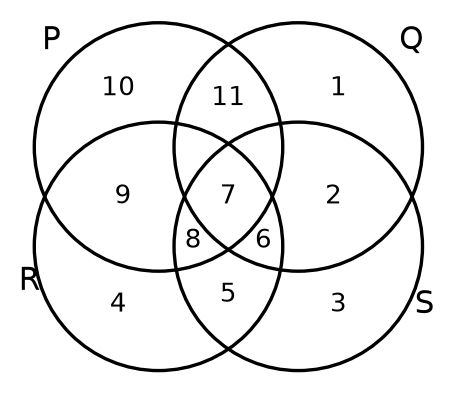
In the above figure, circle P represents hardworking people, circle Q represents intelligent people, circle R represents truthful people, and circle S represents honest people. Which region represents the people who are intelligent, honest and truthful but not hardworking?
Answer (a) & explanation
Region 6 is correct (a). Step 1: we need people who are intelligent (Q), truthful (R) and honest (S) but not hardworking (outside P). So the region must lie inside Q, R and S, and outside P. Step 2: region 7 is inside all four circles, so it includes hardworking people: wrong. Region 8 is inside P: wrong. Region 11 is only in P and Q: wrong. Step 3: region 6 is inside Q, R and S and outside P. So (b), (c) and (d) fail.
Tip: turn the description into 'inside' and 'outside' lists first. Then test each region number against both lists; one wrong circle rules it out.
Answer as per the official UPSC answer key.
As a citizen you have some work with a government department. The official calls you again and again; and without directly asking you, sends out feelers for a bribe. You want to get your work done. You would...
Answer (b) & explanation
(b) and (c) are both correct (UPSC accepted both; no negative marking). Step 1: the official is hinting at a bribe but has not asked directly. You want your work done honestly. Step 2: (b) ignoring the hints and pressing your application, or (c) asking a senior officer for help, both refuse the bribe and keep your case moving. Step 3: (a) paying a bribe is a crime under the Prevention of Corruption Act. (d) a formal complaint based only on hints is hard to prove and may delay your work.
Tip: for these interpersonal items, pick the response that is lawful, honest and fixes the real problem through proper channels. Avoid options that give in, run away from duty or act without hearing the facts.
Answer as per the official UPSC answer key.
What is/are the recent policy initiative(s) of Government of India to promote the growth of manufacturing sector?
- 1. Setting up of National Investment and Manufacturing Zones
- 2. Providing the benefit of ‘single window clearance’
- 3. Establishing the Technology Acquisition and Development Fund
Select the correct answer using the codes given below :
Answer (d) & explanation
All three are correct (d). The National Manufacturing Policy (2011) aimed to raise manufacturing's share of GDP to 25% and create 10 crore jobs. It provided for National Investment and Manufacturing Zones (NIMZs), large integrated industrial townships (1), single-window clearance to cut red tape (2), and a Technology Acquisition and Development Fund to help MSMEs buy green technology (3). So options (a), (b) and (c) leave out real measures.
Notice the later push: Make in India (2014), PLI schemes (2020) across 14 sectors, PM Gati Shakti (2021), and the National Manufacturing Mission announced in the 2025–26 Budget. Manufacturing is still around 17% of GDP. Trap: all three look like generic reforms, but each was named in the 2011 policy.
Answer as per the official UPSC answer key.
With reference to Dhrupad, one of the major traditions of India that has been kept alive for centuries, which of the following statements are correct?
- 1. Dhrupad originated and developed in the Rajput kingdoms during the Mughal period.
- 2. Dhrupad is primarily a devotional and spiritual music.
- 3. Dhrupad Alap uses Sanskrit syllables from Mantras.
Select the correct answer using the codes given below :
Answer (b) & explanation
Statements 2 and 3 are correct per UPSC's key (b). Dhrupad is the oldest surviving form of Hindustani classical music, and it is primarily devotional and spiritual, rooted in temple singing (2). Its alap uses syllables such as a, ta, na, ri, num, believed to come from mantras like 'Om Ananta Narayana' (3). Statement 1 is the doubt: Dhrupad's roots lie in temple music long before the Mughals, though it flourished under Raja Man Singh Tomar of Gwalior and at Akbar's court with Tansen, so some books mark (c). UPSC treated its origin as pre-Mughal.
Notice the living tradition: the Dagar family (Dagarvani) and the Gundecha brothers kept it alive. Khayal later became more popular. Trap: 'developed in Rajput courts' is half-true, but 'originated' is not.
Answer as per the official UPSC answer key.
The National Green Tribunal Act, 2010 was enacted in consonance with which of the following provisions of the Constitution of India?
- 1. Right to healthy environment, construed as a part of Right to life under Article 21
- 2. Provision of grants for raising the level of administration in the Scheduled Areas for the welfare of Scheduled Tribes under Article 275(1)
- 3. Powers and functions of Gram Sabha as mentioned under Article 243(A)
Select the correct answer using the codes given below :
Answer (a) & explanation
Statement 1 only is correct (a). The NGT Act, 2010 preamble says the right to a healthy environment is part of the right to life under Article 21, and that the Act gives effect to India's commitments at the 1992 Rio Earth Summit. (2) is wrong: Article 275(1) provides grants to states for tribal welfare and Scheduled Areas; it has nothing to do with the tribunal. (3) is wrong: Article 243A concerns the Gram Sabha's powers. So (b), (c) and (d) fail.
Notice the tribunal: the NGT's principal bench is in New Delhi, with zonal benches at Bhopal, Pune, Kolkata and Chennai. It must decide cases within six months, follows the polluter pays and precautionary principles, and appeals go to the Supreme Court. India was the third country, after Australia and New Zealand, with such a body.
Answer as per the official UPSC answer key.
Examine the following statements:
- 1. Rama scored more than Rani.
- 2. Rani scored less than Ratna.
- 3. Ratna scored more than Rama.
- 4. Padma scored more than Rama but less than Ratna.
Who scored the highest?
Answer (d) & explanation
Ratna is correct (d). Step 1: statement 1 gives Rama > Rani. Statement 3 gives Ratna > Rama. Statement 4 puts Padma between them: Ratna > Padma > Rama. Step 2: put them in one line: Ratna > Padma > Rama > Rani. Statement 2 (Rani < Ratna) agrees with this. Step 3: Ratna is at the top. Rama is third, Padma second and Rani last, so (a), (b) and (c) fail.
Tip: write each clue as a '>' sign and slot every new name into one single line. 'Scored less than' is just the same sign read the other way; turn all clues into 'more than' form so you do not mix up directions.
Answer as per the official UPSC answer key.
(Same information as the question above.)
Which lecture is the last one in the week?
Answer (c) & explanation
Mathematics is correct (c). Step 1: History is fixed on Tuesday. English, Economics and Mathematics must run on three days in a row in that order, and the only such free days are Wednesday, Thursday and Friday. Step 2: so Mathematics, the last of the three, falls on Friday. Statistics fills Monday. Step 3: the week is Mon Statistics, Tue History, Wed English, Thu Economics, Fri Mathematics. Friday is the last day, so the last lecture is Mathematics. History, English and Economics are earlier in the week, so (a), (b) and (d) fail.
Tip: when three items must come in a row and one day is already taken, list the possible runs of free days. Often only one run fits.
Answer as per the official UPSC answer key.
Biomass gasification is considered to be one of the sustainable solutions to the power crisis in India. In this context, which of the following statements is/are correct?
- 1. Coconut shells, groundnut shells and rice husk can be used in biomass gasification.
- 2. The combustible gases generated from biomass gasification consist of hydrogen and carbon dioxide only.
- 3. The combustible gases generated from biomass gasification can be used for direct heat generation but not in internal combustion engines.
Select the correct answer using the codes given below :
Answer (a) & explanation
Statement 1 only is correct (a). A gasifier partly burns biomass in limited air to make producer gas. Coconut shells, groundnut shells and rice husk are all good feedstocks (1). Statement 2 is wrong: the gas is mainly carbon monoxide, hydrogen and methane, with nitrogen and some CO₂; carbon dioxide does not burn. Statement 3 is wrong: the gas can be used for heat and also to run internal combustion engines for electricity, as in village power plants. So (b), (c) and (d) fail.
Notice the example: Husk Power Systems in Bihar has lit villages using rice-husk gasifiers since 2007. India's SATAT scheme promotes compressed biogas, a different, biological route. Trap: 'only' and 'but not' make statements 2 and 3 false.
Answer as per the official UPSC answer key.