
Self-Help Groups in India: Meaning, SHG-Bank Linkage, DAY-NRLM, Kudumbashree, Lakhpati Didi and Challenges (UPSC Notes + PYQs)
UPSC has already asked about this. Read the story with these questions in mind.
Background: from Grameen to Indian SHGs
In 1976 Muhammad Yunus began lending to poor women in Jobra, Bangladesh, which became the Grameen Bank (1983). India took a different route: instead of a lender forming groups, it encouraged groups to form, save, and then link with existing banks. NGOs like MYRADA (Karnataka) and PRADAN (Jharkhand, Madhya Pradesh) built the early groups. In 1992 NABARD, with RBI support, began the SHG-Bank Linkage Programme, and the RBI allowed banks to lend to unregistered groups. That decision turned a few pilot groups into a national movement.
How an SHG works
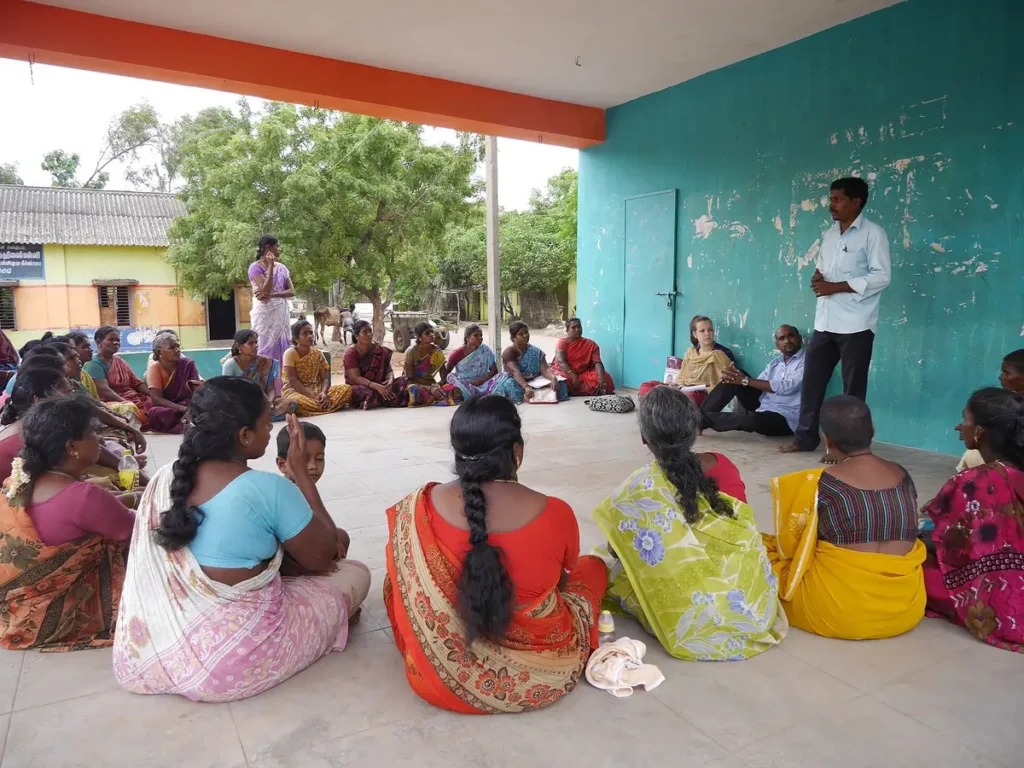
Members meet weekly or monthly, save a fixed small sum, and keep books. After a few months of regular saving and internal lending, the group is graded and a bank opens a savings account and then extends credit, often several times its savings, without collateral. The Panchasutra under NRLM: regular meetings, regular savings, regular internal lending, timely repayment, and up-to-date books. Groups federate into village organisations and cluster-level federations.
- 110-20 women form a group
- 2Regular saving and meetings (Panchasutra)
- 3Internal lending from pooled savings
- 4Grading and bank account
- 5Bank credit without collateral
- 6Federation and livelihood enterprise
Milestones
- Early work by MYRADA in Karnataka in the 1980s.
- 1992: NABARD pilot of SHG-Bank Linkage with 500 groups.
- 1998: Kerala’s Kudumbashree, a women’s network linked to panchayats.
- 1999: Swarnjayanti Gram Swarozgar Yojana.
- 2011: National Rural Livelihoods Mission (Aajeevika), renamed DAY-NRLM in 2016; DAY-NULM for towns.
- 2023-24: Lakhpati Didi, a target of 3 crore SHG women earning at least ₹1 lakh a year.
Why they matter
SHGs gave poor women credit, a bank account, a public voice and a training ground for leadership; many SHG members later won panchayat seats. They run community kitchens, make masks (as during COVID-19), act as Banking Correspondent Sakhis and drone operators under Namo Drone Didi. Loan repayment rates have generally been high.
From SHG to enterprise: Lakhpati Didi
The next step for SHGs is to move members from saving and small loans to steady livelihoods. The Lakhpati Didi initiative, announced in 2023, aims to help three crore SHG women earn at least ₹1 lakh a year on a sustained basis through farm and non-farm enterprises, using skill training, enterprise loans and market links. By 2025 the Government reported over 1.5 crore women had crossed that mark. The Start-up Village Entrepreneurship Programme funds small rural businesses run by SHG members, and SHG products are sold through the Government e-Marketplace (GeM), the Saras fairs and e-commerce platforms. Namo Drone Didi (2023) gives drones to SHGs to provide fertiliser and pesticide spraying services to farmers. Bank Sakhis and Business Correspondent Sakhis, drawn from SHGs, take banking to villages.
- Irregular meetings and poor books
- Loans used for consumption
- No market for products
- Over-borrowing from MFIs
Kerala’s Kudumbashree and Andhra’s model
Kudumbashree (1998), Kerala’s State poverty eradication mission, organises women in neighbourhood groups linked to local governments; it runs canteens, farming groups and microenterprises, and works closely with panchayats. Andhra Pradesh built the largest SHG federation network through its Society for Elimination of Rural Poverty, which became a model for DAY-NRLM. Both show that SHGs succeed when they are federated at village, block and district level, have access to bank credit, and work with local government rather than parallel to it.
SHGs beyond money
Studies of DAY-NRLM, including by the International Initiative for Impact Evaluation, find gains in women’s savings, access to credit and say in household decisions. SHGs also act as platforms for health and nutrition campaigns, community kitchens during COVID-19, mask-making, sanitation drives and local politics: many women panchayat members began their public life in an SHG. The risk is that groups get loaded with too many Government tasks without pay, turning a self-help movement into unpaid outreach.
Credit linkage and repayment
Under the SHG-Bank Linkage Programme, a group that has saved regularly for about six months and kept good books can borrow from a bank, at first a few times its savings and later much more, without collateral. DAY-NRLM gives a revolving fund and community investment fund, and interest subvention brings the rate on loans up to ₹3 lakh down to 7%, with a further 3% off for prompt repayment in many districts. Bank data show SHG non-performing assets are lower than the average for priority sector lending, though higher in some States. Women repay because the group, not a single borrower, carries the loan, and peer pressure works. Group members also vet each other’s needs before a loan is shared out, which keeps lending close to real uses.
Problems
- Uneven spread: the South has far more mature groups than central and eastern India.
- Small loans used for consumption rather than enterprise; weak market links for products.
- Overlap with microfinance lenders and over-indebtedness, as in the Andhra Pradesh crisis of 2010.
- Elite capture and dropout of the poorest.
Key data
| Indicator | Figure |
|---|---|
| Women in DAY-NRLM SHGs | About 10 crore |
| SHGs under DAY-NRLM | About 90 lakh |
| Lakhpati Didi target | 3 crore women |
| Interest subvention | Loans up to ₹3 lakh at 7%, with 3% more for prompt repayment in many districts |
Figures are from the Ministry of Rural Development and NABARD’s annual Status of Microfinance reports; check the latest edition before quoting.
Committees and policy
- NABARD working groups in the 1990s laid down SHG lending norms.
- Radhakrishna Committee (2009) helped design NRLM after SGSY fell short.
- Malegam Committee (2011) after the Andhra microfinance crisis led to RBI rules for NBFC-MFIs (caps on loans per borrower, number of lenders).
- RBI’s 2022 microfinance framework set a common household-income limit for all lenders.
Way forward
Move from credit to enterprise: market links (Saras fairs, GeM and e-commerce listings), producer companies for SHG federations, insurance and pensions for members, digital bookkeeping, and gender-sensitive training. In lagging States, invest in community resource persons, the backbone of NRLM.
PYQ trend
Prelims asked how NRLM improves livelihoods (2012) and SHGs in inclusive growth (2011). Mains GS-II includes “role of SHGs” in the syllabus; prepare one answer with Kudumbashree and Jeevika (Bihar) as examples.
Self Help Groups: UPSC angle
For UPSC CSE
Prelims: SHG-BLP, NRLM features, NABARD role. Mains GS-II: “role of SHGs” in development; GS-III: financial inclusion and women-led development.
Self Help Groups UPSC PYQs (Prelims)
Questions UPSC has actually asked, from the official papers. Pick an option to check yourself.
How does the National Rural Livelihood Mission seek to improve livelihood options of rural poor?
– 1. By setting up a large number of new manufacturing industries and agribusiness centres in rural areas
– 2. By strengthening ‘self-help groups’ and providing skill development
– 3. By supplying seeds, fertilizers, diesel pump-sets and micro-irrigation equipment free of cost to farmers
Select the correct answer using the codes given below :
NRLM (Aajeevika, 2011) organises poor rural women into self-help groups, links them to bank credit and gives skill training for self-employment and jobs. It does not set up factories or hand out free farm inputs. Answer as per the official UPSC key · Battle IAS PYQ bankAnswer (b) & why
Which of the following can aid in furthering the Government’s objective of inclusive growth ?
– 1. Promoting Self-Help Groups
– 2. Promoting Micro, Small and Medium Enterprises
– 3. Implementing the Right to Education Act
Select the correct answer using the codes given below :
Inclusive growth (the theme of the 11th Plan) means growth whose gains reach the poor. SHGs give women and the poor credit and income, MSMEs create jobs on a large scale, and the Right to Education builds the skills to share in growth. All three help. Answer as per the official UPSC key · Battle IAS PYQ bankAnswer (d) & why
Mains PYQs on this topic
No UPSC Mains question from 2023-2026 is directly on this topic. Older papers (2013-2022) will be added as the Mains bank grows.
Quick quiz
The SHG-Bank Linkage Programme was started by
In 1992.Answer (b)
Kudumbashree is associated with
Launched 1998.Answer (b)
NRLM was renamed as
In 2016.Answer (a)
FAQs
How many members does an SHG have?
Usually 10 to 20; NRLM allows smaller groups in difficult areas.
Do SHGs need collateral to borrow?
No. Banks lend to the group on the basis of its savings and track record.
What is Lakhpati Didi?
A target to help SHG women earn at least ₹1 lakh a year from livelihoods.
How are SHGs different from microfinance institutions?
SHGs are member-owned savings and credit groups; MFIs are lenders that give loans to joint-liability groups.
What is a Community Resource Person?
An experienced SHG member trained to help form and strengthen new groups.
What is Jeevika?
Bihar’s rural livelihoods programme, a large SHG network supported by the World Bank.
Spotted an error? Tell us. We correct within 48 hours.
Image: Pondicherry17, Wikimedia Commons, CC BY-SA 4.0
How to use this in Mains
If asked: Self-Help Groups have empowered rural women but face limits. Examine. (GS-I/II)
Quote: “SHGs gave poor women credit, a bank account, a public voice and a training ground for leadership; many SHG members later won panchayat seats.”
Use it: Perfect opener showing impact beyond credit.
In the news
‘She-Mart’ cooperative outlets launched in Keralam to link women SHGs to markets
On 26 September 2026 the Union Minister of Cooperation launched She-Mart at Kollam, Keralam. Announced in the Budget, She-Mart links women Self-Help Groups and rural women entrepreneurs directly to buyers. More than 300 She-Mart stores are planned across Kerala, Tamil Nadu and Karnataka, selling local and Bharat Brand products.
26 Sep 2026
Cooperative “Bharat Taxi” launched in Lucknow and four more UP cities
On 23 September 2026 the cooperative ride service Bharat Taxi was launched in Lucknow, Gorakhpur, Varanasi, Kanpur and Prayagraj. Run on the "Driver is the Owner" principle, it has more than 10 lakh drivers (Saarthis) in six months, about 20,000 rides a day and over Rs 100 crore credited to drivers.
23 Sep 2026
9 lakh Community Resource Persons: the frontline of rural service delivery
A PIB backgrounder of 20 September 2026 describes India's rural frontline cadres. Over 9 lakh Community Resource Persons (CRPs), mostly SHG women under DAY-NRLM, work with over 10.40 lakh ASHAs and 10.58 lakh trained Anganwadi Workers. Nearly 4.08 lakh CRPs work on livelihoods as Krishi, Pashu, Matsya and Van Sakhis; the rest on banking, insurance and gender.
20 Sep 2026
“Bharat Taxi” cooperative ride service scales up in Gujarat
Bharat Taxi, India's first driver-owned ride-hailing service run by Sahkar Taxi Cooperative Limited, was set for a formal launch in 14 Gujarat cities on 27 June 2026, the Cooperation Ministry said. It runs on a zero-commission, surge-free model under "Saarthi Hi Maalik". Of 7 lakh Saarthis nationwide, more than 1.5 lakh are from Gujarat.
26 Jun 2026