
India’s first sugar-to-bioplastic (PLA) plant at Kumbhi, Kheri: giant reactor arrives
A 110-ft cyclisation reactor from Belgium, carried on a 240-wheel trailer, reached Lakhimpur Kheri on 21 October 2026 after a six-month road journey through Odisha, Jharkhand, Bihar and UP. It is the core machine of India’s first integrated sugar-to-bioplastic plant, being built by Balrampur Chini Mills at Kumbhi. The plant will turn sugarcane into polylactic acid (PLA), a compostable plastic, and is expected to start next month.
- Location
- Kumbhi, Lakhimpur Kheri
- Capacity
- 80,000 tonnes a year
- Investment
- ₹2,850 crore (gross)
- Foundation
- 22 Feb 2025
Kumbhi PLA plant: what happened?
UP grows more sugarcane than any other State. This project asks a simple question: what if that cane became not just sugar and ethanol, but plastic that breaks down in compost?
- The reactor (110 ft long, 26 ft wide) entered Kheri from Bahraich on 21 October and moved to Kumbhi on 22 October (HT).
- It was landed at Paradip Port, Odisha; the trailer’s wheels were cut from 308 to 240 in Jharkhand to take sharp turns.
- Transport alone cost an estimated ₹4–5 crore, with district administrations, PWD and power departments clearing the route.
- Mill officials expect operations to begin next month; a 200-acre industrial park for downstream units is proposed.
What is PLA and how is it made?
- Polylactic acid (PLA) is a bio-based plastic made from plant sugars.
- Steps: sugar → lactic acid (by fermentation) → lactide (in the cyclisation reactor) → PLA granules.
- Uses: cups, cutlery, food trays, straws, bags, alternatives to banned single-use plastics.
- It is industrially compostable, not simply biodegradable in a field.
How does PLA compare with normal plastic?
| Point | Petroleum plastic | PLA |
|---|---|---|
| Raw material | Crude oil, natural gas | Sugarcane sugar |
| End of life | Persists for centuries | Industrial composting |
| Emissions | Higher | About 68% lower GHG (company claim) |
| Cost | Lower | Higher today |
Which rules and policies apply?
- Plastic Waste Management Rules, 2016 (amended 2021) banned identified single-use plastic items from 1 July 2022.
- Compostable plastic products must meet the BIS standard IS 17088 and be certified under the rules.
- The project expects a capital subsidy of about ₹1,100 crore under a UP government scheme (company filing).
- UP government signed an MoU for the plant on 27 May 2025.
What are the challenges?
- PLA needs industrial composting units, which are few in India.
- Mixed with normal plastic, it can contaminate recycling.
- Higher cost needs steady demand from buyers.
- Diverting cane to new uses must not hurt farmers’ timely payments.
What should be done next?
- Build composting capacity in UP’s cities alongside PLA use.
- Clear labelling so buyers know PLA is compostable, not recyclable.
- Link sugar mills, cane farmers and downstream units in the industrial park.
- Use public procurement to create early demand.
What can Prelims ask on bioplastics?
- PLA = polylactic acid, from lactic acid.
- First integrated sugar-to-PLA plant in India: Kumbhi, Lakhimpur Kheri.
- Capacity: 80,000 tonnes per annum.
- Single-use plastic ban: 1 July 2022.
- Lakhimpur Kheri: UP’s largest district by area; home to Dudhwa National Park.
How to write about bioplastics in UPPCS Mains
Practice question (10 marks, 150 words): Sugar-based bioplastics can add value to Uttar Pradesh’s sugarcane economy. Discuss. (UPPCS GS-VI)
- Intro: Kumbhi PLA plant; reactor arrival, Oct 2026.
- Value chain: cane → sugar → lactic acid → PLA.
- Benefits: green industry, jobs, alternative to single-use plastic.
- Limits: composting, cost, demand.
- Conclusion: pair the plant with waste infrastructure.
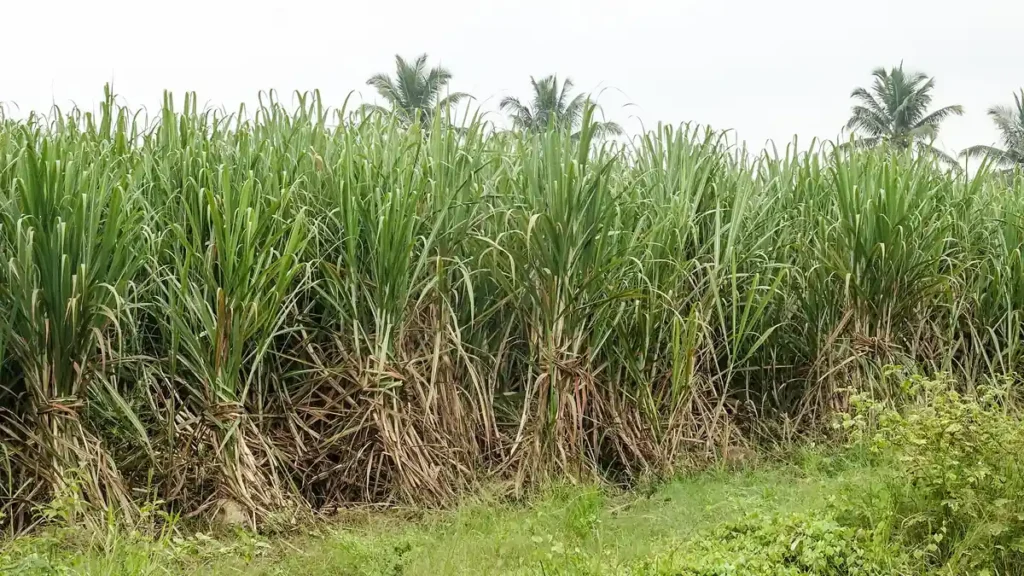
Image: A sugarcane field (representative image). Timothy A. Gonsalves, Wikimedia Commons, CC BY-SA 4.0
Read all of October 2026 in the monthly UP current affairs compilation →
How to use this in Mains
If asked: Discuss the scope of value addition in Uttar Pradesh’s sugar sector. (UPPCS GS-VI)
Quote: “Sugarcane-derived sugar will first be converted into lactic acid, which will then be processed into PLA granules and pellets.”
Use it: Use it to explain the value chain in one line.
If asked: Examine alternatives to single-use plastics. (UPPCS GS-VI)
Quote: “The vessel is a cyclisation reactor, the key machine in producing polylactic acid (PLA), a completely biodegradable plastic.”
Use it: Quote it, then add the composting caveat.
Exam angle
UPPCS Prelims: PLA, Kheri, plastic rules. · Mains GS-VI: agro-industry and green manufacturing in UP.
Practice MCQs
Original practice questions (not PYQs).
Polylactic acid (PLA), recently in the news in Uttar Pradesh, is
Answer (b) & explanation
PLA is a bio-based, compostable plastic made from lactic acid derived from sugars.
India’s first integrated sugar-to-PLA plant is coming up in which district of Uttar Pradesh?
Answer (b) & explanation
It is at Kumbhi in Lakhimpur Kheri, by Balrampur Chini Mills.
The ban on identified single-use plastic items in India came into force on
Answer (b) & explanation
Under the amended Plastic Waste Management Rules, the ban took effect on 1 July 2022.
Questions students ask about this
What is being built at Kumbhi?
India’s first integrated plant that turns sugarcane into PLA bioplastic.
Who is building it?
Balrampur Chini Mills Ltd.
What is its capacity?
80,000 tonnes a year.
When will it start?
Officials expect operations next month.
Keep studying
Go deeper
facts from cited sources only; cross-checked; faculty review pending