
UPSC Mains 2024 GS3 Q17: model answer
What is disaster resilience? How is it determined? Describe various elements of a resilience framework. Also mention the global targets of Sendai Framework for Disaster Risk Reduction (2015-2030).
What the question wants
Define resilience, how it is measured, elements, and Sendai targets.
How to structure it
Intro: define resilience (UNDRR). Body: (1) how resilience is determined (hazard, exposure, vulnerability, capacity); (2) elements of a resilience framework; (3) the seven Sendai targets. Conclusion: India's role (CDRI).
- 1(1) how resilience is determined (hazard, exposure, vulnerability, capacity)
- 2(2) elements of a resilience framework
- 3(3) the seven Sendai targets
Model answer
UNDRR defines resilience as the ability of a system or community exposed to hazards to resist, absorb, adapt to and recover from them in a timely and efficient manner.
- Risk understanding
- Governance
- Risk-reduction investment
- Early warning
- Response capacity
- Build back better
How it is determined
- Risk = hazard × exposure × vulnerability, reduced by capacity.
- Indicators: building quality, early warning, income, health access, social networks, governance.
- Tools: disaster resilience indices, risk assessments, post-disaster recovery time.
Elements of a resilience framework
- Risk understanding: hazard mapping and data.
- Governance: laws, plans and institutions (DM Act 2005, NDMA, SDMAs).
- Investment in risk reduction: resilient infrastructure, building codes.
- Preparedness and early warning: cyclone warnings that cut deaths in Odisha.
- Response capacity: NDRF, SDRF, community volunteers (Aapda Mitra).
- Recovery: 'build back better', insurance and social protection.
Sendai Framework global targets (2015-2030)
- Substantially reduce global disaster mortality.
- Reduce the number of affected people.
- Reduce direct economic loss in relation to GDP.
- Reduce damage to critical infrastructure and disruption of basic services.
- Increase countries with national and local DRR strategies by 2020.
- Enhance international cooperation with developing countries.
- Increase availability of multi-hazard early warning and risk information.
India's Coalition for Disaster Resilient Infrastructure shows how resilience is moving from relief to prevention.
Keywords, cases and data to drop in
UNDRR risk equation build back better seven targets CDRI
Where most answers lose marks
- Missing some of the seven targets.
Fresh examples from current affairs
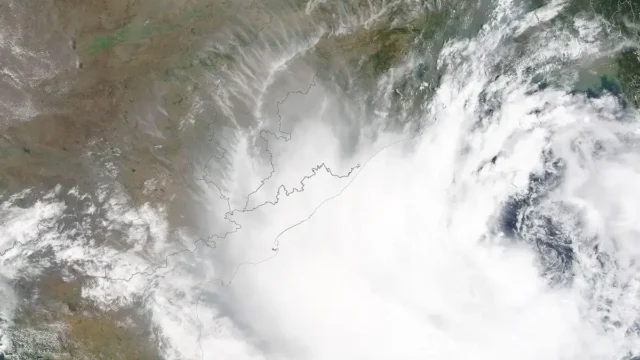
IMD launches a map-based Decision Support System for cyclone and marine warnings
On 12 October 2026 the India Meteorological Department dedicated a Cyclone Warning and Marine Weather Services Decision Support System to the nation. The WebGIS platform shows cyclone track, intensity, winds, rainfall, storm surge and district-wise warnings on one map for disaster managers and the public.
UPSC angle: Prelims: IMD, cone of uncertainty, storm surge. · Mains GS-III: early warning and disaster preparedness.
13 Oct 2026
India offers flood relief to Nepal; PM speaks to Nepal PM
On 26 August 2026 Prime Minister Narendra Modi spoke to Nepal's Prime Minister Balendra Shah and conveyed condolences on the loss of lives in floods in Nepal. He said India is ready to provide all possible humanitarian assistance, and that Indian teams are coordinating closely with Nepalese authorities on rescue and relief.
UPSC angle: Mains: India–Nepal water and flood cooperation.
26 Aug 2026
UNCCD COP17: India urges shift from drought response to drought resilience
At a ministerial dialogue on drought resilience at UNCCD COP17 in Ulaanbaatar, Mongolia, on 25 August 2026, India called for a shift from reactive drought relief to proactive, technology-enabled resilience. The Environment Minister said drought must be managed as a predictable, preventable risk, with preparedness over response and prevention over crisis management.
UPSC angle: Mains: Drought resilience strategies.
25 Aug 2026
India hosts 3rd BRICS ministerial on disaster risk reduction
Under India's BRICS Chairship 2026, NDMA hosted the 3rd BRICS Ministerial Meeting on Disaster Risk Reduction in New Delhi on 24 July 2026. Members unanimously adopted a BRICS Joint Statement on DRR and pledged to speed up the BRICS DRR Work Plan for 2025 to 2028.
UPSC angle: Prelims: Sendai; CDRI.
24 Jul 2026Learn the concept
Question text as printed in the official UPSC question paper: https://www.upsc.gov.in/sites/default/files/QP_CSM_2024_GenStud_III_03102024.pdf The model answer is original Battle IAS work; use it to learn structure, not to memorise.