
Indian National Congress (1885-1947): Formation, Safety-Valve Debate, Moderates and Extremists, Important Sessions and Role in the Freedom Struggle (UPSC Notes + PYQs)
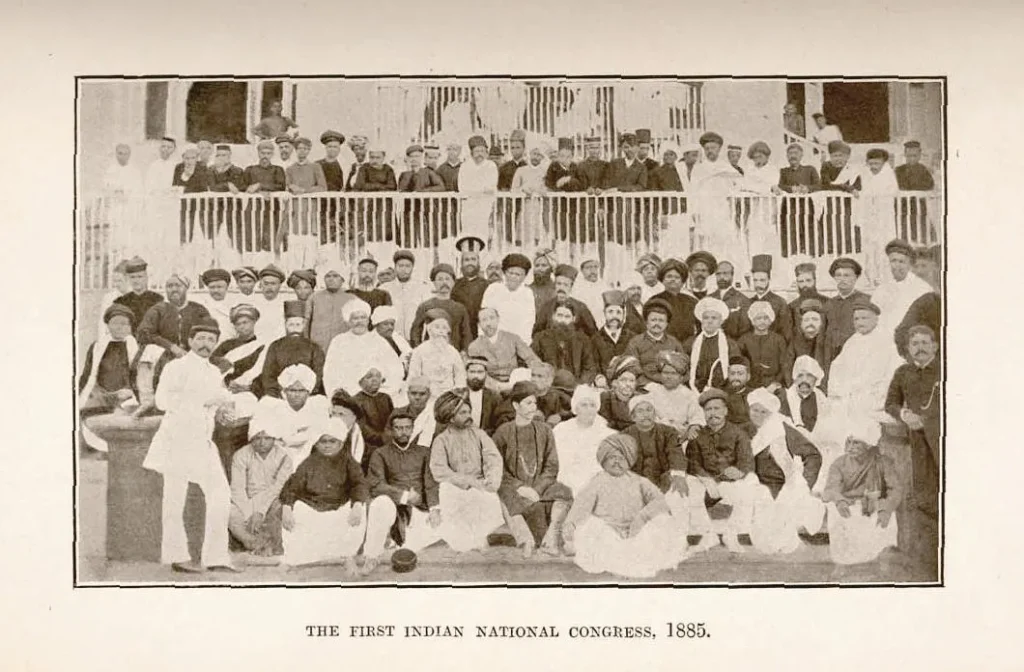
UPSC has already asked about this. Read the story with these questions in mind.
- Prelims 2016What was the main reason for the split in the Indian National Congress at Surat in 1907?Solve it below ↓
- Prelims 2014The 1929 Session of Indian National Congress is of significance in the history of the Freedom Movement because theSolve it below ↓
See all 5 PYQs
- Prelims 2015Consider the following statements: The first woman President of the Indian National Congress was Sarojini Naidu. …Solve it below ↓
- Prelims 2012The Lahore Session of the Indian National Congress (1929) is very important in history, becauseSolve it below ↓
- Prelims 2012During Indian freedom struggle, the National Social Conference was formed. What was the reason for its formation?Solve it below ↓
Background: associations before 1885
Educated Indians had formed political bodies for decades: the Landholders’ Society (1838), British Indian Association (1851), Poona Sarvajanik Sabha (1870), Indian Association of Calcutta under Surendranath Banerjea and Ananda Mohan Bose (1876), and the Madras Mahajan Sabha (1884). Issues like the lowering of the ICS age limit (1876), the Vernacular Press Act (1878) and the Ilbert Bill agitation (1883) showed the need for an all-India body. Surendranath’s Indian National Conference met in 1883 and 1885; it merged with the Congress in 1886.
The safety-valve debate
The “safety-valve” theory says Hume and Viceroy Dufferin created the Congress to let off steam and avoid another 1857. It drew on William Wedderburn’s biography of Hume; Lala Lajpat Rai used it to attack the Moderates. Historian Bipan Chandra argued the opposite: Indian leaders used Hume as a “lightning conductor”, a sympathetic Englishman whose presence would make the body seem less threatening to the government. Most historians now see the Congress as the product of Indian political awakening, not a British device.
- Hume and Dufferin designed the Congress
- Aim: prevent another 1857
- Congress as a British tool
- Indian leaders used Hume as cover
- Aim: avoid official hostility
- Congress as an Indian initiative (Bipan Chandra)
The Moderate phase (1885-1905)
Leaders: Dadabhai Naoroji, Pherozeshah Mehta, Gopal Krishna Gokhale, Surendranath Banerjea, Badruddin Tyabji, Justice Ranade. Methods: resolutions, petitions, speeches, and press work, the “3 Ps”. Demands: expansion of legislative councils, Indianisation of services, simultaneous ICS exams in India, cuts in military spending, and relief from land revenue. Their greatest gift was the economic critique of colonialism: Naoroji’s drain theory (Poverty and Un-British Rule in India, 1901) and R.C. Dutt’s Economic History of India. The Indian Councils Act, 1892 was a small gain.
The Extremists and the Surat split
Lal, Bal, Pal (Lajpat Rai, Tilak, Bipin Chandra Pal) and Aurobindo Ghosh wanted Swaraj and mass action: boycott, swadeshi, national education. Partition of Bengal (1905) brought the split into the open. At Surat in 1907 the two groups clashed over the presidency and resolutions; the Extremists were pushed out. They returned at Lucknow in 1916, the same session that saw the Congress-League pact.
The Gandhian Congress
The Nagpur session (December 1920) endorsed Non-Cooperation and changed the Congress constitution: linguistic Provincial Congress Committees, a Working Committee, and four-anna membership. The Congress became a mass party. It led Civil Disobedience (1930), contested the 1937 elections under the 1935 Act and formed ministries in most provinces, and launched Quit India (1942). It also spoke for a democratic, secular and socialist vision, set out in the Karachi Resolution (1931) on Fundamental Rights and economic policy.
- 1885-1905Moderate phase: petitions and economic critique
- 1905-1918Extremists, Surat split, Lucknow reunion
- 1919-1934Gandhian mass movements
- 1935-1939Elections and provincial ministries
- 1940-1947Quit India and transfer of power
Important sessions
| Year, place | President | Why it matters |
|---|---|---|
| 1885 Bombay | W.C. Bonnerjee | First session, 72 delegates |
| 1887 Madras | Badruddin Tyabji | First Muslim president |
| 1905 Benares | G.K. Gokhale | Support for swadeshi in Bengal |
| 1906 Calcutta | Dadabhai Naoroji | Swaraj as the goal |
| 1907 Surat | Rash Behari Ghosh | Moderate-Extremist split |
| 1916 Lucknow | A.C. Majumdar | Reunion; Lucknow Pact with the League |
| 1917 Calcutta | Annie Besant | First woman president |
| 1920 Nagpur | C. Vijayaraghavachariar | Non-Cooperation endorsed; new constitution |
| 1924 Belgaum | M.K. Gandhi | Only session Gandhi presided over |
| 1925 Kanpur | Sarojini Naidu | First Indian woman president |
| 1929 Lahore | Jawaharlal Nehru | Purna Swaraj resolution |
| 1931 Karachi | Vallabhbhai Patel | Fundamental Rights and economic policy resolution |
| 1938 Haripura, 1939 Tripuri | Subhas Chandra Bose | National Planning Committee; Bose re-elected then resigned |
Assessment
The Congress’s strength was its breadth: it brought together classes, regions and, for long periods, communities, and trained a generation in democratic politics. Its weaknesses: the failure to keep the Muslim League and many Muslims within the national movement, the slow inclusion of Dalit concerns (the Gandhi-Ambedkar clash at the Round Table and the Poona Pact), and tensions between Left and Right. Still, the institutions it built, from elected committees to internal debates, became the base of India’s parliamentary democracy.
PYQ trend
UPSC loves sessions and “firsts”: Surat split (2016), Lahore 1929 (2012, 2014), first Muslim and woman presidents (2015), the National Social Conference (2012). Mains GS-I asks about the Moderates’ contribution and phases of the movement.
Indian National Congress: UPSC angle
For UPSC CSE
Prelims: sessions, presidents, resolutions. Mains GS-I: contribution of the Moderates, Extremists vs Moderates, Congress and mass mobilisation.
Indian National Congress UPSC PYQs (Prelims)
Questions UPSC has actually asked, from the official papers. Pick an option to check yourself.
What was the main reason for the split in the Indian National Congress at Surat in 1907?
At Surat (1907) the Extremists (Tilak, Lajpat Rai, Aurobindo) wanted to carry swadeshi, boycott and national education across India and had no faith in the Moderates’ petition-and-prayer methods. The two sides clashed over the presidency of Rash Behari Ghosh and the session broke up. Answer as per the official UPSC key · Battle IAS PYQ bankAnswer (b) & why
The 1929 Session of Indian National Congress is of significance in the history of the Freedom Movement because the
At the Lahore session (December 1929), with Jawaharlal Nehru as president, the Congress adopted Purna Swaraj as its goal. It hoisted the tricolour on the Ravi bank on 31 December and fixed 26 January 1930 as Independence Day. It also authorised civil disobedience. Answer as per the official UPSC key · Battle IAS PYQ bankAnswer (b) & why
Consider the following statements :
– 1. The first woman President of the Indian National Congress was Sarojini Naidu.
– 2. The first Muslim President of the Indian National Congress was Badruddin Tyabji.
Which of the statements given above is/are correct?
Annie Besant presided at Calcutta (1917) and was the first woman president. Sarojini Naidu (Kanpur, 1925) was the first Indian woman president. Badruddin Tyabji presided at Madras (1887) as the first Muslim president. Answer as per the official UPSC key · Battle IAS PYQ bankAnswer (b) & why
The Lahore Session of the Indian National Congress (1929) is very important in history, because
– 1. the Congress passed a resolution demanding complete independence
– 2. the rift between the extremists and moderates was resolved in that Session
– 3. a resolution was passed rejecting the two-nation theory in that Session
Which of the statements given above is/are correct?
At Lahore (December 1929), under Jawaharlal Nehru, the Congress adopted Purna Swaraj and fixed 26 January 1930 as Independence Day. The moderate-extremist split was healed at Lucknow in 1916, and the two-nation theory was not on the agenda in 1929. Answer as per the official UPSC key · Battle IAS PYQ bankAnswer (a) & why
During Indian freedom struggle, the National Social Conference was formed. What was the reason for its formation?
The early Congress kept to political questions so as not to divide its members. M. G. Ranade and Raghunath Rao therefore set up the Indian National Social Conference (1887) as a separate forum for social reform, meeting at the same venue as the Congress sessions. Answer as per the official UPSC key · Battle IAS PYQ bankAnswer (b) & why
Mains PYQs on this topic
No UPSC Mains question from 2023-2026 is directly on this topic. Older papers (2013-2022) will be added as the Mains bank grows.
Quick quiz
The first session of the Congress was presided over by
Bombay, 1885.Answer (b)
The Congress split at Surat in
Moderates vs Extremists.Answer (c)
The Fundamental Rights resolution was passed at
Presided by Patel.Answer (b)
FAQs
Who founded the Indian National Congress?
A.O. Hume helped organise it with Indian leaders; W.C. Bonnerjee presided over the first session.
What is the safety-valve theory?
The claim that the British created the Congress to release Indian discontent safely.
Why did the Congress split in 1907?
Over methods and goals: the Extremists wanted boycott and Swaraj; the Moderates wanted constitutional methods.
When did the Congress adopt Purna Swaraj?
At the Lahore session, December 1929; 26 January 1930 was observed as Independence Day.
How many sessions did Gandhi preside over?
One, at Belgaum in 1924.
Spotted an error? Tell us. We correct within 48 hours.
How to use this in Mains
If asked: Assess the role of the Indian National Congress in the national movement. (GS-I)
Quote: “The Congress’s strength was its breadth: it brought together classes, regions and, for long periods, communities, and trained a generation in democratic politics.”
Use it: Ideal balanced conclusion.
In the news
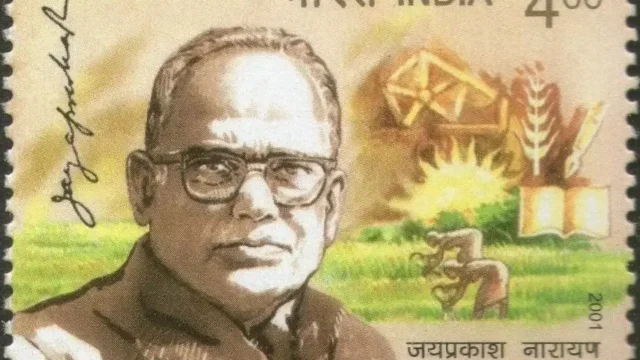
Birth anniversaries: Jayaprakash Narayan and Nanaji Deshmukh
11 October is the birth anniversary of Loknayak Jayaprakash Narayan and Nanaji Deshmukh, both Bharat Ratna awardees. The Prime Minister recalled JP's voice during the Emergency and his concern for good governance, and Nanaji's work in rural development and community participation. Treat this as a personality note for Prelims.
11 Oct 2026
ASI and Denmark museum to search for 1619 Danish shipwreck Oresund off Karaikal
The Archaeological Survey of India's Underwater Archaeology Wing and the National Museum of Denmark (Njord Centre, Copenhagen) signed an MoU to locate and document the Danish ship Oresund, wrecked off Karaikal, Puducherry, in 1619 CE. It is described as the first Danish ship known to have reached India.
15 Jun 2026
Veer Bal Diwas and the Rashtriya Bal Puraskar
The PM announced the day on 9 January 2022 and the first Veer Bal Diwas was held on 26 December 2022 [PMO].
26 Dec 2025
Stamp on Emperor Perumbidugu Mutharaiyar II
Questions on lesser-known regional dynasties are common in Prelims. Stamps and anniversaries often bring them into the news.
14 Dec 2025