
Quad to spread trusted AI and recycle critical minerals
The Quad is a group of India, the United States, Japan and Australia. Its Foreign Ministers met in Atlanta and agreed to help Indo-Pacific countries use trusted artificial intelligence. The United States will also fund the recycling of critical minerals in India and South-East Asia. Read it to revise the Quad and why critical minerals matter.
- Where
- Atlanta, United States
- AI help
- $85 million
- Minerals recycling
- $10 million for India and ASEAN
- Members
- India, US, Japan, Australia
The Quad AI and minerals plan: what happened?
Phones, electric cars and solar panels all need minerals like lithium and cobalt. Today a few countries control most of them, so the Quad wants safer supply chains, including from recycled waste.
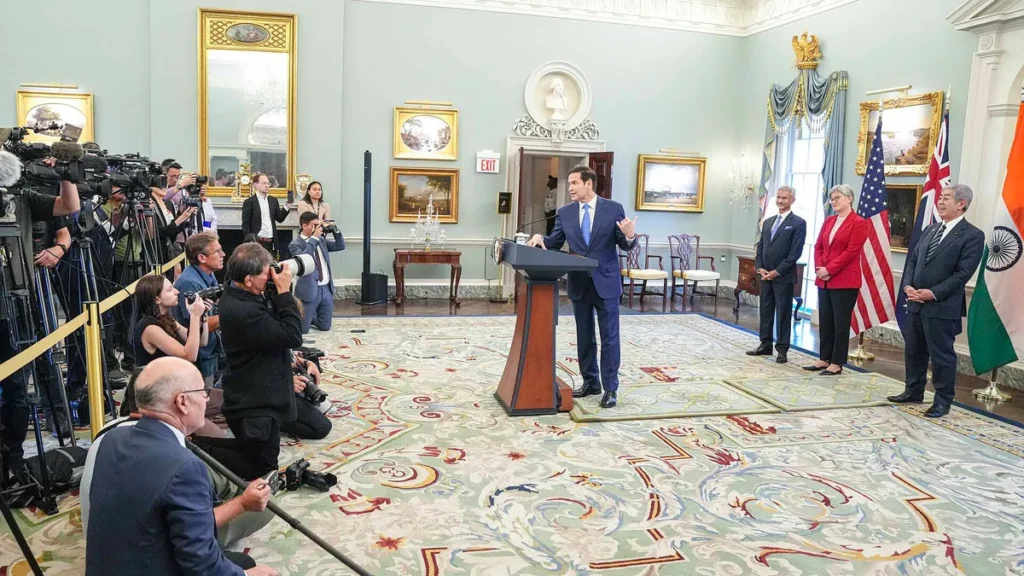
- Quad Foreign Ministers met in Atlanta, United States, on the sidelines of the G20 Foreign Ministers’ meeting.
- S. Jaishankar (India), Penny Wong (Australia) and Toshimitsu Motegi (Japan) attended; Marco Rubio (United States) hosted.
- The Quad plans $85 million in technical help to widen access to trusted AI across the Indo-Pacific.
- The United States will give $10 million to recover critical minerals from waste in India and ASEAN countries.
- It was the third Quad Foreign Ministers’ meeting this year, after New Delhi (May) and Manila (July). The Leaders’ Summit is due in mid-November.
What is the Quad and why do critical minerals matter?
The Quad (Quadrilateral Security Dialogue) began as a group that helped after the 2004 Indian Ocean tsunami. It was revived in 2017 and held its first Leaders’ Summit in 2021.
It works for a “free, open and inclusive Indo-Pacific”, on health, climate, technology, infrastructure and maritime awareness. It is not a military alliance.
Critical minerals are minerals that are vital for the economy but at risk of supply problems. India listed 30 critical minerals in 2023, including lithium, cobalt, nickel and rare earth elements.
India joined the United States-led Minerals Security Partnership in 2023 and launched the National Critical Mineral Mission in 2025 to secure supply, including through recycling.
Which laws and Articles apply?
- India’s list of 30 critical minerals (2023).
- Mines and Minerals (Development and Regulation) Act, 1957, amended in 2023 to allow auction of critical minerals.
- National Critical Mineral Mission (2025).
- Minerals Security Partnership (India joined in 2023).
Why does the Quad AI and minerals plan matter?
| Angle | What to note |
|---|---|
| Economy | Clean energy and electronics depend on critical minerals. |
| Strategy | Reduces dependence on one country for supply. |
| Technology | Trusted AI helps smaller Indo-Pacific nations. |
| Environment | Recycling cuts mining and waste. |
What are the problems with the Quad AI and minerals plan?
- Recycling alone cannot meet India’s growing mineral demand.
- The amounts announced are small compared to the need.
- Some see the Quad as aimed at China, which can strain ties.
- India lacks enough processing capacity for minerals.
What should be done next on the Quad AI and minerals plan?
- Build recycling plants for batteries and e-waste in India.
- Invest in mineral processing at home.
- Use Quad partnerships to secure mines abroad.
- Set common standards for trusted and safe AI.
What can Prelims ask on the Quad AI and minerals plan?
Prelims probability: Expect a question on critical minerals: India lists 30; it joined the United States-led Minerals Security Partnership in 2023.
- Quad: India, United States, Japan, Australia; revived 2017; first Leaders’ Summit 2021.
- India lists 30 critical minerals (2023).
- India joined the Minerals Security Partnership in 2023.
- National Critical Mineral Mission: 2025.
- Quad plan: $85 million for trusted AI; $10 million for minerals recycling.
How to write about the Quad AI and minerals plan in Mains
Practice question (15 marks, 250 words): Critical minerals have become central to India’s foreign policy. Discuss with reference to the Quad.
- Intro: Atlanta meeting; AI and minerals plans.
- What critical minerals are; India’s list of 30.
- Quad and Minerals Security Partnership role.
- Challenges: processing, dependence, small funds.
- Conclusion: diversify supply, recycle, build capacity.
Ready lines for your answer
- Mineral security is the new energy security.
- The Quad is a partnership for public goods, not a military bloc.
Quotable data pointIndia listed 30 critical minerals in 2023.
Photo: U.S. Department of State, Public domain, via Wikimedia Commons
Exam angle
Prelims: Quad members, critical minerals list, Minerals Security Partnership. · Mains GS-II: India and groupings, supply chain security.
Practice MCQs
Original practice questions (not PYQs).
The Strait of Hormuz connects:
Answer (c) & explanation
The Strait of Hormuz lies between Iran and Oman and links the Persian Gulf with the Gulf of Oman. About a fifth of the world's oil passes through it.
Consider the following statements:
1. The Quad has a permanent secretariat.
2. The Quad was set up by a military alliance treaty in 2017.
3. The 2026 Quad Leaders' Summit is to be held in Japan.
How many of the above statements are correct?
Answer (d) & explanation
None is correct. The Quad has no treaty or secretariat; it was revived in 2017 as a dialogue, and the mid-November summit is planned in the Philippines.
Questions students ask about this
Who are the members of the Quad?
India, the United States, Japan and Australia.
What did the Quad agree on artificial intelligence?
It plans $85 million in technical help to widen access to trusted AI across the Indo-Pacific.
How many critical minerals has India listed?
30, in 2023.
Where did the Quad Foreign Ministers meet?
In Atlanta, United States, on the sidelines of the G20 Foreign Ministers' meeting.