
Coal mine auction draws 85 bids, 20 first-time bidders
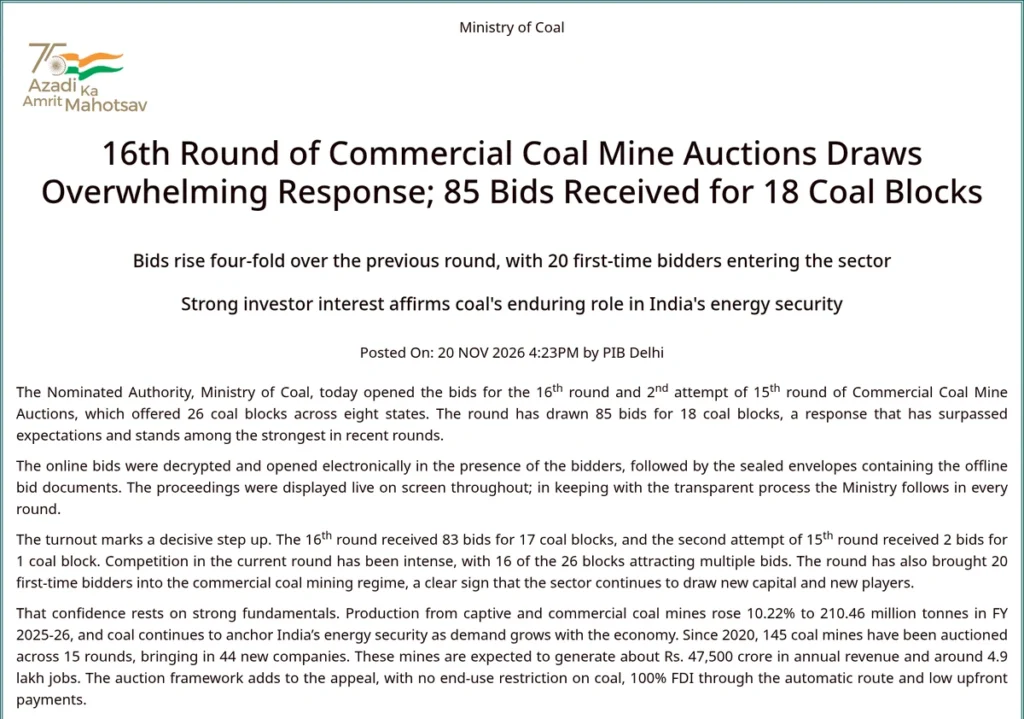
The 16th round of commercial coal mine auctions, together with a second attempt for one block from the 15th round, drew 85 bids for 18 coal blocks, the Ministry of Coal said on 20 November. Twenty first-time bidders entered the sector, and bids rose four-fold over the previous round. Since commercial auctions began in 2020, 145 mines have been sold across 15 rounds, bringing in 44 new companies. They are expected to yield about Rs 47,500 crore a year in revenue and about 4.9 lakh jobs. Read it to revise coal reforms, energy security and the debate between growth and environment.
- Bids
- 85 bids for 18 blocks (16th round plus second attempt of 15th round)
- New players
- 20 first-time bidders; bids up four-fold
- So far
- 145 mines auctioned in 15 rounds since 2020; 44 new companies
- Output
- Captive and commercial mines produced 210.46 million tonnes in 2025-26, up 10.22%
What did the latest coal auction show?
Coal still supplies most of India's electricity. Opening mines to private and new players is meant to raise domestic output and cut imports.
- The 16th round of commercial coal mine auctions and the second attempt of the 15th round offered 26 blocks across eight States.
- They drew 85 bids for 18 blocks: 83 bids for 17 blocks in the 16th round and 2 bids for one block from the 15th round.
- 16 of the 26 blocks attracted multiple bids, and 20 first-time bidders entered commercial coal mining.
- Bids rose four-fold over the previous round.
- Production from captive and commercial mines rose 10.22% to 210.46 million tonnes in 2025-26.
- Bids will be checked by a Technical Evaluation Committee; qualified bidders go to an electronic auction on the MSTC portal.
How does commercial coal mining work?
Commercial coal mining auctions began in June 2020. Since then 145 mines have been auctioned in 15 rounds, bringing in 44 new companies.
There is no end-use restriction on the coal mined, 100% FDI is allowed through the automatic route, and upfront payments are low.
The auctioned mines are expected to generate about Rs 47,500 crore in annual revenue and about 4.9 lakh jobs.
Coal was nationalised in the 1970s under Indira Gandhi; blocks are now allotted by auction, not lottery (UPSC Prelims 2019).
Growth versus environment
- Energy security: more domestic coal cuts imports and supports power demand.
- New capital: 20 first-time bidders show the sector is drawing fresh investors.
- Climate cost: mining affects forests, water and local communities, which is why the 2017 Mains question called coal mining “inevitable” despite harm.
Previous year questions linked to this story
UPSC Prelims 2019
Consider the following statements :
1. Coal sector was nationalized by the Government of India under Indira Gandhi.
2. Now, coal blocks are allocated on lottery basis.
3. Till recently, India imported coal to meet the shortages of domestic supply, but now India is self-sufficient in coal production.
Which of the statements given above is/are correct?
Answer: (a)
UPPCS Prelims 2025
Which of the following pairs is/are correctly matched? (Coal Producing Area – State)
1. Maolong – Arunachal Pradesh
2. Raniganj – West Bengal
3. Ramgarh – Jharkhand
4. Talcher – Odisha
Answer: (c)
UPSC Mains 2017 (General Studies Paper 1)
"In spite of adverse environmental impact, coal mining is still inevitable for development." Discuss.
What can Prelims ask on this story?
Prelims probability: Medium.Features of commercial auctions (no end-use limit, 100% FDI) are testable.
- Commercial coal auctions since June 2020; 145 mines in 15 rounds.
- No end-use restriction; 100% FDI via the automatic route.
- Coalfields: Raniganj (West Bengal), Talcher (Odisha), Ramgarh (Jharkhand).
How to write about this story in Mains
Practice question (15 marks, 250 words): Commercial coal mining auctions are drawing new investors even as India pursues clean energy. Discuss whether expanding coal production is consistent with India's climate commitments.
- Open with the round: 85 bids, 20 new bidders.
- Explain the reform: open auctions, no end-use limit, FDI.
- Weigh energy security against environmental and social costs.
- Conclude: coal as a bridge fuel with a just-transition plan.
Ready lines for your answer
- Open auctions have drawn new capital into coal.
- Expansion must be matched by environmental safeguards.
Quotable data pointPIB, 20 November 2026: 85 bids for 18 blocks; 145 mines auctioned since 2020.
Original article clipping: PIB release, Ministry of Coal, 20 Nov 2026 (featured image). Source: PIB · Open original article clipping
Exam angle
Prelims: auction rules, coalfields. · Mains GS-III: energy security and mining reforms; GS-I: resource distribution.
Practice MCQs
Original practice questions (not PYQs).
Under the commercial coal mining auction regime introduced in 2020, which of the following is correct?
Answer (b) & explanation
The Ministry of Coal says the framework has no end-use restriction, allows 100% FDI through the automatic route and has low upfront payments.
According to the Ministry of Coal (November 2026), how many coal mines have been auctioned under the commercial regime since 2020 across 15 rounds?
Answer (c) & explanation
145 coal mines have been auctioned across 15 rounds since 2020, bringing in 44 new companies.