
UPSC Mains 2026 GS3 Q15: model answer
Mention salient features of 'Mission Drishti'. Discuss the imaging techniques used in the satellite launched on 3rd May 2026. Why it is being considered world's first satellite of its kind?
What the question wants
Features of the mission (private Indian Earth-observation satellite); the two imaging methods (optical/multispectral and synthetic aperture radar) and their fusion; why it is a world first.
How to structure it
Intro: who built it and why it matters for private space. Body: features; optical vs SAR; fusion as the first. Conclusion: uses for India.
- 1Features
- 2Optical vs SAR
- 3Fusion as the first
Model answer
Mission Drishti is an Earth-observation satellite built by GalaxEye, a Bengaluru startup incubated at IIT Madras. It is among the largest privately built Indian satellites, a product of the IN-SPACe reforms.
| Feature | Optical (multispectral) | SAR |
|---|---|---|
| Sensing | Passive, reflected sunlight | Active microwave pulses |
| Night / cloud | Fails | Works |
| Output | Colour, vegetation health | Texture, moisture, movement |
| Drishti | Fuses both into one OptoSAR image |
Salient features
- Two sensors on one platform: an optical multispectral camera and a synthetic aperture radar.
- Their outputs are fused into one 'OptoSAR' image.
- Frequent revisits for agriculture, disasters, infrastructure and defence.
- Privately owned, with commercial data sales.
Imaging techniques
- Optical is passive, recording reflected sunlight in visible and near-infrared bands. It shows colour and crop health but fails at night and under cloud.
- SAR is active: it sends microwave pulses and reads the echo. Microwaves pass through cloud, so it works day, night and monsoon, showing texture, moisture and movement.
- Fusion aligns near-simultaneous images of one place, giving SAR's reliability with optical's readability.
Why a world first: optical and SAR data have come from separate satellites at different times and angles. Drishti is presented as the first to carry both on one platform and deliver fused images.
For India the gain is monsoon imagery: floods in Assam and Bihar, crop estimates under cloud, border watch. It also shows private firms can now build serious sensors at home.
Keywords, cases and data to drop in
GalaxEye (IIT Madras incubated) IN-SPACe Indian Space Policy 2023 multispectral optical imaging Synthetic Aperture Radar active vs passive sensing all-weather, day-night imaging OptoSAR sensor fusion flood and crop mapping
Where most answers lose marks
- Confusing Mission Drishti with ISRO's NISAR (a NASA-ISRO radar satellite).
- Explaining SAR without saying why it beats optical in the monsoon.
- Not answering the 'why world first' part directly.
Same theme in Prelims
Consider the following statements with regard to involvement of private entities in India’s space programme :
- 1. The Indian National Space Promotion and Authorisation Centre (IN-SPACe) is an autonomous agency formed to facilitate participation of private entities.
- 2. Agnikul Cosmos launched the world’s first flight using 3D-printed rocket engine.
- 3. Skyroot Aerospace has developed liquid fuel for GSLV.
Which of the statements given above is/are correct ?
Answer (c) & explanation
Statements 1 and 2 are correct (c). Statement 1 is right: IN-SPACe (2020) is the single-window, autonomous body under the Department of Space that authorises private space activity. Statement 2 is right: Agnikul's Agnibaan SOrTeD (May 2024) flew on the world's first single-piece 3D-printed semi-cryogenic engine. Statement 3 is wrong: Skyroot builds its own Vikram rockets; it does not make fuel for ISRO's GSLV. So options (a), (b) and (d) fail.
Notice Skyroot's milestone: Vikram-S (2022) was India's first privately built rocket to reach space. The Indian Space Policy, 2023 opened all space activities to private firms, and 100% FDI is allowed in parts of the sector. NSIL is ISRO's commercial arm.
Answer as per the official UPSC answer key.
Which of the following statements with regard to drone swarms is/are correct ?
- 1. They use Terahertz band of frequency to communicate with the command centre.
- 2. Individual drones in the swarm can communicate with other drones in the swarm.
- 3. GPS Spoofing is a commonly used technique to counter drone swarm attack.
Select the answer using the code given below :
Answer (b) & explanation
Statements 2 and 3 are correct (b). Statement 2 is right: in a swarm, the drones talk to each other and share tasks, so the group keeps working even if some are lost. Statement 3 is right: defenders often jam or spoof GPS to send them off course. Statement 1 is wrong: swarms usually use ordinary radio bands; terahertz links are still experimental and short-range. So options (a), (c) and (d) fail.
Notice other counters: laser weapons, like DRDO's directed-energy systems, anti-drone guns and net systems. India showed a 75-drone swarm at the 2021 Army Day parade. Drone wars in Ukraine and during Operation Sindoor (2025) showed how cheap drones can overwhelm costly defences.
Answer as per the official UPSC answer key.
Which of the following statements with regard to the National Quantum Mission (NQM) is/are correct ?
- 1. It aims at developing intermediate-scale quantum computers with 50-1000 physical qubits.
- 2. Its implementation includes setting up of four Thematic Hubs (T-Hubs) in academic and national R&D institutes across India.
Select the answer using the code given below :
Answer (c) & explanation
Both statements are correct (c). Statement 1 is right: the National Quantum Mission (2023, under the DST) aims at quantum computers of 50–1,000 physical qubits within eight years. Statement 2 is right: it has four T-Hubs: computing at IISc Bengaluru, communication at IIT Madras, sensing and metrology at IIT Bombay, and materials and devices at IIT Delhi. So options (a), (b) and (d) fail.
Notice the budget: about ₹6,000 crore from 2023-24 to 2030-31. The mission also aims at secure quantum communication over 2,000 km between cities, and satellite-based quantum links. India joined a handful of nations, like the USA, China and France, with such a dedicated mission.
Answer as per the official UPSC answer key.
Fresh examples from current affairs
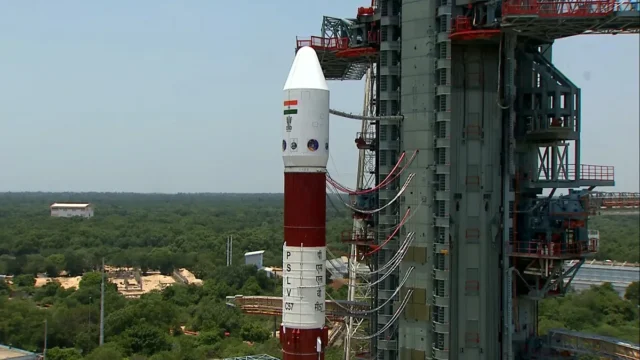
Aditya-L1’s VELC produces Doppler velocity images of the solar corona
Scientists at the Indian Institute of Astrophysics (IIA), Bengaluru, have produced Doppler velocity images of the solar corona using the Visible Emission Line Coronagraph (VELC) on Aditya-L1. The images show whether coronal plasma is moving towards or away from us, and can help track whether a coronal mass ejection (CME) is heading for Earth. The method has been published in the Astrophysical Journal.
UPSC angle: Prelims: Aditya-L1, L1 point, VELC, CMEs, Doppler effect. · Mains GS-III: space science and protecting space assets.
20 Oct 2026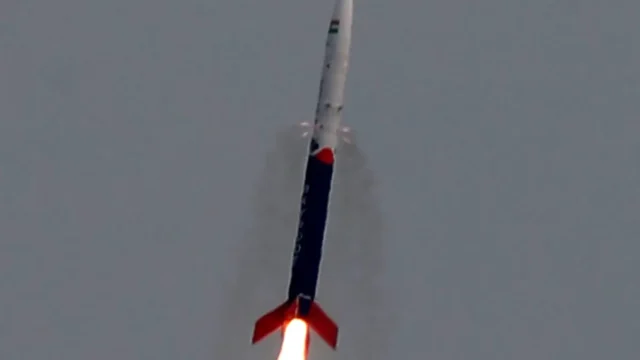
India’s space economy to grow from about $9 billion to $40-45 billion in 7-8 years
On 17 October 2026, Union Minister Dr Jitendra Singh said India’s space economy, worth about USD 9 billion today, should reach USD 40-45 billion in the next seven to eight years. He said the task now is to move from showing what India can do in space to building space companies that can compete and earn worldwide. For that, private firms need steady demand, quick approvals and patient capital. This is the story of space turning from a science mission into an industry.
UPSC angle: Prelims: IN-SPACe, NSIL, Space Policy 2023, FDI caps, Vikram-S. · Mains GS-III: private sector in space, strategic autonomy.
18 Oct 2026
Government says satellite communication licensing is fair; three NGSO-based GMPCS licensees at same stage
On 8 October 2026 the Department of Telecommunications rejected a social media claim that satellite internet licensing is discriminatory. Three licences for Global Mobile Personal Communication by Satellite services using non-geostationary satellites have been issued; all three are going through security assessment, after which each can seek spectrum.
UPSC angle: Prelims: satcom terms. · Mains GS-III: communication infrastructure, security.
8 Oct 2026
ARIES-led decade-long study of blazar OJ 287, a binary supermassive black hole
A study coordinated by ARIES, Nainital, with 106 scientists from 18 countries, tracked the blazar OJ 287 from 2015 to 2025. OJ 287, about 4 billion light years away, has two supermassive black holes in a 12-year orbit. The study estimated the central black hole at no less than 3.89 billion solar masses.
UPSC angle: Prelims: space science terms. · Mains: limited.
6 Oct 2026Learn the concept
Question text as printed in the official UPSC question paper: https://www.upsc.gov.in/sites/default/files/QP-CSM-26-010926-GENERAL-STUDIES-PAPER-III.pdf The model answer is original Battle IAS work; use it to learn structure, not to memorise.