
Civil Disobedience Movement (1930-34): Purna Swaraj, Dandi March, Gandhi-Irwin Pact and Round Table Conferences (UPSC Notes + PYQs)
UPSC has already asked about this. Read the story with these questions in mind.
Background: 1922 to 1929
After the Non-Cooperation Movement ended, nationalist politics went through a quiet but important phase. The Swarajists fought elections and obstructed the councils, while No-changers built khadi, Hindu-Muslim unity and work among the depressed classes. In November 1927 the British appointed the Simon Commission to review the 1919 reforms, without a single Indian member. It was boycotted across India with the slogan ‘Simon Go Back’, and Lala Lajpat Rai died after a police lathi charge at Lahore in 1928. The Nehru Report (1928) proposed dominion status, which younger leaders such as Jawaharlal Nehru and Subhas Bose thought too little. At Calcutta in 1928 the Congress gave the government a year to accept dominion status. Lord Irwin’s offer of a Round Table Conference (October 1929) did not promise it, and the Lahore session of December 1929 declared Purna Swaraj as the goal.
Background
The all-white Simon Commission (1927), the Nehru Report (1928), the Lahore session under Jawaharlal Nehru declaring Purna Swaraj, and 26 January 1930 observed as Independence Day. Gandhi’s Eleven Demands to Irwin were ignored.
- Dec 1929Lahore: Purna Swaraj
- 26 Jan 1930Independence Day observed
- 12 Mar 1930Dandi March begins
- 6 Apr 1930Salt law broken at Dandi
- Nov 1930First Round Table Conference
- Mar 1931Gandhi-Irwin Pact
- 1932Movement resumed; Poona Pact
- 1934Movement withdrawn
Why salt
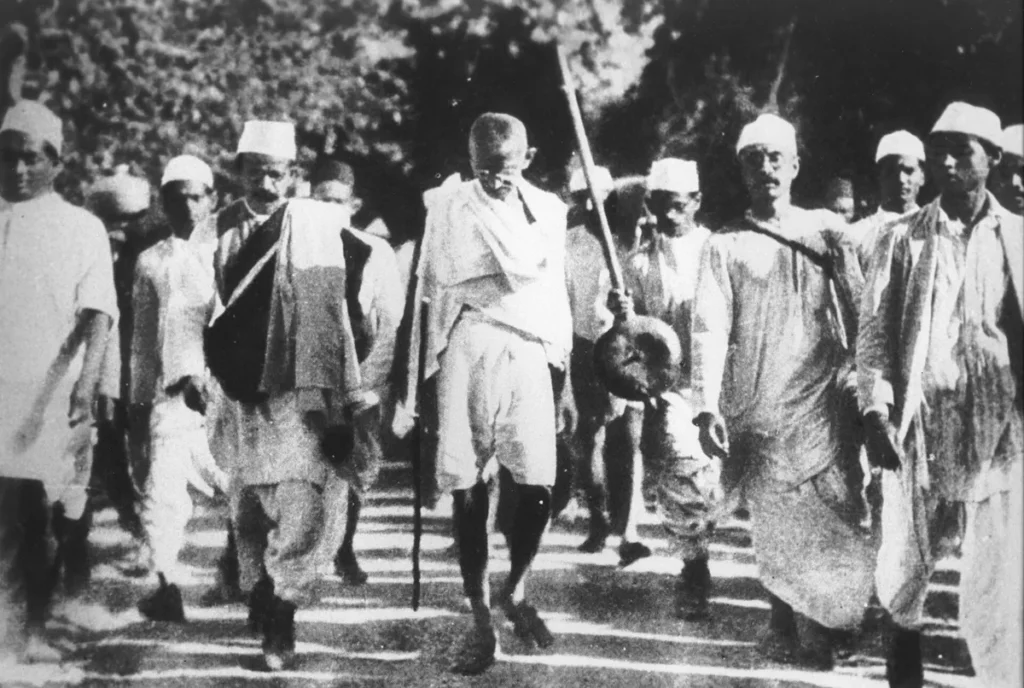
Salt was used by every household, taxed by the government and produced cheaply on the coast. Breaking the salt law was simple, non-violent and understood everywhere. Gandhi marched 240 miles from Sabarmati to Dandi with 78 followers.
Spread
- Tamil Nadu: C. Rajagopalachari’s march from Trichy to Vedaranyam.
- Malabar: K. Kelappan; Payyanur.
- North-West Frontier: Khan Abdul Ghaffar Khan’s Khudai Khidmatgars; Peshawar firing (Garhwali soldiers refused to fire).
- Dharasana salt works raid led by Sarojini Naidu.
- Manipur and Nagaland: Rani Gaidinliu.
- No-tax campaigns in UP and Gujarat; forest laws defied in Maharashtra, Karnataka, Central Provinces.
- Large-scale participation of women, picketing liquor and foreign cloth shops.
- PrisonersRelease of those not guilty of violence
- SaltCoastal villagers may make salt for own use
- PropertyReturn of confiscated land not yet sold
- CongressSuspend CDM and attend Second RTC
Gandhi-Irwin Pact and Round Tables
| Event | Date | Outcome |
|---|---|---|
| First Round Table | Nov 1930-Jan 1931 | Congress absent |
| Gandhi-Irwin Pact | 5 March 1931 | Release of non-violent prisoners, coastal salt making allowed; Congress to attend RTC |
| Karachi session | March 1931 | Resolutions on Fundamental Rights and economic policy |
| Second Round Table | Sept-Dec 1931 | Gandhi attended; failed on the minorities question |
| Communal Award | August 1932 | Separate electorates for depressed classes; Gandhi’s fast; Poona Pact (Sept 1932) |
| Third Round Table | Nov-Dec 1932 | Congress absent |
Gandhi’s eleven demands
Before launching the movement Gandhi sent Irwin eleven demands on 31 January 1930, a clever mix that spoke to different classes. General demands included a 50% cut in army spending and civil service salaries, total prohibition, release of political prisoners, reform of the CID and licences for firearms for self-defence. For the bourgeoisie he asked for a lower rupee-sterling exchange rate, protective tariffs on foreign cloth and reservation of coastal shipping for Indian firms. For peasants he sought a 50% cut in land revenue and abolition of the salt tax. When Irwin did not respond, the Congress Working Committee gave Gandhi full authority to start civil disobedience.
| Region | Leader | Form |
|---|---|---|
| Tamil Nadu | C. Rajagopalachari | Salt march from Trichinopoly to Vedaranyam |
| Malabar | K. Kelappan | Salt march to Payyanur |
| North-West Frontier | Khan Abdul Ghaffar Khan | Khudai Khidmatgars (Red Shirts) |
| Dharasana, Gujarat | Sarojini Naidu | Raid on salt works |
| Manipur, Nagaland | Rani Gaidinliu | Revolt against British rule |
| Central Provinces, Maharashtra | Local Congress | Forest satyagraha |
Assessment
It brought in women, merchants and peasants on a larger scale than before, while Muslim participation was lower than in 1920-22. Business groups supported it, then wanted a settlement. It led to the Government of India Act, 1935.
Non-Cooperation and Civil Disobedience compared
| Point | Non-Cooperation (1920-22) | Civil Disobedience (1930-34) |
|---|---|---|
| Goal | Swaraj within a year, redress of Punjab and Khilafat wrongs | Purna Swaraj |
| Method | Refusing to cooperate with the government | Deliberately breaking laws, starting with salt |
| Muslim participation | High, through Khilafat | Much lower, except in the NWFP |
| Workers | Wide participation | Less involvement after the Meerut case |
| Women | Limited | Large-scale, in marches, picketing and arrests |
| Business | Cautious | Active early support from Indian industrialists |
| End | Withdrawn after Chauri Chaura | Suspended by the Gandhi-Irwin Pact; formally withdrawn in 1934 |
Role of women
Civil Disobedience brought women into the national movement on a scale never seen before. Gandhi asked them to lead picketing of liquor and foreign cloth shops, which he thought suited non-violent persuasion. Sarojini Naidu led the Dharasana raid after Gandhi’s arrest; Kamaladevi Chattopadhyay made salt in Bombay; Usha Mehta, then a schoolgirl, and many others joined processions. In cities like Bombay, Delhi and Calcutta thousands of women were arrested. In the North-East, the young Rani Gaidinliu led an armed struggle and was jailed for life. This participation changed both the movement and women’s own public role, and many of these women later shaped the Constituent Assembly debates and social reform after independence.
Communal Award and the Poona Pact
After the Second Round Table Conference failed, the British Prime Minister Ramsay MacDonald announced the Communal Award in August 1932. It extended separate electorates to the depressed classes. Gandhi, then in Yerawada jail, saw this as an attempt to divide Hindu society and began a fast unto death in September 1932. The Poona Pact, signed by B.R. Ambedkar and Madan Mohan Malaviya among others, replaced separate electorates for the depressed classes with joint electorates and reserved seats, raising those seats from 71 to 148 in provincial legislatures. Gandhi then turned to the Harijan campaign against untouchability. The episode shows how the movement’s struggle with the British was linked with questions of caste and representation inside Indian society.
Assessment for Mains
The movement failed to win Purna Swaraj, and it was formally withdrawn in 1934. Yet it achieved much. It turned the abstract idea of independence into a mass demand, using salt, a commodity every household needed, as the symbol. It brought new groups into politics: women, merchants, tribal people and peasants in many regions. The Gandhi-Irwin Pact forced the British to deal with the Congress as an equal, and the Government of India Act, 1935 was in part a response to the pressure. Its weaknesses were the limited Muslim participation and the withdrawal of business support as repression grew. For the 2026 GS-I question on the masses mobilised by Gandhian movements, use Civil Disobedience as the clearest example of mass participation across classes and regions.
Civil Disobedience Movement: UPSC angle
For UPSC CSE
Prelims: dates, regional leaders, terms of the Pact, Round Table outcomes. Mains GS-I: comparison with Non-Cooperation; role of women.
Civil Disobedience Movement UPSC PYQs (Prelims)
Questions UPSC has actually asked, from the official papers. Pick an option to check yourself.
The 1929 Session of Indian National Congress is of significance in the history of the Freedom Movement because the
At the Lahore session (December 1929), with Jawaharlal Nehru as president, the Congress adopted Purna Swaraj as its goal. It hoisted the tricolour on the Ravi bank on 31 December and fixed 26 January 1930 as Independence Day. It also authorised civil disobedience. Answer as per the official UPSC key · Battle IAS PYQ bankAnswer (b) & why
With reference to the British colonial rule in India, consider the following statements :
– 1. Mahatma Gandhi was instrumental in the abolition of the system of ‘indentured labour’.
– 2. In Lord Chelmsford’s ‘War Conference’, Mahatma Gandhi did not support the resolution on recruiting Indians for World War.
– 3. Consequent upon the breaking of Salt Law by Indian people, the Indian National Congress was declared illegal by the colonial rulers.
Which of the statements given above are correct?
Gandhi’s campaign helped end indentured emigration in 1917. At Chelmsford’s War Conference (Delhi, April 1918) he supported the recruitment resolution and then toured Kheda to raise soldiers. During the salt satyagraha (1930) the Congress Working Committee was declared illegal. Answer as per the official UPSC key · Battle IAS PYQ bankAnswer (b) & why
Mains PYQs on this topic
Questions from the official UPSC Mains papers (2023-2026 in the Battle IAS Mains bank), newest first. Each links to a model answer.
- UPSC Mains 2026 · GS Paper I · Q3 · 10 marks
The significance of the Gandhian movements lay in the masses they mobilized. Elucidate.
- UPSC Mains 2026 · GS Paper IV · Q3a · 10 marks
Dr. B. R. Ambedkar had cautioned that employing civil disobedience within a constitutional democracy equates to endorsing ‘anarchy’. How should modern democracies navigate the ethical dilemmas posed by civil disobedience movements that aim to promote social justice against policies that may raise genuine concerns?
Quick quiz
Purna Swaraj was adopted at the Congress session of
Under Jawaharlal Nehru.Answer (b)
Who led the salt march to Vedaranyam?
From Trichy.Answer (b)
The Poona Pact was signed between Gandhi and
September 1932.Answer (b)
FAQs
When did the Dandi March take place?
12 March to 6 April 1930.
What was the Gandhi-Irwin Pact?
A March 1931 agreement that paused the movement in return for release of prisoners and limited salt-making rights.
Which Round Table Conference did Gandhi attend?
The second, in 1931.
How was Civil Disobedience different from Non-Cooperation?
It involved breaking laws, not just withdrawing cooperation.
Why did Gandhi choose salt?
Salt was used by every household, rich or poor, and the tax fell hardest on the poor. Breaking the salt law was simple, legal in moral terms and easy to copy everywhere.
What did the Karachi session of 1931 do?
Presided over by Vallabhbhai Patel, it endorsed the Gandhi-Irwin Pact and passed resolutions on Fundamental Rights and National Economic Programme.
Why was Muslim participation low?
After the breakdown of Hindu-Muslim unity in the 1920s and disputes over the Nehru Report, many Muslim leaders stayed away, though the Khudai Khidmatgars in the NWFP were a major exception.
Spotted an error? Tell us. We correct within 48 hours.
Image: https://commons.wikimedia.org/wiki/File:Marche_sel.jpg
How to use this in Mains
If asked: UPSC Mains 2026, GS-I: The significance of the Gandhian movements lay in the masses they mobilized. Elucidate.
Quote: “It brought in women, merchants and peasants on a larger scale than before, while Muslim participation was lower than in 1920-22.”
Use it: Use as evidence of mass mobilisation.
In the news
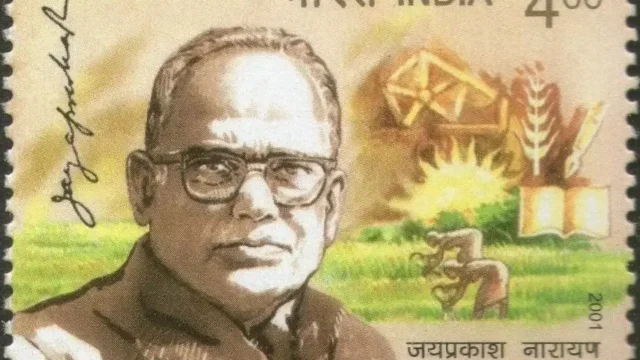
Birth anniversaries: Jayaprakash Narayan and Nanaji Deshmukh
11 October is the birth anniversary of Loknayak Jayaprakash Narayan and Nanaji Deshmukh, both Bharat Ratna awardees. The Prime Minister recalled JP's voice during the Emergency and his concern for good governance, and Nanaji's work in rural development and community participation. Treat this as a personality note for Prelims.
11 Oct 2026
ASI and Denmark museum to search for 1619 Danish shipwreck Oresund off Karaikal
The Archaeological Survey of India's Underwater Archaeology Wing and the National Museum of Denmark (Njord Centre, Copenhagen) signed an MoU to locate and document the Danish ship Oresund, wrecked off Karaikal, Puducherry, in 1619 CE. It is described as the first Danish ship known to have reached India.
15 Jun 2026
Veer Bal Diwas and the Rashtriya Bal Puraskar
The PM announced the day on 9 January 2022 and the first Veer Bal Diwas was held on 26 December 2022 [PMO].
26 Dec 2025
Stamp on Emperor Perumbidugu Mutharaiyar II
Questions on lesser-known regional dynasties are common in Prelims. Stamps and anniversaries often bring them into the news.
14 Dec 2025