
Glaciers ending in lakes lose ice fastest: Study
Most glaciers end on land, but some end in lakes, oceans or ice shelves. A new study finds that these water-ending glaciers are just over 3% of all glaciers, yet they caused more than half of all glacier ice loss between 2000 and 2019. As the climate warms, glacier lakes are growing, so this matters for India’s Himalaya. Read it to revise calving and glacial lake outburst floods (GLOFs).
- Share of glaciers
- Just over 3% end in water
- Share of ice loss
- More than half (2000–2019)
- Yearly loss
- 134 billion tonnes of ice
- Faster flow
- 10% (lake) and 44% (ocean) faster than land-ending
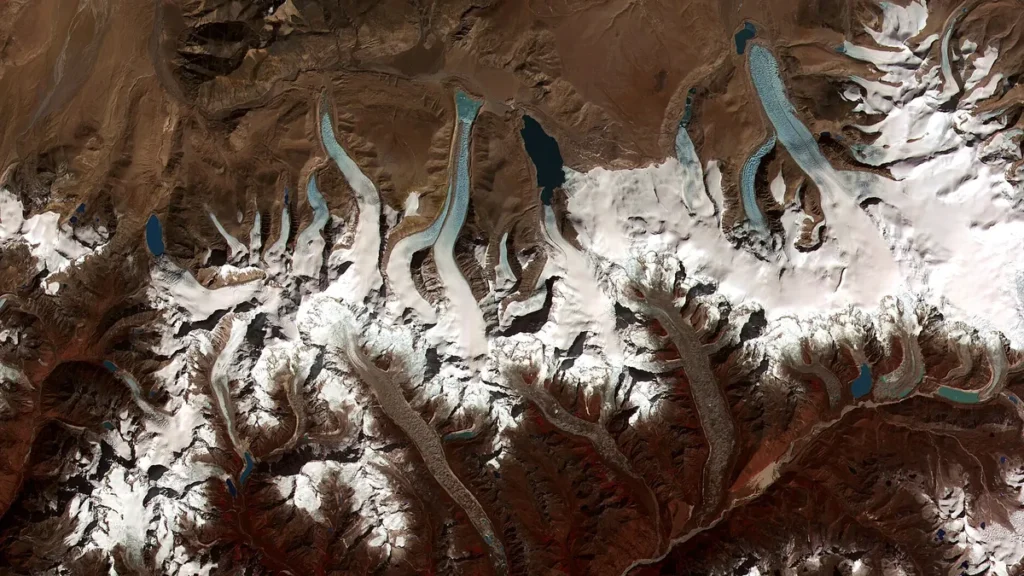
Lake-ending glaciers: what did the study find?
An ice cube melts faster in a glass of water than on a plate. Glaciers behave the same way: those that end in water lose ice much faster than those that end on land.
- A new study looked at glaciers that end in lakes, oceans or ice shelves instead of on land.
- These glaciers are just over 3% of all glaciers.
- Yet they caused more than half of all glacier ice loss from 2000 to 2019, losing 134 billion tonnes of ice a year.
- Lake-ending glaciers flow 10% faster and ocean-ending glaciers 44% faster than land-ending ones.
- The reasons: big chunks break off as icebergs (calving), and lake or sea water melts ice below the waterline.
- As the climate warms, glacier lakes are becoming more common, so this effect may grow.
What are calving and glacial lake outburst floods?
A glacier is a large mass of ice that moves slowly downhill under its own weight. Where it ends is called its snout or terminus.
Calving is when large blocks of ice break off the front of a glacier into water. Water also melts the ice from below, so these glaciers shrink fast.
As glaciers melt and retreat, water collects behind loose rock and soil left by the glacier, called a moraine. This forms a glacial lake.
If the moraine wall breaks, for example after heavy rain, an avalanche or an earthquake, the lake empties suddenly. This is a glacial lake outburst flood (GLOF). In October 2023, a GLOF from South Lhonak Lake in Sikkim damaged the Teesta III dam at Chungthang.
Where a glacier ends changes how fast it shrinks
| Glacier ends in | Flow speed vs land-ending | Main way it loses ice |
|---|---|---|
| Land | Baseline | Surface melting |
| Lake | About 10% faster | Calving and melting below the waterline |
| Ocean | About 44% faster | Calving and warm sea water |
Which rules and plans apply?
- Disaster Management Act, 2005: sets up the NDMA and the system to prepare for disasters like GLOFs.
- NDMA guidelines on managing GLOFs (2020): mapping lakes, early warning and lowering risky lakes.
- National Mission for Sustaining the Himalayan Ecosystem: one of the missions under the National Action Plan on Climate Change.
- Sendai Framework for Disaster Risk Reduction (2015–2030): global plan India follows.
Why does lake-ending glaciers matter?
| Angle | What to note |
|---|---|
| Disaster risk | More glacier lakes mean more GLOF danger for Himalayan towns and dams. |
| Water security | Himalayan glaciers feed the Ganga, Indus and Brahmaputra. |
| Better forecasts | Models that ignore water-ending glaciers may underestimate ice loss. |
| Sea level | Faster ice loss adds to sea level rise. |
What are the problems with lake-ending glaciers?
- Many Himalayan glacier lakes are remote and poorly monitored.
- Dams and roads are being built in high-risk valleys.
- Early warning systems are few and often fail.
- Climate models may not fully count glaciers that end in water.
What should be done next on lake-ending glaciers?
- Map and watch all risky glacier lakes with satellites and sensors.
- Install early warning systems and train local communities.
- Lower water levels in dangerous lakes where possible.
- Check GLOF risk before approving dams in high valleys.
What can Prelims ask on lake-ending glaciers?
Prelims probability: Expect a statement question on glacier terms: calving is ice breaking off as icebergs, and a glacial lake outburst flood happens when a glacier lake’s wall breaks.
- Calving = ice breaking off a glacier’s front into water as icebergs.
- GLOF = sudden flood when a glacial lake’s moraine wall breaks.
- South Lhonak Lake (Sikkim) GLOF, October 2023: Teesta III dam damaged.
- Glacier–river pairs: Gangotri–Bhagirathi, Zemu–Teesta, Bara Shigri–Chenab, Milam–Gori Ganga, Bandarpunch–Yamuna.
- Water-ending glaciers: just over 3% of glaciers, over half of ice loss (2000–2019).
How to write about lake-ending glaciers in Mains
Practice question (15 marks, 250 words): Glacial lake outburst floods are an emerging threat in the Indian Himalaya. Discuss the causes and suggest measures to reduce the risk.
- Intro: study on lake-ending glaciers losing ice fastest.
- Causes: warming, retreat, moraine-dammed lakes, triggers like rain and quakes.
- Example: South Lhonak 2023, Kedarnath 2013.
- Measures: mapping, early warning, lake lowering, safer dam planning, NDMA guidelines.
- Conclusion: adapt now as glacier lakes grow.
Ready lines for your answer
- Glaciers ending in water are just over 3% of glaciers but caused more than half of ice loss.
- As glacier lakes grow, early warning saves more lives than rescue.
Quotable data pointWater-ending glaciers lost 134 billion tonnes of ice a year between 2000 and 2019.
Exam angle
Prelims: calving, GLOF, glacier–river pairs. · Mains GS-I: geography of glaciers; GS-III: climate change and disaster management.
Practice MCQs
Original practice questions (not PYQs).
Which of the following is the most logical and rational inference that can be made from the passage?
Answer (a) & explanation
The passage says water-ending glaciers lose ice fastest, are becoming more common, and are not fully counted in models. So forecasts may underestimate loss. Options (b), (c) and (d) are not supported or contradict the passage.
Which one of the following pairs of glacier and river is correctly matched?
Answer (d) & explanation
Bandarpunch feeds the Yamuna. Milam feeds the Gori Ganga, Zemu feeds the Teesta, and Bara Shigri feeds the Chenab.
Questions students ask about this
What did the new glacier study find?
Glaciers ending in lakes, oceans or ice shelves are just over 3% of all glaciers but caused more than half of glacier ice loss from 2000 to 2019.
What is calving?
It is when large blocks of ice break off the front of a glacier into water as icebergs.
What is a GLOF?
A glacial lake outburst flood happens when the natural wall holding a glacier lake breaks and the lake empties suddenly.
Why does this matter for India?
Glacier lakes in the Himalaya are growing, which raises flood risk for towns, roads and dams downstream.