
UPSC Mains 2014 GS Paper 3 Q20: model answer
China and Pakistan have entered into an agreement for development of an economic corridor. What threat does this pose for India’s security? Critically examine.
What the question wants
Critically examine the security threat that the China–Pakistan Economic Corridor poses to India.
How to structure it
What CPEC is, threats, balance.
- CPEC basics
- Threats: sovereignty, military, strategic, economic
- Counter-view
- India's response
How to think it through
CPEC 2013-15, ~$62 bn, Kashgar to Gwadar, passes through PoK (Gilgit-Baltistan). Threats: sovereignty violation, China's presence in PoK, two-front collusion, Gwadar naval base potential (string of pearls), Chinese troops for security, dual-use infrastructure, legitimising Pakistan's claim, Pakistan's debt making it dependent. Critical: CPEC slowed, attacks on Chinese workers (Baloch), Gwadar underused, debt crisis. India: protest, boycott BRI forums, Chabahar, IMEC, INSTC, border infrastructure.
Model answer
The China–Pakistan Economic Corridor, launched in 2013–15 and valued at about $62 billion, runs from Kashgar in Xinjiang to Gwadar on the Arabian Sea. Its route passes through Gilgit-Baltistan, part of Indian territory under Pakistan's illegal occupation. That single fact shapes India's view of it.
Threats to India
- Sovereignty: building in PoK without India's consent challenges India's legal claim.
- Chinese presence in PoK: engineers, security staff and perhaps troops near the LoC.
- Two-front pressure: closer China–Pakistan military cooperation on India's west and north.
- Gwadar: a possible Chinese naval foothold near the Strait of Hormuz, part of the 'string of pearls'.
- Dual-use roads and airfields that can move troops quickly.
- Strategic legitimacy for Pakistan's position on Kashmir.
- Economic pull on India's neighbours through BRI projects.
A critical view
- CPEC has slowed; many projects are delayed.
- Baloch attacks on Chinese workers and Pakistan's debt crisis limit its value.
- Gwadar port is still underused.
- So the threat is real but slower than first feared.
India's response
- Clear opposition and refusal to join BRI meetings.
- Alternatives: Chabahar port, INSTC and the India–Middle East–Europe Corridor (2023).
- Faster border roads and airfields in Ladakh.
- Stronger naval presence in the western Indian Ocean.
CPEC is less a road for trade than a line drawn through India's claim; India's answer must be both legal and practical.
Draw: A map of CPEC from Kashgar to Gwadar through Gilgit-Baltistan, with Chabahar marked.
Keywords, cases and data to drop in
CPEC, ~$62 bn, Kashgar to Gwadar, Gilgit-Baltistan, PoK, sovereignty, two-front, string of pearls, Strait of Hormuz, dual-use, Baloch attacks, Chabahar, INSTC, IMEC 2023.
Where most answers lose marks
- Not being 'critical'; show that CPEC's weaknesses also shape how big the threat is.
Related Mains PYQs
- Discuss how national security can be balanced with concerns of human rights. UPSC 2026 · GS-IV
- Rajapuram is a border district. Jhara and Biru, its two major communities are in continual conflict with each other. The social fabric… UPSC 2026 · GS-IV
- Keeping the national security in mind, examine the ethical dilemmas related to controversies over environmental clearance of development projects in ecologically sensitive… UPSC 2025 · GS-IV
- Raman is a senior IPS officer and has recently been posted as D.G. of a state. Among the various issues and problems/challenges… UPSC 2024 · GS-IV
Fresh examples from current affairs
Vehicle data sold for ₹5: Centre orders CERT-In audit of VAHAN, SARATHI and e-Challan portals
The Ministry of Road Transport and Highways has asked CERT-In, India’s cyber-security agency, for a forensic audit of its VAHAN, SARATHI, e-Challan and pollution-certificate portals. A security firm found that owners’ names, addresses and phone numbers were being sold through apps and a Telegram channel for as little as ₹5. On the same day, The Hindu reported a separate leak of film certification records. For you, this connects cyber security, the right to privacy and the Digital Personal Data Protection Act, 2023.
UPSC angle: Prelims: CERT-In, Section 70B IT Act, VAHAN/SARATHI, Puttaswamy, DPDP Act 2023, GDPR. · Mains GS-III: cyber security and data protection.
25 Oct 2026
Nasha Mukt Bharat Abhiyaan reaches 35 crore people: demand reduction and the 2029 drug-free goal
The Ministry of Social Justice and Empowerment said on 22 October 2026 that the Nasha Mukt Bharat Abhiyaan has reached over 35 crore people, including 13.94 crore youth and 10.86 crore women, and more than 32 lakh educational institutions. Launched on 15 August 2020 in 272 vulnerable districts, it now runs across the country. It is the demand side of a twin strategy, while police and the NCB attack supply, with the Home Minister’s target of uprooting the drug trade by 31 December 2029.
UPSC angle: Prelims: NMBA, NAPDDR, Article 47, NDPS Act, helpline 14446. · Mains GS-II/III: drug abuse, demand and supply reduction.
23 Oct 2026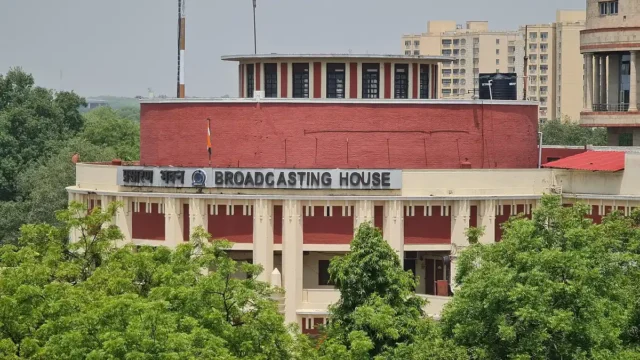
Prasar Bharati at 29: why India’s public broadcaster still lacks the autonomy its law promised
A lead article in The Hindu on 23 October 2026 argues that Prasar Bharati, set up to be a free public broadcaster, still works like a government department. The Prasar Bharati Act of 1990 came into force only in 1997, and its key safeguards, a parliamentary committee (Section 13) and a Broadcasting Council for complaints (Sections 14–15), were never set up, while Section 23 still lets the Centre give binding directions. For you, this is a neat case study of a law that promises autonomy but never builds the institutions that make it real.
UPSC angle: Prelims: Prasar Bharati Act 1990, Sections 13–15 and 23, Cricket Association of Bengal (1995). · Mains GS-II: autonomy of statutory bodies; media and democracy.
23 Oct 2026
Face-off with China continues in Arunachal: ITBP chief confirms stand-off at Asaphila
ITBP Director General Shatrujeet Kapur said on 22 October 2026 that face-offs with Chinese troops are continuing at several places along the Arunachal Pradesh border. It is the first official confirmation of the scale of tension since July, when Chinese troops pitched tents 6–7 km inside India’s perception of the Line of Actual Control near Asaphila in Upper Subansiri. Three rounds of high-level talks have not ended it, so the ITBP is betting on drones and underground shelters.
UPSC angle: Prelims: McMahon Line, WMCC, SR talks, ITBP, Upper Subansiri. · Mains GS-III: border management; GS-II: India–China.
23 Oct 2026Learn the concept
Question text as printed in the official UPSC Civil Services (Main) question paper. The model answer is original Battle IAS work; use it to learn structure, not to memorise.
Want every PYQ in one place? See the Battle IAS PYQ Book.