
UPSC Mains 2017 GS Paper 2 Q19: model answer
The question of India’s Energy Security constitutes the most important part of India’s economic progress. Analyze India’s energy policy cooperation with West Asian countries.
What the question wants
Analyse India's energy cooperation with West Asian countries as part of its energy security.
How to structure it
Analyse cooperation: why West Asia, what India has done, risks, way forward.
- Why energy security matters
- Dependence on West Asia
- Forms of cooperation
- Risks
- Way forward
How to think it through
India imports about 85–88% of its crude. For decades West Asia supplied most of it; since 2022 Russia has become a top supplier, but Iraq, Saudi Arabia and the UAE remain central, and LNG from Qatar dominates. Cooperation has moved from buyer–seller to investment partner. The 2026 war showed the risk of Hormuz.
Model answer
India imports about 85–88% of the crude oil it uses and about half its gas. For most of the past five decades, the bulk came from West Asia. When shipping through the Strait of Hormuz was disrupted during the 2026 war involving Iran, Indian refiners and the rupee felt it within days.
Dependence on West Asia
- Crude: Iraq, Saudi Arabia and the UAE are among India's top suppliers; Russian crude rose sharply after 2022 but did not replace the Gulf.
- LNG: Qatar is the largest supplier, with long-term contracts renewed in 2024 till 2048.
- LPG: largely from the Gulf.
Forms of cooperation
- From buyer to partner: the 'Look West' approach and strategic partnerships with Saudi Arabia (Strategic Partnership Council, 2019) and the UAE (CEPA, 2022).
- Strategic reserves: ADNOC stores crude in India's reserve at Mangaluru; underground caverns at Visakhapatnam and Padur.
- Upstream stakes: Indian companies hold a stake in Abu Dhabi's Lower Zakum field.
- Downstream investment: Saudi Aramco and ADNOC plans in Indian refining.
- Green energy: green hydrogen and solar partnerships; the UAE and India in the International Solar Alliance.
- Connectivity: the India–Middle East–Europe Economic Corridor (IMEC, 2023).
- Diaspora: about 90 lakh Indians in the Gulf.
Risks
- Regional wars: the Gaza war (since 2023) and the 2026 conflict around Iran disrupted the Red Sea and Hormuz routes.
- Sanctions on Iran ended Iranian supplies and stalled Chabahar.
- Price shocks and OPEC+ output decisions.
Way forward
- Diversify suppliers (Russia, the US, Guyana, Africa) and routes.
- Expand strategic reserves towards 90 days.
- Long-term contracts and upstream equity.
- Accelerate renewables, biofuels and green hydrogen.
Conclusion
India's energy policy in West Asia has matured from buying oil to building interdependence. The next stage is to make that interdependence safe from the region's wars.
Draw: A map of the Gulf with supply arrows to Indian ports, Hormuz marked as a chokepoint, and reserve sites in India.
Keywords, cases and data to drop in
import dependence 85–88%, ISPRL (Mangaluru, Padur, Visakhapatnam), ADNOC storage, Lower Zakum, Qatar LNG to 2048, India–UAE CEPA 2022, IMEC 2023, Hormuz, Red Sea, Look West.
Where most answers lose marks
- Listing suppliers without analysing cooperation.
Related Mains PYQs
- “India's global diaspora acts as a living bridge, as a critical economic factor and knowledge network in transforming cultural heritage into geopolitical… UPSC 2026 · GS-II
- “China's Belt and Road Initiative (BRI) has transformed South Asia from a regional space into a theatre of great power competition.” Analyse… UPSC 2026 · GS-II
- “IPMDA (Indo-Pacific Partnership for Maritime Domain Awareness) bridges the gap between India's SAGAR (Security and Growth for All in the Region) vision… UPSC 2026 · GS-II
- “BRICS acts as a powerful counterweight in global governance, actively amplifying the voice and influence of the Global South.” Explain the role… UPSC 2026 · GS-II
Fresh examples from current affairs
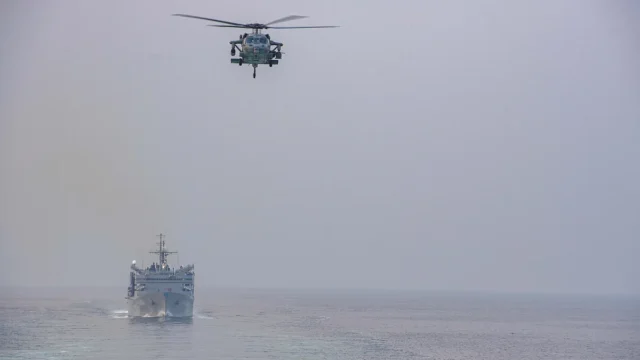
Iran warns of an ‘apocalyptic war’ if attacked again: what it means for India, the Strait of Hormuz and BRICS
Iran has warned that any fresh attack by the United States and Israel will turn into an “apocalyptic war” whose effects will reach the Gulf monarchies around it. Its Revolutionary Guards say American warships will not be allowed into the Persian Gulf, as Washington weighs new air strikes. The row has reached New Delhi too: Iran’s Parliament Speaker will skip the BRICS Parliamentary Forum here next week, amid a dispute over a medicine flight. For you, this links three exam favourites: the Strait of Hormuz, the Gulf Cooperation Council and India’s energy security.
UPSC angle: Prelims: Strait of Hormuz, GCC members, BRICS expansion, Chabahar, INSTC. · Mains GS-II: India’s West Asia policy and energy security.
25 Oct 2026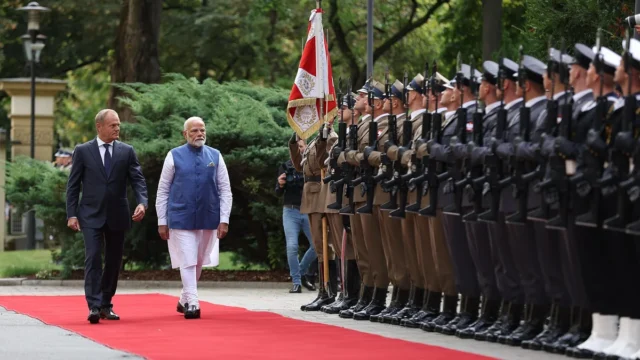
India–Poland joint statement: trade to double by 2030, Poland joins CDRI, defence industry dialogue
Polish Prime Minister Donald Tusk met Prime Minister Narendra Modi in New Delhi on 22 October 2026, two years after the ties became a Strategic Partnership. They set a target to double trade (about $6 billion) by 2030, started a Defence Industry Dialogue and a counter-terrorism dialogue, and Poland joined the Coalition for Disaster Resilient Infrastructure (CDRI). A pact on protecting classified information is expected soon.
UPSC angle: Prelims: V4, CDRI, IPOI, Operation Ganga, Good Maharaja. · Mains GS-II: India–Central Europe; India–EU partnership.
22 Oct 2026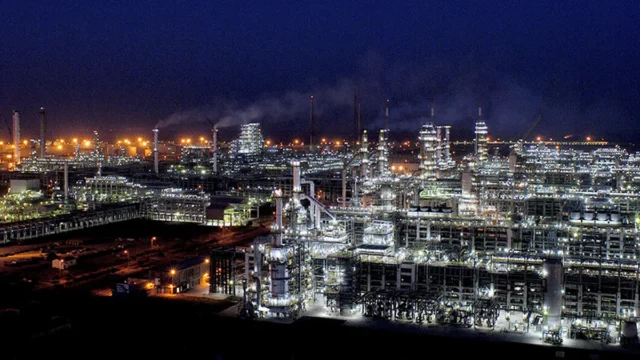
Rubio at Jamnagar: US pitches oil and Venezuelan crude to India’s ‘refining superpower’
US Secretary of State Marco Rubio visited Reliance’s Jamnagar refinery complex in Gujarat on 21 October 2026, a day after calling India a ‘refining superpower’. He wants India to buy more US oil and refine more Venezuelan crude. In Mumbai on 20 October, External Affairs Minister S. Jaishankar also held an unannounced India–US–UAE meeting on energy and connectivity, with the Strait of Hormuz blocked.
UPSC angle: Prelims: Jamnagar, Hormuz, I2U2, IMEC, SPR sites. · Mains GS-II/III: energy security vs strategic autonomy; India–US–UAE.
21 Oct 2026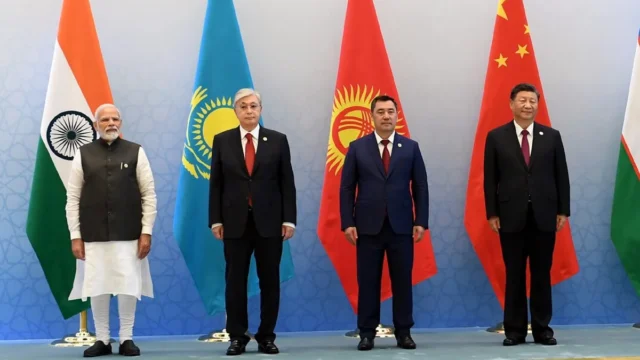
SCO Heads of Government meet in Dushanbe: Rajnath calls for dismantling the terror ecosystem
Defence Minister Rajnath Singh represented India at the 25th meeting of the SCO Council of Heads of Government in Dushanbe, Tajikistan, on 20 October 2026. With Pakistan’s Deputy Prime Minister in the room, he said there can be no justification and no double standards on terrorism. The meeting adopted the SCO budget for 2027 and a 2026–30 action plan for trade and economic cooperation.
UPSC angle: Prelims: SCO bodies and locations, new centres, INSTC. · Mains GS-II: SCO’s value for India; GS-III: terror financing.
21 Oct 2026Learn the concept
Question text as printed in the official UPSC Civil Services (Main) question paper. The model answer is original Battle IAS work; use it to learn structure, not to memorise.
Want every PYQ in one place? See the Battle IAS PYQ Book.