
UPSC Mains 2022 GS Paper 1 Q3: model answer
Why was there a sudden spurt in famines in colonial India since the mid-eighteenth century? Give reasons.
What the question wants
Give reasons for the rise in famines in colonial India from the mid-18th century.
How to structure it
Give reasons: economic and policy causes, not just drought.
- Major famines
- Revenue and agrarian policies
- Commercialisation and market failure
- Policy response and conclusion
How to think it through
Droughts are natural; famines are man-made. That one line (inspired by Amartya Sen's entitlement approach) is your thesis. Then prove it: high revenue, cash crops, grain exports during scarcity, ruined crafts and a 'laissez-faire' state. The Bengal famine of 1770 and 1943 are your bookends.
Model answer
Colonial India saw a series of major famines: Bengal (1770), the great famine of 1876–78, 1896–97 and 1899–1900, and Bengal (1943), which killed millions.
Revenue and agrarian policies
- High and rigid land revenue demands (Permanent Settlement, Ryotwari) collected even in bad years; peasants lost reserves and land.
- Neglect of irrigation in many regions before the late 19th century.
Commercialisation and markets
- Shift to cash crops (indigo, cotton, jute) reduced food grain cultivation in some areas.
- Railways moved grain to ports, so food was exported even during scarcity.
Collapse of other livelihoods
- De-industrialisation made rural people dependent on agriculture alone.
State response
- A laissez-faire attitude; relief was often inadequate; Famine Commissions (1880, 1898, 1901) and Famine Codes came later.
- In 1943, war-time priorities, price rise and poor response worsened the Bengal famine.
Famines were caused less by rain failure than by policy: revenue pressure, market changes and a weak relief system made droughts deadly. This is why independent India built food security institutions.
Keywords, cases and data to drop in
Bengal 1770, 1876–78, Famine Commission 1880, Famine Codes, Bengal 1943, entitlement approach.
Where most answers lose marks
- Blaming only monsoon failure.
Related Mains PYQs
- Why did the armies of the British East India Company - mostly comprising of Indian soldiers - win consistently against the more… UPSC 2022 · GS-I
- Bring out the constructive programmes of Mahatma Gandhi during Non-Cooperation Movement and Civil Disobedience Movement. UPSC 2021 · GS-I
- Trace the rise and growth of socio-religious reform movements with special reference to Young Bengal and Brahmo Samaj. UPSC 2021 · GS-I
- To what extent did the role of the Moderates prepare a base for the wider freedom movement? Comment. UPSC 2021 · GS-I
Fresh examples from current affairs
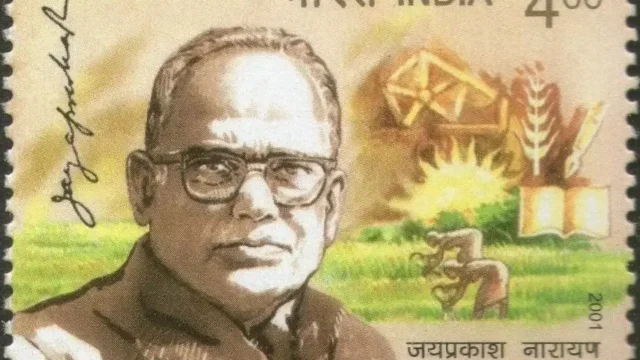
Birth anniversaries: Jayaprakash Narayan and Nanaji Deshmukh
11 October is the birth anniversary of Loknayak Jayaprakash Narayan and Nanaji Deshmukh, both Bharat Ratna awardees. The Prime Minister recalled JP's voice during the Emergency and his concern for good governance, and Nanaji's work in rural development and community participation. Treat this as a personality note for Prelims.
UPSC angle: Prelims: personalities, Bharat Ratna years. · Mains: limited; GS-IV examples of public service.
11 Oct 2026
ASI and Denmark museum to search for 1619 Danish shipwreck Oresund off Karaikal
The Archaeological Survey of India's Underwater Archaeology Wing and the National Museum of Denmark (Njord Centre, Copenhagen) signed an MoU to locate and document the Danish ship Oresund, wrecked off Karaikal, Puducherry, in 1619 CE. It is described as the first Danish ship known to have reached India.
UPSC angle: Prelims: Danish settlements in India.
15 Jun 2026
Veer Bal Diwas and the Rashtriya Bal Puraskar
The PM announced the day on 9 January 2022 and the first Veer Bal Diwas was held on 26 December 2022 [PMO].
UPSC angle: Prelims: Sikh history.
26 Dec 2025
Stamp on Emperor Perumbidugu Mutharaiyar II
Questions on lesser-known regional dynasties are common in Prelims. Stamps and anniversaries often bring them into the news.
UPSC angle: Prelims: early medieval Tamil dynasties.
14 Dec 2025Learn the concept
Question text as printed in the official UPSC Civil Services (Main) question paper. The model answer is original Battle IAS work; use it to learn structure, not to memorise.
Want every PYQ in one place? See the Battle IAS PYQ Book.