
UPSC Mains 2024 GS3 Q5: model answer
What is the present world scenario of intellectual property rights with respect to life materials? Although, India is second in the world to file patents, still only a few have been commercialized. Explain the reasons behind this less commercialization.
What the question wants
Global IPR regime on life forms and why Indian patents are rarely commercialised.
How to structure it
Intro: patents on life materials. Body: (1) global regime (TRIPS, CBD, Nagoya, WIPO 2024 treaty); (2) India's position (Section 3(d), Biological Diversity Act); (3) reasons for low commercialisation; (4) remedies. Conclusion.
- 1(1) global regime (TRIPS, CBD, Nagoya, WIPO 2024 treaty)
- 2(2) India's position (Section 3(d), Biological Diversity Act)
- 3(3) reasons for low commercialisation
- 4(4) remedies
Model answer
Life materials include genes, microbes, plant varieties and biological processes.
World scenario
- TRIPS Art. 27.3(b) requires patents for micro-organisms and protection for plant varieties.
- The US allows wide biotech patents, but Myriad (2013) barred patents on naturally occurring DNA.
- The CBD and Nagoya Protocol require benefit-sharing; the WIPO Treaty on Genetic Resources and Associated Traditional Knowledge (2024) mandates disclosure of origin.
- India excludes plants, animals and mere new forms (Section 3(b), 3(j), 3(d)) and protects varieties under the PPVFR Act, 2001.
Reasons for low commercialisation
- Many filings are by foreign firms or academic institutions without market plans.
- Weak industry-academia links and few technology transfer offices.
- Low R&D spending (about 0.65% of GDP).
- Scarce risk capital for deep tech; long regulatory approvals.
Incubators, the Anusandhan National Research Foundation and better licensing can turn patents into products.
Keywords, cases and data to drop in
TRIPS 27.3(b) Nagoya Protocol WIPO 2024 treaty Section 3(d) ANRF
Where most answers lose marks
- Ignoring the 'life materials' part.
Fresh examples from current affairs
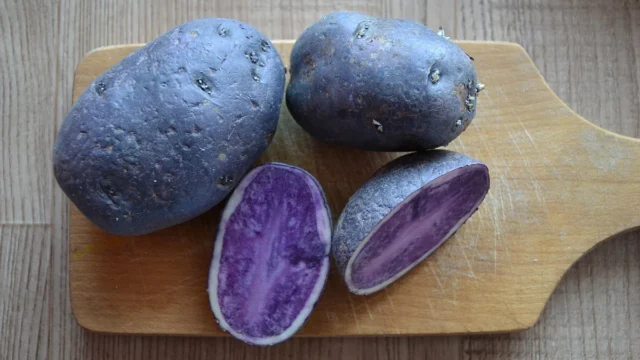
Kufri Jamunia: ICAR-CPRI’s purple potato to fight hidden hunger
A PIB backgrounder of 18 October 2026 puts the spotlight on Kufri Jamunia, a purple-fleshed potato bred by ICAR’s Central Potato Research Institute and released in 2024. It has nearly twice the Vitamin C of a common potato and several times more zinc and iron, along with antioxidants called anthocyanins. The idea is clever: instead of asking people to change what they eat, make the food they already eat more nutritious. That is biofortification.
UPSC angle: Prelims: Kufri Jamunia, CPRI, anthocyanins, biofortification vs fortification. · Mains GS-III: nutrition security; GS-II: hunger.
18 Oct 2026
First commercial bio-based PLA plastic under BioE3: Balrampur Chini Mills pilot
On 24 September 2026 the Department of Biotechnology launched the commercial use of bio-based biodegradable plastic made of Polylactic Acid (PLA) under the BioE3 framework. A ₹75 crore BIRAC grant supports a 100 TPA pilot R&D facility for PLA and co-polymers by Balrampur Chini Mills at Kumbhi, Uttar Pradesh.
UPSC angle: Prelims: PLA feedstock; BioE3 expansion.
24 Sep 2026
7th National Formulary of India launched; new Biovigilance Programme approved
On 21 September 2026 the Health Ministry launched the 7th edition of the National Formulary of India, with 653 drugs, and announced that the Government has approved a Biovigilance Programme of India. Under it, the Indian Pharmacopoeia Commission will monitor adverse events linked to medicines and biological products used in organ and tissue transplantation.
UPSC angle: Prelims: IPC's role; what pharmacovigilance means.
21 Sep 2026
Health Ministry advisory: stem cell therapy only for approved indications; autism use only in trials
On 16 September 2026 the Health Ministry told States and UTs that stem cell therapy may be given as standard care only for conditions on the Ministry's approved list. For autism, any stem cell use must stay inside approved clinical trials. The advisory follows a Supreme Court judgment of 30 January 2026 in Yash Charitable Trust v. Union of India.
UPSC angle: Prelims: Clinical Establishments Act, 2010; what stem cells are.
17 Sep 2026Learn the concept
Question text as printed in the official UPSC question paper: https://www.upsc.gov.in/sites/default/files/QP_CSM_2024_GenStud_III_03102024.pdf The model answer is original Battle IAS work; use it to learn structure, not to memorise.