
UPSC Mains 2026 GS1 Q2: model answer
Discuss the impact of Macaulay’s Minute on colonial administration and education in India.
What the question wants
Explain what the 1835 Minute argued, then its effects on administration (a clerical class, English as the language of rule) and on education (Western curriculum, neglect of vernaculars), with both intended and unintended outcomes.
How to structure it
Intro: Minute of Feb 1835 and Bentinck's resolution. Body: administrative impact; educational impact; unintended effect (nationalist elite). Conclusion: mixed legacy.
- 1Administrative impact
- 2Educational impact
- 3Unintended effect (nationalist elite)
Model answer
Macaulay's Minute (February 1835) ended the Orientalist-Anglicist debate. Bentinck's resolution that year directed funds to English education in Western learning.
Impact on administration
- A class 'Indian in blood and colour, but English in taste' was to staff courts and offices.
- English replaced Persian as the language of courts and government (1837).
- The 'downward filtration' idea kept spending on a narrow urban elite.
Impact on education
- Government colleges taught English literature and Western science; Sanskrit and Arabic learning lost patronage.
- Vernacular and mass schooling were neglected until Wood's Despatch (1854).
- Universities at Calcutta, Bombay and Madras (1857) followed this model.
Unintended result: English gave Indians access to liberal ideas. Rammohun Roy's generation and later Congress leaders used that language to demand self-rule.
The Minute built a loyal clerical class and, without meaning to, the vocabulary of Indian nationalism.
Keywords, cases and data to drop in
Anglicist-Orientalist debate downward filtration Wood's Despatch 1854 English Education Act 1835
Where most answers lose marks
- Treating the Minute only as cultural imperialism
- Skipping the administrative side
- No mention of unintended consequences
Fresh examples from current affairs

NMC withdraws MSMER-2023: medical colleges lose the fixed penalty rulebook, annual disclosure stays
The National Medical Commission (NMC) has de-notified the Maintenance of Standards of Medical Education Regulations, 2023 (MSMER-2023) by a notification dated 14 October 2026, published in the Gazette on 16 October. Its fixed penalties, including seat cuts and fines of up to ₹5 lakh for false records, go with it. The Annual Disclosure Report stays.
UPSC angle: Prelims: NMC Act 2019, autonomous boards, Concurrent List Entry 25. · Mains GS-II: regulation of medical education.
19 Oct 2026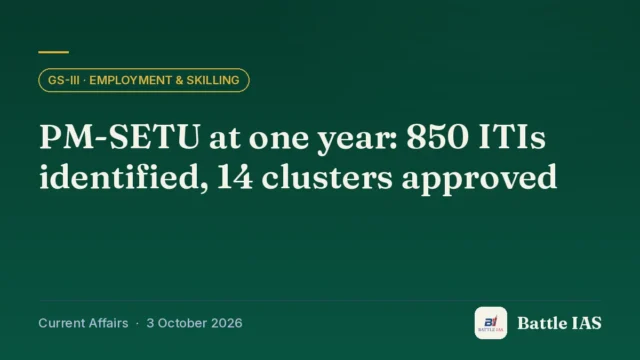
PM-SETU at one year: 850 ITIs identified, 14 clusters approved
PM-SETU, launched on 4 October 2025 to upgrade 1,000 Government ITIs through a hub-and-spoke model, has identified 850 ITIs and approved 14 ITI clusters worth ₹3446 crore in its first year. The scheme has a ₹60,000 crore outlay shared by the Centre, States and industry, and also upgrades five NSTIs.
UPSC angle: Prelims: PM-SETU expansion; hub-and-spoke. · Mains: Making ITIs industry-relevant.
3 Oct 2026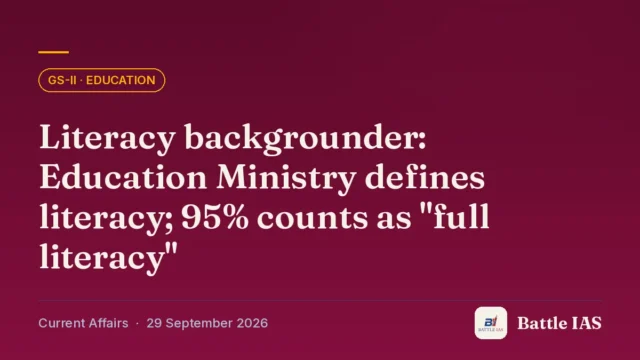
Literacy backgrounder: Education Ministry defines literacy; 95% counts as “full literacy”
A PIB backgrounder of 29 September 2026 says the Education Ministry has, for the first time, defined literacy as reading, writing and computing with comprehension, plus life skills like digital and financial literacy. A State or UT at 95 per cent counts as fully literate. PLFS 2025 puts India's literacy rate at 81.1 per cent.
UPSC angle: Prelims: 95% threshold; new definition components.
29 Sep 2026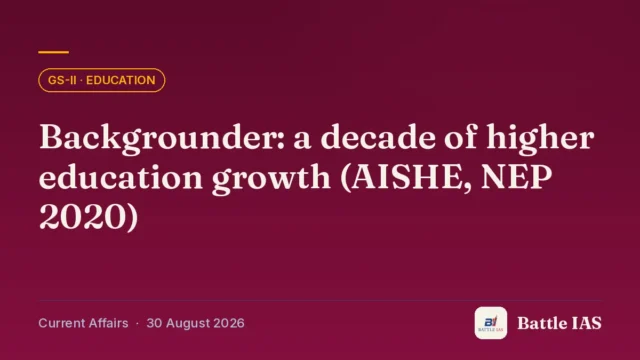
Backgrounder: a decade of higher education growth (AISHE, NEP 2020)
A PIB backgrounder of 30 August 2026 uses AISHE data to show a decade of change in higher education. Between 2014-15 and 2023-24 universities rose from 760 to 1,289, enrolment from 3.42 crore to 4.50 crore, and GER from 23.7 to 30 per cent. Female GER reached 31.2 per cent, ahead of male GER.
UPSC angle: Prelims: AISHE; NEP GER target.
30 Aug 2026Learn the concept
Question text as printed in the official UPSC question paper: https://www.upsc.gov.in/sites/default/files/QP-CSM-26-010926-GENERAL%20STUDIES%20PAPER%20-%20I.pdf The model answer is original Battle IAS work; use it to learn structure, not to memorise.