
National Parks in India: Legal Framework, National Park vs Sanctuary, Tiger and Biosphere Reserves, Key Parks by State and Issues (UPSC Notes + PYQs)
UPSC has already asked about this. Read the story with these questions in mind.
Legal framework
Before 1972, forests were managed mainly for timber under the Indian Forest Act. The Wildlife (Protection) Act, 1972 created a national system of protected areas. The 42nd Amendment (1976) moved forests and wildlife from the State List to the Concurrent List and added Articles 48A (State to protect environment and wildlife) and 51A(g) (citizens’ duty). Later amendments added conservation reserves and community reserves (2002), the National Tiger Conservation Authority (2006), and in 2022 rationalised schedules and brought CITES into the Act.
Types of protected areas
| Category | Declared by | Human activity |
|---|---|---|
| National park (Sec. 35) | State government; boundaries altered only on the State Board for Wildlife’s recommendation | No grazing; no rights allowed inside; tourism permitted |
| Wildlife sanctuary (Sec. 18) | State government | Some rights (grazing, collection) can be allowed |
| Conservation reserve (Sec. 36A) | State, after consulting local communities | Buffers and corridors on government land |
| Community reserve (Sec. 36C) | State, on community or private land | Managed with local people |
| Tiger reserve (Sec. 38V) | State on NTCA’s advice | Core (inviolate) and buffer zones |
Biosphere reserves (18 in India, 13 in UNESCO’s MAB network) are not under the WPA; they follow UNESCO’s Man and the Biosphere programme with core, buffer and transition zones. Eco-sensitive zones up to 10 km around protected areas are notified under the Environment Protection Act, 1986.
- Higher protection
- No grazing or private rights
- Boundaries changed only on State Board for Wildlife's advice
- Section 35, WPA
- Lower protection
- Some rights and grazing may be allowed
- Boundaries changed by the State
- Section 18, WPA
Notable national parks
| Park | State | Known for |
|---|---|---|
| Jim Corbett | Uttarakhand | India’s first (1936); Ramganga river; Project Tiger launched here in 1973 |
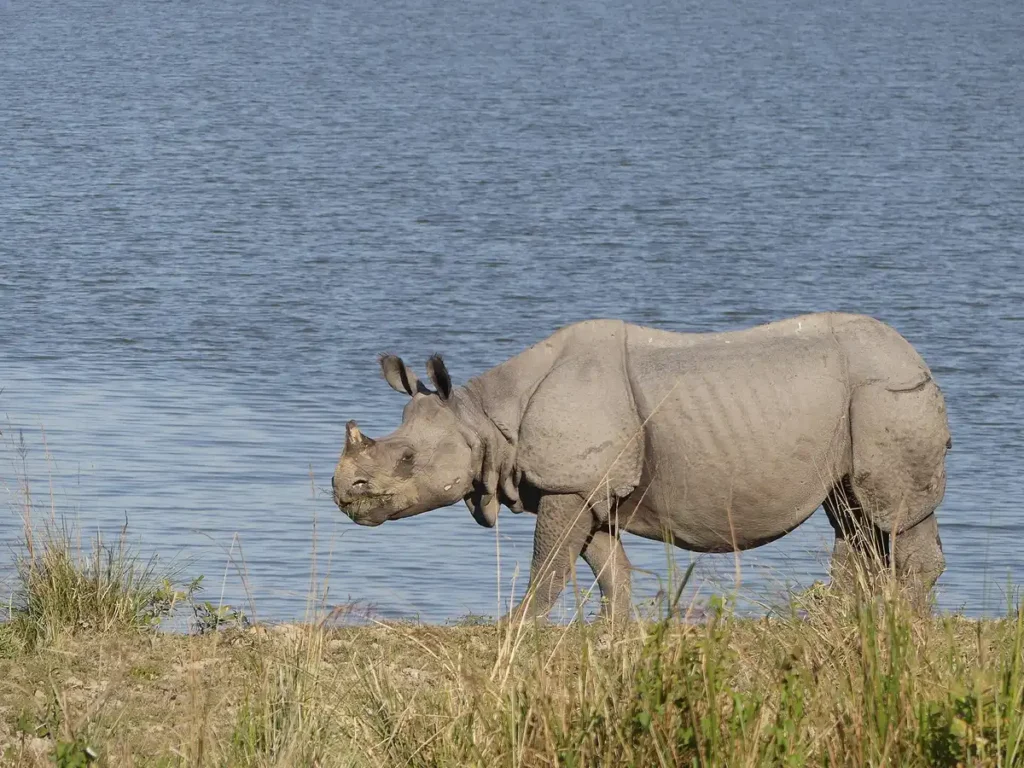
| Kaziranga | Assam | Great one-horned rhino; Brahmaputra floods; World Heritage Site |
| Hemis | Ladakh | Largest national park; snow leopard |
| Gir | Gujarat | Only wild Asiatic lions |
| Sundarbans | West Bengal | Mangrove tigers; World Heritage Site |
| Keibul Lamjao | Manipur | Only floating park (phumdis on Loktak lake); sangai deer |
| Silent Valley | Kerala | Tropical evergreen forest saved from a dam; lion-tailed macaque |
| Kuno | Madhya Pradesh | Cheetah reintroduction from 2022 |
| Desert NP | Rajasthan | Great Indian Bustard; spread over Jaisalmer and Barmer |
| Dudhwa | Uttar Pradesh | Swamp deer, rhino reintroduction (1984) |
Tiger reserves and Project Tiger
Project Tiger began on 1 April 1973 with nine reserves. India now has 58 tiger reserves (Madhav in Madhya Pradesh became the 58th in March 2025). The All India Tiger Estimation 2022 put the minimum population at 3,167 (mean estimate 3,682), about three-quarters of the world’s wild tigers. Madhya Pradesh has the most tigers, followed by Karnataka and Uttarakhand. Reserves are rated through Management Effectiveness Evaluation.
- 1936Hailey National Park (Corbett)
- 1972Wildlife (Protection) Act
- 1973Project Tiger
- 1976Forests and wildlife to Concurrent List
- 2002Conservation and community reserves
- 2006NTCA set up
- 2022Cheetahs reintroduced at Kuno; WPA amended
Issues
- Displacement and rights: relocation from core areas and conflict with the Forest Rights Act, 2006.
- Human-wildlife conflict: elephants, tigers and leopards outside reserves.
- Fragmentation by roads, railways, canals and mines; corridors under pressure.
- Over-tourism and resorts in buffer zones.
- Invasive weeds and grassland neglect.
- Many parks are small islands; species need landscapes.
Way forward
Plan at landscape level with corridors; make relocation voluntary with fair packages; involve communities through eco-development committees and community reserves; use technology (camera traps, M-STrIPES patrol app); cap tourism; and protect neglected habitats like grasslands, deserts and wetlands, not only forests.
Eco-sensitive zones and community areas
Under the Environment (Protection) Act, the Union notifies eco-sensitive zones around national parks and sanctuaries as buffers where mining, polluting industries and large construction are regulated. In 2022 the Supreme Court directed a minimum 1 km zone around every protected area, later relaxing the rule where zones had already been notified or where it would hurt towns. The Wildlife Act also recognises conservation reserves and community reserves (added in 2002), where local people or communities manage land for wildlife, as in parts of Nagaland and Rajasthan. Since the Forest Rights Act, 2006, people living inside parks can claim rights, and relocation must be voluntary and well compensated. Critical Wildlife Habitats and Critical Tiger Habitats can be declared only after scientific study and consultation with gram sabhas.
PYQ trend
Prelims asks parks and rivers (2013), what is banned in national parks (2012), Desert National Park (2020) and Madhav National Park (2026). Mains GS-I 2023 asked the significance of wildlife sanctuaries in conserving flora and fauna. Learn parks in the news each year.
National Parks: UPSC angle
For UPSC CSE
Prelims: parks by State, rivers through parks, species, rules. Mains GS-III: conservation, human-wildlife conflict, rights of forest dwellers.
National Parks UPSC PYQs (Prelims)
Questions UPSC has actually asked, from the official papers. Pick an option to check yourself.
In which one among the following categories of protected areas in India are local people *not* allowed to collect and use the biomass?
National Parks have the strictest protection under the Wildlife (Protection) Act: no grazing and no collection of forest produce. Sanctuaries may allow some regulated rights, and biosphere reserves have buffer and transition zones where people live and work. Answer as per the official UPSC key · Battle IAS PYQ bankAnswer (b) & why
Consider the following pairs :
| National Park | River flowing through the Park
| 1. Corbett National Park | Ganga
| 2. Kaziranga National Park | Manas
| 3. Silent Valley National Park | Kaveri
Which of the above pairs is/are correctly matched?
Corbett lies on the Ramganga, Kaziranga on the Brahmaputra (with the Diphlu flowing through it), and Silent Valley on the Kunthipuzha (a Bharathapuzha tributary). None of the pairs is correct; the Manas river flows through Manas National Park. Answer as per the official UPSC key · Battle IAS PYQ bankAnswer (d) & why
With reference to India’s Desert National Park, which of the following statements are correct ?
– 1. It is spread over two districts.
– 2. There is no human habitation inside the Park.
– 3. It is one of the natural habitats of Great Indian Bustard.
Select the correct answer using the code given below :
Desert National Park covers parts of Jaisalmer and Barmer in Rajasthan. It is the last major stronghold of the Great Indian Bustard. Several villages lie inside it, so 2 is wrong. Answer as per the official UPSC key · Battle IAS PYQ bankAnswer (c) & why
With reference to Madhav National Park, which of the following statements is/are correct ?
– 1. It was declared a Tiger Reserve in India in 2025.
– 2. Sakhya Sagar, which is designated as a Ramsar Site, is situated within this National Park.
– 3. Its area is shared between Madhya Pradesh and Rajasthan.
Select the answer using the code given below :
Madhav National Park in Shivpuri district became India’s 58th tiger reserve in March 2025. Sakhya Sagar lake inside it was named a Ramsar site in 2022. The park lies wholly in Madhya Pradesh, so 3 is wrong. Answer as per the official UPSC key · Battle IAS PYQ bankAnswer (b) & why
Mains PYQs on this topic
Questions from the official UPSC Mains papers (2023-2026 in the Battle IAS Mains bank), newest first. Each links to a model answer.
- UPSC Mains 2026 · GS Paper III · Q8 · 10 marks
Discuss the aim and goals of Kunming-Montreal global biodiversity framework. Mention India's commitments and initiatives to achieve the goals and targets of this framework giving suitable examples.
- UPSC Mains 2023 · GS Paper I · Q15 · 15 marks
Identify and discuss the factors responsible for diversity of natural vegetation in India. Assess the significance of wildlife sanctuaries in rain forest regions of India.
Quick quiz
India’s first national park was
1936.Answer (b)
Local people are not allowed to collect biomass in
PYQ 2012.Answer (b)
The only floating national park is in
Keibul Lamjao on Loktak lake.Answer (b)
FAQs
Who declares a national park?
The State government under Section 35 of the Wildlife Protection Act; the Centre can also declare one in certain cases.
How many national parks does India have?
Over 100, about 106 at last count, covering about 1.3% of land area.
Are biosphere reserves legal protected areas?
No. They follow UNESCO’s MAB programme; their core zones are usually national parks or sanctuaries.
What is a core area of a tiger reserve?
A critical tiger habitat kept inviolate, without human use.
Where were cheetahs reintroduced?
Kuno National Park, Madhya Pradesh, from September 2022; some later moved to Gandhi Sagar.
Spotted an error? Tell us. We correct within 48 hours.
Image: A. J. T. Johnsingh, WWF-India and NCF, Wikimedia Commons, CC BY-SA 4.0
How to use this in Mains
If asked: Discuss the challenges in managing India's protected areas. (GS-III)
Quote: “Human-wildlife conflict: elephants, tigers and leopards outside reserves.”
Use it: Use it in the challenges part when discussing protected areas.
In the news

NBA shares Rs 1.19 crore with 29 State Biodiversity Boards from use of crop genetic resources
On 17 October 2026 the National Biodiversity Authority (NBA) said it had shared ₹1.19 crore with 29 State Biodiversity Boards and one UT Biodiversity Council. The money came from seed companies that used Indian maize, rice, pearl millet and cotton for research and commercial hybrids. As the crops were bought from markets and the original holders could not be traced, the amount was split in proportion to each State’s cultivation area. The release comes two days before the CBD COP 17 opens in Yerevan.
18 Oct 2026
National Biodiversity Authority shares ₹2.02 crore Access and Benefit-Sharing money from seed companies
The National Biodiversity Authority distributed ₹2.02 crore of Access and Benefit-Sharing money, paid by seed companies using crops such as rice, tomato and okra, among 27 State Biodiversity Boards and 3 UT councils by cultivation area. Its total ABS disbursement has now reached ₹202 crore, ahead of CBD COP 17 in Yerevan from 19 October 2026.
10 Oct 2026
NHAI documents 2,150+ wildlife mitigation structures on national highways
NHAI released a document on wildlife mitigation measures during National Wildlife Week (2-8 October 2026). It records over 2,150 wildlife crossing structures built or proposed on national highways and about ₹19,700 crore spent in five years on such measures, from animal underpasses and overpasses to viaducts, tunnels and canopy crossings.
8 Oct 2026
Project Cheetah: Indian-born cheetah gives birth to five cubs at Kuno; population reaches 60
On 5 October 2026 KJP21, a 32-month-old Indian-born female cheetah, gave birth to five cubs at Kuno National Park. India now has 60 cheetahs, 41 of them born in India. KJP21 is the third Indian-born female to breed, and the father is from Botswana, starting a Botswanan lineage in India.
5 Oct 2026