
Chapter 3 · Topic 3.2 · Prelims + Mains2 of 3
Indus Valley Civilization: Economy, seals, religion and art
Key points
- Crops: wheat, barley, cotton (among the first), rice in Gujarat; Kalibangan ploughed field.
- Trade with Mesopotamia (Meluhha) via Dilmun and Magan; chert weights doubling up to 64, then multiples of ten.
- Steatite seals with the 'unicorn'; script of about 400 signs, unread; bronze Dancing Girl made by the lost-wax method.
Prelims box: facts and traps
- Raw materials: copper from Khetri, lapis lazuli from Badakhshan via Shortughai, tin from Afghanistan.
- Dancing Girl: bronze, about 10.8 cm, National Museum, New Delhi (Prelims 2025).
- Pashupati seal: horned figure with elephant, tiger, rhino and buffalo; called proto-Shiva by Marshall.
- Fire altars: Kalibangan and Lothal.
- Trap (Prelims 2026): large private houses do not prove a common property system.
Farming, crafts, trade, weights and measures
Harappan farmers grew wheat and barley, peas, sesame and mustard, and rice at sites in Gujarat such as Lothal and Rangpur. They were among the earliest people to grow cotton; the Greeks later called cotton cloth sindon, after Sindh. They kept cattle, sheep, goats and buffalo. Spare grain fed the towns. Floods brought fresh silt (rich soil left by rivers), and Kalibangan shows a ploughed field from the Early Harappan phase.
Craftsmen were highly skilled: bronze casting, bead-making in carnelian (a red stone), steatite (soft soapstone) and faience (a glazed paste), shell and ivory work, and pottery made on the wheel, red with black painted designs. Trade brought raw materials from far away: copper from Khetri in Rajasthan, gold probably from southern India, lapis lazuli from Badakhshan via Shortughai, and tin from Afghanistan. Mesopotamian texts mention trade with Meluhha, generally taken to be the Indus region, through Dilmun (Bahrain) and Magan (Oman), and Harappan seals have been found in Mesopotamia.
Weights were small cubes, mostly of chert (a hard stone), in a fixed series: doubling at first (1, 2, 4, 8 up to 64) and then in multiples of ten (160, 320, 640 and so on). Picture a shopkeeper’s set of weights that was the same in every town. Measuring scales of shell (Mohenjo-daro) and ivory (Lothal), marked in equal steps, have been found. Standard weights and bricks suggest one common system across a huge area.
Prelims 2026 turned this into an inference question, where you judge what the evidence suggests. Its first statement read: There is wide occurrence of spindlewhorls in the houses but absence of spinning wheels. A spindle whorl is a small disc used to twist thread by hand. The second described graduated weights and scales, and the third large brick houses with courtyards, wells and bathing platforms. Two inferences follow: spinning was hard work done at home, and the weights show scientific knowledge. But large private houses do not suggest a common property system, so the provisional answer is 1 and 2 only (a).
Consider the following statements about the archaeological findings in Harappan towns : I. There is wide occurrence of spindle-whorls in the houses but absence of spinning wheels. II. Weights and measurement scales, complete with graduations have been discovered. III. There are houses built in large part with baked bricks, around relatively spacious courtyards, with their own wells, bathing platforms, and large rooms. Which of the following inferences can be drawn from the above statements ? 1. Statement I suggests that spinning was a laborious activity done at home. 2. Statement II suggests the extent of the scientific knowledge that the Harappans possessed. 3. Statement III suggests the emergence of a common property system. Select the answer using the code given below :
- 1 and 2 only
- 2 and 3 only
- 1 and 3 only
- 1, 2 and 3
Show answer
Answer: (a) · UPSC provisional key (final key awaited)
Lothal had a large brick basin, about 219 m by 37 m, linked to an old river channel. S. R. Rao, who dug the site, called it a dockyard, a place where boats are docked; others think it was a water tank. Either way, Lothal was a busy craft and trade town, with a bead factory and a warehouse.
What UPSC asks
Prelims: crops, trade links, weights (2026 inference question). Mains: trade and craft as the base of cities. Next likely: Harappan goods found abroad.
Seals, script, religion and art
We know little directly about Harappan rulers. No palaces or royal tombs have been found, and the script cannot be read. Uniform planning, bricks and weights suggest some central authority, perhaps merchants or priests rather than kings. House sizes vary, so there were rich and poor.
Seals are the most typical Harappan objects, and thousands have been found. Most are small and square, made of steatite, with an animal and a short line of writing. The humped bull, elephant, tiger and rhinoceros appear, but the commonest animal is the one-horned ‘unicorn’. Seals probably marked goods in trade, like a company logo on a parcel. The script has about 400 signs and was mostly written from right to left. It has not been deciphered, because the lines are short and no bilingual text (the same words in two languages) has been found.
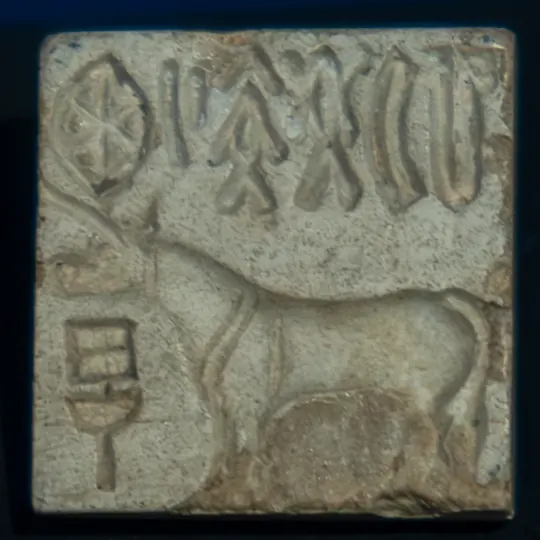
There are no clear temples. Clay (terracotta) female figurines suggest worship of a mother goddess. A seal from Mohenjo-daro shows a horned figure sitting in a yoga pose, surrounded by an elephant, a tiger, a rhinoceros and a buffalo. John Marshall called it ‘Pashupati’ or proto-Shiva (an early form of Shiva), a view many scholars question. The pipal tree, the humped bull and possibly phallic stones were revered, and fire altars appear at Kalibangan and Lothal. The dead were usually buried with pots and ornaments.
Prelims 2011 asked about two statements: that it was predominantly a secular civilization and the religious element, though present, did not dominate the scene, and that during this period, cotton was used for manufacturing textiles in India. Both were taken as correct, so the answer was (c). The first is an interpretation, a guess based on the absence of temples, so read such statements carefully.
Regarding the Indus Valley Civilization, consider the following statements : 1. It was predominantly a secular civilization and the religious element, though present, did not dominate the scene. 2. During this period, cotton was used for manufacturing textiles in India. Which of the statements given above is/are correct ?
- 1 only
- 2 only
- Both 1 and 2
- Neither 1 nor 2
Show answer
Answer: (c) · UPSC official key
Harappan art is small but fine. The ‘Priest-King’ is a steatite bust of a bearded man in a cloak with a trefoil (three-leaf) pattern. Prelims 2025 asked what the famous female figurine known as the ‘Dancing Girl’, found at Mohenjodaro, is made of. It is bronze (c), cast by the lost-wax method: a wax model is covered in clay, the wax is melted out, and metal is poured in. It is about 10.8 cm tall and now in the National Museum, New Delhi. Terracotta toys, bulls on wheels and painted pottery complete the picture.
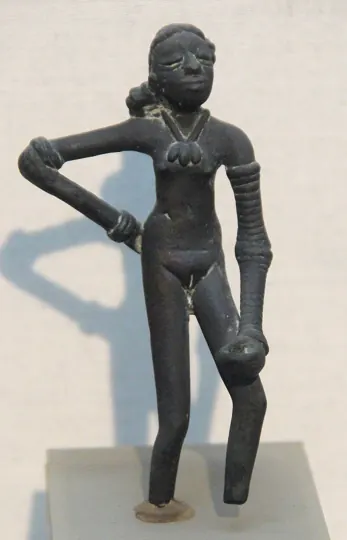
The famous female figurine known as ‘Dancing Girl’, found at Mohenjo-daro, is made of
- carnelian
- clay
- bronze
- gold
Show answer
Answer: (c) · UPSC official key
What UPSC asks
Prelims: the Dancing Girl’s material (2025); seals; religion (2011). Mains: religion and art without temples or palaces. Next likely: attempts to read the script, and DNA studies.
Mains box: analysis and answer points
- Trade and crafts made the cities: standard weights, long-distance raw materials, bead and bronze industries.
- Religion without temples: mother goddess figurines, sacred trees and animals, fire altars.
- Likely next angle: attempts to read the script; DNA studies.
Practice
Practice MCQs (8)
In January 2025, at a conference marking the centenary of the announcement of the Indus Valley Civilisation's discovery, which State government announced a prize of US$ 1 million for deciphering the Indus script?
Answer (c) & explanation
On 5 January 2025 the Chief Minister of Tamil Nadu, M.K. Stalin, inaugurating an international conference in Chennai on the centenary of John Marshall's 1924 announcement, offered a prize of US$ 1 million to any person or organisation that deciphers the Indus script to the satisfaction of archaeologists. He also announced a research chair named after the epigraphist Iravatham Mahadevan. As of 2025 the script remains undeciphered.
The seal showing a figure seated cross-legged in a 'yogic' posture, which John Marshall identified as a 'proto-Shiva', was found at
Answer (b) & explanation
The seal was found at Mohenjodaro. NCERT explains that John Marshall called the figure a 'proto-Shiva', an early form of the later Hindu god, because of its posture and the animals around it. NCERT also cautions that such readings project later beliefs onto the past, which is why the identification is held as a hypothesis.
Consider the following statements about religious practice in the Harappan civilisation:
1. Many terracotta female figurines, often heavily jewelled, have been interpreted as mother goddesses.
2. No Harappan structure has been securely identified as a temple.
3. Structures interpreted as fire altars have been found at Kalibangan and Lothal.
4. Seals depict the god Indra driving a horse-drawn chariot.
How many of the statements given above are correct?
Answer (c) & explanation
Statements 1, 2 and 3 are correct. NCERT notes that early archaeologists read heavily jewelled female figurines as mother goddesses, and that structures such as the Great Bath and the fire altars of Kalibangan and Lothal have been given ritual meaning. R.S. Sharma observes that no temple has been found at any Harappan site. Statement 4 is wrong: the horse and the chariot are not depicted on Harappan seals, and Indra belongs to the Rigveda.
With reference to Harappan burials, consider the following statements:
1. The dead were generally laid in pits, some of which were lined with bricks.
2. Some graves contain pottery and ornaments, perhaps reflecting a belief that these could be used in the afterlife.
3. Jewellery has been found only in the burials of men.
Which of the statements given above is/are correct?
Answer (c) & explanation
NCERT explains that at burials in Harappan sites the dead were generally laid in pits, and that differences in the making of the grave, such as brick-lined pits, may point to social differences. Some graves contain pottery and ornaments, perhaps showing belief in an afterlife. Statement 3 is wrong: jewellery has been found in burials of both men and women; NCERT mentions a male skull buried with an ornament of shell rings, a jasper bead and hundreds of micro-beads.
NCERT states that the Harappan script was apparently written from right to left. This inference is based on
Answer (a) & explanation
NCERT explains that the script was apparently written from right to left, because some seals show wider spacing on the right and cramping on the left, as if the engraver began on the right and ran out of space on the left. No bilingual inscription is known, the Dholavira signboard has not been read, and the Rigveda says nothing of the Harappan script.
With reference to the Harappan script, consider the following statements:
1. It has not yet been deciphered.
2. It was not alphabetic, and it had between about 375 and 400 signs.
3. Most Harappan inscriptions are long, often running to more than fifty signs.
Which of the statements given above is/are correct?
Answer (b) & explanation
NCERT calls the Harappan script an enigma: it remains undeciphered. It was not alphabetic, since an alphabet would need far fewer signs; it had between 375 and 400 signs. Statement 3 is wrong: most inscriptions are short, the longest containing about 26 signs, and many seals carry only a few signs, often a line on the top of the seal.
With reference to how archaeologists study social differences in Harappan society, consider the following statements:
1. Archaeologists classify finds broadly as utilitarian objects or luxuries.
2. Objects made of costly non-local materials or by complicated techniques tend to be classed as luxuries.
3. Such luxuries are found in roughly equal numbers in large cities and in small settlements.
Which of the statements given above is/are correct?
Answer (a) & explanation
NCERT explains that, besides burials, archaeologists study the distribution of artefacts, dividing them into utilitarian objects (querns, pottery, needles) and luxuries. Objects of costly, non-local materials or of complicated technology, such as little faience pots, are treated as luxuries. Statement 3 is wrong: NCERT notes that such rare objects are found mainly in large centres like Mohenjodaro and Harappa and are rare or absent in small settlements like Kalibangan.
On the well-known Mohenjodaro seal of a figure seated in a yogic posture, sometimes called the 'Pashupati' seal, which one of the following animals is NOT depicted?
Answer (d) & explanation
The seal shows a horned figure seated cross-legged, surrounded by an elephant, a tiger, a rhinoceros and a water buffalo, with two deer or antelopes below the seat. The bull, though very common on other Harappan seals, does not appear on this one; it is the classic distractor, because later Shiva iconography links the god with the bull Nandi.
0 / 0 correct
Write an answer
In 150 words, explain the significance of Indus Valley Civilization with one recent example.
Flashcards (3)
Mesopotamian name for the Indus region?
Meluhha.
Commonest animal on Harappan seals?
The one-horned 'unicorn'.
Which metal did the Harappans not know?
Iron.
Read more: related explainers
In the news
- 20 Oct 2026Sirpur in Chhattisgarh enters UNESCO’s Tentative List of World Heritage sites
- 15 Oct 2026PM inaugurates five Ladakh projects: Nimmu–Padum–Darcha road, Leh terminal, Hanu hydro
- 14 Oct 2026HAL, NCF and ASI sign MoA for Hampi, Taj Mahal and Bekal Fort
- 11 Oct 2026Birth anniversaries: Jayaprakash Narayan and Nanaji Deshmukh
 Next topic · 3.3 →Indus Valley Civilization: Decline, the Vedic contrast and the legacy
Syllabus: Prelims GS-I · History of India and Indian National Movement.