
Chapter 3 · Topic 3.1 · Prelims + Mains1 of 3
Indus Valley Civilization: Sites and town planning
Key points
- Harappa (1921, Sahni) and Mohenjo-daro (1922, Banerji); announced by John Marshall in 1924.
- Mature phase about 2600–1900 BCE; Bronze Age; nearly 13 lakh sq km, bigger than Egypt and Mesopotamia together.
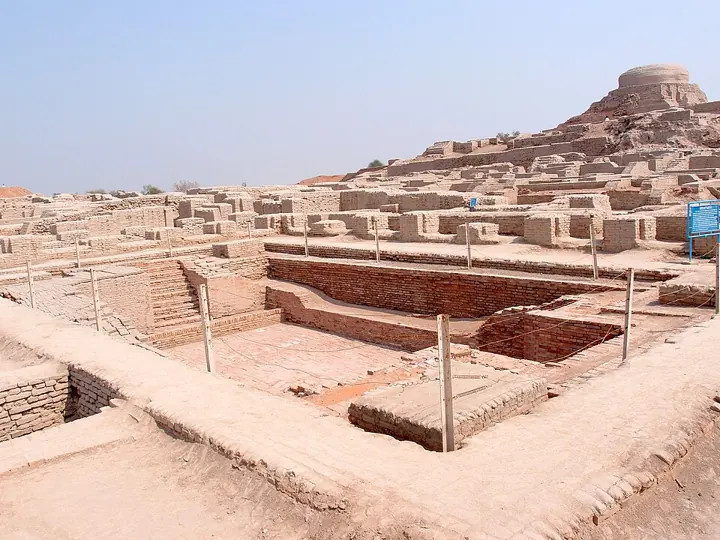
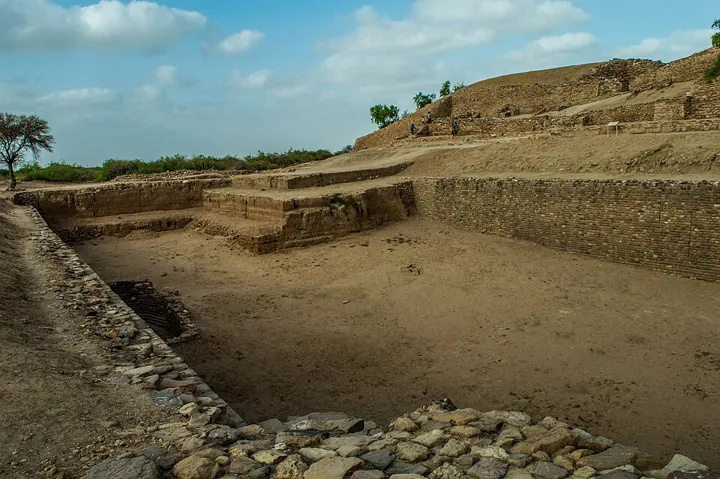
- Planned cities: citadel and lower town, grid streets, 1:2:4 bricks, covered drains, Great Bath, Dholavira's reservoirs.
Prelims box: facts and traps
- Extreme points: Sutkagen Dor (west), Alamgirpur (east), Manda (north), Daimabad (south).
- Trap (Prelims 2019): Sohgaura is a Mauryan copper-plate site, not Harappan.
- Dholavira: dams and connected reservoirs (Prelims 2021); three-part plan; UNESCO 2021.
- Great Bath: about 12 m × 7 m × 2.4 m, sealed with bitumen.
- Lothal: dockyard and bead factory, Gujarat.
Discovery, extent and the main sites
The Indus Valley or Harappan Civilization was South Asia’s first urban culture, meaning the first with real cities. It came to light in the 1920s. Daya Ram Sahni dug at Harappa on the Ravi in 1921, and R. D. Banerji dug at Mohenjo-daro on the Indus in 1922. In 1924 John Marshall, Director-General of the Archaeological Survey of India, announced a new civilization to the world. It is called ‘Harappan’ after the first site found, the usual practice in archaeology.
It had three phases. The Early Harappan (about 3300–2600 BCE) had growing villages and towns. The Mature Harappan (about 2600–1900 BCE) was the age of the great planned cities. In the Late Harappan (about 1900–1300 BCE) the cities faded into regional village cultures. It was a Bronze Age culture: people used copper and bronze (copper mixed with tin), not iron.
It was larger than ancient Egypt and Mesopotamia combined, covering nearly 13 lakh sq km. Learn the four extreme points: Sutkagen Dor in Balochistan (west), Alamgirpur near Meerut in Uttar Pradesh (east), Manda near Jammu (north) and Daimabad in Maharashtra (south). Shortughai, on the Amu Darya in Afghanistan, was a trading outpost for lapis lazuli, a deep-blue precious stone.
| Site | Where | Remember it for |
|---|---|---|
| Harappa | Ravi river, Punjab (Pakistan) | First site excavated (1921); rows of ‘granary’ platforms; Cemetery H |
| Mohenjo-daro | Indus river, Sindh (Pakistan) | Great Bath, ‘Priest-King’, Dancing Girl, Pashupati seal |
| Chanhudaro | Sindh (Pakistan) | Bead-making workshops; a town without a citadel |
| Kalibangan | Ghaggar river, Rajasthan | Ploughed field (Early Harappan), fire altars |
| Lothal | Bhogavo river near the Gulf of Khambhat, Gujarat | Dockyard, bead factory |
| Dholavira | Khadir island, Kutch, Gujarat | Reservoirs and dams; three-part city; large inscribed ‘signboard’ |
| Rakhigarhi and Banawali | Haryana | Rakhigarhi is among the largest sites; Banawali gave a toy plough |
| Surkotada and Ropar | Kutch (Gujarat); Punjab (India) | Claimed horse bones (disputed); a dog buried with a human |
Prelims 2019 asked: Which one of the following is not a Harappan site? The options were Chanhudaro, Kot Diji, Sohgaura and Desalpur. Chanhudaro and Kot Diji are in Sindh and Desalpur is in Kutch, all Harappan. Sohgaura, near Gorakhpur in Uttar Pradesh, is known for a copper plate inscription of the Mauryan age, so the answer is (c). Learn sites in groups by region.
Which one of the following is not a Harappan site?
- Chanhudaro
- Kot Diji
- Sohgaura
- Desalpur
Show answer
Answer: (c) · UPSC official key
What UPSC asks
Prelims: site, river and State pairs; ‘not a Harappan site’ (2019). Mains: the spread and phases of the first cities. Next likely: new digs at Rakhigarhi and in Gujarat.
Town planning, drainage and great buildings
Harappan cities are famous for planning. Most had a raised, walled citadel (a high fortified area) on the west for big public buildings, and a larger lower town on the east where people lived. Streets ran roughly north–south and east–west and crossed almost at right angles, like squares on a chessboard. Bricks, baked or sun-dried, kept the same ratio of 1:2:4 (thickness, width, length) across the whole region, a sign of shared rules.
Drainage was the best in the ancient world. Every house had a bathing area. Its dirty water flowed into covered brick drains along the streets, with manholes for cleaning. Many houses had their own wells; Mohenjo-daro may have had about 700. House doors usually opened onto side lanes, not main streets, perhaps for privacy and safety.
The Great Bath of Mohenjo-daro, about 12 m long, 7 m wide and 2.4 m deep, is the best-known building. Fine bricks, gypsum mortar and a layer of bitumen (natural tar) made it watertight. It had steps at both ends and rooms around it, and was probably used for ritual bathing. The large buildings at Harappa and Mohenjo-daro called ‘granaries’ may have stored grain, though some archaeologists now doubt that label.
Dholavira stands out in another way. Prelims 2021 asked which ancient town is well-known for its elaborate system of water harvesting and management by building a series of dams and channelizing water into connected reservoirs. The answer is Dholavira (a). In the dry Rann of Kutch its people dammed seasonal streams and stored the water in rock-cut reservoirs, like a town saving rain in giant tanks. Dholavira also had a three-part plan (citadel, middle town and lower town) and became a UNESCO World Heritage Site in 2021.
Which one of the following ancient towns is well-known for its elaborate system of water harvesting and management by building a series of dams and channelizing water into connected reservoirs?
- Dholavira
- Kalibangan
- Rakhigarhi
- Ropar
Show answer
Answer: (a) · UPSC official key
Mains 2025 asked candidates to discuss the salient features of the Harappan architecture. Build your answer on the grid plan, citadel and lower town, standard bricks, covered drains, wells, the Great Bath, the ‘granaries’, the Lothal dockyard and Dholavira’s reservoirs. Then note what is missing: no palaces or temples on the Egyptian scale. End on what this says about city rules and cleanliness.
Discuss the salient features of the Harappan architecture.
What UPSC asks
Prelims: Dholavira’s water system (2021); Great Bath; bricks 1:2:4. Mains: features of Harappan architecture (2025). Next likely: protecting Dholavira as a World Heritage Site.
Mains box: analysis and answer points
- Features: grid plan, zoning, standard bricks, covered drains, wells, Great Bath, 'granaries', Lothal dockyard, Dholavira water system.
- What is missing: no grand palaces or temples, hinting at civic rather than royal power.
- Asked: Mains 2025 (GS Paper I, 10 marks): Discuss the salient features of the Harappan architecture.
Practice
Practice MCQs (8)
Mehrgarh, the Neolithic site that has yielded some of the earliest evidence of farming and herding in the subcontinent, is located in
Answer (d) & explanation
Mehrgarh lies on the Kachi plain at the foot of the Bolan Pass in Baluchistan, Pakistan. NCERT Class VI uses it as the example of an early village where people grew wheat and barley and reared sheep and goats; its earliest levels go back to about the seventh millennium BCE, long before the Harappan cities. Burzahom near Srinagar and the Belan valley sites are later Neolithic sites in other regions.
The Bronze Age civilisation of the Indus region is called the 'Harappan' civilisation because Harappa
Answer (a) & explanation
NCERT explains that the civilisation is named after Harappa, the first site where this culture was discovered. Archaeologists name a culture after its first-found or type site, so the label says nothing about size or political rank. The largest of the early-known cities was Mohenjodaro, and Harappa stands inland on the Ravi in Pakistani Punjab.
At which Harappan site did the excavator S.R. Rao identify a large brick-lined basin on the eastern side of the town as a dockyard linked by a channel to the river?
Answer (a) & explanation
At Lothal, near the Gulf of Khambhat, S.R. Rao interpreted a trapezoidal brick enclosure about 219 m long as a dockyard connected by a channel to the old course of the river. R.S. Sharma repeats this reading, but some scholars have argued that the basin was a water reservoir instead, so the identification is best stated as Rao's. Dholavira is famous for its stone-cut reservoirs, not a dock.
Consider the following statements about the extent and character of the Harappan civilisation:
1. Many Harappan settlements lie along the Ghaggar-Hakra river system rather than along the Indus itself.
2. Harappan settlements are known from outside present-day India and Pakistan, in north- eastern Afghanistan.
3. Harappa and Mohenjodaro both stand on the banks of the Indus.
4. It was a Bronze Age culture, and the Harappans did not use iron.
How many of the statements given above are correct?
Answer (c) & explanation
Statements 1, 2 and 4 are correct. Surveys in Cholistan, Haryana and Rajasthan have shown that a large share of sites lie along the dried Ghaggar-Hakra, which is why many scholars find the label 'Indus valley' too narrow. Shortughai in north-eastern Afghanistan is a Harappan settlement. Statement 3 is wrong: Mohenjodaro is on the Indus in Sindh, but ==Harappa== stands on the Ravi in Pakistani Punjab. The Harappans used copper and bronze; iron appears in the subcontinent only much later.
Consider the following statements about Dholavira:
1. It lies on the island of Khadir in the Great Rann of Kachchh.
2. It is set between two seasonal streams, the Mansar and the Manhar.
3. A large inscription of ten signs, often called a 'signboard', was found near its northern gateway.
4. It was built almost entirely of burnt brick, with little use of stone.
How many of the statements given above are correct?
Answer (c) & explanation
Statements 1, 2 and 3 are correct. Dholavira stands on Khadir bet in the Great Rann, between the Mansar and Manhar streams, whose water it stored in large reservoirs. R.S. Bisht's excavation found a ten-sign inscription of large gypsum inlay letters near the northern gate, one of the largest Harappan inscriptions known. Statement 4 is wrong: Dholavira is notable for its use of stone, dressed and rubble, in its walls and gateways, unlike the brick cities of the plains.
Consider the following statements about Kalibangan:
1. An Early Harappan level there yielded a ploughed field with two sets of furrows crossing at right angles.
2. Its houses of the Harappan period were built mainly of baked bricks.
3. Like its citadel, its lower town was also enclosed by a fortification wall.
Which of the statements given above is/are correct?
Answer (b) & explanation
NCERT records a ploughed field at Kalibangan in the Early Harappan levels, with two sets of furrows at right angles, which suggests two crops grown together. The ASI's account of the site adds that in the Harappan period both the citadel and the lower city were fortified. Statement 2 is wrong: the houses were of mud brick; baked bricks were kept for drains, wells and door sills. The citadel also had platforms with fire altars.
Consider the following pairs: Harappan site : Location
1. Sutkagen-dor : Makran coast of Baluchistan
2. Daimabad : Godavari delta in Andhra Pradesh
3. Alamgirpur : Hindon valley in western Uttar Pradesh
4. Shortughai : Indus delta in Sindh
How many of the pairs given above are correctly matched?
Answer (b) & explanation
Pairs 1 and 3 are correct. Sutkagen-dor, on the Dasht river near the Makran coast, is the westernmost Harappan site, and Alamgirpur on the Hindon in Meerut district is the easternmost. Pair 2 is wrong: Daimabad, the southern limit, lies on the Pravara, a tributary of the Godavari, in Ahmednagar district of Maharashtra, not in the delta. Pair 4 is wrong: Shortughai lies on the Amu Darya (Oxus) in north-eastern Afghanistan, far from Sindh.
Arrange the following in chronological order of the start of their excavation:
1. Dholavira by R.S. Bisht
2. Harappa by Daya Ram Sahni
3. Lothal by S.R. Rao
4. Chanhudaro by N.G. Majumdar
Select the correct answer using the code given below.
Answer (d) & explanation
Daya Ram Sahni began digging at Harappa in 1921. N.G. Majumdar worked at Chanhudaro in Sindh in 1931, before Ernest Mackay's larger season of 1935-36. After Partition left the big cities in Pakistan, the ASI looked for sites in India: S.R. Rao excavated Lothal from 1955 to 1960, and R.S. Bisht excavated Dholavira in Kachchh from 1990, although J.P. Joshi had discovered it in 1967-68. The order is 2-4-3-1.
0 / 0 correct
Write an answer
In 150 words, explain the significance of Indus Valley Civilization with one recent example.
Flashcards (17)
Who excavated Harappa, and when?
Daya Ram Sahni, 1921.
Who excavated Mohenjo-daro, and when?
R. D. Banerji, 1922.
Dates of the Mature Harappan phase?
About 2600–1900 BCE.
Westernmost and easternmost Harappan
sites? Sutkagen Dor (Balochistan) and Alamgirpur (Uttar Pradesh).
Northernmost and southernmost sites?
Manda (Jammu) and Daimabad (Maharashtra).
Which site was a lapis lazuli trading outpost
in Afghanistan? Shortughai.
Which Harappan town had no citadel and
many bead workshops? Chanhudaro.
Standard Harappan brick ratio?
1:2:4.
Size of the Great Bath?
About 12 m × 7 m, 2.4 m deep.
What waterproofed the Great Bath?
A layer of bitumen.
Which town is known for dams and
reservoirs? Dholavira, Kutch.
When did Dholavira become a World
Heritage Site? 2021.
Where was a ploughed field found?
Kalibangan, Rajasthan.
Where is a Harappan dockyard?
Lothal, Gujarat.
Where did Harappan copper come from?
Mainly Khetri, Rajasthan.
What is the Dancing Girl made of?
Bronze.
Where were fire altars found?
Kalibangan and Lothal.
Read more: related explainers
In the news
- 20 Oct 2026Sirpur in Chhattisgarh enters UNESCO’s Tentative List of World Heritage sites
- 15 Oct 2026PM inaugurates five Ladakh projects: Nimmu–Padum–Darcha road, Leh terminal, Hanu hydro
- 14 Oct 2026HAL, NCF and ASI sign MoA for Hampi, Taj Mahal and Bekal Fort
- 11 Oct 2026Birth anniversaries: Jayaprakash Narayan and Nanaji Deshmukh
 Next topic · 3.2 →Indus Valley Civilization: Economy, seals, religion and art
Syllabus: Prelims GS-I · History of India and Indian National Movement.