
Chapter 5 · Topic 5.2 · Prelims + Mains2 of 3
Religious Movements: Jainism and Buddhism: The Buddha, councils and schools
Key points
- Buddha: born Lumbini, enlightened at Bodh Gaya, first sermon at Sarnath, died at Kushinagar at 80.
- Four Noble Truths and the Eightfold Path form a Middle Path; nirvana means the 'blowing out' of desire (Prelims 2013).
- Four councils: Rajagriha, Vaishali (split), Pataliputra (Ashoka), Kashmir (Kanishka); Mahayana honours bodhisattvas.
Prelims box: facts and traps
- Epithets: Shakyamuni and Tathagata; Nayaputta is Mahavira (Prelims 2024).
- Kingdoms of the Buddha's life: Kosala and Magadha (Prelims 2014).
- Maitreya: the future Buddha (Prelims 2018).
- Trap (Prelims 2017): Sautrantika and Sammitiya are Buddhist, not Jain.
- Trap (Prelims 2020): Sthaviravadins are not Mahayana.
- Name trap: "Hinayana" is a Mahayana label; the older school calls itself Theravada.
The Buddha and his teachings
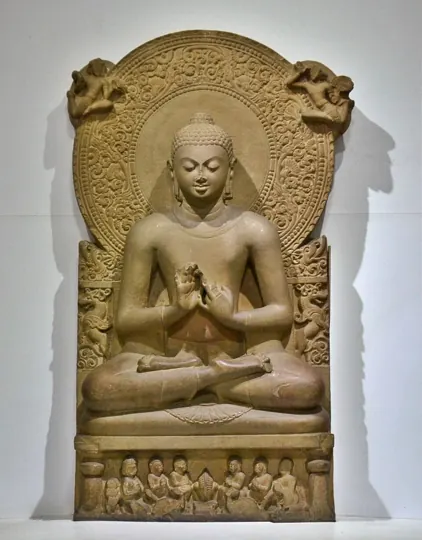
Siddhartha Gautama was born at Lumbini (in today’s Nepal) into the Shakya clan of Kapilavastu. His father was Shuddhodana and his mother Mahamaya. Tradition dates his life to 563–483 BCE; many historians now place it about a century later. Moved by the sight of an old man, a sick man, a dead body and an ascetic, he left home at 29: the Great Renunciation (mahabhinishkramana). After years of searching he gained enlightenment (full understanding of the truth) at 35 under a pipal tree at Bodh Gaya. He gave his first sermon at Sarnath near Varanasi (‘turning the wheel of dharma’) and died at 80 at Kushinagar, the mahaparinirvana or final release.
Prelims 2024 asked: Gautama Buddha was generally known by which of the following epithets? An epithet is a title or nickname. Shakyamuni (‘sage of the Shakyas’) and Tathagata (‘one who has thus gone’) are his; Nayaputta refers to Mahavira. The answer is 2 and 3 only (b). Prelims 2014 asked: Which of the following Kingdoms were associated with the life of the Buddha? He spent most of his life in Kosala (King Prasenajit, capital Shravasti) and Magadha (Kings Bimbisara and Ajatashatru, capital Rajagriha), so the answer is 3 and 4 only (c).
With reference to ancient India, Gautama Buddha was generally known by which of the following epithets ? 1. Nayaputta 2. Shakyamuni 3. Tathagata Select the correct answer using the code given below :
- 1 only
- 2 and 3 only
- 1, 2 and 3
- None of the above are epithets of Gautama Buddha
Show answer
Answer: (b) · UPSC official key
Which of the following Kingdoms were associated with the life of the Buddha? 1. Avanti 2. Gandhara 3. Kosala 4. Magadha Select the correct answer using the code given below.
- 1, 2 and 3
- 2 and 4
- 3 and 4 only
- 1, 3 and 4
Show answer
Answer: (c) · UPSC official key
The Buddha’s teaching begins with the Four Noble Truths, much like a doctor’s method: name the illness, find its cause, say it can be cured, give the medicine. Life involves suffering (dukkha); suffering has a cause, desire or craving (tanha); suffering can end; and the way to end it is the Eightfold Path. The path is right view, right resolve, right speech, right action, right livelihood, right effort, right mindfulness and right concentration. It is a Middle Path between luxury and extreme self-punishment. He also taught that nothing lasts forever (anicca) and that there is no permanent self (anatta). Karma, not caste or sacrifice, shapes rebirth.
Prelims 2013 asked which describes best the concept of Nirvana in Buddhism. Nirvana literally means ‘blowing out’, like a candle. So the best answer is the extinction of the flame of desire (a): the end of craving, and so of rebirth, not the destruction of the self.
Which one of the following describes best the concept of Nirvana in Buddhism?
- The extinction of the flame of desire
- The complete annihilation of self
- A state of bliss and rest
- A mental stage beyond all comprehension
Show answer
Answer: (a) · UPSC official key
The Buddhist community has three jewels: the Buddha, the dhamma (teaching) and the sangha (order of monks and nuns). The sangha was open to all varnas and, after some hesitation, to women. Its rules are in the Vinaya Pitaka.
GS Paper IV (2020) asked: What teachings of Buddha are most relevant today and why? Strong answers use the Middle Path (against excess and buying too much), right livelihood (honest business), non-violence and compassion (for conflict and climate), mindfulness (for mental health), and his advice to test ideas instead of accepting them blindly (against fake news).
What teachings of Buddha are most relevant today and why? Discuss.
What UPSC asks
Prelims: epithets (2024); kingdoms (2014); nirvana (2013). Mains: teachings relevant today (GS IV 2020).
Buddhist councils, schools and texts
Four councils (great meetings of monks) mark the growth of Buddhism, and each one is a favourite exam item.
| Council | Place, date and patron | Presided by | Outcome |
|---|---|---|---|
| First | Rajagriha, about 483 BCE, Ajatashatru | Mahakassapa | Sutta and Vinaya compiled (recited by Ananda and Upali) |
| Second | Vaishali, about 383 BCE, Kalashoka | Sabakami | Split into Sthaviravadins and Mahasanghikas |
| Third | Pataliputra, about 250 BCE, Ashoka | Moggaliputta Tissa | Abhidhamma added; missions sent abroad |
| Fourth | Kashmir, 1st century CE, Kanishka | Vasumitra (with Ashvaghosha) | Commentaries in Sanskrit; Mahayana grows |
The Sthaviravadins (‘elders’) gave rise to the Theravada and other early schools. The Mahasanghikas (‘great assembly’) gave rise to the Lokottaravadins and helped prepare the way for Mahayana. Prelims 2020 tested this: the statement that Sthaviravadins belong to Mahayana Buddhism is wrong, while the Lokottaravadin sect was an offshoot of Mahasanghika sect of Buddhism, and the Mahasanghikas’ deification of the Buddha (treating him as a god) fostered Mahayana. The answer is 2 and 3 only (b).
With reference to the religious history of India, consider the following statements : 1. Sthaviravadins belong to Mahayana Buddhism. 2. Lokottaravadin sect was an offshoot of Mahasanghika sect of Buddhism. 3. The deification of Buddha by Mahasanghikas fostered the Mahayana Buddhism. Which of the statements given above is/are correct ?
- 1 and 2 only
- 2 and 3 only
- 3 only
- 1, 2 and 3
Show answer
Answer: (b) · UPSC official key
Prelims 2017 offered the statement that Sautrantika and Sammitiya were the sects of Jainism. That is wrong: both were Buddhist schools. The second statement, that the Sarvastivadins held that the constituents of phenomena were not wholly momentary but existed forever in a latent form, is right. (Sarvastivada means ‘the doctrine that all exists’). The answer is 2 only (b).
With reference to the religious history of India, consider the following statements : 1. Sautrantika and Sammitiya were the sects of Jainism. 2. Sarvastivadin held that the constituents of phenomena were not wholly momentary, but existed forever in a latent form. Which of the statements given above is/are correct ?
- 1 only
- 2 only
- Both 1 and 2
- Neither 1 nor 2
Show answer
Answer: (b) · UPSC official key
Mahayana (‘great vehicle’) worshipped the Buddha in images and honoured bodhisattvas, beings who delay their own nirvana to help others. Nagarjuna founded its Madhyamaka philosophy. Watch the names: Mahayana followers called the older schools “Hinayana” (‘lesser vehicle’), but those schools called themselves Theravada, the way of the elders. Learn the main bodhisattvas: Avalokiteshvara, also called Padmapani and Lokeshvara (compassion); Manjushri (wisdom); Vajrapani (protection); and Maitreya. Prelims 2018 asked who is a future Buddha, yet to come to save the world. The answer is Maitreya (c). Vajrayana, the tantric form, grew from about the seventh century in eastern India and spread to Tibet.
With reference to Indian history, who among the following is a future Buddha, yet to come to save the world ?
- Avalokiteshvara
- Lokesvara
- Maitreya
- Padmapani
Show answer
Answer: (c) · UPSC official key
The Pali canon is the Tripitaka (‘three baskets’): the Sutta Pitaka (the Buddha’s talks), the Vinaya Pitaka (rules for the sangha) and the Abhidhamma Pitaka (philosophy). The Jatakas tell the Buddha’s earlier lives. Later works include the Milindapanha (the Greek king Menander’s questions to the monk Nagasena), Ashvaghosha’s Buddhacharita, and the Sri Lankan chronicles Dipavamsa and Mahavamsa.
What UPSC asks
Prelims: councils; schools (2017, 2020); bodhisattvas (2018). Mains: growth of Mahayana and its art. Next likely: Pali’s classical language status (2024).
Mains box: analysis and answer points
- Teachings for today: Middle Path vs consumerism, right livelihood, compassion, mindfulness, testing ideas against misinformation.
- Asked: Mains 2020 (GS Paper IV, 10 marks): What teachings of Buddha are most relevant today and why?
Practice
Practice MCQs (8)
Consider the following pairs: Event in the life of the Buddha : Place
1. Mahabhinishkramana (the Great Departure) : Kapilavastu
2. Sambodhi (Enlightenment) : Uruvela
3. Dharmachakra-pravartana (the First Sermon) : Rajagriha
4. Mahaparinirvana : Kusinara
How many of the pairs given above are correctly matched?
Answer (c) & explanation
Three pairs are correct. Siddhartha left his home at Kapilavastu, the Shakya capital, at the age of 29 (the Great Departure). He attained enlightenment under a pipal tree at Uruvela (modern Bodh Gaya) on the bank of the Niranjana. He then walked to the Deer Park at Isipatana (Sarnath) near Varanasi, where he preached his first sermon to five former companions; Rajagriha, the Magadhan capital, is linked with Bimbisara and later with the First Council, not with the first sermon. He passed away at Kusinara (Kushinagar), in the territory of the Mallas.
Devadatta, who according to Buddhist tradition tried to take over the leadership of the Sangha, caused its first schism and sought the support of Prince Ajatashatru, was
Answer (c) & explanation
Devadatta was a Shakya and the Buddha's cousin who had become a monk. The Vinaya says that he asked the ageing Buddha to hand over the leadership of the Sangha, was refused, and then plotted against him with the help of Prince Ajatashatru, who was impatient to replace his father Bimbisara. He also proposed stricter rules (such as forest dwelling and vegetarianism for all monks) and led some young monks away, the first split in the Sangha. The minister who asked about the Vajjis was Vassakara, and the chief disciple for wisdom was Sariputta.
With reference to the Fourth Buddhist Council held in Kashmir under Kanishka, consider the following statements:
1. It was presided over by Vasumitra, with Ashvaghosha as his deputy.
2. Its proceedings were conducted in Pali.
3. It is associated with the Sarvastivada school and the compilation of the Mahavibhasha commentary.
Which of the statements given above is/are correct?
Answer (b) & explanation
Statements 1 and 3 are correct. The Fourth Council met at Kundalavana in Kashmir under the Kushana king Kanishka (first-second century CE). Tradition names Vasumitra as president and the poet-philosopher Ashvaghosha as vice-president. It was a council of the Sarvastivada school of the north-west, and the great commentary on its Abhidharma, the Mahavibhasha, is linked with it. Statement 2 is wrong: the work was done in Sanskrit, a sign of the shift of northern Buddhism from Pali to Sanskrit. The Theravada tradition of Sri Lanka does not count this council.
With reference to the First Buddhist Council, consider the following statements:
1. It was held in the Saptaparni cave near Rajagriha.
2. Upali recited the rules of the Vinaya and Ananda recited the discourses of the Buddha.
3. It was presided over by Mahakassapa.
Which of the statements given above is/are correct?
Answer (d) & explanation
All three statements are correct. According to tradition, the First Council met in the Saptaparni cave on the Vaibhara hill near Rajagriha in the rainy season after the Buddha's death, with about five hundred arhats. It was convened and presided over by Mahakassapa, the senior disciple. Upali, the former barber who had become an expert in monastic discipline, recited the Vinaya, and Ananda, the Buddha's attendant who had heard most of his sermons, recited the Suttas. The aim was to fix the teaching in memory before disagreements could grow.
Which one of the following pairs of a Buddhist philosophical school and its exponent is correctly matched?
Answer (c) & explanation
Nagarjuna (c. second century CE), traditionally linked with the Satavahana realm in the Deccan, founded the Madhyamaka school, also called Shunyavada because it teaches that all things are empty (shunya) of independent existence. His disciple Aryadeva carried the school forward. The other great Mahayana school, Yogachara, also called Vijnanavada ('consciousness only'), was systematised by the brothers Asanga and Vasubandhu in the fourth century CE. Nagasena was the monk in the Milindapanha, and Moggaliputta Tissa presided over the Third Council.
Consider the following pairs: Figure in Mahayana Buddhism : Chiefly associated with
1. Avalokiteshvara : Compassion
2. Manjushri : Wisdom
3. Amitabha : The future Buddha who will appear on earth
Which of the pairs given above is/are correctly matched?
Answer (b) & explanation
Pairs 1 and 2 are correct. Avalokiteshvara, often shown holding a lotus as Padmapani, is the Bodhisattva of compassion. Manjushri, shown with a sword that cuts through ignorance and a book, is the Bodhisattva of wisdom. Pair 3 is wrong: Amitabha is a celestial Buddha who presides over the western paradise of Sukhavati, central to Pure Land devotion; the future Buddha who will appear on earth is Maitreya. These figures became objects of worship once the Mahayana developed the Bodhisattva ideal.
The early Buddhist school whose name expresses its central thesis that the elements of existence (dharmas) exist in the past, the present and the future, and which was strong in Kashmir and Gandhara, is the
Answer (d) & explanation
Sarvastivada means 'the doctrine that all exists' (sarvam asti): its teachers held that the dharmas exist in all three times, past, present and future, which explained how past karma can bear fruit. It was the dominant school of Kashmir and Gandhara, had its own Vinaya and Abhidharma in Sanskrit, and is linked with the Fourth Council and the Mahavibhasha. The Sautrantikas broke away by rejecting this view and accepting only the sutras as authoritative. Yogachara and Madhyamaka are later Mahayana philosophies.
Consider the following statements: Statement-I: The Kathavatthu, a text of the Abhidhamma Pitaka, is traditionally associated with the Third Buddhist Council held at Pataliputra. Statement-II: According to the Theravada tradition, Moggaliputta Tissa composed the Kathavatthu at that council to refute views that the Theravadins regarded as heretical.
Which one of the following is correct in respect of the above statements?
Answer (a) & explanation
Both statements are correct, and Statement-II explains Statement-I. The Sri Lankan chronicles say that the Third Council was held at Pataliputra under Ashoka to purge the Sangha of monks holding wrong views, and that its president Moggaliputta Tissa composed the Kathavatthu ('Points of Controversy'), which examines and rejects more than two hundred propositions of other schools. That is precisely why the text is tied to the Third Council. Note that Ashoka's own inscriptions do not mention a council; the account comes from the Theravada chronicles, though the Schism Edict shows his concern for Sangha unity.
0 / 0 correct
Write an answer
In 150 words, explain the significance of Religious Movements with one recent example.
Flashcards (9)
Where did the Buddha give his first
sermon? Sarnath, near Varanasi.
Two epithets of the Buddha?
Shakyamuni and Tathagata.
What is the cause of suffering in Buddhism?
Desire or craving (tanha).
What does nirvana mean?
The extinction of the flame of desire.
Which council split the sangha into two?
The second, at Vaishali.
Who presided over the third council?
Moggaliputta Tissa.
Who held the fourth council?
Kanishka, in Kashmir.
Who is the future Buddha?
Maitreya.
The three Pitakas?
Sutta, Vinaya and Abhidhamma.
Read more: related explainers
In the news
- 20 Oct 2026Sirpur in Chhattisgarh enters UNESCO’s Tentative List of World Heritage sites
- 15 Oct 2026PM inaugurates five Ladakh projects: Nimmu–Padum–Darcha road, Leh terminal, Hanu hydro
- 14 Oct 2026HAL, NCF and ASI sign MoA for Hampi, Taj Mahal and Bekal Fort
- 11 Oct 2026Birth anniversaries: Jayaprakash Narayan and Nanaji Deshmukh
 Next topic · 5.3 →Religious Movements: Jainism and Buddhism: Spread, decline and legacy
Syllabus: Prelims GS-I · History of India and Indian National Movement.