
Chapter 4 · Topic 4.1 · Prelims + Mains1 of 2
Vedic Civilization: Vedic texts and Rigvedic life
Key points
- The Vedas were composed and passed on by memory (shruti) for centuries; Rigveda has 1,028 hymns in 10 mandalas.
- Rigvedic polity was tribal: rajan, purohita, senani, voluntary bali; sabha, samiti, vidatha and gana; Battle of Ten Kings.
- Economy was herding (cattle = wealth, barley crop), no iron or coins; religion was nature gods and yajnas, no temples (Prelims 2012).
Prelims box: facts and traps
- Satyameva Jayate: Mundaka Upanishad (Prelims 2014).
- Gayatri mantra: Rigveda Book 3; Purusha Sukta: Book 10 (first mention of four varnas).
- Trap (Prelims 2024): the Upanishads do have parables (Nachiketa, Satyakama Jabala).
- Rivers: Vitasta = Jhelum, Asikni = Chenab, Parushni = Ravi, Vipas = Beas, Shutudri = Sutlej.
- Boghazkoi (about 1400 BCE): names Indra, Mitra, Varuna and the Nasatyas.
- Gods: Indra about 250 hymns, Agni about 200.
The Vedic people and the Vedic texts
After the Harappan cities declined, a new culture took shape in the north-west. We know it mainly from texts, not from cities. Its people called themselves Arya and spoke an early form of Sanskrit. Sanskrit belongs to the Indo-European family of languages, so it is a distant cousin of Persian, Greek and Latin. Most scholars think Indo-Aryan speakers came into the subcontinent in stages from Central Asia during the second millennium BCE (the 1000 years from 2000 to 1000 BCE); the details are still debated. A treaty inscription of about 1400 BCE from Boghazkoi in Anatolia (Türkiye) names the Vedic gods Indra, Mitra, Varuna and the Nasatyas.
Historians split the period into the Early Vedic or Rigvedic age (about 1500–1000 BCE) and the Later Vedic age (about 1000–600 BCE). Veda means knowledge. The texts were composed and passed on by mouth for centuries, memorised word-perfect, like a family recipe passed down without a notebook, and written down much later. They are called shruti, ‘what was heard’, as against smriti, ‘what is remembered’, such as the Dharmashastras (law books) and the epics.
| Text | What it contains |
|---|---|
| Rigveda | 1,028 hymns in 10 mandalas, mostly praising gods; Books 2–7 are the oldest; the Gayatri mantra is in Book 3 and the Purusha Sukta in Book 10 |
| Samaveda | Rigvedic verses set to melodies for singing at sacrifices; the root of Indian music |
| Yajurveda | Formulas for performing sacrifices; Shukla (white) and Krishna (black) branches |
| Atharvaveda | Charms, spells and prayers of everyday life: healing, protection, love and harmony |
| Brahmanas, Aranyakas, Upanishads | Prose on rituals; ‘forest texts’ on their meaning; philosophy of atman and brahman |
| Vedangas (six) | Shiksha (phonetics), Kalpa (ritual), Vyakarana (grammar), Nirukta (etymology), Chhandas (metre), Jyotisha (astronomy) |
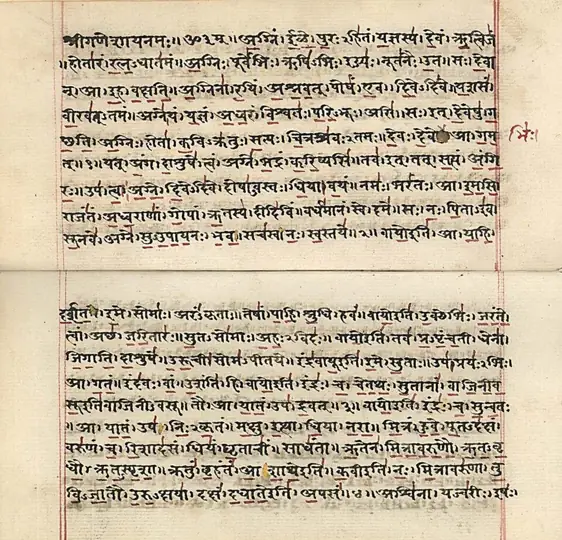
A Rigveda manuscript copied on paper in the early 19th century. The hymns were passed on by mouth for many centuries before being written down.
The Upanishads need special care. Prelims 2024 asked about two statements: There are no parables in Upanishads, and Upanishads were composed earlier than the Puranas. A parable is a short story that teaches a lesson. The first statement is wrong, because the Upanishads are full of stories, such as Nachiketa and Yama in the Katha Upanishad and Satyakama Jabala and Svetaketu in the Chandogya. The second is right: the main Upanishads (roughly 800–300 BCE) are much older than the Puranas. So the answer is 2 only (b).
Consider the following statements : 1. There are no parables in Upanishads. 2. Upanishads were composed earlier than the Puranas. Which of the statements given above is/are correct ?
- 1 only
- 2 only
- Both 1 and 2
- Neither 1 nor 2
Show answer
Answer: (b) · UPSC official key
Prelims 2014 asked where the national motto of India, ‘Satyameva Jayate’ (“truth alone triumphs”), inscribed below the Emblem of India, is taken from. The answer is the Mundaka Upanishad (d). Learn a few such links: the Gayatri mantra (Rigveda, Book 3, addressed to Savitri, the sun god) and the Purusha Sukta (Rigveda, Book 10, the first mention of the four varnas).
The national motto of India, ‘Satyameva Jayate’ inscribed below the Emblem of India is taken from
- Katha Upanishad
- Chandogya Upanishad
- Aitareya Upanishad
- Mundaka Upanishad
Show answer
Answer: (d) · UPSC official key
What UPSC asks
Prelims: which text contains what; Upanishads (2024); Satyameva Jayate (2014). Mains: the Vedas as sources of history. Next likely: Vedic chanting, which is on UNESCO’s list of living (intangible) heritage.
Early Vedic (Rigvedic) life
The Rigvedic people lived in the land of seven rivers, Sapta Sindhu, in today’s Afghanistan, Pakistan and north-western India. The Indus (Sindhu) is the river named most often and the Saraswati the most sacred, called naditama, ‘best of rivers’. The Rigveda uses older names for the Punjab rivers: Vitasta (Jhelum), Asikni (Chenab), Parushni (Ravi), Vipas (Beas) and Shutudri (Sutlej).
Political life was tribal. The jana (tribe) was led by a rajan, more a chief than a king, whose main job was to protect the tribe and its cattle. The purohita (priest) and the senani (army chief) helped him. People gave him voluntary gifts called bali, not fixed taxes. Assemblies mattered: the sabha (a small council of elders), the samiti (the larger meeting of the whole tribe, which could accept or choose the rajan), the vidatha and the gana. Think of the sabha as a village panchayat of elders and the samiti as the full gram sabha. Women attended the sabha and the vidatha. Wars were often fought over cattle; the word for war, gavishti, means ‘search for cows’. The best-known battle is the Battle of Ten Kings on the Parushni (Ravi), where Sudas of the Bharata tribe defeated a group of ten tribes.
Society was built on kinship (family ties): the family (kula), the village (grama), the clan (vis) and the tribe (jana). Varna divisions were not yet rigid; the Rigveda speaks of the Arya and the Dasa or Dasyu. Women had fairly high status. They could attend assemblies and take part in sacrifices, and hymns are credited to women such as Apala, Ghosha, Lopamudra and Vishvavara. There is no evidence of child marriage.
The economy was mainly pastoral, based on herding animals. Cattle were the measure of wealth, and a rich man was gomat, ‘owner of cattle’. Barley (yava) was the main crop. Copper and bronze (ayas) were used, but not iron, and there were no coins. Prelims 2026 tested Rigvedic farming through evidence: the Rigveda’s mention of ashma chakra (stone pulley wheel) and ahava (strapped wooden pails) supports drawing water from wells, and oxen used even before the Rigveda support animal power. Mentions of axes and sickles do not, so the answer is 1 and 3 only (c).
Consider the following statements about the Rigvedic period : I. Irrigation from wells allowed agriculture to expand away from flood plains and strips on river margins into the present Punjab and Haryana plains having underground water levels reasonably close to the surface. II. Draught-animal power was employed to draw up water out of the wells. Which of the following information support/supports the above statements ? 1. There is evidence in the Rigveda of the use of ashma chakra (stone pulley wheel) and ahava (strapped wooden pails) to draw up water. 2. Mention has been made in the Rigveda of the use of implements like parashu/ kulisha (axe) and datra /sreni (sickle). 3. There is a history of the use of ox, even before the Rigveda, for ploughing the land and pulling the carts. Select the answer using the code given below :
- 1 and 2 only
- 1, 2 and 3
- 1 and 3 only
- 3 only
Show answer
Answer: (c) · UPSC provisional key (final key awaited)
Religion centred on the forces of nature. Indra, the warrior god of rain and thunder, called Purandara (‘destroyer of forts’), has about 250 hymns, the most of any god. Agni, the fire god who carried offerings from humans to the gods, has about 200. Varuna upheld rita, the order of the universe; Soma was the sacred drink; Surya, Savitri and the dawn goddess Ushas were also praised. Prelims 2012 asked what the religion of early Vedic Aryans was primarily of. The answer is worship of nature and Yajnas (fire sacrifices) (c): there were no temples, images or bhakti.
The religion of early Vedic Aryans was primarily of
- Bhakti
- image worship and Yajnas
- worship of nature and Yajnas
- worship of nature and Bhakti
Show answer
Answer: (c) · UPSC official key
What UPSC asks
Prelims: rivers, assemblies, gods; religion (2012); wells (2026). Mains: tribal politics and a herding economy. Next likely: Rigvedic evidence in debates on the Saraswati.
Mains box: analysis and answer points
- Vedas as sources: rich on beliefs, society and assemblies; weak on dates and places; read with archaeology.
- Tribal polity: chief bound by sabha and samiti, women in assemblies, wars over cattle (gavishti).
- Likely next angle: Rigvedic evidence in the Saraswati debate.
Practice
Practice MCQs (8)
In the context of the early Vedic period, the term 'Sapta Sindhu' refers to
Answer (b) & explanation
Sapta Sindhu, 'the land of seven rivers', is the region in which the early Vedic people lived. R.S. Sharma places it in the north-west, centred on the Punjab: the Indus with its tributaries and the Saraswati. The exact list of seven varies in the sources, but the region is clear. The Avesta knows the same land as Hapta Hendu.
Consider the following statements about the later Vedic texts:
1. The Aranyakas are independent texts not attached to any of the four Vedas.
2. The Brahmanas are mainly prose texts that explain the meaning and performance of sacrifices.
3. The Aranyakas, the 'forest books', dwell on the symbolic and mystical meaning of ritual.
Which of the statements given above is/are correct?
Answer (c) & explanation
Each Veda grew in layers: the Samhita (hymns), then the Brahmanas (prose on ritual), then the Aranyakas and finally the Upanishads. The Aranyakas, meant to be studied in the forest, turn from the outward act of sacrifice to its symbolic and mystical meaning, and so lead into the Upanishads. They are part of the Vedic corpus of particular schools, for example the Aitareya Aranyaka of the Rigveda, so statement 1 is wrong.
R.S. Sharma notes that the later Vedic texts speak of only three of the four ashramas (stages of life). Which stage was not yet well established in that period?
Answer (d) & explanation
The scheme of four ashramas, brahmacharya (student), grihastha (householder), vanaprastha (forest-dweller) and sannyasa (renouncer), is fully set out only in post-Vedic texts such as the Dharmasutras. Sharma notes that the later Vedic texts mention only three, and the fourth, final stage was not well established. The Chandogya Upanishad, for example, speaks of three branches of dharma.
The Rigveda mentions the rivers Kubha, Krumu, Gomati and Suvastu. These names show that the geographical horizon of the early Vedic people included
Answer (d) & explanation
R.S. Sharma identifies the Rigvedic Kubha with the Kabul, the Krumu with the Kurram, the Gomati with the Gomal and the Suvastu with the Swat. All four are western tributaries of the Indus that flow through eastern Afghanistan and the north-western frontier. Together with the Sapta Sindhu of the Punjab, they mark the early Vedic area of settlement.
With reference to women and marriage in the Rigvedic period, consider the following statements:
1. The practice of niyoga (levirate) is known from the Rigveda.
2. The remarriage of widows was forbidden.
3. There is no clear evidence of child marriage.
Which of the statements given above is/are correct?
Answer (a) & explanation
R.S. Sharma notes that the Rigveda shows the practice of levirate (niyoga), in which a childless widow could have a son by her husband's younger brother, and also of widow remarriage. There is no clear evidence of child marriage; the marriageable age in the Rigveda seems to have been 16 to 17. So statement 2 is wrong: widow remarriage was not forbidden in Rigvedic times. Restrictions on women grew in the later Vedic and post-Vedic periods.
Arrange the following texts in the chronological order of their composition, earliest first:
1. The Ashtadhyayi of Panini
2. The family books of the Rigveda
3. The Chandogya Upanishad
4. The Atharvaveda Samhita
Select the correct answer using the code given below:
Answer (a) & explanation
The family books of the Rigveda are the oldest Vedic texts (c. 1500-1000 BCE). The Atharvaveda Samhita, with the Sama and Yajur Samhitas, belongs to the later Vedic period (c. 1000-600 BCE). The Chandogya, one of the oldest prose Upanishads, is placed by Olivelle around the sixth century BCE, before the Buddha. Panini's Ashtadhyayi (c. fifth-fourth century BCE) is post-Vedic and describes Vedic Sanskrit as an older form of the language.
With reference to the geographical spread of the later Vedic people, consider the following statements:
1. The centre of Vedic culture shifted from the Punjab to the Ganga-Yamuna doab and the Kurukshetra region.
2. Kosala, Kashi and Videha are named in the later Vedic texts.
3. The Aitareya Brahmana names peoples such as the Andhras, Pundras, Shabaras and Pulindas as living outside the Vedic social order.
Which of the statements given above is/are correct?
Answer (d) & explanation
R.S. Sharma shows that in the later Vedic period the Vedic people spread from the Punjab over the whole of western Uttar Pradesh, and the Kuru-Panchala country of the doab became the centre of their culture. Further east, the later Vedic texts know Kosala, Kashi and Videha. The Aitareya Brahmana tells how the sons of Vishvamitra who disobeyed him became the Andhras, Pundras, Shabaras and Pulindas, peoples living on the borders, outside the Vedic order. All three statements are correct.
With reference to the nature of the Rigvedic polity, consider the following statements:
1. The term 'jana' (people or tribe) occurs often in the Rigveda, but the term 'janapada' (territory) does not occur at all.
2. The chief was assisted by a purohita; Vasishtha and Vishvamitra are well-known examples.
3. Regular taxes were collected for the chief by an officer called the bhagadugha.
Which of the statements given above is/are correct?
Answer (a) & explanation
R.S. Sharma notes that jana occurs about 275 times in the Rigveda while janapada does not occur even once: loyalty was to the tribe, not yet to a territory. The purohita was the chief's main helper; Vasishtha and Vishvamitra, the priests linked with the Bharata chief Sudas, are the famous examples. Regular taxes and the bhagadugha belong to the later Vedic period, so statement 3 is wrong.
0 / 0 correct
Write an answer
In 150 words, explain the significance of Vedic Civilization with one recent example.
Flashcards (16)
How many hymns and mandalas in the
Rigveda? 1,028 hymns in 10 mandalas.
Which Rigvedic books are the oldest?
Books 2 to 7 (the family books).
Where is the Gayatri mantra?
Rigveda, Book 3, addressed to Savitri.
Where are the four varnas first mentioned?
The Purusha Sukta, Rigveda Book 10.
Which Veda is the root of Indian music?
The Samaveda.
Source of 'Satyameva Jayate'?
The Mundaka Upanishad.
Which inscription names Vedic gods in
Anatolia? Boghazkoi, about 1400 BCE.
Most sacred river in the Rigveda?
The Saraswati (naditama).
Rigvedic name of the Ravi?
Parushni.
Who won the Battle of Ten Kings?
Sudas of the Bharata tribe.
Rigvedic word for war?
Gavishti, 'search for cows'.
God with the most Rigvedic hymns?
Indra (about 250).
Who upheld rita?
Varuna.
Main Rigvedic crop?
Barley (yava).
Name two women composers of Rigvedic
hymns. Apala, Ghosha, Lopamudra or Vishvavara.
Which assembly disappeared in the Later
Vedic age? The vidatha.
Read more: related explainers
In the news
- 20 Oct 2026Sirpur in Chhattisgarh enters UNESCO’s Tentative List of World Heritage sites
- 15 Oct 2026PM inaugurates five Ladakh projects: Nimmu–Padum–Darcha road, Leh terminal, Hanu hydro
- 14 Oct 2026HAL, NCF and ASI sign MoA for Hampi, Taj Mahal and Bekal Fort
- 11 Oct 2026Birth anniversaries: Jayaprakash Narayan and Nanaji Deshmukh
 Next topic · 4.2 →Vedic Civilization: Later Vedic, iron and kingdoms
Syllabus: Prelims GS-I · History of India and Indian National Movement.