
Chapter 3 · Topic 3.1 · Prelims + Mains1 of 3
Inflation: Types and causes
Key points
- Inflation: sustained rise in the general price level.
- Types: creeping, walking, galloping, hyper; deflation, disinflation, stagflation, reflation, skewflation.
- Causes: demand-pull, cost-push, built-in expectations, structural supply gaps.
- Most inflationary: creating new money to fund a deficit (Prelims 2013, 2021).
9 PYQs 2015–2024
Prelims box: facts and traps
- Hyperinflation example: Zimbabwe, 2008.
- CPI 2024 series (12 February 2026): food and beverages 36.75% (down from 45.86%), still the largest of 12 divisions.
- Trap (Prelims 2021): inflation-indexed wages and rising interest rates do not cause demand-pull inflation.
Meaning and types of inflation
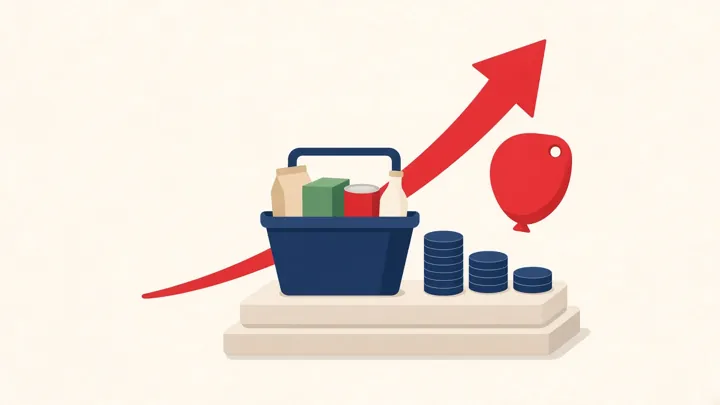
A ₹20 samosa now costs ₹22. When most prices rise like this for long, it is inflation.
| Term | Meaning |
|---|---|
| Inflation | Sustained rise in the general price level; money loses purchasing power |
| Creeping / walking / galloping / hyper | Rising rates: mild (below about 3%), moderate (single digit), double or triple digit, and runaway (as in Zimbabwe, 2008) |
| Deflation | Fall in the general price level (negative inflation) |
| Disinflation | Inflation falls but stays positive |
| Stagflation | High inflation with stagnant output and high unemployment (1970s oil shocks) |
| Reflation | Deliberate stimulus to lift prices and output after a slump |
| Skewflation | Prices of a few items (often food) rise sharply while others stay stable |
| Base effect | A low (or high) index a year ago makes this year’s rate look high (or low) |
What UPSC asks: Prelims: types by rate. Mains: stagflation vs disinflation. Next likely angle: the base effect.
Causes: demand-pull and cost-push
| Type | Cause | Examples |
|---|---|---|
| Demand-pull | Too much money chasing too few goods | Expansionary monetary or fiscal policy, rising incomes, credit boom |
| Cost-push | Higher costs of production pushed into prices | Crude oil shocks, wage-price spiral, supply failures, depreciation of the rupee |
| Built-in | Expectations of inflation | Wage indexation, firms’ pricing behaviour |
| Structural (India) | Supply bottlenecks | Monsoon dependence, storage and marketing gaps, low farm productivity |
Prelims 2021 listed five possible causes of demand-pull inflation. Expansionary policies, fiscal stimulus and higher purchasing power add to demand. Inflation-indexed wages push costs, and rising interest rates cool demand. Answer: 1, 2 and 4 only.
With reference to Indian economy, demand-pull inflation can be caused/increased by which of the following? 1. Expansionary policies 2. Fiscal stimulus 3. Inflation-indexing wages 4. Higher purchasing power 5. Rising interest rates Select the correct answer using the code given below.
- 1, 2 and 4 only
- 3, 4 and 5 only
- 1, 2, 3 and 5 only
- 1, 2, 3, 4 and 5
Show answer
Answer: (a) · UPSC official key
Prelims 2013 and 2021 both asked which way of financing a deficit is most inflationary. Answer: Creation of new money to finance a budget deficit. Monetising the deficit adds directly to money supply.
Which one of the following is likely to be the most inflationary in its effects?
- Repayment of public debt
- Borrowing from the public to finance a budget deficit
- Borrowing from the banks to finance a budget deficit
- Creation of new money to finance a budget deficit
Show answer
Answer: (d) · UPSC official key
What UPSC asks: Prelims: demand-pull vs cost-push (2021). Next likely angle: monetised deficits.
Mains box: analysis and answer points
- Base effect: a low index a year ago makes this year's rate look high.
- India's structural inflation: monsoon dependence, storage and marketing gaps.
Practice
Practice MCQs (8)
Which one of the following is the best example of demand-pull rather than cost-push inflation?
Answer (c) & explanation
Demand-pull inflation arises when spending power grows faster than the supply of goods. A large pay revision for government employees puts more income in households' hands and lifts consumption demand, which pulls prices up if supply does not keep pace. The other three are supply-side shocks: crop damage reduces supply, dearer coal raises the cost of electricity, and a weaker rupee raises the cost of imports. In each of those, prices rise because costs rise or supply shrinks, not because buyers have more money.
According to the quantity theory of money expressed as MV = PT, if the velocity of circulation (V) and the volume of transactions (T) remain constant, doubling the money supply (M) will:
Answer (b) & explanation
Irving Fisher's equation of exchange, MV = PT, says that money spent (money stock × the number of times each unit changes hands) equals the value of transactions (price level × volume of transactions). If V and T are held constant, P moves in proportion to M, so doubling M doubles P. This is the logic behind the monetarist view that sustained inflation is 'too much money chasing too few goods' and behind the conclusion that financing deficits by creating new money is the most inflationary route.
With reference to demand-pull and cost-push inflation, consider the following statements:
1. When an economy is operating below full capacity, a rise in aggregate demand raises output as well as prices.
2. Cost-push inflation shifts the aggregate supply curve to the left, so that prices rise while output tends to fall.
3. A wage-price spiral can begin as cost-push inflation and be sustained if monetary policy accommodates the higher costs.
Which of the statements given above is/are correct?
Answer (d) & explanation
All three statements are correct. Demand-pull inflation comes from aggregate demand outrunning supply; while there is slack, extra demand also draws idle capacity into use, so output rises along with prices, and near full capacity the effect falls mostly on prices. Cost- push inflation comes from the supply side (dearer oil, wages, raw materials or indirect taxes): the aggregate supply curve shifts left, prices go up and output falls, the stagflation-like case. In a wage-price spiral, workers seek higher wages to keep up with prices, firms pass the higher wage bill on, and the loop continues only if money and credit expand to finance it.
Consider the following developments:
1. A sharp depreciation of the rupee against the US dollar
2. A rise in global crude oil prices
3. Wage increases that outpace the growth of labour productivity
4. An increase in the excise duty on diesel
How many of the above would tend to cause cost-push inflation in India?
Answer (d) & explanation
All four raise the cost of producing or supplying goods. A weaker rupee makes imports dearer in rupee terms (imported inflation), and India imports most of its crude oil, edible oils and many inputs. Higher global crude prices raise fuel, freight and fertiliser costs across the economy. Wage rises beyond productivity growth raise unit labour costs, which firms pass on in prices. Higher indirect taxes such as excise on diesel raise the delivered price of fuel and, through transport costs, of almost everything else. Each shifts aggregate supply to the left rather than adding to demand.
With reference to food inflation in India, consider the following statements:
1. A deficient or erratic monsoon can push up food prices through supply shocks.
2. Rising incomes that shift demand towards protein-rich foods such as milk, eggs, meat and pulses add to structural food inflation.
3. After the shift to the CPI series with base 2024=100, food and beverages is no longer the largest division in the CPI basket.
Which of the statements given above is/are correct?
Answer (b) & explanation
Statements 1 and 2 are correct. Indian food prices are highly sensitive to the monsoon, heat waves and unseasonal rain, which hit perishable vegetables and pulses hardest. Over the longer term, dietary diversification with rising incomes raises demand for protein foods faster than supply, a structural driver the Economic Survey has repeatedly highlighted. Statement 3 is wrong: in the CPI 2024 series released by MoSPI on 12 February 2026, food and beverages has a combined weight of 36.75 per cent (down from 45.86 per cent in the 2012 series) but remains the largest of the 12 divisions; housing, water, electricity, gas and other fuels comes next at about 17.67 per cent.
A 'positive output gap', in which the actual output of an economy exceeds its potential output, generally indicates:
Answer (a) & explanation
The output gap is actual output minus potential output (the level the economy can sustain without accelerating inflation). When it is positive, the economy is running above capacity: firms work overtime, labour markets tighten and costs rise, so prices tend to accelerate. This is demand-side inflationary pressure. A negative gap means slack (idle capacity, unemployment above its natural rate) and disinflationary pressure. The RBI's monetary policy statements regularly refer to the output gap when judging whether growth is adding to inflation.
Consider the following statements: Statement-I: A sustained depreciation of the rupee tends to raise domestic inflation in India. Statement-II: Depreciation makes imported goods costlier in rupee terms, and India depends heavily on imports of crude oil and other inputs.
Which one of the following is correct in respect of the above statements?
Answer (a) & explanation
Both statements are correct and Statement-II explains Statement-I. The exchange- rate pass-through works mainly through import prices: when the rupee weakens, every dollar of imported crude oil, edible oil, fertiliser, coal, electronics and gold costs more rupees. These costs feed into fuel prices, transport, manufactured goods and, with a lag, the wider CPI basket. The size of the pass-through depends on how much of the cost is absorbed by firms or by taxes, but the direction is clear: depreciation is a source of imported inflation, which is why the RBI watches the rupee closely when inflation is already high.
With reference to explanations of inflation in developing economies, consider the following statements:
1. The structuralist school attributes inflation largely to supply bottlenecks such as low agricultural productivity and inadequate infrastructure.
2. The monetarist school holds that sustained inflation is essentially a monetary phenomenon, arising when money supply grows faster than real output.
3. The structuralist school holds that inflation in such economies can be cured quickly and at little cost through tight monetary policy alone.
Which of the statements given above are correct?
Answer (b) & explanation
Statements 1 and 2 are correct. The structuralist view, developed by Latin American economists and widely applied to India, traces inflation to rigidities in the real economy: an inelastic food supply, infrastructure and foreign-exchange bottlenecks, and skewed distribution. The monetarist view, associated with Milton Friedman, says that inflation is always and everywhere a monetary phenomenon. Statement 3 reverses the structuralist position: precisely because the causes lie in supply constraints, structuralists argue that monetary squeezing alone cannot cure inflation without hurting growth; they prescribe supply- side and structural reforms.
0 / 0 correct
Prelims PYQs on this topic (8)
Consider the following statements in respect of the digital rupee :
- 1. It is a sovereign currency issued by the Reserve Bank of India (RBI) in alignment with its monetary policy.
- 2. It appears as a liability on the RBI's balance sheet.
- 3. It is insured against inflation by its very design.
- 4. It is freely convertible against commercial bank money and cash.
Which of the statements given above are correct ?
Answer (d) & explanation
Statements 1, 2 and 4 are correct (d). Statement 1 is right: the e-rupee (Central Bank Digital Currency, pilots since 2022) is legal tender issued by the RBI in line with its monetary policy. Statement 2 is right: like a currency note, it is a liability on the RBI's balance sheet. Statement 4 is right: it can be swapped one-to-one for bank deposits and cash. Statement 3 is wrong: like any currency, it loses value with inflation; nothing in its design protects it.
Notice the difference from crypto: Bitcoin has no issuer and its price swings, while the e-rupee is just a digital form of the rupee. The RBI runs both a retail (e₹-R) and a wholesale (e₹-W) version, and has added offline and programmable features.
"insured against inflation". No currency, paper or digital, is.
Answer as per the official UPSC answer key.
With reference to the Indian economy, consider the following statements :
- 1. An increase in Nominal Effective Exchange Rate (NEER) indicates the appreciation of rupee.
- 2. An increase in the Real Effective Exchange Rate (REER) indicates an improvement in trade competitiveness.
- 3. An increasing trend in domestic inflation relative to inflation in other countries is likely to cause an increasing divergence between NEER and REER.
Which of the above statements are correct ?
Answer (c) & explanation
Statements 1 and 3 are correct (c). Statement 1 is right: NEER (Nominal Effective Exchange Rate) is a weighted average of the rupee against a basket of trading partners' currencies; a rise means the rupee has appreciated. Statement 2 is wrong: REER adjusts NEER for inflation differences. A rising REER means Indian goods are getting dearer abroad, so competitiveness falls, not improves. Statement 3 is right: if India's inflation runs higher than its partners', REER rises even when NEER does not, so the two drift apart.
Notice that the RBI publishes NEER and REER on 40-currency and 6-currency baskets. A REER above 100 suggests the rupee is overvalued against the base year.
statement 2 reverses the effect. A stronger real rupee hurts exporters; it does not help them.
Answer as per the official UPSC answer key.
With reference to the Indian economy, consider the following statements :
- 1. If the inflation is too high, Reserve Bank of India (RBI) is likely to buy government securities.
- 2. If the rupee is rapidly depreciating, RBI is likely to sell dollars in the market.
- 3. If interest rates in the USA or European Union were to fall, that is likely to induce RBI to buy dollars.
Which of the statements given above are correct ?
Answer (b) & explanation
Statements 2 and 3 are correct (b). Statement 1 is wrong: to fight high inflation, the RBI sells government securities through open market operations, pulling money out of the system; buying them would add money. Statement 2 is right: to stop the rupee falling fast, the RBI sells dollars from its forex reserves, which raises the supply of dollars. Statement 3 is right: when US or EU interest rates fall, foreign money flows into India and the rupee tends to rise, so the RBI buys dollars to smooth this and add to reserves.
Notice sterilisation: when the RBI buys dollars it releases rupees, so it may sell bonds to soak them up. India's forex reserves crossed $700 billion in 2024.
statement 1 has the right tool but the wrong direction. Always ask: does this action add money or remove it?
Answer as per the official UPSC answer key.
With reference to the Indian economy, what are the advantages of "Inflation-Indexed Bonds (IIBs)" ?
- 1. Government can reduce the coupon rates on its borrowing by way of IIBs.
- 2. IIBs provide protection to the investors from uncertainty regarding inflation.
- 3. The interest received as well as capital gains on IIBs are not taxable.
Which of the statements given above are correct ?
Answer (a) & explanation
Statements 1 and 2 are correct (a). In an Inflation-Indexed Bond, the principal, and so the interest, is adjusted for inflation. Statement 2 is right: this protects the investor's real return from uncertain inflation. Statement 1 is right: because of this cover, investors accept a lower coupon, which saves the government money on its borrowing. Statement 3 is wrong: there is no tax break; interest and capital gains on IIBs are taxable like any other bond.
Notice that India's IIBs of 2013 were linked to the WPI, and later ones to the CPI, but they drew little interest. Other countries' versions include the US TIPS. The Sovereign Gold Bond (2015) offered a different hedge, linked to gold prices.
statement 3 adds a tax benefit that sounds attractive. Indian IIBs never had one.
Answer as per the official UPSC answer key.
In India, which one of the following is responsible for maintaining price stability by controlling inflation ?
Answer (d) & explanation
The Reserve Bank of India controls inflation (d). The RBI Act, 1934, amended in 2016, says the primary objective of monetary policy is price stability while keeping growth in mind. The government sets a CPI inflation target of 4%, with a band of 2–6%, and the six-member Monetary Policy Committee sets the repo rate to meet it. Option (a) is wrong: the Department of Consumer Affairs tracks prices of essentials and runs consumer protection. Option (b) is wrong: the Expenditure Management Commission (2014) only advised on government spending. Option (c) is wrong: the FSDC, chaired by the Finance Minister, looks after financial stability, not inflation.
Notice that if inflation stays outside the band for three quarters in a row, the RBI must explain it in writing to the government.
Answer as per the official UPSC answer key.
Indian Government Bond Yields are influenced by which of the following?
- 1. Actions of the United States Federal Reserve
- 2. Actions of the Reserve Bank of India
- 3. Inflation and short-term interest rates
Select the correct answer using the code given below.
Answer (d) & explanation
All three influence Indian bond yields (d). A bond yield is the return investors demand for holding a bond; it moves opposite to the bond's price. Item 1 is right: if the US Federal Reserve raises rates, US bonds pay more, foreign investors sell Indian bonds, and Indian yields rise. Item 2 is right: RBI moves on the repo rate, and its bond purchases through open market operations, move yields directly. Item 3 is right: higher inflation and higher short-term rates make investors ask for a higher return on long bonds.
Notice that Indian government bonds joined JP Morgan's emerging market bond index in 2024, which drew foreign inflows. The 10-year G-Sec yield is India's benchmark interest rate.
Answer as per the official UPSC answer key.
Mains PYQs on this topic (1)
Write an answer
In 150 words, explain the significance of Inflation with one recent example.
Flashcards (7)
Stagflation?
High inflation with stagnant growth and unemployment.
Disinflation?
Falling but still positive inflation.
Base effect?
Last year's index level distorting this year's rate.
Demand-pull inflation is caused by?
Excess demand: expansionary policy, higher purchasing power.
Most inflationary way to fund a deficit?
Creating new money.
Wage-price spiral is which type?
Cost-push.
WPI base year?
2022-23.
Read more: related explainers
- Reserve Bank of India: History, Structure, Functions, Monetary Policy Committee, Surplus Transfer and the Autonomy Debate
- Inflation for UPSC: Meaning, Types, CPI vs WPI, Causes, Effects and How India Controls It (Notes + PYQs)
- Unemployment in India for UPSC: Types, How PLFS Measures It, Causes and Policy Responses (with PYQs)
In the news
- 23 Oct 2026PLFS changes from January 2027: new stratum for platform workers and unpaid work questions
- 21 Oct 2026Core sector grows 7.9% in September 2026; iron ore, electricity and coal lead
- 20 Oct 2026Financial inclusion saturation campaign in 2.70 lakh panchayats and ULBs from 21 October
- 15 Oct 2026PLFS September 2026: unemployment steady at 5%; urban women’s participation highest since October 2025
 Next topic · 3.2 →Inflation: Effects and measurement
Syllabus: GS-III · Indian Economy and issues relating to planning, mobilization, of resources, grow…