
Chapter 7 · Topic 7.1 · Prelims + Mains1 of 3
Pollution: Air pollution
Key points
- Air pollutants and sources.
- Smog, acid rain, cloud seeding.
- NAAQS, WHO AQG and NCAP.
- Water pollution.
10 PYQs 2016–2025
Prelims box: facts and traps
| Pollutant | Main sources |
|---|---|
| PM10 and PM2.5 | Combustion, road and construction dust, crop and waste burning |
| Sulphur dioxide | Burning coal and oil, smelting |
| Nitrogen oxides | Vehicles, power plants, soils |
| Carbon monoxide | Incomplete burning |
| Ground-level ozone | Formed from NOx and hydrocarbons in sunlight. |
- Performance-linked grants of ₹16,423.55 crore went to the 130 cities from 2019-20 to 2025-26, of which ₹11,575.54 crore (70.5%) has been reported as used on the PRANA portal (PIB, 30 July 2026).
- Source for the table: National Ambient Air Quality Standards notified by the Central Pollution Control Board under the Air (Prevention and Control of Pollution) Act, 1981, Gazette of India, 18 November 2009.
- WHO released new Global Air Quality Guidelines on 22 September 2021, its first update since 2005.
- Trap (UPSC Prelims 2022): “In a year, the highest levels of ozone pollution occur during the periods of inclement weather” is incorrect. “PM<sub>10</sub> can penetrate the lung barrier and enter the bloodstream” is incorrect.
- Trap (UPSC Prelims 2021): “Microwave stoves within homes” is incorrect. “Telephone lines” is incorrect.
On this page (3 sections)
Air pollution: sources and pollutants
Air pollution is the presence in the air of substances in amounts that harm people, other living things or materials. Primary pollutants are released directly, such as sulphur dioxide (SO2), nitrogen oxides (NOx), carbon monoxide (CO) and particulate matter (PM). Secondary pollutants such as ground-level ozone form in the air from reactions between primary pollutants.
| Pollutant | Main sources | Main harm |
|---|---|---|
| PM10 and PM2.5 | Combustion, road and construction dust, crop and waste burning | Lungs and heart; PM2.5 can enter the bloodstream (WHO, 2021) |
| Sulphur dioxide | Burning coal and oil, smelting | Acid rain, breathing problems |
| Nitrogen oxides | Vehicles, power plants, soils | Smog, acid rain, ozone formation |
| Carbon monoxide | Incomplete burning | Reduces oxygen carried by blood |
| Ground-level ozone | Formed from NOx and hydrocarbons in sunlight | Triggers asthma, harms crops |
According to the US Environmental Protection Agency, the largest source of sulphur dioxide emissions is Power plants using fossil fuels (Prelims 2024).
According to the Environmental Protection Agency (EPA), which one of the following is the largest source of sulphur dioxide emissions ?
- Locomotives using fossil fuels
- Ships using fossil fuels
- Extraction of metals from ores
- Power plants using fossil fuels
Show answer
Answer: (d) · UPSC official key
The steel industry releases oxides of sulphur, oxides of nitrogen, carbon monoxide and carbon dioxide (Prelims 2014: 1, 2, 3 and 4).
Which of the following are some important pollutants released by steel industry in India? 1. Oxides of sulphur 2. Oxides of nitrogen 3. Carbon monoxide 4. Carbon dioxide Select the correct answer using the code given below.
- 1, 3 and 4 only
- 2 and 3 only
- 1 and 4 only
- 1, 2, 3 and 4
Show answer
Answer: (d) · UPSC official key
Copper smelting is a concern because the slag can leach heavy metals and the plants release sulphur dioxide; release of lethal carbon monoxide was not accepted (Prelims 2021: 2 and 3 only).
Why is there a concern about copper smelting plants? 1. They may release lethal quantities of carbon monoxide into environment. 2. The copper slag can cause the leaching of some heavy metals into environment. 3. They may release sulphur dioxide as a pollutant. Select the correct answer using the code given below.
- 1 and 2 only
- 2 and 3 only
- 1 and 3 only
- 1, 2 and 3
Show answer
Answer: (b) · UPSC official key
Exposure to benzene comes from automobile exhaust, tobacco smoke and wood burning (Prelims 2020: 1, 2 and 3 only).
Which of the following are the reasons/factors for exposure to benzene pollution ? 1. Automobile exhaust 2. Tobacco smoke 3. Wood burning 4. Using varnished wooden furniture 5. Using products made of polyurethane Select the correct answer using the code given below :
- 1, 2 and 3 only
- 2 and 4 only
- 1, 3 and 4 only
- 1, 2, 3, 4 and 5
Show answer
Answer: (a) · UPSC official key
Magnetite particles, suspected of causing neurodegenerative problems, come from the brakes and engines of motor vehicles and from power plants (Prelims 2021: 1, 2 and 4 only).
Magnetite particles, suspected to cause neurodegenerative problems, are generated as environmental pollutants from which of the following? 1. Brakes of motor vehicles 2. Engines of motor vehicles 3. Microwave stoves within homes 4. Power plants 5. Telephone lines Select the correct answer using the code given below.
- 1, 2, 3 and 5 only
- 1, 2 and 4 only
- 3, 4 and 5 only
- 1, 2, 3, 4 and 5
Show answer
Answer: (b) · UPSC official key
Smog, acid rain and cloud seeding
Classical or sulphurous smog forms in cool, damp air from smoke and sulphur dioxide from burning coal, as in London in 1952. Photochemical smog forms on sunny days when nitrogen oxides and volatile organic compounds from vehicles and industry react in sunlight to make ozone, peroxyacetyl nitrate (PAN) and aldehydes. It irritates eyes and lungs and harms plants.
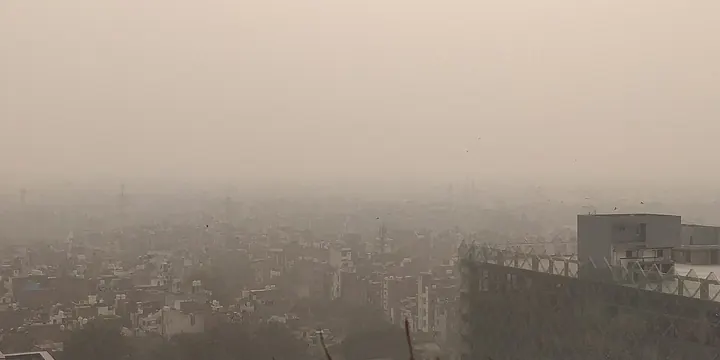
Acid rain forms when sulphur dioxide and nitrogen oxides react with water vapour to form sulphuric and nitric acids. It damages forests, lakes, soils and buildings; the yellowing of the Taj Mahal marble is a well-known Indian example of acid and particle damage.
Acid rain is caused by the pollution of the environment by nitrous oxide and sulphur dioxide (Prelims 2013). Strictly, the culprits are the oxides of nitrogen and sulphur.
Acid rain is caused by the pollution of environment by
- carbon dioxide and nitrogen
- carbon monoxide and carbon dioxide
- ozone and carbon dioxide
- nitrous oxide and sulphur dioxide
Show answer
Answer: (d) · UPSC official key
Mains 2022: Discuss in detail photochemical smog emphasizing its formation, effects, and mitigation. Mains 2022 Explain the 1999 Gothenburg Protocol. The Protocol to Abate Acidification, Eutrophication and Ground-level Ozone, signed at Gothenburg on 30 November 1999 under the 1979 Convention on Long-range Transboundary Air Pollution and in force since 17 May 2005 (UN Treaty Collection), sets national emission ceilings for sulphur, nitrogen oxides, volatile organic compounds and ammonia to cut acidification, eutrophication and ground-level ozone.
Discuss in detail the photochemical smog emphasizing its formation, effects and mitigation. Explain the 1999 Gothenburg Protocol.
Cloud seeding, an artificial way of causing rainfall that has been tried to reduce air pollution, makes use of silver iodide and potassium iodide (Prelims 2025).
Artificial way of causing rainfall to reduce air pollution makes use of
- silver iodide and potassium iodide
- silver nitrate and potassium iodide
- silver iodide and potassium nitrate
- silver nitrate and potassium chloride
Show answer
Answer: (a) · UPSC official key
Air quality standards and NCAP
| Pollutant | India NAAQS, annual | India NAAQS, 24 hours |
|---|---|---|
| PM10 | 60 µg/m³ | 100 µg/m³ |
| PM2.5 | 40 µg/m³ | 60 µg/m³ |
Source for the table: National Ambient Air Quality Standards notified by the Central Pollution Control Board under the Air (Prevention and Control of Pollution) Act, 1981, Gazette of India, 18 November 2009. The same limits apply to industrial, residential, rural and other areas.
WHO released new Global Air Quality Guidelines on 22 September 2021, its first update since 2005. It lowered almost all guideline levels and set levels for six pollutants: PM2.5, PM10, ozone, nitrogen dioxide, sulphur dioxide and carbon monoxide, with interim targets for a stepwise approach (WHO news release, 22 September 2021).
Under the WHO Air Quality Guidelines, the 24-hour mean of PM2.5 should not exceed 15 µg/m³ and the annual mean should not exceed 5 µg/m³, and excessive ozone can trigger asthma. PM2.5, not PM10, is the fraction that can enter the bloodstream (Prelims 2022: 1 and 4 only).
In the context of WHO Air Quality Guidelines, consider the following statements : 1. The 24-hour mean of PM<sub>2·5</sub> should not exceed 15 µg/m3 and annual mean of PM<sub>2·5</sub> should not exceed 5 µg/m3. 2. In a year, the highest levels of ozone pollution occur during the periods of inclement weather. 3. PM<sub>10</sub> can penetrate the lung barrier and enter the bloodstream. 4. Excessive ozone in the air can trigger asthma. Which of the statements given above are correct ?
- 1, 3 and 4
- 1 and 4 only
- 2, 3 and 4
- 1 and 2 only
Show answer
Answer: (b) · UPSC official key
The National Clean Air Programme (NCAP) covers 130 cities with city clean air action plans. Its revised target is up to a 40% cut in PM10 or meeting the national standard by 2025-26, compared with 2017-18. Performance-linked grants of ₹16,423.55 crore went to the 130 cities from 2019-20 to 2025-26, of which ₹11,575.54 crore (70.5%) has been reported as used on the PRANA portal (PIB, 30 July 2026).
| NCAP result, 2025-26 vs 2017-18 | Cities (source) |
|---|---|
| Lower annual PM10 | 108 |
| PM10 cut by more than 20% | 72 |
| PM10 cut by more than 40% | 26 |
| Meeting NAAQS | 14 (6 in 2017-18) |
Source for the table: Rajya Sabha reply, PIB 30 July 2026. These are measured results reported by the Government.
Mains 2021: Describe the key points of the revised Global Air Quality Guidelines (AQGs) recently released by the World Health Organisation (WHO). Mains 2021 How are these different from its last update in 2005? What changes in India’s National Clean Air Programme are required to achieve these revised standards?
Describe the key points of the revised Global Air Quality Guidelines (AQGs) recently released by the World Health Organisation (WHO). How are these different from its last update in 2005? What changes in India’s National Clean Air Programme are required to achieve these revised standards?
Mains box: analysis and answer points
- Copper smelting is a concern because the slag can leach heavy metals and the plants release sulphur dioxide; release of lethal carbon monoxide was not accepted (Prelims 2021: 2 and 3 only).
- Air pollution is the presence in the air of substances in amounts that harm people, other living things or materials.
- Primary pollutants are released directly, such as sulphur dioxide (SO2), nitrogen oxides (NOx), carbon monoxide (CO) and particulate matter (PM).
- Likely next angle: PM2.5 enters blood
- Asked: Mains 2022 (GS Paper III, 10 marks): Discuss in detail the photochemical smog emphasizing its formation, effects and mitigation. Explain the 1999 Gothenburg Protocol.
Practice
Practice MCQs (8)
Rain is normally termed 'acid rain' when its pH falls below about
Answer (c) & explanation
Even unpolluted rain is slightly acidic, because carbon dioxide dissolves in rainwater to form weak carbonic acid, giving a pH of about 5.6. Rain is therefore called acid rain only when its pH drops below about 5.6. The extra acidity comes mainly from sulphur dioxide and nitrogen oxides, which are oxidised to sulphuric and nitric acids. Acid rain corrodes marble and metals (as feared for the Taj Mahal), acidifies lakes and leaches nutrients from soils.
With reference to carbon monoxide (CO) as an air pollutant, consider the following statements:
1. It combines with haemoglobin to form carboxyhaemoglobin, binding far more strongly than oxygen does.
2. Incomplete combustion of carbon-containing fuels, as in vehicle exhaust, is its major source.
3. It is a coloured gas with a sharp, pungent smell, so exposure is easily noticed.
Which of the statements given above are correct?
Answer (a) & explanation
Statements 1 and 2 are correct. Carbon monoxide binds to haemoglobin to form carboxyhaemoglobin, a complex far more stable than oxyhaemoglobin, so the blood's oxygen- carrying capacity falls (NCERT puts it at about 300 times more stable). It is produced mainly by incomplete combustion of petrol, diesel, wood, coal and biomass; vehicle exhaust is the leading urban source. Statement 3 is wrong: CO is colourless and odourless, which is exactly why it is called a 'silent killer' in closed rooms with heaters or generators.
With reference to the National Clean Air Programme (NCAP), consider the following statements:
1. It was launched by the Ministry of Environment, Forest and Climate Change in January 2019.
2. Its revised target is a reduction of up to 40% in PM10 levels, or meeting the national standard, by 2025-26 over a 2017-18 baseline.
3. It is a statutory programme notified under the Air (Prevention and Control of Pollution) Act, 1981, with penalties for cities that miss targets.
Which of the statements given above is/are correct?
Answer (c) & explanation
Statements 1 and 2 are correct. The NCAP was launched in January 2019 as a national, time-bound strategy for non-attainment and million-plus cities in 24 States/UTs. Its first goal was a 20–30% cut in particulate levels by 2024; the target was later revised to a reduction of up to 40% in PM10 or meeting the national standard of 60 µg/m³ by 2025-26, against the 2017-18 baseline (PIB, 2024). Statement 3 is wrong: NCAP is a programme and strategy, not a law, and works through city action plans and performance-linked grants such as the Fifteenth Finance Commission funds.
In its Global Air Quality Guidelines released in September 2021, the WHO tightened the annual guideline for which one of the following pollutants fourfold, from 40 µg/m³ to 10 µg/m³?
Answer (a) & explanation
The 2021 WHO Air Quality Guidelines (22 September 2021) cut the annual nitrogen dioxide guideline from 40 to 10 µg/m³, a fourfold tightening, because new evidence linked even low NO2 levels to health effects. Other changes: annual PM2.5 went from 10 to 5 µg/m³ and annual PM10 from 20 to 15 µg/m³. For sulphur dioxide the 24-hour guideline actually moved the other way, from 20 to 40 µg/m³. These are health-based guidelines, not legally binding limits.
With reference to the Comprehensive Environmental Pollution Index (CEPI) used in India, consider the following statements:
1. It was developed by the Central Pollution Control Board with IIT Delhi to assess industrial clusters.
2. It measures only the ambient air quality of an area.
3. In the 2009 assessment, clusters with a CEPI score of 70 or more were classed as critically polluted.
Which of the statements given above are correct?
Answer (b) & explanation
Statements 1 and 3 are correct. The CEPI was developed by the CPCB with IIT Delhi and applied in 2009 to 88 industrial clusters. It is a single score that combines air, water and land pollution, built from source, pathway and receptor factors, so statement 2 is wrong. Clusters scoring 70 or more were termed 'critically polluted' (43 in 2009) and those between 60 and 70 'severely polluted'. The index was later used to impose and lift moratoria on new projects in such clusters.
Consider the following air pollutants:
1. Ground-level (tropospheric) ozone
2. Peroxyacetyl nitrate (PAN)
3. Carbon monoxide
4. Sulphur dioxide
How many of the above are secondary pollutants, that is, formed in the atmosphere rather than emitted directly from a source?
Answer (b) & explanation
Two are secondary pollutants. A primary pollutant is emitted directly from a source, such as carbon monoxide from exhaust or sulphur dioxide from burning sulphur- bearing coal. A secondary pollutant forms in the air when primary pollutants react. Ground- level ozone and PAN are not emitted by any chimney or tailpipe; they form when sunlight drives reactions between nitrogen oxides and volatile organic compounds. Carbon monoxide and sulphur dioxide are therefore primary, although SO2 can later turn into secondary sulphate particles.
With reference to India's National Ambient Air Quality Standards (NAAQS), notified in November 2009, consider the following statements:
1. They prescribe limits for twelve pollutants.
2. Benzene and benzo(a)pyrene are among the pollutants covered.
3. Carbon dioxide is among the pollutants covered.
4. For sulphur dioxide and nitrogen dioxide, stricter annual limits apply in ecologically sensitive areas than in industrial, residential and rural areas.
Which of the statements given above are correct?
Answer (a) & explanation
Statements 1, 2 and 4 are correct. The NAAQS 2009 cover 12 pollutants: SO2, NO2, PM10, PM2.5, ozone, lead, CO, ammonia, benzene, benzo(a)pyrene, arsenic and nickel. Separate limits are set for two area classes; for SO2 the annual limit is 50 µg/m³ in industrial, residential, rural and other areas but 20 µg/m³ in ecologically sensitive areas, and for NO2 it is 40 against 30. Statement 3 is wrong: CO2 is a greenhouse gas handled under climate policy, not an ambient air quality standard.
Consider the following statements about smog:
1. Classical smog, of the kind seen in London in 1952, is a mixture of smoke, fog and sulphur dioxide and is chemically reducing in nature.
2. Photochemical smog forms in warm, dry and sunny conditions and is chemically oxidising in nature.
3. Peroxyacetyl nitrate (PAN) is a characteristic component of classical smog.
Which of the statements given above are correct?
Answer (c) & explanation
Statements 1 and 2 are correct. Classical smog occurs in cool, humid climates and is a mixture of smoke, fog and sulphur dioxide; because of its SO2 content it is a reducing mixture (reducing smog). Photochemical smog occurs in warm, dry and sunny climates when sunlight acts on nitrogen oxides and hydrocarbons from vehicles; it has a high concentration of oxidising agents and is called oxidising smog. Its typical components are ozone, nitric oxide, acrolein, formaldehyde and PAN. Statement 3 is wrong because PAN belongs to photochemical, not classical, smog.
0 / 0 correct
Prelims PYQs on this topic (8)
Artificial way of causing rainfall to reduce air pollution makes use of
Answer (a) & explanation
Silver iodide and potassium iodide are used (a). Cloud seeding sprays particles into suitable clouds so that water droplets or ice crystals form around them. Silver iodide is the standard agent, as its crystal shape is close to ice, and potassium iodide is used with it. Rain then washes dust and smoke out of the air. Options (b), (c) and (d) are wrong: silver nitrate, potassium nitrate and potassium chloride are not the usual agents, though common salt is used in some warm-cloud seeding.
Notice the catch: seeding needs clouds with enough moisture; it cannot make rain from a clear sky. Delhi tried cloud seeding against smog with IIT Kanpur in 2025, with little success because the air was too dry.
Answer as per the official UPSC answer key.
Consider the following statements :
- Statement-I : Many chewing gums found in the market are considered a source of environmental pollution.
- Statement-II : Many chewing gums contain plastic as gum base.
Which one of the following is correct in respect of the above statements ?
Answer (a) & explanation
Both statements are correct and II explains I (a). Statement I is right: discarded chewing gum is a major source of litter and pollution: spat-out gum sticks to streets and pavements for years, and is costly to clean. Statement II is right and explains it: most modern gum bases are synthetic polymers such as polyvinyl acetate and polyisobutylene, which are plastics, in place of the old natural chicle from the sapodilla tree. These do not break down, so gum stays in the environment.
Notice that Singapore has banned the sale of most chewing gum since 1992. Gum also adds to microplastics, and studies have found that chewing it can release microplastic particles into saliva. Some makers are going back to natural, biodegradable gum bases.
Answer as per the official UPSC answer key.
Consider the following statements regarding mercury pollution :
- 1. Gold mining activity is a source of mercury pollution in the world.
- 2. Coal-based thermal power plants cause mercury pollution.
- 3. There is no known ‘safe level’ of exposure to mercury.
How many of the above statements are correct?
Answer (b) & explanation
Two statements are correct (b). Statement 1 is right: small-scale gold mining, which uses mercury to bind gold particles, is the largest source of mercury released by people worldwide. Statement 2 is right: coal burning, mainly in thermal power plants, comes next, as coal holds traces of mercury. Statement 3 is wrong under UPSC's key: "no known safe level" is what the WHO says about lead. For mercury, health agencies set tolerable intake limits, though they treat it as highly toxic.
Notice the Minamata Convention (2013, in force 2017), named after Japan's mercury poisoning disaster from factory waste. India has ratified it. Mercury turns into methylmercury in water and builds up in fish, harming the brain.
the phrase "no known safe level" is borrowed from lead.
Answer as per the official UPSC answer key.
In the context of WHO Air Quality Guidelines, consider the following statements :
- 1. The 24-hour mean of PM2·5 should not exceed 15 µg/m3 and annual mean of PM2·5 should not exceed 5 µg/m3.
- 2. In a year, the highest levels of ozone pollution occur during the periods of inclement weather.
- 3. PM10 can penetrate the lung barrier and enter the bloodstream.
- 4. Excessive ozone in the air can trigger asthma.
Which of the statements given above are correct ?
Answer (b) & explanation
Statements 1 and 4 are correct (b). Statement 1 is right: the 2021 WHO Air Quality Guidelines set PM2.5 at 15 µg/m³ for the 24-hour mean and 5 µg/m³ for the annual mean. Statement 2 is wrong: ground-level ozone forms when sunlight acts on pollutants, so it peaks in hot, sunny weather, not in bad weather. Statement 3 is wrong: PM2.5, not PM10, is fine enough to pass the lung barrier into the bloodstream. Statement 4 is right: excess ozone irritates airways and can trigger asthma.
Notice that India's National Ambient Air Quality Standards (2009) are much looser: PM2.5 at 60 (24-hour) and 40 (annual). The National Clean Air Programme (2019) targets cuts in 131 cities.
PM10 reaches the lungs, but the bloodstream needs the finer PM2.5.
Answer as per the official UPSC answer key.
Which of the following are the reasons/factors for exposure to benzene pollution ?
- 1. Automobile exhaust
- 2. Tobacco smoke
- 3. Wood burning
- 4. Using varnished wooden furniture
- 5. Using products made of polyurethane
Select the correct answer using the code given below :
Answer (a) & explanation
Factors 1, 2 and 3 are correct in UPSC's key (a). Benzene is released when carbon-rich material burns incompletely. Major sources are vehicle exhaust (1), as benzene is in petrol and is formed during burning; tobacco smoke (2), the main source for smokers; and wood burning (3), including stoves and forest fires. Benzene is a known cause of leukaemia and other blood cancers. UPSC's key leaves out varnished furniture (4) and polyurethane products (5), which give off other volatile organic compounds such as formaldehyde.
Notice India's limits: BS-VI fuel (from 2020) limits benzene in petrol to 1%, and the National Ambient Air Quality Standards set a yearly limit of 5 µg/m³. Petrol pumps use vapour recovery systems.
Answer as per the official UPSC answer key.
How is the National Green Tribunal (NGT) different from the Central Pollution Control Board (CPCB) ?
- 1. The NGT has been established by an Act whereas the CPCB has been created by an executive order of the Government.
- 2. The NGT provides environmental justice and helps reduce the burden of litigation in the higher courts whereas the CPCB promotes cleanliness of streams and wells, and aims to improve the quality of air in the country.
Which of the statements given above is/are correct ?
Answer (b) & explanation
Only statement 2 is correct (b). Statement 1 is wrong because both bodies are statutory. The CPCB was set up in 1974 under the Water (Prevention and Control of Pollution) Act and was later given powers under the Air Act, 1981 and the Environment Protection Act. The NGT was set up under the NGT Act, 2010. Statement 2 is right because the NGT gives fast environmental justice, deciding cases within six months, and reduces the load on higher courts. The CPCB works to keep streams and wells clean and to improve air quality.
The NGT's principal bench is in New Delhi, with four zonal benches. Notice the principles it applies: sustainable development, the precautionary principle, and polluter pays, under Section 20 of the NGT Act.
"executive order" is the slip. The CPCB came from a law, like the NGT.
Answer as per the official UPSC answer key.
Mains PYQs on this topic (2)
- UPSC Mains 2024 · GS Paper III · Q7Industrial pollution of river water is a significant environmental issue in India. Discuss the various mitigation measures to deal with this problem and also the government’s initiatives in this regard.How to approach: Intro: scale (CPCB polluted stretches). Body: (1) technical measures (ZLD, CETPs); (2) regulatory measures; (3) government initiatives (Namami Gange, NRCP, onli…
- UPSC Mains 2023 · GS Paper III · Q8What is oil pollution? What are its impacts on the marine ecosystem? In what way is oil pollution particularly harmful for a country like India?How to approach: Intro: release of petroleum into the sea from spills, ship discharge, runoff. Body: (1) Marine impacts: slick blocks light and oxygen, coats birds and mammals,…
Write an answer
In 150 words, explain the significance of Pollution with one recent example.
Flashcards (11)
Largest SO2 source (EPA)?
Power plants using fossil fuels.
Example of a secondary pollutant?
Ground-level ozone.
Steel industry pollutants (2014 PYQ)?
SOx, NOx, CO and CO2.
Benzene exposure sources?
Vehicle exhaust, tobacco smoke, wood burning.
Gases behind acid rain?
Sulphur dioxide and nitrogen oxides.
Chemicals used in cloud seeding?
Silver iodide and potassium iodide.
1999 Gothenburg Protocol limits?
SO2, NOx, VOCs and ammonia.
India annual PM2.5 standard?
40 µg/m³ (NAAQS 2009).
WHO 2021 annual PM2.5 guideline?
5 µg/m³.
Cities under NCAP?
130.
NCAP cities meeting NAAQS in 2025-26?
14 (6 in 2017-18).
Read more: related explainers
In the news
- 22 Oct 2026GRAP Stage I invoked in Delhi-NCR as AQI turns ‘Poor’: the 25 actions and what comes next
- 20 Oct 2026National Red List of birds: 1,211 species under assessment, 107 done in first review
- 16 Oct 2026CAQM orders PTZ cameras at all polluting industries in NCR by 30 November 2026
- 15 Oct 2026Sukhna Wetland and Sauj Jheel become Ramsar sites; India’s tally reaches 103
 Next topic · 7.2 →Pollution: Water, soil and other pollution
Syllabus: GS-III · Conservation, environmental pollution and degradation, environmental impact asse…