
Chapter 11 · Topic 11.3 · Prelims + Mains3 of 3
Environmental Acts: Chapter test
Key points
- Coastal Regulation Zone
- Environmental Impact Assessment
Prelims box: facts and traps
| Zone (CRZ 2019) | Development Zone |
|---|---|
| CRZ-III A: rural areas with density of 2,161 per sq km or more (Census 2011) | 50 m from the High Tide Line (was 200 m) |
| CRZ-III B: rural areas with density below 2,161 per sq km | 200 m from the High Tide Line No Zone |
| All islands | 20 m. |
- The Cabinet approved the new notification in December 2018; it was issued as the CRZ Notification, 2019, replacing that of 2011 (PIB, 28 December 2018; PIB, 7 December 2023).
- The EIA Notification, 2006 (S.O. 1533(E), 14 September 2006) regulates development projects according to their potential environmental impact and has been amended several times (PIB, 7 December 2023).
- Temporary tourism facilities such as shacks are allowed on beaches, at least 10 m from the High Tide Line (PIB, 28 December 2018).
- Trap: “Specified plants are now listed in Schedule VI of the Act” is wrong. After the 2022 rationalisation, specified plants such as red vanda, pitcher plant and ladies' slipper orchids sit in Schedule III; Schedule VI no longer exists.
- Trap: The 'National Heritage Animal' status (2010) was an administrative decision, not part of the Act, and the elephant remains in Schedule I.
Coastal Regulation Zone
Coastal Regulation Zone notifications, issued under the Environment (Protection) Act, restrict industries and construction along the coast to protect coastal and marine ecosystems and the livelihoods of fishing communities. The Cabinet approved the new notification in December 2018; it was issued as the CRZ Notification, 2019, replacing that of 2011 (PIB, 28 December 2018; PIB, 7 December 2023).

No
| Zone (CRZ 2019) | Development Zone |
|---|---|
| CRZ-III A: rural areas with density of 2,161 per sq km or more (Census 2011) | 50 m from the High Tide Line (was 200 m) |
| CRZ-III B: rural areas with density below 2,161 per sq km | 200 m from the High Tide Line No Zone |
| All islands | 20 m |
Only projects in CRZ-I (ecologically sensitive areas) and CRZ-IV (between the low tide line and 12 nautical miles seaward) need clearance from the Environment Ministry; powers for CRZ-II and III were delegated to the States. Temporary tourism facilities such as shacks are allowed on beaches, at least 10 m from the High Tide Line (PIB, 28 December 2018).
Environmental Impact Assessment
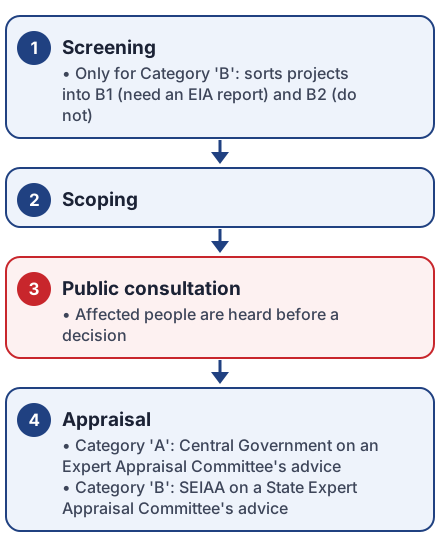
Environmental Impact Assessment (EIA) studies a project’s likely effects on the environment before it is approved. The EIA Notification, 2006 (S.O. 1533(E), 14 September 2006) regulates development projects according to their potential environmental impact and has been amended several times (PIB, 7 December 2023). Public consultation lets affected people be heard before a decision.
Category ‘A’ projects need prior environmental clearance from the Central Government (MoEF) on the advice of an Expert Appraisal Committee; Category ‘B’ projects go to the State/UT Environment Impact Assessment Authority (SEIAA) on the advice of a State Expert Appraisal Committee. Clearance for a new project has a maximum of four stages, in order: (1) Screening (only for Category ‘B’), (2) Scoping, (3) Public Consultation and (4) Appraisal. Screening sorts B projects into B1 (need an EIA report) and B2 (do not) (EIA Notification, 2006, paras 2, 4 and 7).
Mains 2020: How does the draft Environment Impact Assessment (EIA) Notification, 2020 differ from the existing EIA Notification, 2006? Mains 2020
How does the draft Environment Impact Assessment (EIA) Notification, 2020 differ from the existing EIA Notification, 2006?
Mains 2024: What role do environmental NGOs and activists play in influencing Environmental Impact Assessment (EIA) outcomes for major projects in India? Mains 2024 Cite four examples with all
important details.
What role do environmental NGOs and activists play in influencing Environmental Impact Assessment (EIA) outcomes for major projects in India? Cite four examples with all important details.
Mains box: analysis and answer points
- Coastal Regulation Zone notifications, issued under the Environment (Protection) Act, restrict industries and construction along the coast to protect coastal and marine ecosystems and the livelihoods of fishing communities.
- Likely next angle: Islands: 20 m
- Asked: Mains 2020 (GS Paper III, 10 marks): How does the draft Environment Impact Assessment (EIA) Notification, 2020 differ from the existing EIA Notification, 2006?
Practice
Practice MCQs (8)
Under the Wild Life (Protection) Act, 1972 as amended in 2022, which authority is empowered to regulate or prohibit the import, trade, possession or proliferation of invasive alien species?
Answer (a) & explanation
The new section 62A empowers the Central Government to regulate or prohibit the import, trade, possession or proliferation of invasive alien species, defined as plant or animal species not native to India whose introduction or spread may threaten or adversely affect wildlife or its habitat. The Centre may authorise an officer to seize and dispose of such species. The NBA works under the Biological Diversity Act on access and benefit sharing, and ICAR is a research body without regulatory power under this Act.
With reference to the Wild Life (Protection) Amendment Act, 2022, consider the following statements:
1. It reduced the number of Schedules in the principal Act from six to four.
2. It removed the separate Schedule of vermin species.
3. Under the revised scheme, Schedule III lists animal species given a lower degree of protection.
Which of the statements given above are correct?
Answer (a) & explanation
Statements 1 and 2 are correct. The amendment (in force from 1 April 2023) rationalised six Schedules into four: Schedule I (animals with the highest protection), Schedule II (animals with a lesser degree of protection), Schedule III (specified plants) and a new Schedule IV for specimens listed in the CITES Appendices. The old Schedule V of vermin was deleted. Statement 3 is wrong because Schedule III now holds the protected plants (the former Schedule VI), not animals.
The 2022 amendment to the Wild Life (Protection) Act, 1972 made a specific provision regarding elephants. What does it provide?
Answer (c) & explanation
A proviso added to section 43 permits the transfer or transport of a captive elephant for a religious or any other purpose by a person with a valid certificate of ownership, subject to terms and conditions prescribed by the Central Government (later laid down in rules on captive elephant transfer). The general bar on commercial transfer of captive animals remains. The 'National Heritage Animal' status (2010) was an administrative decision, not part of the Act, and the elephant remains in Schedule I.
Consider the following statements regarding 'specified plants' under the Wild Life (Protection) Act, 1972, as amended in 2022:
1. Specified plants are now listed in Schedule VI of the Act.
2. No person may wilfully pick, uproot, damage, destroy, acquire or collect a specified plant from any forest land or any area notified by the Central Government.
3. A member of a Scheduled Tribe may pick, collect or possess a specified plant in the district where he resides for his personal use.
Which of the statements given above are correct?
Answer (b) & explanation
Statements 2 and 3 are correct. Section 17A prohibits wilful picking, uprooting, damaging, destroying, acquiring or collecting of any specified plant from forest land or notified areas, while its proviso protects a Scheduled Tribe member's picking, collection or possession of a specified plant in his home district for personal use. Statement 1 is wrong: after the 2022 rationalisation, specified plants such as red vanda, pitcher plant and ladies' slipper orchids sit in Schedule III; Schedule VI no longer exists. Cultivation and trade of specified plants still need a licence.
Consider the following statements regarding section 11 of the Wild Life (Protection) Act, 1972:
1. The Chief Wild Life Warden may, by a reasoned written order, permit the hunting of a Schedule I animal that has become dangerous to human life or is so disabled or diseased as to be beyond recovery.
2. No such animal is to be ordered killed unless the Chief Wild Life Warden is satisfied that it cannot be captured, tranquilised or translocated.
3. A wild animal killed in good faith in self-defence becomes the property of the person who killed it.
Which of the statements given above are correct?
Answer (d) & explanation
Statements 1 and 2 are correct. Section 11(1)(a) lets the Chief Wild Life Warden permit the hunting of a Schedule I animal that is dangerous to human life or disabled or diseased beyond recovery, through a written order stating reasons; its proviso adds that killing is the last resort, ordered only if the animal cannot be captured, tranquilised or translocated. Section 11(2) makes killing or wounding in good faith in self-defence not an offence, but section 11(3) declares any animal so killed or wounded to be Government property, so statement 3 is wrong.
Under the Wild Life (Protection) Act, 1972 as amended in 2022, which one of the following correctly describes the power to declare a wild animal as 'vermin'?
Answer (b) & explanation
After the 2022 amendment there is no standing vermin Schedule. Under section 62, the Central Government may by notification declare any wild animal specified in Schedule II to be vermin for a specified area and period; while the notification is in force, that animal is deemed not to be in Schedule II there, so the hunting ban of section 9 does not apply to it. Schedule I animals can never be declared vermin. Earlier, species such as the Indian flying fox, common crow and rats sat in the old Schedule V as vermin.
With reference to penalties under the Wild Life (Protection) Act, 1972 after the 2022 amendment, consider the following statements:
1. For general violations of the Act, the maximum fine was raised from ₹25,000 to ₹1 lakh.
2. For offences relating to specially protected animals, the minimum fine was raised from ₹10,000 to ₹25,000.
Which of the statements given above is/are correct?
Answer (c) & explanation
Both statements are correct. The 2022 amendment raised fines under section 51: for general violations the maximum fine went up from ₹25,000 to ₹1 lakh, and for violations involving specially protected animals (Schedule I and similar provisions) the minimum fine rose from ₹10,000 to ₹25,000, alongside the existing imprisonment of three to seven years for such offences. Unlike the EP, Air and Water Acts, the Wild Life Act was not decriminalised; it kept and stiffened criminal sanctions because wildlife crime is linked to organised trafficking.
With reference to the provisions inserted in the Wild Life (Protection) Act, 1972 by the 2022 amendment, consider the following statements:
1. The Central Government designates a Management Authority to grant export and import permits for trade in specimens listed under CITES.
2. The Central Government designates a Scientific Authority to advise on the impact of such trade on the survival of the species.
3. A person who voluntarily surrenders a captive animal or animal article to the Chief Wild Life Warden is entitled to compensation at its market value.
Which of the statements given above are correct?
Answer (a) & explanation
Statements 1 and 2 are correct. To implement CITES domestically, the amendment added sections 49E and 49F, providing for a Management Authority (permits, identification marks, registration of live specimens of Schedule IV animals) and a Scientific Authority (advice on whether trade is detrimental to survival). Statement 3 is wrong: the new section 42A allows voluntary surrender of captive animals, animal articles or specified plants, but no compensation is payable and the item becomes the property of the State Government.
0 / 0 correct
Write an answer
In 150 words, explain the significance of Environmental Acts with one recent example.
Flashcards (4)
NDZ for islands (CRZ 2019)?
20 m.
EIA Notification number?
S.O. 1533(E), 14 September 2006.
Four stages of EIA clearance?
Screening (B only), Scoping, Public Consultation, Appraisal.
Who clears Category B projects?
SEIAA, on SEAC advice.
Read more: related explainers
In the news
- 22 Oct 2026GRAP Stage I invoked in Delhi-NCR as AQI turns ‘Poor’: the 25 actions and what comes next
- 20 Oct 2026National Red List of birds: 1,211 species under assessment, 107 done in first review
- 16 Oct 2026CAQM orders PTZ cameras at all polluting industries in NCR by 30 November 2026
- 15 Oct 2026Sukhna Wetland and Sauj Jheel become Ramsar sites; India’s tally reaches 103
 Next chapter · 12. Disaster and Environment →Disaster and Environment: Floods, GLOFs, drought and desertification
Syllabus: GS-III · Conservation, environmental pollution and degradation, environmental impact asse…