
Chapter 7 · Topic 7.3 · Prelims + Mains3 of 3
Pollution: Chapter test
Key points
- Plastic and marine pollution.
- E-waste, biomedical and hazardous waste.
- Solid waste and degradation.
10 PYQs 2016–2025
Prelims box: facts and traps
- Identified single-use plastic items → Banned from 1 July 2022, including earbuds with plastic sticks, balloon sticks, plastic flags, candy and ice-cream sticks, thermocol decoration, plates, cups, cutlery, straws, trays, stirrers, and PVC banners under 100 micron: Plastic carry bags → Minimum thickness raised from 50 to 75 micron from 30 September 2021, and to 120 micron from 31 December 2022; Packaging not banned → Managed through Extended Producer Responsibility (EPR) of producers, importers and brand owners.
- The Solid Waste Management Rules, 2026 were notified on 27 January 2026, replace the 2016 Rules, and came into effect on 1 April 2026 (PIB, 30 March 2026).
- Source for the table: MoEFCC notification of the Plastic Waste Management Amendment Rules, 2021 (PIB, 13 August 2021).
- Improper disposal of old computers releases beryllium, cadmium, chromium, mercury and lead into the environment (Prelims 2013: 1, 2, 3, 5 and 6 only).
- Trap (UPSC Prelims 2013): “Heptachlor” is incorrect. “Plutonium” is incorrect.
- Trap: “The thickness requirement applies equally to carry bags made of compostable plastic” is wrong. The rules expressly say that the thickness provision does not apply to carry bags made of compostable or biodegradable plastic, which must instead meet the specified standards and labelling (IS/ISO 17088:2021 for compostable plastic).
On this page (3 sections)
Plastic and marine pollution
| Plastic Waste Management (Amendment) Rules, 2021 | Rule |
|---|---|
| Identified single-use plastic items | Banned from 1 July 2022, including earbuds with plastic sticks, balloon sticks, plastic flags, candy and ice-cream sticks, thermocol decoration, plates, cups, cutlery, straws, trays, stirrers, and PVC banners under 100 micron |
| Plastic carry bags | Minimum thickness raised from 50 to 75 micron from 30 September 2021, and to 120 micron from 31 December 2022 |
| Packaging not banned | Managed through Extended Producer Responsibility (EPR) of producers, importers and brand owners |
Source for the table: MoEFCC notification of the Plastic Waste Management Amendment Rules, 2021 (PIB, 13 August 2021). At the 4th UN Environment Assembly in 2019, India piloted a resolution on single-use plastic pollution.
Marine pollution includes plastic litter, oil spills, sewage and farm run-off that cause coastal dead zones, and ballast water that carries invasive species. Plastic breaks into microplastics that are eaten by plankton, fish and seabirds.
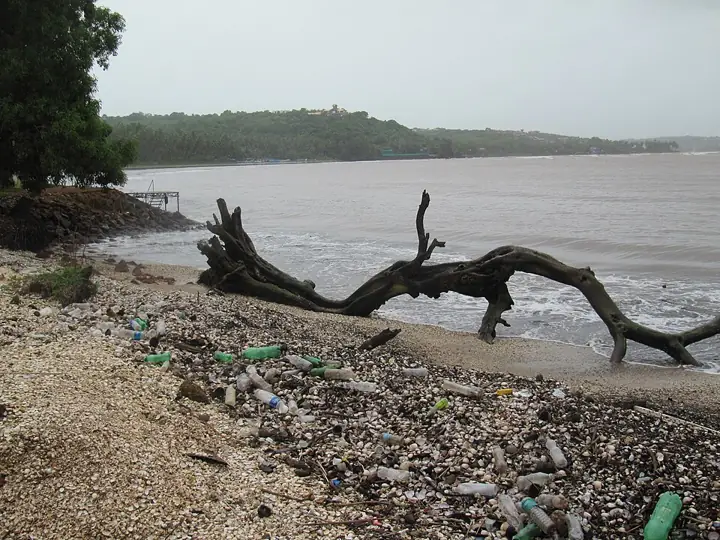
Microbeads are a concern because They are considered harmful to marine ecosystems. Prelims 2019 (Prelims 2019)
Why is there a great concern about the ‘microbeads’ that are released into environment?
- They are considered harmful to marine ecosystems.
- They are considered to cause skin cancer in children.
- They are small enough to be absorbed by crop plants in irrigated fields.
- They are often found to be used as food adulterants.
Show answer
Answer: (a) · UPSC official key
Cigarette butts, eyeglass lenses and car tyres all contain plastic (Prelims 2025: All the three).
Consider the following : I. Cigarette butts II. Eyeglass lenses III. Car tyres How many of them contain plastic?
- Only one
- Only two
- All the three
- None
Show answer
Answer: (c) · UPSC official key
Many chewing gums use plastic as gum base, which is why they are a source of environmental pollution: Both Statement-I and Statement-II are correct and Statement-II explains Statement-I (Prelims 2024).
Consider the following statements : Statement-I : Many chewing gums found in the market are considered a source of environmental pollution. Statement-II : Many chewing gums contain plastic as gum base. Which one of the following is correct in respect of the above statements ?
- Both Statement-I and Statement-II are correct and Statement-II explains Statement-I
- Both Statement-I and Statement-II are correct, but Statement-II does not explain Statement-I
- Statement-I is correct, but Statement-II is incorrect
- Statement-I is incorrect, but Statement-II is correct
Show answer
Answer: (a) · UPSC official key
Bisphenol A (BPA), a suspected hormone disruptor, is a key building block of polycarbonate plastics.
E-waste, biomedical and hazardous waste
E-waste is discarded electrical and electronic equipment. Under the E-Waste (Management) Rules, 2022, manufacturers, producers, refurbishers and recyclers must register on the CPCB EPR portal, and producers meet their recycling targets through registered recyclers (CPCB FAQ on the 2022 Rules). Informal recycling by open burning and acid baths releases toxic metals.
Improper disposal of old computers releases beryllium, cadmium, chromium, mercury and lead into the environment (Prelims 2013: 1, 2, 3, 5 and 6 only).
Due to improper/indiscriminate disposal of old and used computers or their parts, which of the following are released into the environment as e-waste? 1. Beryllium 2. Cadmium 3. Chromium 4. Heptachlor 5. Mercury 6. Lead 7. Plutonium Select the correct answer using the codes given below.
- 1, 3, 4, 6 and 7 only
- 1, 2, 3, 5 and 6 only
- 2, 4, 5 and 7 only
- 1, 2, 3, 4, 5, 6 and 7
Show answer
Answer: (b) · UPSC official key
| Waste stream | Governing rules | Key idea |
|---|---|---|
| Biomedical waste | Bio-Medical Waste Management Rules, 2016 | Colour-coded segregation at source in hospitals; treatment by common facilities |
| Hazardous waste | Hazardous and Other Wastes (Management and Transboundary Movement) Rules, 2016 | Authorisation for handling; import and export controls in line with the Basel Convention |
| Batteries | Battery Waste Management Rules, 2022 | EPR for producers (CPCB) |
Solid waste and environmental degradation
The Solid Waste Management Rules, 2026 were notified on 27 January 2026, replace the 2016 Rules, and came into effect on 1 April 2026 (PIB, 30 March 2026).
| SWM Rules, 2026 | What they require |
|---|---|
| Segregation | Four streams at source: wet, dry, sanitary and special care waste |
| Bulk waste generators | Extended Bulk Waste Generator Responsibility |
| Tracking | Centralised Online Portal for collection, transport, processing and disposal |
| Refuse-derived fuel | Fuel substitution by industries such as cement and waste-to-energy plants to rise from 5% to 15% over six years |
| Legacy waste | Time-bound plans to remediate old dumpsites; tighter limits on landfilling |
| Enforcement | Environmental compensation on the polluter pays principle |
Source for the table: PIB, 30 March 2026.
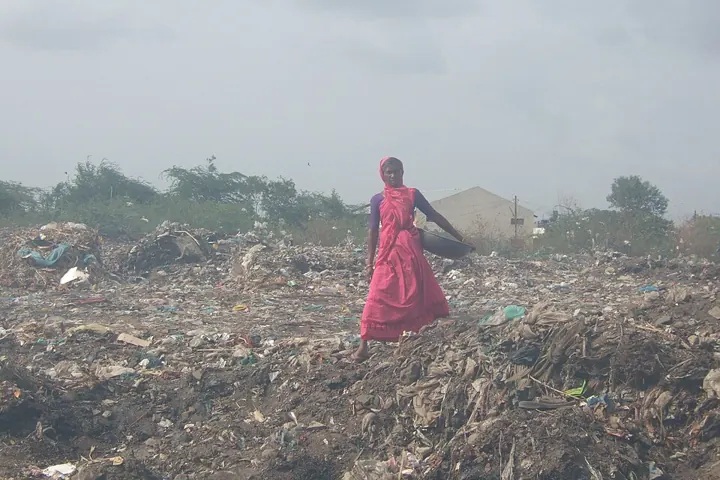
Mains 2026: What are the challenges to solid waste management in India? Mains 2026 Discuss the governmental policy framework on solid waste management. Discuss the success/failure cases of Delhi and Indore cities highlighting the salient feature of their solid waste management initiatives.
What are the challenges to solid waste management in India? Discuss the governmental policy framework on solid waste management. Discuss the success/failure cases of Delhi and Indore cities highlighting the salient feature of their solid waste management initiatives.
Environmental degradation is the long-run decline of air, water, soil, forests and biodiversity. Its drivers are population and consumption pressure, unplanned urbanisation, industrial and farm pollution, deforestation, overuse of groundwater and climate change. Its results include land degradation and desertification, loss of species and ecosystem services, and harm to health and livelihoods, especially of the poor.
Mains box: analysis and answer points
- Microbeads are a concern because They are considered harmful to marine ecosystems.
- Plastic Waste Management Rule (Amendment) Rules, 2021
- Likely next angle: Microbeads
- Asked: Mains 2026 (GS Paper III, 15 marks): What are the challenges to solid waste management in India? Discuss the governmental policy framework on solid waste management. Discuss the success/failure cases of Delhi and Indore cities highlighting the salient feature of their solid waste management initiatives.
Practice
Practice MCQs (8)
Under the categorisation of industries by pollution potential, released by the Environment Ministry and CPCB in March 2016, which category of practically non-polluting industries does not need consent to operate from the State Pollution Control Board?
Answer (d) & explanation
In March 2016 the Ministry and the CPCB revised the categorisation of industrial sectors on the basis of a pollution index score from 0 to 100: Red for a score of 60 and above, Orange for 41–59, Green for 21–40 and White for up to 20. The White category, covering 36 practically non-polluting sectors such as assembly of air coolers or bicycles, does not need consent to operate; intimation to the State Board is enough. Red category industries are generally not allowed in ecologically fragile areas and protected areas.
Under the four-stream segregation mandated by the Solid Waste Management Rules, 2026, used paint cans, discarded bulbs, mercury thermometers and expired medicines belong to which stream?
Answer (d) & explanation
The SWM Rules, 2026 define four streams. Wet waste is kitchen and garden waste such as peels, food and flowers; dry waste is plastic, paper, metal, glass, wood and rubber for recycling; sanitary waste is used diapers, sanitary towels, tampons and condoms; and special care waste covers household items with hazardous content, such as paint cans, bulbs, mercury thermometers and medicines, which must go to authorised agencies or designated collection centres (PIB, 28 January 2026).
The use of plants that take up heavy metals from contaminated soil and store them in their harvestable shoots, which are then removed and disposed of, is called
Answer (a) & explanation
Phytoremediation uses plants to clean up pollution, and it has several forms. In phytoextraction, plants (often 'hyperaccumulators' such as Indian mustard for lead) absorb metals through their roots and move them to the harvestable shoots, which are cut and safely disposed of or processed. Phytostabilisation only locks pollutants in the root zone so that they do not spread. Rhizofiltration uses roots to absorb pollutants from water, and phytovolatilisation turns some pollutants, such as selenium or mercury, into gases released through the leaves.
With reference to the Solid Waste Management Rules, 2026, consider the following statements:
1. They were notified in January 2026, superseding the Solid Waste Management Rules, 2016, and came into force on 1 April 2026.
2. They mandate segregation of waste at source into four streams: wet, dry, sanitary and special care waste.
3. They apply only to urban local bodies.
Which of the statements given above is/are correct?
Answer (c) & explanation
Statements 1 and 2 are correct. The SWM Rules, 2026 were notified on 27 January 2026 under the Environment (Protection) Act, 1986, superseding the 2016 rules, and took effect on 1 April 2026 (PIB, 28 January and 30 March 2026). They make four-stream segregation mandatory: wet waste for composting or biomethanation, dry waste for material recovery facilities, sanitary waste wrapped and stored separately, and special care waste for authorised collection. Statement 3 is wrong: the rules apply to every urban and rural local body, as well as to SEZs, industrial townships, railways, airports, ports, defence establishments and all waste generators.
Under the Plastic Waste Management Rules, 2016, as amended in 2021, consider the following statements:
1. Carry bags made of virgin or recycled plastic must be at least 120 microns thick with effect from 31 December 2022.
2. Non-woven plastic carry bags must be at least 60 grams per square metre (GSM).
3. The thickness requirement applies equally to carry bags made of compostable plastic.
Which of the statements given above is/are correct?
Answer (b) & explanation
Statements 1 and 2 are correct. The amendment of 12 August 2021 raised the minimum thickness of carry bags of virgin or recycled plastic from 50 to 75 microns from 30 September 2021 and to 120 microns from 31 December 2022; thicker bags are more likely to be reused and collected. The same amendment fixed a minimum of 60 GSM for non-woven plastic carry bags. Statement 3 is wrong: the rules expressly say that the thickness provision does not apply to carry bags made of compostable or biodegradable plastic, which must instead meet the specified standards and labelling (IS/ISO 17088:2021 for compostable plastic).
Under the Guidelines on Extended Producer Responsibility (EPR) for plastic packaging in Schedule II of the Plastic Waste Management Rules, 2016, 'Category III' plastic packaging refers to
Answer (c) & explanation
The EPR Guidelines (added in February 2022 and amended in 2024) divide plastic packaging into categories with separate targets for collection, recycling and use of recycled content. Category I is rigid packaging; Category II is flexible packaging of one layer or several layers of different plastics, including carry bags, sheets and sachets; Category III is multilayered packaging with at least one plastic and at least one non-plastic layer, such as chips packets with a metallised or paper layer; Category IV is compostable plastic, and Category V (from 2024) is biodegradable plastic. Category III is the hardest to recycle, so its recycled-content targets are the lowest.
With reference to the Plastic Waste Management (Amendment) Rules, 2024 (notified in March 2024), consider the following statements:
1. 'Biodegradable plastics' are defined as plastics, other than compostable plastics, that degrade by biological processes in a specific environment without leaving any microplastics or visible or toxic residue.
2. Manufacturers of compostable or biodegradable plastic carry bags and commodities must obtain a certificate from the Central Pollution Control Board before marketing them.
3. Commodities made of biodegradable plastics are kept outside the extended producer responsibility (EPR) framework.
Which of the statements given above are correct?
Answer (a) & explanation
Statements 1 and 2 are correct. The amendment of 14 March 2024 rewrote the definition of biodegradable plastics: they are plastics other than compostable plastics that degrade biologically in a specific environment such as soil, landfill, sewage sludge, fresh water or marine water without leaving any microplastics or visible, distinguishable or toxic residue. It also requires makers of compostable or biodegradable carry bags and commodities to get a CPCB certificate before marketing or selling. Statement 3 is wrong: the same amendment created EPR Category V for packaging and commodities of biodegradable plastic (Category IV covers compostable plastic), so they are inside the EPR system.
With reference to the Environment (Construction and Demolition) Waste Management Rules, 2025, consider the following statements:
1. They were notified in April 2025 and came into force on 1 April 2026.
2. They introduce extended producer responsibility, with recycling targets, for producers of construction and demolition waste.
3. They were made under the Environment (Protection) Act, 1986.
4. They also apply to waste covered under the Atomic Energy Act, 1962.
Which of the statements given above are correct?
Answer (a) & explanation
Statements 1, 2 and 3 are correct. The new rules were notified on 2 April 2025 (G.S.R. 219(E)) under sections 6, 8 and 25 of the Environment (Protection) Act, 1986, superseding the C&D Waste Management Rules, 2016, and came into force on 1 April 2026. They bring in extended producer responsibility: producers must meet rising recycling targets (25% of the previous year's waste in 2025-26, rising thereafter), registered recyclers issue EPR certificates on an online portal, and environmental compensation applies for violations. Statement 4 is wrong: waste covered by the Atomic Energy Act, defence and strategic projects, and waste from natural disasters or war are expressly excluded.
0 / 0 correct
Prelims PYQs on this topic (8)
Artificial way of causing rainfall to reduce air pollution makes use of
Answer (a) & explanation
Silver iodide and potassium iodide are used (a). Cloud seeding sprays particles into suitable clouds so that water droplets or ice crystals form around them. Silver iodide is the standard agent, as its crystal shape is close to ice, and potassium iodide is used with it. Rain then washes dust and smoke out of the air. Options (b), (c) and (d) are wrong: silver nitrate, potassium nitrate and potassium chloride are not the usual agents, though common salt is used in some warm-cloud seeding.
Notice the catch: seeding needs clouds with enough moisture; it cannot make rain from a clear sky. Delhi tried cloud seeding against smog with IIT Kanpur in 2025, with little success because the air was too dry.
Answer as per the official UPSC answer key.
Consider the following statements :
- Statement-I : Many chewing gums found in the market are considered a source of environmental pollution.
- Statement-II : Many chewing gums contain plastic as gum base.
Which one of the following is correct in respect of the above statements ?
Answer (a) & explanation
Both statements are correct and II explains I (a). Statement I is right: discarded chewing gum is a major source of litter and pollution: spat-out gum sticks to streets and pavements for years, and is costly to clean. Statement II is right and explains it: most modern gum bases are synthetic polymers such as polyvinyl acetate and polyisobutylene, which are plastics, in place of the old natural chicle from the sapodilla tree. These do not break down, so gum stays in the environment.
Notice that Singapore has banned the sale of most chewing gum since 1992. Gum also adds to microplastics, and studies have found that chewing it can release microplastic particles into saliva. Some makers are going back to natural, biodegradable gum bases.
Answer as per the official UPSC answer key.
Consider the following statements regarding mercury pollution :
- 1. Gold mining activity is a source of mercury pollution in the world.
- 2. Coal-based thermal power plants cause mercury pollution.
- 3. There is no known ‘safe level’ of exposure to mercury.
How many of the above statements are correct?
Answer (b) & explanation
Two statements are correct (b). Statement 1 is right: small-scale gold mining, which uses mercury to bind gold particles, is the largest source of mercury released by people worldwide. Statement 2 is right: coal burning, mainly in thermal power plants, comes next, as coal holds traces of mercury. Statement 3 is wrong under UPSC's key: "no known safe level" is what the WHO says about lead. For mercury, health agencies set tolerable intake limits, though they treat it as highly toxic.
Notice the Minamata Convention (2013, in force 2017), named after Japan's mercury poisoning disaster from factory waste. India has ratified it. Mercury turns into methylmercury in water and builds up in fish, harming the brain.
the phrase "no known safe level" is borrowed from lead.
Answer as per the official UPSC answer key.
In the context of WHO Air Quality Guidelines, consider the following statements :
- 1. The 24-hour mean of PM2·5 should not exceed 15 µg/m3 and annual mean of PM2·5 should not exceed 5 µg/m3.
- 2. In a year, the highest levels of ozone pollution occur during the periods of inclement weather.
- 3. PM10 can penetrate the lung barrier and enter the bloodstream.
- 4. Excessive ozone in the air can trigger asthma.
Which of the statements given above are correct ?
Answer (b) & explanation
Statements 1 and 4 are correct (b). Statement 1 is right: the 2021 WHO Air Quality Guidelines set PM2.5 at 15 µg/m³ for the 24-hour mean and 5 µg/m³ for the annual mean. Statement 2 is wrong: ground-level ozone forms when sunlight acts on pollutants, so it peaks in hot, sunny weather, not in bad weather. Statement 3 is wrong: PM2.5, not PM10, is fine enough to pass the lung barrier into the bloodstream. Statement 4 is right: excess ozone irritates airways and can trigger asthma.
Notice that India's National Ambient Air Quality Standards (2009) are much looser: PM2.5 at 60 (24-hour) and 40 (annual). The National Clean Air Programme (2019) targets cuts in 131 cities.
PM10 reaches the lungs, but the bloodstream needs the finer PM2.5.
Answer as per the official UPSC answer key.
Which of the following are the reasons/factors for exposure to benzene pollution ?
- 1. Automobile exhaust
- 2. Tobacco smoke
- 3. Wood burning
- 4. Using varnished wooden furniture
- 5. Using products made of polyurethane
Select the correct answer using the code given below :
Answer (a) & explanation
Factors 1, 2 and 3 are correct in UPSC's key (a). Benzene is released when carbon-rich material burns incompletely. Major sources are vehicle exhaust (1), as benzene is in petrol and is formed during burning; tobacco smoke (2), the main source for smokers; and wood burning (3), including stoves and forest fires. Benzene is a known cause of leukaemia and other blood cancers. UPSC's key leaves out varnished furniture (4) and polyurethane products (5), which give off other volatile organic compounds such as formaldehyde.
Notice India's limits: BS-VI fuel (from 2020) limits benzene in petrol to 1%, and the National Ambient Air Quality Standards set a yearly limit of 5 µg/m³. Petrol pumps use vapour recovery systems.
Answer as per the official UPSC answer key.
How is the National Green Tribunal (NGT) different from the Central Pollution Control Board (CPCB) ?
- 1. The NGT has been established by an Act whereas the CPCB has been created by an executive order of the Government.
- 2. The NGT provides environmental justice and helps reduce the burden of litigation in the higher courts whereas the CPCB promotes cleanliness of streams and wells, and aims to improve the quality of air in the country.
Which of the statements given above is/are correct ?
Answer (b) & explanation
Only statement 2 is correct (b). Statement 1 is wrong because both bodies are statutory. The CPCB was set up in 1974 under the Water (Prevention and Control of Pollution) Act and was later given powers under the Air Act, 1981 and the Environment Protection Act. The NGT was set up under the NGT Act, 2010. Statement 2 is right because the NGT gives fast environmental justice, deciding cases within six months, and reduces the load on higher courts. The CPCB works to keep streams and wells clean and to improve air quality.
The NGT's principal bench is in New Delhi, with four zonal benches. Notice the principles it applies: sustainable development, the precautionary principle, and polluter pays, under Section 20 of the NGT Act.
"executive order" is the slip. The CPCB came from a law, like the NGT.
Answer as per the official UPSC answer key.
Mains PYQs on this topic (2)
- UPSC Mains 2024 · GS Paper III · Q7Industrial pollution of river water is a significant environmental issue in India. Discuss the various mitigation measures to deal with this problem and also the government’s initiatives in this regard.How to approach: Intro: scale (CPCB polluted stretches). Body: (1) technical measures (ZLD, CETPs); (2) regulatory measures; (3) government initiatives (Namami Gange, NRCP, onli…
- UPSC Mains 2023 · GS Paper III · Q8What is oil pollution? What are its impacts on the marine ecosystem? In what way is oil pollution particularly harmful for a country like India?How to approach: Intro: release of petroleum into the sea from spills, ship discharge, runoff. Body: (1) Marine impacts: slick blocks light and oxygen, coats birds and mammals,…
Write an answer
In 150 words, explain the significance of Pollution with one recent example.
Flashcards (6)
Single-use plastic ban began?
1 July 2022.
Minimum carry-bag thickness since 31 Dec
2022? 120 micron.
Plastic containing BPA?
Polycarbonate.
Current e-waste rules?
E-Waste (Management) Rules, 2022.
Four waste streams under SWM Rules
2026? Wet, dry, sanitary, special care.
SWM Rules 2026 in force from?
1 April 2026.
Read more: related explainers
In the news
- 22 Oct 2026GRAP Stage I invoked in Delhi-NCR as AQI turns ‘Poor’: the 25 actions and what comes next
- 20 Oct 2026National Red List of birds: 1,211 species under assessment, 107 done in first review
- 16 Oct 2026CAQM orders PTZ cameras at all polluting industries in NCR by 30 November 2026
- 15 Oct 2026Sukhna Wetland and Sauj Jheel become Ramsar sites; India’s tally reaches 103
 Next chapter · 8. Climate Change →Climate Change: Greenhouse effect and warming
Syllabus: GS-III · Conservation, environmental pollution and degradation, environmental impact asse…