
Chapter 6 · Topic 6.2 · Prelims + Mains2 of 3
Wildlife Conservation: Crocodiles, snow leopard and lion
Key points
- Crocodiles.
- Snow leopard and river dolphin.
- Asiatic lion.
- One-horned rhino.
2 PYQs 2003–2012
Prelims box: facts and traps
| First national assessment | Estimate (source) |
|---|---|
| Snow leopards | 718 (PIB, 5 February 2026) |
| River dolphins | 6,327 (PIB, 5 February 2026). |
- Project Snow Leopard and Project Dolphin are species programmes alongside Project Tiger, Elephant and Lion (PIB, 5 February 2026).
- By April 1982, 879 gharials, 190 estuarine crocodiles and 493 muggers had been released (A. de Vos, Biological Conservation, 1984).
- Recent Congresses were held in Hawai'i (2016), Marseille (September 2021, postponed from 2020 because of the pandemic) and Abu Dhabi (9-15 October 2025).
- Trap (UPSC Prelims 2024): “Unlike male lions, male leopards do not proclaim their territory by scent marking” is incorrect.
- Trap (UPSC Prelims 2019): “Double-humped camel is naturally found in India only” is incorrect. “One-horned rhinoceros is naturally found in India only” is incorrect.
On this page (3 sections)
Crocodile conservation
India has three crocodilians: the gharial (fish-eating, narrow snout, rivers), the mugger or marsh crocodile (lakes, rivers, reservoirs) and the saltwater or estuarine crocodile (Bhitarkanika, the Sundarbans and the Andaman and Nicobar Islands).
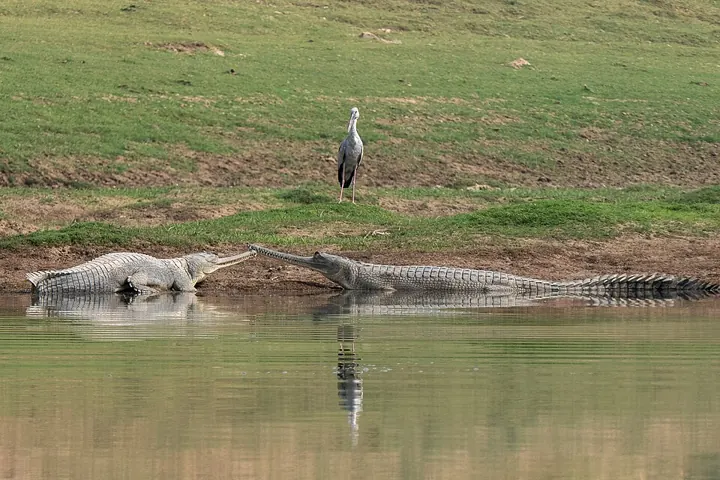
A crocodile breeding and management project was launched in 1975 by the Government of India with UNDP and FAO help, starting in Odisha. Eggs were collected from the wild, hatched and reared, and the young released. By April 1982, 879 gharials, 190 estuarine crocodiles and 493 muggers had been released (A. de Vos, Biological Conservation, 1984).
If you want to see gharials in their natural habitat, the best place is the Chambal River (National Chambal Sanctuary, shared by Rajasthan, Madhya Pradesh and Uttar Pradesh) (Prelims 2017).
If you want to see gharials in their natural habitat, which one of the following is the best place to visit ?
- Bhitarkanika Mangroves
- Chambal River
- Pulicat Lake
- Deepor Beel
Show answer
Answer: (b) · UPSC official key
The gharial, the leatherback turtle and the swamp deer are all endangered (Prelims 2013: 1, 2 and 3).
Consider the following fauna of India : 1. Gharial 2. Leatherback turtle 3. Swamp deer Which of the above is/are endangered?
- 1 and 2 only
- 3 only
- 1, 2 and 3
- None
Show answer
Answer: (c) · UPSC official key
Snow leopard and river dolphin
The snow leopard lives in the high Himalaya and trans-Himalaya, in Ladakh, Jammu and Kashmir, Himachal Pradesh, Uttarakhand, Sikkim and Arunachal Pradesh. Project Snow Leopard and Project Dolphin are species programmes alongside Project Tiger, Elephant and Lion (PIB, 5 February 2026).
| First national assessment | Estimate (source) |
|---|---|
| Snow leopards | 718 (PIB, 5 February 2026) |
| River dolphins | 6,327 (PIB, 5 February 2026) |
The black-necked crane, the flying squirrel and the snow leopard are naturally found in India, but the cheetah was not at the time of the question (Prelims 2012: 1, 3 and 4 only).
Consider the following : 1. Black-necked crane 2. Cheetah 3. Flying squirrel 4. Snow leopard Which of the above are naturally found in India?
- 1, 2 and 3 only
- 1, 3 and 4 only
- 2 and 4 only
- 1, 2, 3 and 4
Show answer
Answer: (b) · UPSC official key
Besides poaching, Ganges river dolphins decline because of dams and barrages, getting caught in fishing nets, and farm chemicals running into rivers; crocodiles are not the cause (Prelims 2014: 1, 3 and 4 only).
Other than poaching, what are the possible reasons for the decline in the population of Ganges River Dolphins? 1. Construction of dams and barrages on rivers 2. Increase in the population of crocodiles in rivers 3. Getting trapped in fishing nets accidentally 4. Use of synthetic fertilizers and other agricultural chemicals in crop-fields in the vicinity of rivers. Select the correct answer using the code given below.
- 1 and 2 only
- 2 and 3 only
- 1, 3 and 4 only
- 1, 2, 3 and 4
Show answer
Answer: (c) · UPSC official key
Asiatic lion
| Year | Lions (source) |
|---|---|
| 1990 | 284 |
| 2020 | 674 |
| 2025 (May estimation) | 891, up about 32% since 2020 |
Source: PIB, 10 August 2025. Lions now range over about 35,000 sq km in 11 districts of Saurashtra, Gujarat. Project Lion was announced on 15 August 2020, and Barda Wildlife Sanctuary is described as an emerging second home.
Of the three animals asked, only the Asiatic lion is naturally found in India alone; the double-humped camel and one-horned rhino also occur in other countries (Prelims 2019: 1 only).
Consider the following statements : 1. Asiatic lion is naturally found in India only. 2. Double-humped camel is naturally found in India only. 3. One-horned rhinoceros is naturally found in India only. Which of the statements given above is/are correct?
- 1 only
- 2 only
- 1 and 3 only
- 1, 2 and 3
Show answer
Answer: (a) · UPSC official key
To give the lions a second home outside Gujarat, a proposal was made to translocate some to Kuno Palpur Wildlife Sanctuary in Madhya Pradesh (Prelims 2017).
Recently there was a proposal to translocate some of the lions from their natural habitat in Gujarat to which one of the following sites ?
- Corbett National Park
- Kuno Palpur Wildlife Sanctuary
- Mudumalai Wildlife Sanctuary
- Sariska National Park
Show answer
Answer: (b) · UPSC official key
Lions have no particular breeding season, and cheetahs, unlike most other big cats, do not roar. Male leopards do mark territory by scent (Prelims 2024: 1 and 2 only).
Consider the following statements : 1. Lions do not have a particular breeding season. 2. Unlike most other big cats, cheetahs do not roar. 3. Unlike male lions, male leopards do not proclaim their territory by scent marking. Which of the statements given above are correct ?
- 1 and 2 only
- 2 and 3 only
- 1 and 3 only
- 1, 2 and 3
Show answer
Answer: (a) · UPSC official key
Mains box: analysis and answer points
- Besides poaching, Ganges river dolphins decline because of dams and barrages, getting caught in fishing nets, and farm chemicals running into rivers; crocodiles are not the cause (Prelims 2014: 1, 3 and 4 only).
- India has three crocodilians: the gharial (fish-eating, narrow snout, rivers), the mugger or marsh crocodile (lakes, rivers, reservoirs) and the saltwater or estuarine crocodile (Bhitarkanika, the Sundarbans and the Andaman and Nicobar Islands).
- A crocodile breeding and management project was launched in 1975 by the Government of India with UNDP and FAO help, starting in Odisha.
- Likely next angle: Chambal
Practice
Practice MCQs (8)
India's first Vulture Conservation Breeding Centre, set up in 2004 by the State Forest Department and the Bombay Natural History Society, is located at Pinjore in which State?
Answer (c) & explanation
The first Vulture Conservation Breeding Centre (the Jatayu Conservation Breeding Centre) was set up in 2004 at Pinjore in Haryana by the Haryana Forest Department and the Bombay Natural History Society, building on a vulture care centre started there in 2001. It led the captive breeding of the three Critically Endangered resident Gyps vultures. Centres followed at Rajabhatkhawa (West Bengal) and Rani (Assam), and five more with the Central Zoo Authority, making eight.
The IUCN World Conservation Congress, at which the Members' Assembly elects the IUCN President and Council, is normally held once every:
Answer (c) & explanation
The World Conservation Congress is normally held every four years. Recent Congresses were held in Hawai'i (2016), Marseille (September 2021, postponed from 2020 because of the pandemic) and Abu Dhabi (9-15 October 2025). Each Congress sets IUCN's four-year Programme, so the Abu Dhabi Congress adopted the IUCN Programme 2026-2029 along with a 20-year Strategic Vision.
With reference to the species conservation initiatives launched by the Union Environment Ministry during Wildlife Week in October 2025, consider the following statements:
1. Project Dolphin entered a second phase that covers both river and marine cetaceans.
2. Project Sloth Bear and Project Gharial were among the projects launched.
3. The projects were launched at the meeting of the National Board for Wildlife held at Sasan Gir.
Which of the statements given above is/are correct?
Answer (b) & explanation
On 6 October 2025, during Wildlife Week, the Union Environment Minister launched five initiatives at the Forest Research Institute, Dehradun: Project Dolphin (Phase II) for river and marine cetaceans, Project Sloth Bear, Project Gharial, a Centre of Excellence for Human–Wildlife Conflict Management at SACON, and 'Tigers Outside Tiger Reserves'. Action plans for river dolphins and cetaceans, tigers, snow leopards, and the Great Indian Bustard and lesser florican were also released. The Gir meeting of the National Board for Wildlife was a separate event in March 2025, so statement 3 is wrong.
The Asiatic lion population estimation of May 2025 recorded a newly established satellite population of lions in a sanctuary where lions had not been recorded since 1879. Which sanctuary is this?
Answer (a) & explanation
The 16th lion estimation (10–13 May 2025) found that lions dispersing from Gir had naturally established a new satellite population in Barda Wildlife Sanctuary near Porbandar, the first lions there since 1879. Barda had long been proposed as a 'second home' for the Asiatic lion within Gujarat. Girnar and Mitiyala already held satellite populations, while Pania is part of the Gir source population.
With reference to 'Project Nilgiri Tahr', consider the following statements:
1. It is a project of the Government of Tamil Nadu, launched in 2023 with an outlay of about Rs 25 crore.
2. 7 October is observed as Nilgiri Tahr Day in Tamil Nadu in honour of the conservationist E.R.C. Davidar.
3. Its objectives include reintroducing the tahr into parts of its historical range.
Which of the statements given above are correct?
Answer (d) & explanation
Project Nilgiri Tahr was sanctioned by a Tamil Nadu Government Order in December 2022 and formally launched by the Chief Minister on 12 October 2023, with an outlay of about Rs 25 crore. Its aims include synchronised population surveys, radio-telemetry studies, removal of invasive plants from grasslands and reintroduction of the tahr into parts of its historical range. The State observes 7 October, the birth anniversary of E.R.C. Davidar, who pioneered tahr studies, as Nilgiri Tahr Day. All three statements are correct.
Consider the following pairs: Species : IUCN Red List category
1. Nilgiri tahr : Endangered
2. Snow leopard : Endangered
3. Wild water buffalo : Endangered
4. Greater one-horned rhinoceros : Vulnerable
How many of the pairs given above are correctly matched?
Answer (c) & explanation
Pairs 1, 3 and 4 are correct. The Nilgiri tahr, endemic to the southern Western Ghats, is Endangered, and so is the wild water buffalo, whose largest population is in Kaziranga. The greater one-horned rhinoceros is Vulnerable. The snow leopard is not Endangered: it was moved to Vulnerable in 2017, so pair 2 is wrong.
Consider the following events:
1. Start of the Pygmy Hog Conservation Programme
2. Declaration of the cheetah as extinct in India
3. Launch of Project Snow Leopard
4. Release of India's first riverine dolphin estimation report
Which one of the following is the correct chronological order of the above events, from earliest to latest?
Answer (b) & explanation
The cheetah was declared extinct in India in 1952. The Pygmy Hog Conservation Programme began in 1996 with the capture of six hogs from Manas. Project Snow Leopard was launched by the Ministry of Environment and Forests in January 2009. The first range-wide riverine dolphin estimation report was released at Gir on 3 March 2025. The order is 2-1-3-4.
With reference to the Asiatic lion population estimation conducted in Gujarat in May 2025, consider the following statements:
1. It estimated 891 lions, up from 674 in 2020.
2. It used the 'Direct Beat Verification' method across about 35,000 sq km of the Saurashtra region.
3. It was conducted by the Wildlife Institute of India using camera-trap capture–recapture, as in the national tiger estimation.
Which of the statements given above are correct?
Answer (a) & explanation
The 16th lion estimation, held from 10 to 13 May 2025, counted 891 Asiatic lions, a rise of about 32 per cent from 674 in 2020. It was conducted by the Gujarat Forest Department using the Direct Beat Verification method, a minimum total count by field teams in 735 sampling units spread over about 35,000 sq km in 11 districts of Saurashtra. It was not a camera-trap capture–recapture exercise by the Wildlife Institute of India, so statement 3 is wrong.
0 / 0 correct
Prelims PYQs on this topic (2)
Which one of the following groups of animals belongs to the category of endangered species?
Answer (a) & explanation
Option (a) is correct per UPSC's key. Option (a) lists only threatened animals: the Great Indian Bustard (Critically Endangered), musk deer and red panda (Endangered), and the Asiatic wild ass, treated as endangered in India; the Indian subspecies, the khur, is in Schedule I (the IUCN now lists the species as a whole as Near Threatened, so the grouping is loose). Each other option includes a common animal: cheetal and blue bull (nilgai) in (b) and (d), rhesus monkey in (c), and Hanuman langur in (d). So (b), (c) and (d) fail.
Notice the bustard's plight: fewer than 150 remain, mainly in Rajasthan; the Supreme Court has ordered undergrounding of power lines in its habitat. Trap: one common animal sinks an option.
Answer as per the official UPSC answer key.
Consider the following :
- 1. Black-necked crane
- 2. Cheetah
- 3. Flying squirrel
- 4. Snow leopard
Which of the above are naturally found in India?
Answer (b) & explanation
Items 1, 3 and 4 are correct (b). The black-necked crane breeds in Ladakh and winters in Arunachal's Tawang area and Bhutan (1). Flying squirrels live in the Western Ghats, the Himalaya and the north-east (3). The snow leopard lives in the high Himalaya of Ladakh, Himachal, Uttarakhand, Sikkim and Arunachal (4). Item 2 is wrong: the Asiatic cheetah was declared extinct in India in 1952, so it was not naturally found in 2012. So (a), (c) and (d) fail.
Notice the update: African cheetahs were brought to Kuno (MP) from September 2022 under Project Cheetah, and some were moved to Gandhi Sagar in 2025. India's first snow leopard survey (2023) counted about 718. Trap: today's cheetahs are introduced, not native.
Answer as per the official UPSC answer key.
Write an answer
In 150 words, explain the significance of Wildlife Conservation with one recent example.
Flashcards (6)
Crocodile project began?
1975, with UNDP/FAO.
Best place for wild gharials?
Chambal River.
Snow leopards (first assessment)?
718.
River dolphins (first assessment)?
6,327.
Lions in 2025?
891.
Project Lion announced?
15 August 2020.
In the news
- 22 Oct 2026GRAP Stage I invoked in Delhi-NCR as AQI turns ‘Poor’: the 25 actions and what comes next
- 20 Oct 2026National Red List of birds: 1,211 species under assessment, 107 done in first review
- 16 Oct 2026CAQM orders PTZ cameras at all polluting industries in NCR by 30 November 2026
- 15 Oct 2026Sukhna Wetland and Sauj Jheel become Ramsar sites; India’s tally reaches 103
 Next topic · 6.3 →Wildlife Conservation: Chapter test
Syllabus: GS-III · Conservation, environmental pollution and degradation, environmental impact asse…