
Chapter 6 · Topic 6.1 · Prelims + Mains1 of 3
Wildlife Conservation: The Act, tigers and elephants
Key points
- WPA and its four schedules.
- Project Tiger and Cheetah.
- Project Elephant.
Prelims box: facts and traps
| Schedule after the 2022 amendment | Covers |
|---|---|
| Schedule I | Animals with the highest protection |
| Schedule II | Animals with a lower level of protection |
| Schedule III | Specified plants |
| Schedule IV | Specimens listed in the CITES Appendices. |
- The Wild Life (Protection) Amendment Act, 2022 (Act No. 18 of 2022, assented on 19 December 2022) replaced the old six schedules with these four.
- Project Elephant, a centrally sponsored scheme, was launched in February 1992 to protect elephants, their habitats and corridors, reduce human-elephant conflict and look after captive elephants (PIB backgrounder, 20 June 2008).
- Source for the table: Rajya Sabha reply, PIB 5 February 2026.
- Trap (UPSC Prelims 2020, Indian elephants): “An elephant can normally go on calving till the age of 40 years only” is incorrect. “Among the States in India, the highest elephant population is in Kerala” is incorrect.
- Trap (UPSC Prelims 2017): all the statements are correct.
On this page (3 sections)
The Wild Life (Protection) Act, 1972
The Wild Life (Protection) Act, 1972 is India’s main wildlife law. It bans hunting of listed animals, controls trade, and provides for national parks, sanctuaries and conservation and community reserves. Wildlife was moved from the State List to the Concurrent List by the 42nd Amendment in 1976.
| Schedule after the 2022 amendment | Covers |
|---|---|
| Schedule I | Animals with the highest protection |
| Schedule II | Animals with a lower level of protection |
| Schedule III | Specified plants |
| Schedule IV | Specimens listed in the CITES Appendices |
The Wild Life (Protection) Amendment Act, 2022 (Act No. 18 of 2022, assented on 19 December 2022) replaced the old six schedules with these four. The separate vermin schedule was removed: ‘vermin’ now means any wild animal notified by the Centre under section 62. The Act also gave the Centre power to regulate invasive alien species and set up CITES Management and Scientific Authorities (Gazette of India; PRS bill summary).
A tortoise listed in Schedule I: It enjoys the same level of protection as the tiger. Prelims 2017 (Prelims 2017)
In India, if a species of tortoise is declared protected under Schedule I of the Wildlife (Protection) Act, 1972, what does it imply ? prevent its extinction.
- It enjoys the same level of protection as the tiger.
- It no longer exists in the wild, a few individuals are under captive protection; and now it is impossible to
- It is endemic to a particular region of India.
- Both (b) and (c) stated above are correct in this context.
Show answer
Answer: (a) · UPSC official key
Under the old Schedule VI (specified plants, now Schedule III): A licence is required to cultivate that plant. Prelims 2020 (Prelims 2020)
If a particular plant species is placed under Schedule VI of The Wildlife Protection Act, 1972, what is the implication ?
- A licence is required to cultivate that plant.
- Such a plant cannot be cultivated under any circumstances.
- It is a Genetically Modified crop plant.
- Such a plant is invasive and harmful to the ecosystem.
Show answer
Answer: (a) · UPSC official key
The gharial, the Indian wild ass and the wild buffalo all cannot be hunted except as the law allows (Prelims 2017: 1, 2 and 3).
According to the Wildlife (Protection) Act, 1972, which of the following animals cannot be hunted by any person except under some provisions provided by law ? 1. Gharial 2. Indian wild ass 3. Wild buffalo Select the correct answer using the code given below :
- 1 only
- 2 and 3 only
- 1 and 3 only
- 1, 2 and 3
Show answer
Answer: (d) · UPSC official key
The dugong is a herbivorous marine mammal protected under Schedule I. It is found only in a few places such as the Gulf of Mannar, Palk Bay, the Gulf of Kutch and the Andaman and Nicobar Islands, not along the entire coast.
Project Tiger and Project Cheetah
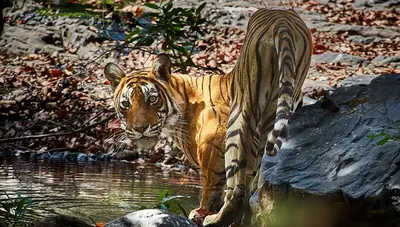
Project Tiger began in 1973. Since the 2006 amendment, the National Tiger Conservation Authority (NTCA) runs it, approves tiger reserves and conducts the All India Tiger Estimation every four years with the Wildlife Institute of India.
| Figure | Value (source) |
|---|---|
| Tigers, 2022 estimation | 3,682 (range 3,167–3,925) |
| Tigers, 2018 estimation | 2,967 (range 2,603–3,346) |
| Leopards, 2022 | 13,874 (range 12,616–15,132) |
| Tiger reserves | 58 in 2025 |
Source for the table: Rajya Sabha reply, PIB 5 February 2026. These are estimates with ranges, not head counts.
Project Cheetah: the cheetah was declared extinct in India in 1952. On 17 September 2022 eight cheetahs from Namibia (five females, three males) were released in Kuno National Park, Madhya Pradesh, in what the Government calls the world’s first intercontinental translocation of a large wild carnivore (PIB, 17 September 2022).
Project Elephant
Project Elephant, a centrally sponsored scheme, was launched in February 1992 to protect elephants, their habitats and corridors, reduce human-elephant conflict and look after captive elephants (PIB backgrounder, 20 June 2008). It is now funded with Project Tiger as ‘Project Tiger and Elephant’.
| Figure | Value (source) |
|---|---|
| Elephant reserves | 33 in 2025 (PIB, 5 February 2026) |
| Elephant corridors identified | 150 (PIB, 5 February 2026) |
| Legal status | Schedule I of the WPA; national heritage animal |
Elephant herds are led by an older female, the matriarch, and pregnancy can last up to about 22 months, the longest of any mammal. Statements that calving stops at 40 and that Kerala has the most elephants were wrong (Prelims 2020: 1 and 2 only).
With reference to Indian elephants, consider the following statements : 1. The leader of an elephant group is a female. 2. The maximum gestation period can be 22 months. 3. An elephant can normally go on calving till the age of 40 years only. 4. Among the States in India, the highest elephant population is in Kerala. Which of the statements given above is/are correct ?
- 1 and 2 only
- 2 and 4 only
- 3 only
- 1, 3 and 4 only
Show answer
Answer: (a) · UPSC official key
Mains box: analysis and answer points
- The Wild Life (Protection) Act, 1972 is India's main wildlife law.
- Wildlife was moved from the State List to the Concurrent List by the 42nd Amendment in 1976.
- Likely next angle: Schedule I = tiger level
Practice
Practice MCQs (8)
Consider the following national symbols of India:
1. Tiger (national animal)
2. Indian peafowl (national bird)
3. Ganges river dolphin (national aquatic animal)
4. Asian elephant (national heritage animal)
How many of the above are listed as Endangered on the IUCN Red List?
Answer (c) & explanation
Three of the four are Endangered. The tiger is Endangered, as are the Ganges river dolphin and the Asian elephant. The Indian peafowl is widespread and common across the subcontinent and is assessed as Least Concern. The dolphin was declared the national aquatic animal in 2009 and the elephant the national heritage animal in 2010.
The World Database on Protected Areas (WDPA), the most comprehensive global database of marine and terrestrial protected areas, is managed by which of the following?
Answer (c) & explanation
The WDPA is a joint project of UNEP and IUCN, compiled and managed by the UNEP World Conservation Monitoring Centre (UNEP-WCMC) in Cambridge, UK, with data supplied by governments and other partners. It is published through the Protected Planet website and underpins the Protected Planet Report, which tracks progress on area-based targets such as Target 3 of the Global Biodiversity Framework. IUCN's protected-area categories are recorded in the database.
Consider the following pairs: IUCN protected area management category — Name
1. Category Ia — Strict Nature Reserve
2. Category Ib — Wilderness Area
3. Category III — Natural Monument or Feature
4. Category V — Protected Landscape/Seascape
How many of the pairs given above are correctly matched?
Answer (d) & explanation
All four pairs are correct. The 2008 IUCN Guidelines list seven categories: Ia Strict Nature Reserve, Ib Wilderness Area, II National Park, III Natural Monument or Feature, IV Habitat/Species Management Area, V Protected Landscape/Seascape and VI Protected Area with Sustainable Use of Natural Resources. Ia and Ib share the number 1 because both keep human impact to a minimum: Ia for science, Ib for large unmodified wilderness.
With reference to the IUCN protected area management categories, consider the following statements:
1. A category is assigned according to the primary management objective, which should apply to at least three-quarters of the protected area.
2. The categories form a ranking of management effectiveness, so a Category VI area is managed less effectively than a Category II area.
3. Any category can, in principle, be combined with any type of governance, whether by government, private owners or communities.
Which of the statements given above is/are correct?
Answer (c) & explanation
Statements 1 and 3 are correct. The 2008 Guidelines assign a category by the primary management objective, which should apply to at least three-quarters of the area. The categories are about objectives, not quality, so statement 2 is wrong: a Category VI area can be better managed than a Category II one, and effectiveness is assessed separately. IUCN treats category and governance type as independent axes, forming a matrix of seven categories and four governance types.
IUCN recognises four broad types of governance for protected areas. Which one of the following is NOT one of them?
Answer (a) & explanation
The four IUCN governance types are: A, governance by government; B, shared governance; C, private governance; and D, governance by Indigenous peoples and local communities. Governance by international organisations is not a type, because protected areas lie within national jurisdiction or are managed by actors in a country. Even World Heritage sites remain under national management; the international listing does not transfer governance.
With reference to 'other effective area-based conservation measures' (OECMs), consider the following statements:
1. The term was defined by a decision of the Conference of the Parties to the Convention on Biological Diversity in 2018.
2. Under Target 3 of the Kunming-Montreal Global Biodiversity Framework, both protected areas and OECMs count towards conserving 30% of land and sea by 2030.
3. An area can be recognised as an OECM only if biodiversity conservation is its primary management objective.
Which of the statements given above is/are correct?
Answer (a) & explanation
Statements 1 and 2 are correct. CBD COP14 (Sharm El-Sheikh, 2018), in Decision 14/8, defined an OECM as a geographically defined area, other than a protected area, governed and managed to achieve positive and sustained long-term outcomes for in situ conservation of biodiversity. Target 3 of the 2022 framework (the '30x30' target) counts both protected areas and OECMs. Statement 3 is wrong: an OECM delivers conservation regardless of its primary objective; examples include sacred groves or defence lands where conservation is a secondary or by-product outcome.
With reference to the IUCN Green List of Protected and Conserved Areas, consider the following statements:
1. Its Standard is organised into four components: good governance, sound design and planning, effective management, and successful conservation outcomes.
2. A site must meet every one of the Standard's criteria to be included in the Green List.
3. Only government-managed national parks are eligible for the Green List.
Which of the statements given above is/are correct?
Answer (a) & explanation
Statements 1 and 2 are correct. The IUCN Green List Standard (version 1.1, 2017) has four components, 17 criteria and 50 indicators. A site is Green Listed only if it meets all the criteria; indicators can be adapted to national conditions, but the criteria are global. Statement 3 is wrong: the programme covers 'protected and conserved areas' under any governance type, including community, private and shared arrangements, and even areas that are not formal protected areas.
Consider the following statements about IUCN protected area management categories:
1. Category V areas are those where the interaction of people and nature over time has produced a distinct character with significant ecological, cultural and scenic value.
2. Category VI areas conserve ecosystems together with associated traditional resource- management systems, with part of the area under low-level, non-industrial sustainable use.
3. Category IV areas often require regular, active interventions to meet the needs of particular species or to maintain habitats.
Which of the statements given above is/are correct?
Answer (d) & explanation
All three statements are correct and paraphrase the 2008 Guidelines. Category V (Protected Landscape/Seascape) values landscapes shaped by long human interaction, such as terraced farmland. Category VI (Protected Area with Sustainable Use of Natural Resources) combines conservation with low-level, non-industrial use, typically by local communities. Category IV (Habitat/Species Management Area) often needs active management, such as maintaining grasslands or water levels for a target species.
0 / 0 correct
Write an answer
In 150 words, explain the significance of Wildlife Conservation with one recent example.
Flashcards (11)
Schedules in the WPA after 2022?
Four.
Schedule III after 2022 covers?
Specified plants.
Schedule IV after 2022 covers?
CITES specimens.
Amendment that moved wildlife to
Concurrent List? 42nd (1976).
Schedule I tortoise implies?
Same protection as the tiger.
Project Tiger began?
1973.
Tigers, 2022 estimate?
3,682.
Cheetah declared extinct in India?
1952.
Where were Namibian cheetahs released?
Kuno National Park, MP (2022).
Project Elephant launched?
February 1992.
Leader of an elephant herd?
A female (matriarch).
In the news
- 22 Oct 2026GRAP Stage I invoked in Delhi-NCR as AQI turns ‘Poor’: the 25 actions and what comes next
- 20 Oct 2026National Red List of birds: 1,211 species under assessment, 107 done in first review
- 16 Oct 2026CAQM orders PTZ cameras at all polluting industries in NCR by 30 November 2026
- 15 Oct 2026Sukhna Wetland and Sauj Jheel become Ramsar sites; India’s tally reaches 103
 Next topic · 6.2 →Wildlife Conservation: Crocodiles, snow leopard and lion
Syllabus: GS-III · Conservation, environmental pollution and degradation, environmental impact asse…