
UPSC Prelims PYQs with explanations
Real questions from official papers, mapped to syllabus topics. Attempt each one; the answer and the reason appear instantly.
You have taken up a project to create night shelters for homeless people during the winter season. Within a week of establishing the shelters, you have received complaints from the residents of the area about the increase in theft cases with a demand to remove the shelters. You would
Answer (b) & explanation
UPSC's key lists (b) and (c), with no negative marking. Step 1: residents complain about thefts and want the night shelters removed. Step 2: (b) assuring an enquiry takes their complaint seriously, and (c) asking them to consider the humanitarian purpose explains why the shelters matter for homeless people in winter. Both keep the shelters running while addressing concerns. Step 3: (d) ignoring the complaint damages trust. (a) only redirects residents to the police without any action of your own.
Tip: for these interpersonal items, pick the response that is lawful, honest and keeps the public work going. Avoid options that give in to pressure, pass the buck or abandon duty.
Answer as per the official UPSC answer key.
In the context of global oil prices, “Brent crude oil” is frequently referred to in the news. What does this term imply ?
- 1. It is a major classification of crude oil.
- 2. It is sourced from North Sea.
- 3. It does not contain sulphur.
Which of the statements given above is/are correct ?
Answer (b) & explanation
Statements 1 and 2 are correct (b). Brent is a major classification and benchmark grade of crude oil (1), drawn from oilfields in the North Sea between Britain and Norway (2). About two-thirds of world crude is priced against it. Statement 3 is wrong: Brent is 'sweet', meaning low in sulphur (about 0.4%), not sulphur-free; no natural crude is entirely free of sulphur. So (a), (c) and (d) fail.
Notice the other benchmarks: WTI (West Texas Intermediate, US) is lighter and sweeter than Brent, Dubai/Oman is a medium sour benchmark for Asian buyers, and India tracks the Indian Basket (mostly sour Gulf crude). Trap: 'low sulphur' is quietly turned into 'no sulphur'.
Answer as per the official UPSC answer key.
Recently, “oilzapper” was in the news. What is it ?
Answer (a) & explanation
Option (a) is correct. Oilzapper is a consortium of oil-eating bacteria developed by TERI with Indian Oil. It is used for bioremediation: the microbes feed on oily sludge and spilled crude and break the hydrocarbons into harmless carbon dioxide and water. (b) is wrong: it is not an exploration technology. (c) is wrong: it is not a GM maize. (d) is wrong: it does not fight oil-well fires.
Notice the related product: Oilivorous-S, a TERI variant that also degrades high-sulphur crude. Bioremediation is cheaper and greener than burning or landfilling sludge, and India's Central Pollution Control Board approves such methods for refinery waste. Trap: the word 'zapper' suggests fire or blasting, not bacteria.
Answer as per the official UPSC answer key.
What is “Virtual Private Network” ?
Answer (b) & explanation
Option (b) is correct. A Virtual Private Network builds a secure, encrypted 'tunnel' over the public internet, so a remote user can reach the office network as if sitting inside it, while the data stay private. (a) is wrong: a VPN does not need a private network; its point is to use the public internet safely. (c) is wrong: it describes cloud computing, where users share computing resources from a provider. (d) fails because (b) is correct.
Notice the policy angle: CERT-In's 2022 directions require VPN providers in India to keep user records for five years, which led some foreign providers to remove Indian servers. VPNs also let users hide their location. Trap: (a) sounds similar but misses the 'public internet' part.
Answer as per the official UPSC answer key.
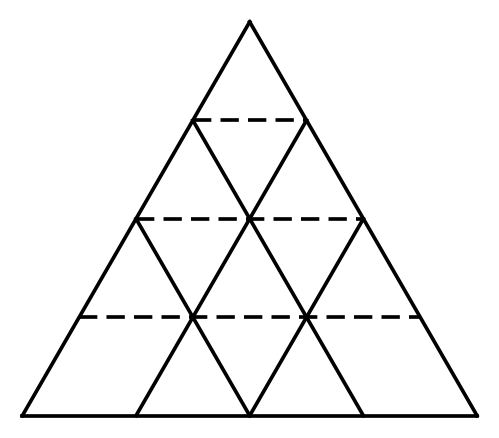
Consider the following figure and answer the item that follows:
What is the total number of triangles in the above grid?
Answer (c) & explanation
1. Count the smallest triangles (one small cell each): 8 point up and 4 point down = 12.
2. Count triangles made of 4 small cells (2 small sides long): 6 point up and 1 points down (in the middle) = 7.
3. Count triangles 3 small sides long: one at each bottom corner and one upright through the middle = 3.
4. The whole big triangle: 1.
5. Total = 12 + 7 + 3 + 1 = 23.
Answer as per the official UPSC answer key.
(Same information as the question above.)
Who are the females in the group?
Answer (c) & explanation
E and A is correct (c). Step 1: the family has three males and two females, with two fathers, two sons and two wives. Step 2: work out the males. B is male (given). The teacher is the wife of a lawyer, who is the son of a doctor, so there are two professional men, father and son. D is the eldest, so D is the grandfather-doctor; B is his son, the lawyer; and C, the youngest, is B's son. So the males are D, B and C. Step 3: that leaves E and A as the two females. The clue that E is 'not a male' confirms E is one of them. So (a), (b) and (d) fail.
Tip: once you know the males, the rest are females. Solve the clue chain (teacher → lawyer → doctor) first, then use 'eldest' and 'youngest' to place people.
Answer as per the official UPSC answer key.
Consider the following actions which the Government can take :
- 1. Devaluing the domestic currency.
- 2. Reduction in the export subsidy.
- 3. Adopting suitable policies which attract greater FDI and more funds from FIIs.
Which of the above action/actions can help in reducing the current account deficit ?
Answer (d) & explanation
Actions 1 and 3 are correct (d). Devaluing the rupee makes Indian exports cheaper abroad and imports costlier at home, which tends to narrow the trade gap and so the current account deficit (1). Policies attracting FDI and FII money bring capital inflows that finance the deficit and ease pressure on the rupee (3). Action 2 is wrong: cutting export subsidies makes exports less competitive, which would widen the deficit. So options (a), (b) and (c) fail.
Notice the structure: the current account covers trade in goods and services, remittances and income; the capital account covers FDI, FPI and loans. India usually runs a CAD because of large oil and gold imports, offset partly by services exports and remittances, where India is the world's top recipient (about US$ 135 billion in 2024-25). Trap: subsidy cuts hurt exports.
Answer as per the official UPSC answer key.
With reference to “Look East Policy” of India, consider the following statements :
- 1. India wants to establish itself as an important regional player in the East Asian affairs.
- 2. India wants to plug the vacuum created by the termination of Cold War.
- 3. India wants to restore the historical and cultural ties with its neighbours in Southeast and East Asia.
Which of the statements given above is/are correct ?
Answer (b) & explanation
Statements 1 and 3 are correct (b). The Look East Policy (1991, under P.V. Narasimha Rao) aimed to make India an important regional player in East and Southeast Asia through trade, investment and ties with ASEAN (1), and to revive old historical and cultural links of Buddhism, trade and Indian kingdoms (3). Statement 2 is wrong: the policy was driven by economic reform and the loss of the Soviet partner, not by a wish to 'fill a Cold War vacuum'. So (a), (c) and (d) fail.
Notice the upgrade: it became the Act East Policy in 2014, adding security, connectivity (Kaladan, India–Myanmar–Thailand highway) and the Indo-Pacific. India became an ASEAN dialogue partner in 1995 and a Comprehensive Strategic Partner in 2022.
Statement 2 sounds right because the policy began in 1991, just as the Cold War ended, but filling a "vacuum" was never its aim.
Answer as per the official UPSC answer key.
Salinization occurs when the irrigation water accumulated in the soil evaporates, leaving behind salts and minerals. What are the effects of salinization on the irrigated land ?
Answer (b) & explanation
It makes some soils impermeable is correct (b). When irrigation water evaporates, it leaves salts behind. Sodium salts break down the soil's crumb structure, and a hard crust forms that water and roots cannot pass through. Such saline and alkaline soils, called reh, usar or kallar, lose fertility, as in parts of Punjab, Haryana and Uttar Pradesh. (a) is wrong: salinisation reduces crop yields. (c) is a cause, not an effect: over-irrigation raises the water table and brings salts up, but salinisation itself does not raise it. (d) is wrong: that describes waterlogging.
Notice the remedies: gypsum application, flushing with good water, sub-surface drainage and salt-tolerant crops. The CSSRI at Karnal leads this research.
Answer as per the official UPSC answer key.
Read the passage
For achieving inclusive growth there is a critical need to rethink the role of the State. The early debate among economists about the size of the Government can be misleading. The need of the hour is to have an enabling Government. India is too large and complex a nation for the State to be able to deliver all that is needed. Asking the Government to produce all the essential goods, create all the necessary jobs, and keep a curb on the prices of all goods is to lead to a large cumbersome bureaucracy and widespread corruption.
The aim must be to stay with the objective of inclusive growth that was laid down by the founding fathers of the nation and also to take a more modern view of what the State can realistically deliver.
This is what leads to the idea of an enabling State, that is, a Government that does not try to directly deliver to the citizens everything that they need. Instead, it (1) creates an enabling ethos for the market so that individual enterprise can flourish and citizens can, for the most part, provide for the needs of one another, and (2) steps in to help those who do not manage to do well for themselves, for there will always be individuals, no matter what the system, who need support and help. Hence we need a Government that, when it comes to the market, sets effective, incentive-compatible rules and remains on the sidelines with minimal interference, and, at the same time, plays an important role in directly helping the poor by ensuring that they get basic education and health services and receive adequate nutrition and food.
What is the essential message being conveyed by the author of the passage ?
Answer (d) & explanation
Rethinking the role of the State is correct (d). Step 1: read the first line: 'For achieving inclusive growth there is a critical need to rethink the role of the State.' Step 2: see how the rest supports it. The passage explains why the State cannot do everything and describes the enabling State as the new role. So the central message is (d). Step 3: check the others. (a) is a supporting detail about the founding fathers. (b) is too narrow: schools and health are only part of the poor's support. (c) is the opposite: the State should not run markets and industries. So (a), (b) and (c) fail.
Tip: the main message is often in the first or last line. A detail, however true, is not the 'essential message'.
Answer as per the official UPSC answer key.
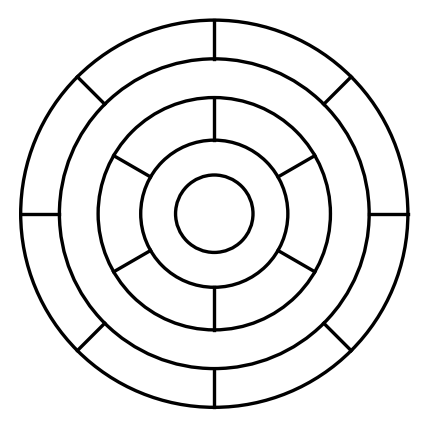
Consider the following figure and answer the item that follows:
What is the minimum number of different colours required to paint the figure given above such that no two adjacent regions have the same colour?
Answer (a) & explanation
1. Going out from the centre: centre circle, plain ring, ring cut into 6, plain ring, ring cut into 8.
2. Colour the ring of 6 red, blue, red, blue, red, blue. 6 is even, so the last piece does not touch a piece of its own colour. Do the same for the ring of 8.
3. Each plain ring touches both red and blue pieces, so it needs a third colour, green.
4. The centre circle touches only the green ring next to it, so it can be red.
5. Minimum colours = 3.
Answer as per the official UPSC answer key.
Read the passage
I opened the bag and packed the boots in; and then, just as I was going to close it, a horrible idea occurred to me. Had I packed my toothbrush ? I don’t know how it is, but I never do know whether I’ve packed my toothbrush.
My toothbrush is a thing that haunts me when I’m travelling, and makes my life a misery. I dream that I haven’t packed it, and wake up in a cold perspiration, and get out of bed and hunt for it. And, in the morning, I pack it before I have used it, and it is always the last thing I turn out of the bag; and then I repack and forget it, and have to rush upstairs for it at the last moment and carry it to the railway station, wrapped up in my pocket-handkerchief.
His toothbrush is finally
Answer (c) & explanation
In his handkerchief is correct (c). Step 1: follow the toothbrush through the story. He packs it, takes it out last, repacks and forgets it, then rushes upstairs for it. Step 2: finally he carries it 'to the railway station, wrapped up in my pocket-handkerchief'. So it ends up in his handkerchief: (c). Step 3: (a) is wrong: it was taken out of the bag and not put back. (b) is wrong: it was not left in bed. (d) is wrong: it was not lost.
Tip: 'finally' asks for the last position in the sequence. Read to the end of the passage before answering.
Answer as per the official UPSC answer key.
Human activities in the recent past have caused the increased concentration of carbon dioxide in the atmosphere, but a lot of it does not remain in the lower atmosphere because of
- 1. its escape into the outer stratosphere.
- 2. the photosynthesis by phytoplankton in the oceans.
- 3. the trapping of air in the polar ice caps.
Which of the statements given above is/are correct ?
Answer (b) & explanation
Only statement 2 is correct (b). The oceans absorb roughly a quarter of the CO₂ humans emit, and phytoplankton, microscopic plants in sunlit surface waters, fix large amounts of it through photosynthesis. When they die, some of that carbon sinks to the deep sea, a process called the biological pump. Statement 1 is wrong: CO₂ does not escape to the outer stratosphere in any significant amount; it is well mixed in the atmosphere. Statement 3 is wrong: air bubbles trapped in polar ice are a tiny, ancient store, useful to scientists for studying past climates, not a sink for today's CO₂. So options (a), (c) and (d) fail.
Notice the cost: absorbing CO₂ makes seawater more acidic, called ocean acidification, which harms corals and shellfish. Forests and soils are the other major carbon sinks. Atmospheric CO₂ passed about 425 ppm in 2025. Trap: ice cores are records, not sinks.
Answer as per the official UPSC answer key.
Which amongst the following provided a common factor for tribal insurrection in India in the 19th century ?
Answer (d) & explanation
The disruption of the old agrarian order is correct (d). New land revenue rules (a), missionaries (b) and moneylenders and revenue farmers called dikus (c) each fuelled particular revolts, but none was present everywhere. What was common to all 19th-century tribal risings was the break-up of the tribal agrarian order: loss of land, forest rights and community ownership, as outsiders and colonial laws took over. So (a), (b) and (c) are partial causes.
Notice the examples: the Kol rising (1831–32), the Santhal Hul (1855–56, Sidhu and Kanhu), and the Munda Ulgulan (1899–1900, Birsa Munda), which led to the Chotanagpur Tenancy Act, 1908. Birsa Munda's birth anniversary, 15 November, is now Janjatiya Gaurav Divas.
Answer as per the official UPSC answer key.
Westerlies in southern hemisphere are stronger and persistent than in northern hemisphere. Why ?
- 1. Southern hemisphere has less landmass as compared to northern hemisphere.
- 2. Coriolis force is higher in southern hemisphere as compared to northern hemisphere.
Which of the statements given above is/are correct ?
Answer (a) & explanation
Statement 1 only is correct (a). Between about 40° and 60° S there is almost only ocean, so the westerlies blow over water without mountains or land to slow them. They become strong and steady, called the Roaring Forties, Furious Fifties and Shrieking Sixties (1). Statement 2 is wrong: the Coriolis force depends on latitude and wind speed, not on the hemisphere; it is equal at the same latitude north and south, only deflecting in opposite directions. So (b), (c) and (d) fail.
Notice the related current: these winds drive the Antarctic Circumpolar Current, the strongest ocean current, around Antarctica. Sailors used the Roaring Forties for fast voyages to Australia. Trap: 'higher Coriolis in the south' sounds technical but is false.
Answer as per the official UPSC answer key.
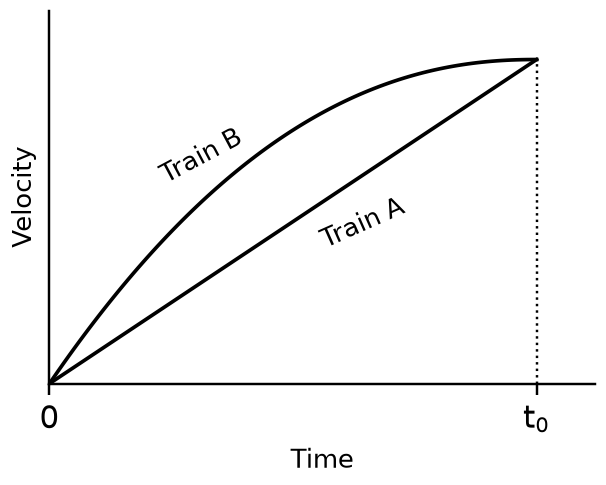
Consider the following Velocity-Time graph. It shows two trains starting simultaneously on parallel tracks.
With reference to the above graph, which one of the following statements is not correct?
Answer (d) & explanation
Option (d) is the statement that is not correct. Step 1: on a velocity–time graph, the slope shows acceleration. At the start B's line climbs more steeply, so (a) is correct. Both lines meet at t₀, so they have the same velocity then, and (c) is correct. Step 2: B's line stays above A's until t₀, so B is faster at all times up to t₀, and (b) is accepted. Step 3: distance is the area under the velocity line. B's line is above A's the whole way, so B covers more ground. 'Both travel the same distance' is wrong.
Tip: on a speed graph, the meeting point means same speed, not same distance. Distance is area, not height.
Some readers also object to (b), since the speeds are equal at the instant t0; the official answer is (d), as printed.
Answer as per the official UPSC answer key.
Consider the following argument: "In order to be a teacher one must graduate from college. All poets are poor. Some Mathematicians are poets. No college graduate is poor." Which one of the following is not a valid conclusion regarding the above argument?
Answer (b) & explanation
Option (b) is the conclusion that is not valid. Step 1: chain the facts. Teacher → college graduate → not poor. Poets are poor, so poets are not teachers (d is valid) and teachers are not poor (c is valid). Step 2: some mathematicians are poets, and those poets are not teachers, so some mathematicians are not teachers (a is valid). Step 3: nothing tells us whether any teacher is a mathematician or not. So 'some teachers are not mathematicians' cannot be concluded: (b) is not valid.
Tip: write each statement as an arrow and follow the chain. A conclusion is valid only if every link is given; if a link is missing, it does not follow.
Answer as per the official UPSC answer key.
You, as an administrative authority, have been approached, by the daughter-in-law of an influential person regarding harassment by her in-laws on account of insufficient dowry. Her parents are not able to approach you because of social pressures. You would
Answer (a) & explanation
UPSC's key lists (a) and (d), with no negative marking. Step 1: a woman reports dowry harassment by influential in-laws. Dowry demands are crimes under the Dowry Prohibition Act and Section 85 of the Bharatiya Nyaya Sanhita (formerly 498A IPC). Step 2: (a) calling the in-laws for an explanation acts at once, and (d) helping her lodge a police complaint starts legal protection. Step 3: (b) telling her to adjust leaves her in danger. (c) waiting for her parents ignores her own complaint; she is an adult entitled to act.
Tip: for these interpersonal items, pick the response that is lawful, honest and keeps the public work going. Avoid options that give in to pressure, pass the buck or abandon duty.
Answer as per the official UPSC answer key.
The function of heavy water in a nuclear reactor is to
Answer (a) & explanation
Slowing down neutrons is correct (a). Heavy water (D₂O) is a moderator. Fast neutrons released in fission are too quick to be captured by uranium-235; colliding with deuterium nuclei slows them to thermal speed so they cause further fission and sustain the chain reaction. Heavy water absorbs few neutrons, so it lets reactors run on natural uranium. (b) is the opposite. (c) is incomplete: heavy water also serves as coolant in India's PHWRs, but its defining function asked here is moderation. (d) is wrong: control rods of boron or cadmium absorb neutrons to slow or stop the reaction.
Notice India's fleet: most Indian reactors are Pressurised Heavy Water Reactors, matching stage one of the three-stage programme.
Answer as per the official UPSC answer key.
A married couple adopted a male child. A few years later, twin boys were born to them. The blood group of the couple is AB positive and O negative. The blood group of the three sons is A positive, B positive, and O positive. The blood group of the adopted son is
Answer (a) & explanation
O positive is correct (a). An AB parent passes either A or B, and an O parent passes only O. So the couple's own children can only be A (genotype AO) or B (genotype BO); an O child is impossible. The twins must be the A positive and B positive sons, and the O positive son must be adopted. (b) and (c) are the twins' groups. (d) is wrong: the data are enough to decide.
Notice the Rh factor: the O parent is Rh negative, the AB parent positive, so Rh-positive children are possible and do not change the answer. Another rule: AB is the universal recipient and O negative the universal donor. Trap: the Rh signs are a distraction.
Answer as per the official UPSC answer key.