
UPSC Prelims PYQs with explanations
Real questions from official papers, mapped to syllabus topics. Attempt each one; the answer and the reason appear instantly.
With reference to the period of colonial rule in India, “Home Charges” formed an important part of drain of wealth from India. Which of the following funds constituted “Home Charges” ?
- 1. Funds used to support the India Office in London.
- 2. Funds used to pay salaries and pensions of British personnel engaged in India.
- 3. Funds used for waging wars outside India by the British.
Select the correct answer using the codes given below :
Answer (b) & explanation
Statements 1 and 2 are correct per UPSC's key (b), but this key is doubtful. Home Charges were what India paid Britain each year: the cost of the India Office in London (1), salaries and pensions of British officials and soldiers (2), and interest on debt raised in Britain. Statement 3 is the doubt: the cost of wars outside India (Afghanistan, Burma, Abyssinia) was charged to Indian revenues, and several historians count it within Home Charges, so (d) is arguable. UPSC treated war costs as a separate burden. So (a) and (c) fail on any reading.
Notice the critics: Dadabhai Naoroji (Poverty and Un-British Rule in India), R.C. Dutt and the drain of wealth theory. Trap: all three look like drain items, but the key separates war spending.
Answer as per the official UPSC answer key.
The lower Gangetic plain is characterised by humid climate with high temperature throughout the year. Which one among the following pairs of crops is most suitable for this region ?
Answer (c) & explanation
Paddy and jute is correct (c). The lower Ganga plain, covering West Bengal and Bangladesh, is hot, humid and flooded in the monsoon, with rich, renewed alluvium. Paddy needs high temperature, heavy rain and standing water, and jute needs warm, wet conditions and water for retting, so this is the world's main jute belt. (a) and (d) are wrong: cotton prefers drier conditions and black soil, as in Maharashtra and Gujarat. (b) and (d) are wrong: wheat needs a cool, dry season, which suits the upper Ganga plain and Punjab.
Notice the rule: West Bengal is India's top rice producer and leading jute producer. The 'golden fibre' is also grown in Assam and Bihar. Trap: wheat is grown in winter, but the region's character favours rice.
Answer as per the official UPSC answer key.
Read the passage
A moral act must be our own act; must spring from our own will. If we act mechanically, there is no moral content in our act. Such action would be moral, if we think it proper to act like a machine and do so. For, in doing so, we use our discrimination. We should bear in mind the distinction between acting mechanically and acting intentionally. It may be moral of a king to pardon a culprit. But the messenger carrying out the order of pardon plays only a mechanical part in the king’s moral act. But if the messenger were to carry out the king’s order considering it to be his duty, his action would be a moral one. How can a man understand morality who does not use his own intelligence and power of thought, but lets himself be swept along like a log of wood by a current ? Sometimes a man defies convention and acts on his own with a view to absolute good.
Which of the following statements best describe/describes the thought of the writer ?
- 1. A moral act calls for using our discretion.
- 2. Man should react to a situation immediately.
- 3. Man must do his duty.
- 4. Man should be able to defy convention in order to be moral.
Select the correct answer from the codes given below :
Answer (d) & explanation
Statements 1 and 4 are correct per UPSC's key (d), though statement 3 is arguable. Step 1: the passage says a moral act uses 'our discrimination' and must spring from our own will: statement 1. Step 2: it says a man sometimes 'defies convention and acts on his own with a view to absolute good': statement 4. Step 3: statement 2 is wrong; the passage never asks for immediate reaction. Statement 3 is the doubt: the messenger acting from duty is called moral, so duty matters, but the writer stresses conscious choice, not duty as such; UPSC left it out. So (a), (b) and (c) fail on the key.
Tip: pick statements that capture the writer's core idea, here thinking for oneself, rather than examples used along the way.
Answer as per the official UPSC answer key.
Read the passage
Now India’s children have a right to receive at least eight years of education, the gnawing question is whether it will remain on paper or become a reality. One hardly needs a reminder that this right is different from the others enshrined in the Constitution, that the beneficiary – a six year old child cannot demand it, nor can she or he fight a legal battle when the right is denied or violated. In all cases, it is the adult society which must act on behalf of the child. In another peculiarity, where a child’s right to education is denied, no compensation offered later can be adequate or relevant. This is so because childhood does not last. If a legal battle fought on behalf of a child is eventually won, it may be of little use to the boy or girl because the opportunity missed at school during childhood cannot serve the same purpose later in life. This may be painfully true for girls because our society permits them only a short childhood, if at all. The Right to Education (RTE) has become law at a point in India’s history when the ghastly practice of female infanticide has resurfaced in the form of foeticide. This is “symptomatic of a deeper turmoil” in society which is compounding the traditional obstacles to the education of girls. Tenacious prejudice against the intellectual potential of girls runs across our cultural diversity and the system of education has not been able to address it.
With reference to the passage, consider the following statements :
- 1. When children are denied education, adult society does not act on behalf of them.
- 2. Right to Education as a law cannot be enforced in the country.
Which of the statements given above is/are correct ?
Answer (d) & explanation
Neither statement is correct (d). Step 1: statement 1 says adult society does not act for children. The passage says adult society 'must act on behalf of the child'. That is a duty, not a description of failure, so 1 is wrong. Step 2: statement 2 says RTE cannot be enforced. The passage only asks whether it will 'remain on paper or become a reality'; it worries about implementation, not that enforcement is impossible. So 2 is wrong. Step 3: options (a), (b) and (c) fail.
Tip: 'must' expresses what should happen, not what does happen. Do not turn a duty into a fact, or a worry into an impossibility.
Answer as per the official UPSC answer key.
India has experienced persistent and high food inflation in the recent past. What could be the reasons ?
- 1. Due to a gradual switchover to the cultivation of commercial crops, the area under the cultivation of food grains has steadily decreased in the last five years by about 30%.
- 2. As a consequence of increasing incomes, the consumption patterns of the people have undergone a significant change.
- 3. The food supply chain has structural constraints.
Which of the statements given above are correct ?
Answer (b) & explanation
Statements 2 and 3 are correct (b). As incomes rose in the 2000s, people shifted their diets towards protein-rich foods, milk, eggs, meat, fruits and vegetables, whose supply did not keep pace, pushing up prices (2). The food supply chain had structural constraints: poor storage and cold chains, many middlemen, APMC market restrictions and wastage (3). Statement 1 is wrong: the area under foodgrains did not fall by 30% in five years; it stayed roughly steady at about 120-125 million hectares. So options (a), (c) and (d) fail.
Notice the policy response over the years: e-NAM (2016), the Operation Greens scheme for tomato, onion and potato, cold-chain support under PM Kisan SAMPADA, and buffer stocks of pulses and onions. CPI food inflation is measured through the Consumer Food Price Index. Trap: an exaggerated figure like '30%' usually signals a false statement.
Answer as per the official UPSC answer key.
The authorization for the withdrawal of funds from the Consolidated Fund of India must come from
Answer (b) & explanation
Parliament is correct (b). Article 114 says no money can be withdrawn from the Consolidated Fund of India except under an Appropriation Act passed by Parliament. This is the core of legislative control over the executive's purse. (a) is wrong: the President recommends money bills and gives assent, but does not authorise spending. (c) and (d) are wrong: the Prime Minister and Finance Minister prepare and present the Budget, but Parliament must vote it.
Notice the related tools: Vote on Account (Article 116) lets Parliament grant money before the Budget is passed; the Contingency Fund (Article 267) is at the President's disposal for emergencies, later recouped by Parliament; and the CAG audits spending afterwards.
Answer as per the official UPSC answer key.
Among the following States, which one has the most suitable climatic conditions for the cultivation of a large variety of orchids with minimum cost of production, and can develop an export oriented industry in this field ?
Answer (b) & explanation
Arunachal Pradesh is correct (b). Orchids need warm, humid, shaded conditions with heavy rain and varied altitudes. Arunachal Pradesh has over 600 orchid species, the most of any Indian state, and an Orchid Research Centre at Tipi, which make it India's 'orchid paradise' with export potential. (a) is wrong: Andhra Pradesh is drier and warmer. (c) is wrong: Madhya Pradesh is semi-arid inland. (d) is wrong: Uttar Pradesh's plains are too hot and dry in summer.
Notice the wider pattern: the Northeast and the Western Ghats together hold most of India's roughly 1,300 orchid species; Sikkim's state flower is the noble dendrobium orchid. Trap: three of the four states lack the humid, hilly conditions orchids need.
Answer as per the official UPSC answer key.
With reference to Indian freedom struggle, Usha Mehta is well-known for
Answer (a) & explanation
Running the secret Congress Radio is correct (a). During the Quit India Movement (1942), the 22-year-old Usha Mehta ran the underground Congress Radio from Bombay from 14 August 1942, broadcasting news and speeches the British censored, until she was arrested in November 1942 and jailed. (b) is wrong: she did not attend the Second Round Table Conference (1931). (c) is wrong: the INA's Rani of Jhansi Regiment was led by Lakshmi Sahgal. (d) is wrong: she had no role in the 1946 Interim Government.
Notice her honour: she received the Padma Vibhushan in 1998. The 2024 film 'Ae Watan Mere Watan' retold her story. Other underground leaders included Ram Manohar Lohia, who helped the radio, and Aruna Asaf Ali.
Answer as per the official UPSC answer key.
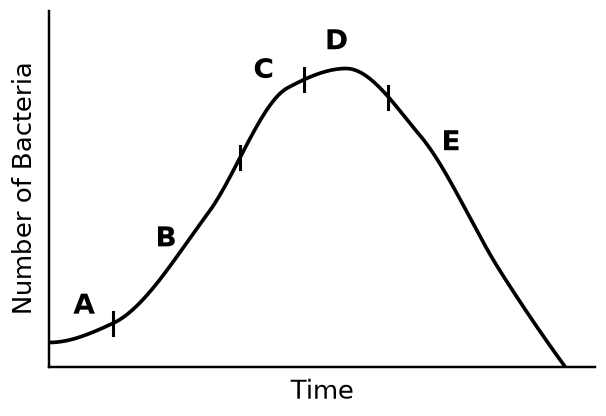
Directions for the following 3 (three) items: Read the passage given below, study the graph that follows and answer the three items given below the figure.
During a party, a person was exposed to contaminated water. A few days later, he developed fever and loose motions. He suffered for some days before going to a doctor for treatment. On starting the treatment, he soon became better and recovered completely a few days later. The following graph shows different phases of the person's disease condition as regions A, B, C, D and E of the curve.
Which region/regions of the curve correspond/corresponds to incubation phase of the infection?
Answer (a) & explanation
A only is correct (a). Step 1: the incubation phase is the quiet time after germs enter the body and before the person falls ill. Step 2: look at the curve. In region A, the bacteria count is low and almost flat: the germs have entered from the contaminated water but are only settling in, and there are no symptoms yet. Step 3: in B the count climbs fast, which means illness has begun, so B is not incubation. So (b), (c) and (d) fail.
Tip: link each part of a disease curve to a stage of the story: exposure and quiet growth, then symptoms, then the peak, then recovery after treatment.
Answer as per the official UPSC answer key.
In a queue, Mr. X is fourteenth from the front and Mr. Y is seventeenth from the end, while Mr. Z is exactly in between Mr. X and Mr. Y. If Mr. X is ahead of Mr. Y and there are 48 persons in the queue, how many persons are there between Mr. X and Mr. Z?
Answer (c) & explanation
8 is correct (c). Step 1: Y is 17th from the end in a queue of 48, so Y is 48 − 17 + 1 = 32nd from the front. Step 2: X is 14th. The people between X and Y are in places 15 to 31, which is 17 people. Z is exactly in the middle of them, so Z is in place 15 + 8 = 23rd. Step 3: the people between X (14th) and Z (23rd) are in places 15 to 22, which is 8 people. So (a), (b) and (d) fail.
Tip: convert every position to 'from the front' first, using position from front = total − position from end + 1. Then count gaps carefully.
Answer as per the official UPSC answer key.
Regarding “carbon credits”, which one of the following statements is *not* correct ?
Answer (d) & explanation
Statement (d) is not correct, so it is the answer. Carbon credits came with the Kyoto Protocol (1997) (a), through mechanisms like the Clean Development Mechanism (CDM) and emissions trading. One credit equals the reduction of one tonne of CO₂ or its equivalent. Countries or entities that cut emissions below their quota earn credits (b) and can sell them, so the goal is to limit emissions (c). But their price is set by supply and demand in carbon markets, not fixed by the UNEP, which makes (d) false.
Notice the new framework: under the Paris Agreement, Article 6 sets up new carbon market rules, finalised at COP29 (Baku, 2024). India launched its own Carbon Credit Trading Scheme (CCTS) under the Energy Conservation (Amendment) Act, 2022, with emission-intensity targets for industries notified in 2025. Trap: the UN body does not fix prices; the market does.
Answer as per the official UPSC answer key.
Consider the following :
- 1. Photosynthesis
- 2. Respiration
- 3. Decay of organic matter
- 4. Volcanic action
Which of the above add carbon dioxide to the carbon cycle on Earth ?
Answer (c) & explanation
Respiration, decay and volcanic action add CO₂, so the answer is (c). Respiration by plants, animals and microbes releases carbon dioxide (2). Decay of organic matter by decomposers releases it too (3). Volcanic eruptions vent CO₂ from deep inside the Earth (4). Statement 1 is wrong: photosynthesis does the reverse; it removes CO₂ from the air and stores the carbon in plants. So (a), (b) and (d) fail.
Notice the wider cycle: the oceans are the biggest carbon sink, forests and soils store a large share, and burning fossil fuels is the main human addition, pushing atmospheric CO₂ above 420 ppm today. Trap: photosynthesis is part of the carbon cycle but it is a sink, not a source.
Answer as per the official UPSC answer key.
In India, which of the following have the highest share in the disbursement of credit to agriculture and allied activities ?
Answer (a) & explanation
Commercial banks is correct (a). Scheduled commercial banks give the largest share of agricultural credit, roughly three-quarters or more, far ahead of cooperative banks (b), Regional Rural Banks (c) and microfinance institutions (d). Cooperatives led in the early decades, but commercial banks overtook them after bank nationalisation (1969, 1980) and the priority-sector lending rule that 18% of credit must go to agriculture.
Notice the delivery tools: the Kisan Credit Card (1998), interest subvention for short-term crop loans, and the agricultural credit target, which crossed ₹27 lakh crore for 2024–25. RRBs were amalgamated under 'One State One RRB', down to 28 RRBs from May 2025. Trap: cooperatives sound most 'rural', but their share has shrunk.
Answer as per the official UPSC answer key.
The following item consists of four statements. Of these four statements, two cannot both be true, but both can be false. Study the statements carefully and identify the two that satisfy the above condition.
- 1. All animals are carnivorous.
- 2. Some animals are not carnivorous.
- 3. Animals are not carnivorous.
- 4. Some animals are carnivorous.
Answer (a) & explanation
Statements 1 and 3 are correct (a). Step 1: we need two statements that cannot both be true but can both be false. Step 2: 'All animals are carnivorous' (1) and 'Animals are not carnivorous', meaning none are (3), cannot both be true. But if only some animals eat meat, both are false. So 1 and 3 fit. Step 3: check the other pairs. 1 and 2 are exact opposites: one must be true. 3 and 4 are also exact opposites. 2 and 4 can both be true. So (b), (c) and (d) fail.
Tip: 'All' and 'None' are contraries: never both true, can both be false. 'All' and 'Some not' are contradictories: exactly one is true.
Answer as per the official UPSC answer key.
There are 100 students in a particular class. 60% students play cricket, 30% students play football and 10% students play both the games. What is the number of students who play neither cricket nor football?
Answer (b) & explanation
20 students is correct (b). Step 1: 60 play cricket and 30 play football. But the 10 who play both are counted twice. Step 2: students playing at least one game = 60 + 30 − 10 = 80. Step 3: students playing neither = 100 − 80 = 20. So (a), (c) and (d) fail.
Tip: for two overlapping groups, total in either = A + B − both. Drawing two overlapping circles (a Venn diagram) makes this clear at a glance.
Answer as per the official UPSC answer key.
A local thug (bad element) has started illegal construction on your vacant plot. He has refused your request to vacate and threatened you of dire consequences in case you do not sell the property at a cheap price to him. You would
Answer (b) & explanation
UPSC's key lists (b) and (d), with no negative marking; (b) is the best response. Step 1: a thug is building illegally on your plot and threatening you. Step 2: going to the police (b) is the lawful and safe course; the police must act against encroachment and criminal intimidation. Step 3: (a) selling cheap gives in to the threat and rewards crime. (c) neighbours may help but cannot enforce the law. (d) negotiating a higher price, also in the key, avoids conflict but still yields to an illegal demand, so (b) is the safer answer to mark.
Tip: for these interpersonal items, pick the response that is lawful, honest and keeps the public work going. Avoid options that give in to pressure, pass the buck or abandon duty.
Answer as per the official UPSC answer key.
Karl Marx explained the process of class struggle with the help of which one of the following theories ?
Answer (d) & explanation
Dialectical materialism is the answer (d). Marx took Hegel's dialectic (thesis, antithesis, synthesis) but turned it to material life: history moves forward through conflict between classes that own the means of production and classes that do not, until a classless society emerges. (a) is wrong: liberalism stresses individual rights and markets, the very order Marx attacked. (b) is wrong: existentialism (Kierkegaard, Sartre) is about individual choice and meaning, not classes. (c) is wrong: Marx admired Darwin, but class struggle is not built on evolution of species.
Notice the wider frame: Marx's historical materialism sees the economic base shaping the political and cultural superstructure. Trap: 'Darwin' tempts because both describe struggle and change.
Answer as per the official UPSC answer key.
What was the reason for Mahatma Gandhi to organize a satyagraha on behalf of the peasants of Kheda ?
- 1. The Administration did not suspend the land revenue collection in spite of a drought.
- 2. The Administration proposed to introduce Permanent Settlement in Gujarat.
Which of the statements given above is/are correct ?
Answer (a) & explanation
Statement 1 only is correct (a). In Kheda (1918), Gujarat, crops failed, and under the revenue rules collection should have been suspended when the yield fell below a quarter of normal. The government still demanded full land revenue, so Gandhi, with Vallabhbhai Patel, Indulal Yagnik and others, led a no-tax satyagraha. Statement 2 is wrong: there was no plan to introduce the Permanent Settlement in Gujarat, which had the ryotwari system. So (b), (c) and (d) fail.
Notice Gandhi's early trio: Champaran (1917) against indigo planters, the Ahmedabad mill strike (1918), where he first fasted, and Kheda (1918). Patel's fame grew later at Bardoli (1928), which earned him the title 'Sardar'.
Answer as per the official UPSC answer key.
What could be the main reason/reasons for the formation of African and Eurasian desert belt ?
- 1. It is located in the sub-tropical high pressure cells.
- 2. It is under the influence of warm ocean currents.
Which of the statements given above is/are correct in this context ?
Answer (a) & explanation
Statement 1 only is correct (a). The Sahara–Arabia–Thar desert belt lies under the subtropical high-pressure cells (about 20°–30° N), where air from the Hadley cell sinks, warms by compression and stays dry, so clouds and rain cannot form (1). Statement 2 is wrong: warm ocean currents add moisture and rain. Deserts on western coasts are linked to cold currents, such as the Canary (Sahara) and Benguela (Namib), which cool the air and stop rain. So (b), (c) and (d) fail.
Notice the wider pattern: the same high-pressure belt makes the Kalahari, Australian and Atacama deserts in the south. The Thar is also helped by the Aravallis lying parallel to the monsoon winds. Trap: the current's temperature is reversed.
Answer as per the official UPSC answer key.
Read the passage
A moral act must be our own act; must spring from our own will. If we act mechanically, there is no moral content in our act. Such action would be moral, if we think it proper to act like a machine and do so. For, in doing so, we use our discrimination. We should bear in mind the distinction between acting mechanically and acting intentionally. It may be moral of a king to pardon a culprit. But the messenger carrying out the order of pardon plays only a mechanical part in the king’s moral act. But if the messenger were to carry out the king’s order considering it to be his duty, his action would be a moral one. How can a man understand morality who does not use his own intelligence and power of thought, but lets himself be swept along like a log of wood by a current ? Sometimes a man defies convention and acts on his own with a view to absolute good.
Which of the following statements is the nearest definition of moral action, according to the writer ?
Answer (b) & explanation
An action based on our sense of discretion is correct (b). Step 1: the passage says 'a moral act must be our own act; must spring from our own will', and 'we use our discrimination'. Discrimination here means judgement or discretion. That is (b). Step 2: check (a). The messenger who acts mechanically on orders is the writer's example of a non-moral act, so (a) is the opposite. Step 3: check (c) and (d). 'Clever' action and 'religious' action are never mentioned. So (a), (c) and (d) fail.
Tip: in old-style English, 'discrimination' means the ability to judge well, not unfair treatment. Knowing this unlocks the answer.
Answer as per the official UPSC answer key.