
UPSC Prelims PYQs with explanations
Real questions from official papers, mapped to syllabus topics. Attempt each one; the answer and the reason appear instantly.
Economic growth is usually coupled with
Answer (b) & explanation
Inflation is correct (b). When an economy grows, incomes and demand rise faster than supply can adjust, so prices usually rise moderately. This mild inflation often comes with growth; the Phillips curve idea links lower unemployment to higher inflation. (a) is wrong: deflation, a fall in prices, usually comes with slumps. (c) is wrong: stagflation means low growth with high inflation, the opposite of growth. (d) is wrong: hyperinflation is a runaway rise in prices, a breakdown, not normal growth.
Notice India's framework: the RBI targets 4% CPI inflation with a band of 2–6% under the flexible inflation targeting regime (2016), now retained for 2026–31. Trap: 'usually coupled' asks for the typical, moderate case.
Answer as per the official UPSC answer key.
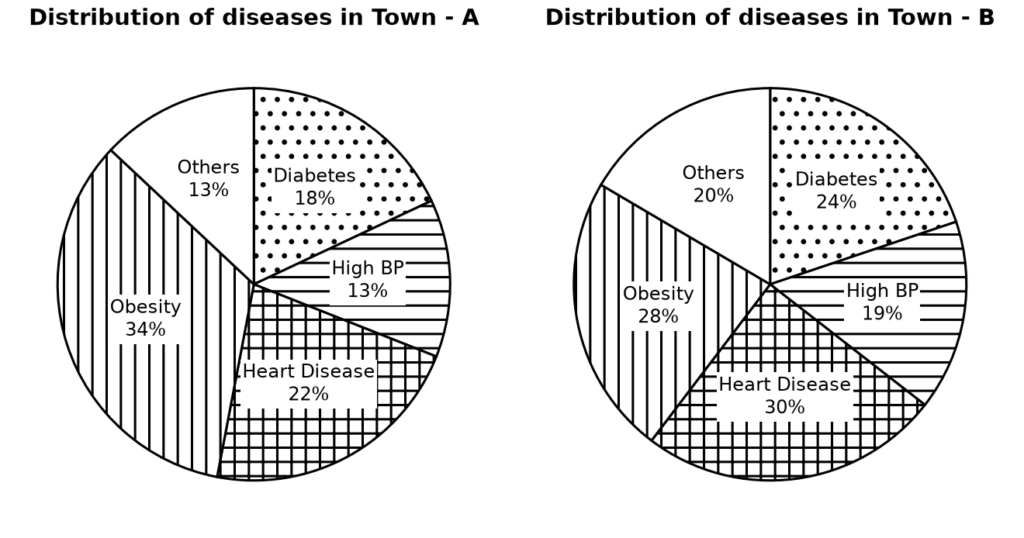
Directions for the following 2 (two) items: The following pie charts show the break-up of disease categories recorded in the patients from two towns, Town A and Town B. Pie charts plot the disease categories as percentage of the total number of patients. Based on these, answer the two items that follow the charts.
Which of the two towns has a higher number of persons with Diabetes?
Answer (d) & explanation
No inference can be drawn is correct (d). Step 1: the pie charts give only percentages: diabetes is 18% of patients in Town A and 24% in Town B. Step 2: we are not told how many patients each town has. Step 3: 24% of a small number can be less than 18% of a big number. For example, 24% of 100 is 24, but 18% of 1,000 is 180. So we cannot say which town has more diabetics. Options (a), (b) and (c) fail.
Tip: a percentage alone never tells you the actual number. Always ask 'percentage of what total?' before comparing two groups.
Answer as per the official UPSC answer key.
Read the passage
A species that exerts an influence out of proportion to its abundance in an ecosystem is called a keystone species. The keystone species may influence both the species richness of communities and the flow of energy and materials through ecosystems. The sea star Pisaster ochraceus, which lives in rocky intertidal ecosystems on the Pacific coast of North America, is also an example of a keystone species. Its preferred prey is the mussel Mytilus californianus. In the absence of sea stars, these mussels crowd out other competitors in a broad belt of the intertidal zone. By consuming mussels, sea star creates bare spaces that are taken over by a variety of other species.
A study at the University of Washington demonstrated the influence of Pisaster on species richness by removing sea stars from selected parts of the intertidal zone repeatedly over a period of five years. Two major changes occurred in the areas from which sea stars were removed. First, the lower edge of the mussel bed extended farther down into the intertidal zone, showing that sea stars are able to eliminate mussels completely where they are covered with water most of the time. Second, and more dramatically, 28 species of animals and algae disappeared from the sea star removal zone. Eventually only Mytilus, the dominant competitor, occupied the entire substratum. Through its effect on competitive relationships, predation by Pisaster largely determines which species live in these rocky intertidal ecosystems.
Which of the following is/are implied by the passage ?
- 1. Mussels are always hard competitors for sea stars.
- 2. Sea stars of the Pacific coast have reached the climax of their evolution.
- 3. Sea stars constitute an important component in the energy flow in intertidal ecosystem.
Which of the statements given above is/are correct ?
Answer (d) & explanation
Statement 3 only is correct (d). Step 1: the passage says keystone species influence 'the flow of energy and materials through ecosystems', and the sea star is a keystone species. So it is an important part of energy flow: statement 3. Step 2: statement 1 is wrong: mussels are the sea star's prey, not its competitors; mussels compete with other species for space. Step 3: statement 2 is wrong: the passage never discusses evolution or a 'climax'. So (a), (b) and (c) fail.
Tip: check each role carefully. Prey and competitor are different relationships, and options love to swap them.
Answer as per the official UPSC answer key.
You are the officer-in-charge of a village administering distribution of vaccine in an isolated epidemic hit village, and you are left with only one vaccine. There is a requirement of that vaccine from the Gram Pradhan and also a poor villager. You are being pressurised by the Gram Pradhan to issue the vaccine to him. You would
Answer (b) & explanation
UPSC's key lists (b) and (d), with no negative marking. Step 1: there is only one vaccine, two people need it, and the Gram Pradhan is using pressure. Step 2: (b) and (d) both arrange a second dose from another area's distributor, so both people get vaccinated. Option (b), arranging for the poor villager from outside while the local dose goes by need, resists undue pressure. Step 3: (a) leaves both unprotected during an epidemic. (c) delays care and passes the decision to someone else.
Tip: for these interpersonal items, pick the response that is lawful, honest and keeps the public work going. Avoid options that give in to pressure, pass the buck or abandon duty.
Answer as per the official UPSC answer key.
With reference to “Aam Admi Bima Yojana”, consider the following statements :
- 1. The member insured under the scheme must be the head of the family or an earning member of the family in a rural landless household.
- 2. The member insured must be in the age group of 30 to 65 years.
- 3. There is a provision for free scholarship for up to two children of the insured who are studying between classes 9 and 12.
Which of the statements given above is/are correct ?
Answer (c) & explanation
Statements 1 and 3 are correct (c). Aam Admi Bima Yojana (2007, run by LIC) insured the head or an earning member of a rural landless household (1), and its add-on Shiksha Sahyog Yojana paid a scholarship to up to two children studying in classes 9 to 12 (3). Statement 2 is wrong: the age band was 18 to 59 years, not 30 to 65. So options (a), (b) and (d) fail.
Notice the later history: AABY was merged with the Janashree Bima Yojana and, from 2017–18, its cover shifted to the PM Jeevan Jyoti Bima Yojana and PM Suraksha Bima Yojana (both 2015). Trap: age bands are a favourite way UPSC makes a scheme statement wrong.
Answer as per the official UPSC answer key.
What is the difference between a CFL and an LED lamp ?
- 1. To produce light, a CFL uses mercury vapour and phosphor while an LED lamp uses semi-conductor material.
- 2. The average life span of a CFL is much longer than that of an LED lamp.
- 3. A CFL is less energy-efficient as compared to an LED lamp.
Which of the statements given above is/are correct ?
Answer (c) & explanation
Statements 1 and 3 are correct (c). A CFL passes current through mercury vapour, whose ultraviolet light makes a phosphor coating glow, while an LED emits light from a semiconductor chip (1). LEDs give more light per watt, so a CFL is less energy-efficient (3). Statement 2 is reversed: an LED lasts much longer, about 25,000 hours or more, against roughly 8,000 for a CFL. So (a), (b) and (d) fail.
Notice the policy: India's UJALA scheme (2015) distributed over 36 crore LED bulbs, cutting their price sharply, and the Street Lighting National Programme replaced street lamps with LEDs. CFLs also pose a mercury disposal problem. The 2014 Nobel Prize in Physics went for the blue LED.
Answer as per the official UPSC answer key.
A state in India has the following characteristics :
- 1. Its northern part is arid and semi-arid.
- 2. Its central part produces cotton.
- 3. Cultivation of cash crops is predominant over food crops.
Which one of the following states has all of the above characteristics ?
Answer (b) & explanation
Gujarat is correct (b). Gujarat's north, including Kutch and Banaskantha, is arid and semi-arid (1). Its central and Saurashtra black-soil belt grows a large share of India's cotton, making it India's top cotton state in most years (2). Cash crops such as cotton, groundnut, castor and tobacco take more land than food grains (3). (a) is wrong: Andhra Pradesh is a rice state. (c) is wrong: Karnataka's north is semi-arid, but its cotton belt is not central and food crops dominate. (d) is wrong: Tamil Nadu has no arid north and is mostly rice-based.
Notice the wider facts: Gujarat leads India in castor, groundnut and cumin, and in Bt cotton area. Trap: Karnataka fits part, but only Gujarat fits all three.
Answer as per the official UPSC answer key.
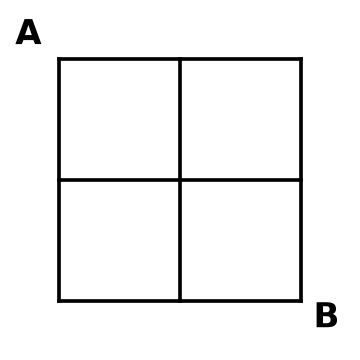
Study the following figure:
A person goes from A to B always moving to the right or downwards along the lines. How many different routes can he adopt?
Select the correct answer from the codes given below:
Answer (c) & explanation
6 routes is correct (c). Step 1: from A to B on this grid, every route needs exactly 2 steps right (R) and 2 steps down (D), in some order. Step 2: list the orders: RRDD, RDRD, RDDR, DRRD, DRDR, DDRR. That is 6 routes. Step 3: check with a formula: the number of ways to arrange 2 R's and 2 D's is 4! ÷ (2! × 2!) = 24 ÷ 4 = 6. So (a), (b) and (d) fail.
Tip: for grid routes moving only right and down, count the steps of each kind, then use (total steps)! ÷ (rights! × downs!). For bigger grids, this saves a lot of drawing.
Answer as per the official UPSC answer key.
Read the following passage and answer the 3 (three) items that follow:
A, B, C, D and E are members of the same family. There are two fathers, two sons, two wives, three males and two females. The teacher was the wife of a lawyer who was the son of a doctor. E is not a male, neither also a wife of a professional. C is the youngest person in the family and D is the eldest. B is a male.
How is D related to E?
Answer (a) & explanation
1. Three generations: doctor → his son the lawyer → the lawyer's child. The eldest, D, is the doctor; the youngest, C, is the grandchild.
2. Two sons means the lawyer and C are both sons, so C is male. With B male, the males are D, the lawyer and C, so the lawyer is B.
3. The two females are then A and E. The teacher is the lawyer's wife, and E is not the wife of a professional, so the teacher is A (B's wife). The other wife, E, is D's wife.
4. So D is E's husband.
The wording "neither also a wife of a professional" is loose; the official answer is (a), as printed.
Answer as per the official UPSC answer key.
The formation of ozone hole in the Antarctic region has been a cause of concern. What could be the reason for the formation of this hole ?
Answer (b) & explanation
The answer is (b). In the Antarctic winter, a strong polar vortex (polar front) isolates very cold air over the continent. Temperatures fall below about −78°C, and polar stratospheric clouds form. On the ice crystals of these clouds, chlorine compounds from chlorofluorocarbons are turned into active forms. When sunlight returns in spring (September-October), this chlorine destroys ozone rapidly, creating the ozone hole. Option (a) is wrong because the process is stratospheric, not tropospheric. Option (c) is wrong because it says polar front and clouds are absent. Option (d) is wrong because warming is not the cause.
Notice the outcome: the Montreal Protocol (1987) phased out CFCs, and the ozone layer is expected to recover to 1980 levels over Antarctica by about 2066, according to UNEP-WMO assessments. The Arctic sees smaller holes because its vortex is weaker. Trap: stratosphere, not troposphere.
Answer as per the official UPSC answer key.
Among the following who are eligible to benefit from the “Mahatma Gandhi National Rural Employment Guarantee Act” ?
Answer (d) & explanation
Adult members of any rural household is correct (d). MGNREGA (2005) guaranteed 100 days of unskilled manual work a year to every rural household whose adult members volunteered for it. It was universal and demand-driven, with no condition of caste, BPL status or backwardness. So (a), (b) and (c) wrongly add a condition. Work had to be given within 15 days of demand, or an unemployment allowance was due.
Notice the recent change: the VB-G RAM G Act, 2025 (Viksit Bharat Guarantee for Rozgar and Ajeevika Mission, Gramin) repealed MGNREGA from 1 July 2026 and raised the guarantee to 125 days per rural household, keeping the same open, demand-based entitlement. Trap: welfare schemes often target BPL, but this one did not.
Answer as per the official UPSC answer key.
The 2004 Tsunami made people realize that mangroves can serve as a reliable safety hedge against coastal calamities. How do mangroves function as a safety hedge ?
Answer (d) & explanation
Option (d) is correct. Mangroves have dense prop and stilt roots anchored deep in coastal mud, so storms and tides rarely uproot them. This tangle of roots and trunks breaks the force of waves and traps sediment, as seen in Tamil Nadu's Pichavaram and Muthupet in 2004, where villages behind mangroves suffered far less. (a) is wrong: people do live near and work in mangroves; fishing and honey collection are common. (b) is wrong: food and medicine are real benefits, but they do not make a safety hedge. (c) is wrong: most mangroves are low trees, not tall shelters.
Notice the scale: India has about 4,990 sq km of mangroves, with the Sundarbans the largest; the MISHTI scheme (2023) plants new mangroves along the coast.
Answer as per the official UPSC answer key.
Read the passage
For achieving inclusive growth there is a critical need to rethink the role of the State. The early debate among economists about the size of the Government can be misleading. The need of the hour is to have an enabling Government. India is too large and complex a nation for the State to be able to deliver all that is needed. Asking the Government to produce all the essential goods, create all the necessary jobs, and keep a curb on the prices of all goods is to lead to a large cumbersome bureaucracy and widespread corruption.
The aim must be to stay with the objective of inclusive growth that was laid down by the founding fathers of the nation and also to take a more modern view of what the State can realistically deliver.
This is what leads to the idea of an enabling State, that is, a Government that does not try to directly deliver to the citizens everything that they need. Instead, it (1) creates an enabling ethos for the market so that individual enterprise can flourish and citizens can, for the most part, provide for the needs of one another, and (2) steps in to help those who do not manage to do well for themselves, for there will always be individuals, no matter what the system, who need support and help. Hence we need a Government that, when it comes to the market, sets effective, incentive-compatible rules and remains on the sidelines with minimal interference, and, at the same time, plays an important role in directly helping the poor by ensuring that they get basic education and health services and receive adequate nutrition and food.
Why is the State unable to deliver “all that is needed” ?
- 1. It does not have sufficient bureaucracy.
- 2. It does not promote inclusive growth.
Select the correct answer from the codes given below :
Answer (d) & explanation
Neither statement is correct (d). Step 1: find the passage's reason. It says 'India is too large and complex a nation for the State to be able to deliver all that is needed'. Step 2: check statement 1. The passage does not blame a shortage of bureaucracy; it warns that trying to do everything would create a large, cumbersome bureaucracy and corruption. So 1 is wrong. Step 3: check statement 2. The State failing to promote inclusive growth is not the reason given; inclusive growth remains the goal. So 2 is wrong too. Options (a), (b) and (c) fail.
Tip: 'why' questions want the reason the passage actually states. Find that sentence first; anything else, however logical, is outside the passage.
Answer as per the official UPSC answer key.
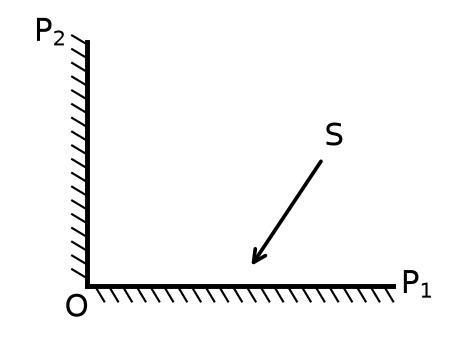
Consider the figure given below and answer the item that follows:
In the figure shown above, OP1 and OP2 are two plane mirrors kept perpendicular to each other. S is the direction of a beam of light falling on the mirror OP1. The direction of the reflected beam of light from the mirror OP2 will be
Answer (c) & explanation
Opposite and parallel to S is correct (c). Step 1: think of the beam as having two parts: an up-down part and a left-right part. Step 2: the first mirror OP₁ reverses one part, and the second mirror OP₂, at 90° to the first, reverses the other part. Step 3: with both parts reversed, the beam goes straight back the way it came, travelling opposite and parallel to S, just shifted sideways. So (a), (b) and (d) fail.
Tip: two mirrors at right angles always send light back parallel to where it came from. This is how corner reflectors on bicycles and the reflectors left on the Moon work.
Answer as per the official UPSC answer key.
Read the passage
I opened the bag and packed the boots in; and then, just as I was going to close it, a horrible idea occurred to me. Had I packed my toothbrush ? I don’t know how it is, but I never do know whether I’ve packed my toothbrush.
My toothbrush is a thing that haunts me when I’m travelling, and makes my life a misery. I dream that I haven’t packed it, and wake up in a cold perspiration, and get out of bed and hunt for it. And, in the morning, I pack it before I have used it, and it is always the last thing I turn out of the bag; and then I repack and forget it, and have to rush upstairs for it at the last moment and carry it to the railway station, wrapped up in my pocket-handkerchief.
What makes his life miserable whenever he undertakes travelling ?
Answer (b) & explanation
Forgetting the toothbrush is correct (b). Step 1: the passage says 'My toothbrush is a thing that haunts me when I'm travelling, and makes my life a misery'. His fear is about forgetting it. Step 2: so the cause of his misery is the worry of forgetting the toothbrush: (b). Step 3: (a) and (c), going to the station and packing, are where the worry plays out, not the cause. (d) bad dreams are only one symptom of the same worry. So (a), (c) and (d) fail.
Tip: separate the cause from its effects. The dreams and the last-minute rush are effects; the toothbrush worry is the cause.
Answer as per the official UPSC answer key.
Three of the following criteria have contributed to the recognition of Western Ghats-Sri Lanka and Indo-Burma regions as hotspots of biodiversity :
- 1. Species richness
- 2. Vegetation density
- 3. Endemism
- 4. Ethno-botanical importance
- 5. Threat perception
- 6. Adaptation of flora and fauna to warm and humid conditions
Which three of the above are correct criteria in this context ?
Answer (c) & explanation
Criteria 1, 3 and 5 are correct (c). A biodiversity hotspot, a concept from Norman Myers (1988) later adopted by Conservation International, must meet two strict tests: it must have at least 1,500 endemic vascular plant species (endemism), and it must have lost at least 70% of its original habitat (threat). Such places also have high species richness. So 1, 3 and 5 are the criteria. Vegetation density (2), ethno-botanical importance (4) and adaptation to warm humid conditions (6) are not hotspot criteria, so options (a), (b) and (d) fail.
Notice the numbers: there are 36 hotspots worldwide, covering about 2.5% of land but holding over half of plant species as endemics. India has parts of four: the Himalaya, Indo-Burma, Western Ghats-Sri Lanka and Sundaland (Nicobar Islands). Trap: dense forest alone does not make a hotspot.
Answer as per the official UPSC answer key.
The tendency for increased litigation was visible after the introduction of the land settlement system of Lord Cornwallis in 1793. The reason for this is normally traced to which of the following provisions ?
Answer (d) & explanation
UPSC's key is (d), none of the three, but this key is doubtful. The Permanent Settlement (1793) made zamindars owners of land with revenue fixed forever, yet it left ryots' rights unrecorded and boundaries vague, and estates of defaulters were auctioned under the Sunset Law. Disputes over rights, rents and sales filled the courts. Many books link this to (a): the Settlement strengthened zamindars against ryots, which bred litigation. (b) is wrong: the Company was already the sovereign, not newly an 'overlord'. (c) is wrong: the courts were slow and costly, not efficient.
Notice the related system: Cornwallis also separated revenue and judicial work (the Cornwallis Code). For the exam, follow the official key, but know the argument for (a).
Answer as per the official UPSC answer key.
The lowering of Bank Rate by the Reserve Bank of India leads to
Answer (a) & explanation
More liquidity in the market is correct (a). The Bank Rate is the rate at which the RBI lends to banks on a longer-term basis without collateral of government securities. Cutting it makes borrowing from the RBI cheaper, so banks can lend more at lower rates, and liquidity rises. (b) and (c) are wrong for that reason. (d) is wrong: lower policy rates tend to lower deposit rates, so deposits do not rise because of the cut.
Notice the present practice: the repo rate is now the main policy signal; the Bank Rate is aligned with the Marginal Standing Facility rate (repo + 0.25%) and is used mainly for penal rates. Other tools: CRR, SLR, the Standing Deposit Facility and open market operations. Trap: deposits fall, not rise, when rates are cut.
Answer as per the official UPSC answer key.
(Same pie charts as the question above.)
What can we say about persons with more than one disease from these graphs?
Answer (b) & explanation
Town B is correct (b). Step 1: add the slices of Town A: 13 + 18 + 13 + 22 + 34 = 100%. So each patient is counted exactly once. Step 2: add the slices of Town B: 20 + 24 + 19 + 30 + 28 = 121%. That is more than 100%. Step 3: the extra 21% can only come from patients counted in two disease groups. So Town B is likely to have persons with more than one disease. So (a), (c) and (d) fail.
Tip: when pie-chart slices add up to more than 100%, some items are counted twice. That simple sum is the whole question.
Answer as per the official UPSC answer key.
Read the passage
A species that exerts an influence out of proportion to its abundance in an ecosystem is called a keystone species. The keystone species may influence both the species richness of communities and the flow of energy and materials through ecosystems. The sea star Pisaster ochraceus, which lives in rocky intertidal ecosystems on the Pacific coast of North America, is also an example of a keystone species. Its preferred prey is the mussel Mytilus californianus. In the absence of sea stars, these mussels crowd out other competitors in a broad belt of the intertidal zone. By consuming mussels, sea star creates bare spaces that are taken over by a variety of other species.
A study at the University of Washington demonstrated the influence of Pisaster on species richness by removing sea stars from selected parts of the intertidal zone repeatedly over a period of five years. Two major changes occurred in the areas from which sea stars were removed. First, the lower edge of the mussel bed extended farther down into the intertidal zone, showing that sea stars are able to eliminate mussels completely where they are covered with water most of the time. Second, and more dramatically, 28 species of animals and algae disappeared from the sea star removal zone. Eventually only Mytilus, the dominant competitor, occupied the entire substratum. Through its effect on competitive relationships, predation by Pisaster largely determines which species live in these rocky intertidal ecosystems.
Consider the following assumptions :
- 1. The food chains/food web in an ecosystem are influenced by keystone species.
- 2. The presence of keystone species is a specific characteristic of aquatic ecosystems.
- 3. If the keystone species is completely removed from an ecosystem, it will lead to the collapse of the ecosystem.
With reference to the passage, which of the above assumptions is/are valid ?
Answer (c) & explanation
Assumptions 1 and 3 are valid per UPSC's key (c). Step 1: the passage says predation by the sea star 'largely determines which species live' there, so keystone species shape the food web: assumption 1. Step 2: when sea stars were removed, 28 species vanished and only mussels remained, a collapse of the community: UPSC accepts assumption 3, though 'collapse of the ecosystem' slightly overstates a single study. Step 3: assumption 2 is wrong: one marine example cannot show that keystone species are found only in aquatic ecosystems. So (a), (b) and (d) fail.
Tip: one example never proves 'specific to' or 'only'. Generalising from a single case is the trap.
Answer as per the official UPSC answer key.