
UPSC Prelims PYQs with explanations
Real questions from official papers, mapped to syllabus topics. Attempt each one; the answer and the reason appear instantly.
Consider the following statements :
- 1. The duration of the monsoon decreases from southern India to northern India.
- 2. The amount of annual rainfall in the northern plains of India decreases from east to west.
Which of the statements given above is/are correct?
Answer (c) & explanation
Both statements are correct (c). The monsoon arrives first in Kerala around 1 June and withdraws from the south last, in October–December, while it reaches north-west India in July and leaves in September, so its duration decreases from south to north (1). In the northern plains, the Bay of Bengal branch loses moisture as it moves west, so annual rainfall decreases from east to west, from over 150 cm in West Bengal to under 50 cm in western Rajasthan (2). So (a), (b) and (d) fail.
Notice the related rule: rainfall also decreases inland from the Western Ghats, leaving a rain-shadow in the Deccan. The 2025 monsoon onset over Kerala came early, on 24 May. Trap: both are standard gradients.
Answer as per the official UPSC answer key.
Read the passage
Today’s developing economies use much less energy per capita than developed countries such as the United States did at similar incomes, showing the potential for lower-carbon growth. Adaptation and mitigation need to be integrated into a climate-smart development strategy that increases resilience, reduces the threat of further global warming, and improves development outcomes. Adaptation and mitigation measures can advance development, and prosperity can raise incomes and foster better institutions. A healthier population living in better-built houses and with access to bank loans and social security is better equipped to deal with a changing climate and its consequences. Advancing robust, resilient development policies that promote adaptation is needed today because changes in the climate, already begun, will increase even in the short term.
The spread of economic prosperity has always been intertwined with adaptation to changing ecological conditions. But as growth has altered the environment and as environmental change has accelerated, sustaining growth and adaptability demands greater capacity to understand our environment, generate new adaptive technologies and practices, and diffuse them widely. As economic historians have explained, much of humankind’s creative potential has been directed at adapting to the changing world. But adaptation cannot cope with all the impacts related to climate change, especially as larger changes unfold in the long term.
Countries cannot grow out of harm’s way fast enough to match the changing climate. And some growth strategies, whether driven by the government or the market, can also add to vulnerability — particularly if they overexploit natural resources. Under the Soviet development plan, irrigated cotton cultivation expanded in water-stressed Central Asia and led to the near disappearance of the Aral Sea, threatening the livelihoods of fishermen, herders and farmers. And clearing mangroves — the natural coastal buffers against storm surges — to make way for intensive farming or housing development, increases the physical vulnerability of coastal settlements, whether in Guinea or in Louisiana.
Which of the following inferences can be made from the passage ?
- 1. Rainfed crops should not be cultivated in irrigated areas.
- 2. Farming under water-deficient areas should not be a part of development strategy.
Select the correct answer using the codes given below :
Answer (d) & explanation
Neither inference is correct (d). Step 1: statement 1 talks about rainfed crops in irrigated areas. The passage never mentions rainfed crops, so this cannot be inferred. Step 2: statement 2 says farming in water-short areas should not be part of development. The Aral Sea example blames overexploiting water for irrigated cotton, not farming in dry areas as such. Careful farming in such areas is not ruled out. Step 3: so (a), (b) and (c) fail.
Tip: an example in a passage warns against a specific mistake. Do not stretch it into a total ban; 'should not be part of development at all' is far stronger than what the passage says.
Answer as per the official UPSC answer key.
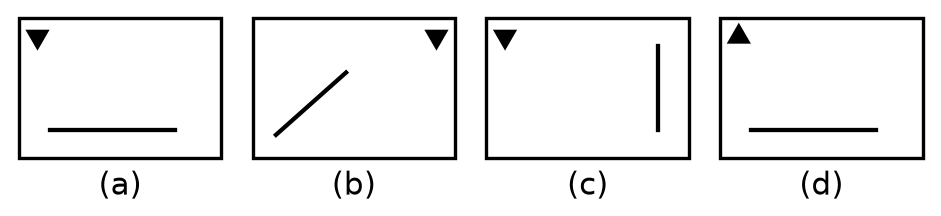
The elements of the problem figures given below are changing with a certain rule as we observe them from left to right:
According to this rule, which of the following would be the next figure if the changes were continued with the same rule?
Answer (d) & explanation
Figure (d) is correct. Step 1: watch the black triangle. It moves round the corners anticlockwise: top-left, bottom-left, bottom-right, top-right. Next it returns to the top-left. Step 2: the triangle points up, down, up, down in turn, so next it points up. Step 3: the line turns a little each time: upright, slightly tilted, slanting, nearly flat. Next it becomes flat (horizontal). A flat line with an upward triangle in the top-left corner is (d). So (a), (b) and (c) fail.
Tip: in figure series, follow one element at a time (position, direction, angle). Write a short rule for each, then combine the rules to build the next figure.
(a) has the right line and corner but the triangle points down.
Answer as per the official UPSC answer key.
You are the chairperson of a state sports committee. You have received a complaint and later it was found that an athlete in the junior age category who has won a medal has crossed the age criteria by 5 days. You would...
Answer (a) & explanation
(a) and (d) are both correct (UPSC accepted both; no negative marking). Step 1: an athlete was found 5 days over the age limit after winning a medal. You must act fairly and follow due process. Step 2: (a) asking the screening committee to explain how the error happened, and (d) taking the views of the sports committee, both gather facts before a decision. Step 3: (b) taking the medal back at once skips due process. (c) a court affidavit cannot change the athlete's real age.
Tip: for these interpersonal items, pick the response that is lawful, honest and fixes the real problem through proper channels. Avoid options that give in, run away from duty or act without hearing the facts.
Answer as per the official UPSC answer key.
How does the National Rural Livelihood Mission seek to improve livelihood options of rural poor?
- 1. By setting up a large number of new manufacturing industries and agribusiness centres in rural areas
- 2. By strengthening ‘self-help groups’ and providing skill development
- 3. By supplying seeds, fertilizers, diesel pump-sets and micro-irrigation equipment free of cost to farmers
Select the correct answer using the codes given below :
Answer (b) & explanation
Statement 2 only is correct (b). The National Rural Livelihood Mission (Aajeevika, 2011), now DAY-NRLM, organises poor rural women into self-help groups and their federations, links them to bank credit, and provides skill training for self-employment and placement-linked jobs (2). Statement 1 is wrong: it does not set up manufacturing industries or agribusiness centres itself. Statement 3 is wrong: it does not supply seeds, fertilisers, pump-sets or micro-irrigation equipment free to farmers. So (a), (c) and (d) fail.
Notice the scale: about 10 crore women in some 90 lakh SHGs. Its 'Lakhpati Didi' drive aims at women earning ₹1 lakh a year, and DDU-GKY handles skilling. Trap: free inputs and factories sound helpful but are not its method.
Answer as per the official UPSC answer key.
What are the reasons for the people’s resistance to the introduction of Bt brinjal in India?
- 1. Bt brinjal has been created by inserting a gene from a soil fungus into its genome.
- 2. The seeds of Bt brinjal are terminator seeds and therefore, the farmers have to buy the seeds before every season from the seed companies.
- 3. There is an apprehension that the consumption of Bt brinjal may have adverse impact on health.
- 4. There is some concern that the introduction of Bt brinjal may have adverse effect on the biodiversity.
Select the correct answer using the codes given below :
Answer (c) & explanation
Statements 3 and 4 are correct (c). The 2010 moratorium on Bt brinjal followed public fears about possible health effects of eating it (3), and concern that it could contaminate India's many native brinjal varieties, since India is a centre of origin of brinjal (4). Statement 1 is wrong: the Bt gene comes from a bacterium, Bacillus thuringiensis, not a fungus. Statement 2 is wrong: Bt brinjal seeds are not terminator seeds; terminator technology was never commercialised, and public-sector Bt brinjal varieties could be saved. So (a), (b) and (d) fail.
Notice the context: GEAC cleared it in 2009, but Jairam Ramesh imposed the moratorium after public hearings in February 2010. Bangladesh has grown Bt brinjal since 2014. Trap: two plausible myths are mixed with two real concerns.
Answer as per the official UPSC answer key.
What would happen if phytoplankton of an ocean is completely destroyed for some reason?
- 1. The ocean as a carbon sink would be adversely affected.
- 2. The food chains in the ocean would be adversely affected.
- 3. The density of ocean water would drastically decrease.
Select the correct answer using the codes given below :
Answer (a) & explanation
Statements 1 and 2 are correct (a). Phytoplankton are the ocean's microscopic plants. Through photosynthesis they absorb CO₂ and, when they die and sink, carry carbon to the deep sea: the biological pump, which makes the ocean a carbon sink (1). They form the base of marine food chains, feeding zooplankton, fish and whales (2). Statement 3 is wrong: seawater density depends on temperature and salinity, not on plankton. So (b), (c) and (d) fail.
Notice the scale: phytoplankton produce about half of the world's oxygen. Ocean warming and acidification threaten them, and blooms can turn harmful. Satellites track them through ocean colour, as India's Oceansat does to forecast fishing zones. Trap: losing plankton would not change water density.
Answer as per the official UPSC answer key.
Mr. Kumar drives to work at an average speed of 48 km/h. The time taken to cover the first 60% of the distance is 10 minutes more than the time taken to cover the remaining distance. How far is his office?
Answer (b) & explanation
40 km is correct (b). Step 1: the speed is the same all the way, so time depends only on distance. The first part is 60% of the distance and the rest is 40%. The 10-minute gap comes from the extra 20% of the distance. Step 2: in 10 minutes at 48 km/h he covers 48 × 10/60 = 8 km. So 20% of the distance = 8 km. Step 3: the full distance = 8 × 5 = 40 km. Check: 24 km takes 30 min, 16 km takes 20 min, a 10-minute gap. So (a), (c) and (d) fail.
Tip: at a constant speed, a time difference equals a distance difference. Turn minutes into km first and the rest is simple percentage.
Answer as per the official UPSC answer key.
Read the passage
In a typical Western liberal context, deepening of democracy invariably leads to consolidation of ‘liberal values’. In the Indian context, democratization is translated into greater involvement of people not as ‘individuals’ which is a staple to liberal discourse, but as communities or groups. Individuals are getting involved in the public sphere not as ‘atomized’ individuals but as members of primordial communities drawn on religious or caste identity. Community-identity seems to be the governing force. It is not therefore surprising that the so-called peripheral groups continue to maintain their identities with reference to the social groups (caste, religion or sect) to which they belong while getting involved in the political processes despite the fact that their political goals remain more or less identical. By helping to articulate the political voice of the marginalized, democracy in India has led to ‘a loosening of social strictures’ and empowered the peripherals to be confident of their ability to improve the socio-economic conditions in which they are placed. This is a significant political process that had led to a silent revolution through a meaningful transfer of power from the upper caste elites to various subaltern groups within the democratic framework of public governance.
What is the “silent revolution” that has occurred in the Indian democratic process ?
Answer (c) & explanation
(c) is correct. Step 1: the passage says democracy led to 'a silent revolution through a meaningful transfer of power from the upper caste elites to various subaltern groups'. That is exactly (c). Step 2: (a) is wrong: caste is still very relevant; community identity is called 'the governing force'. Step 3: (b) is wrong: 'loosening of social strictures' is mentioned, but not in voting behaviour and patterns; it refers to the marginalized gaining confidence. Since (a) and (b) fail, (d) fails too.
Tip: when the passage defines a quoted phrase in the same sentence ('a silent revolution through…'), the answer is usually that definition. Read the words right after the phrase.
Answer as per the official UPSC answer key.
Regarding the office of the Lok Sabha Speaker, consider the following statements :
- 1. He/She holds the office during the pleasure of the President.
- 2. He/She need not be a member of the House at the time of his/her election but has to become a member of the House within six months from the date of his/her election.
- 3. If he/she intends to resign, the letter of his/her resignation has to be addressed to the Deputy Speaker.
Which of the statements given above is/are correct?
Answer (b) & explanation
Statement 3 only is correct (b). Statement 1 is wrong: the Speaker is elected by the Lok Sabha and holds office normally for the life of the House, not at the President's pleasure; she can be removed only by a Lok Sabha resolution passed by an effective majority after 14 days' notice. Statement 2 is wrong: the Speaker must be a member of the Lok Sabha when elected; the six-month rule applies to ministers, not the Speaker. Statement 3 is correct: under Article 94, the Speaker resigns by writing to the Deputy Speaker. So (a), (c) and (d) fail.
Notice the related rule: the Speaker does not vacate office on dissolution, but continues until the new House meets. The Speaker casts only a casting vote in a tie. Trap: statement 2 borrows the minister's six-month rule.
Answer as per the official UPSC answer key.
Which of the following is the chief characteristic of ‘mixed farming’?
Answer (c) & explanation
Rearing animals and growing crops together is correct (c). Mixed farming means crops plus livestock on the same farm: animals give milk, meat and draught power, and their dung becomes manure, while crops and residues give fodder. This cycle cuts costs and spreads risk. (a) is wrong: growing both cash and food crops is just diversified cropping. (b) is wrong: growing two or more crops in the same field is mixed cropping or intercropping. (d) fails because (c) is correct.
Notice the related terms: integrated farming systems add fish, poultry and bees, and multiple cropping means more than one crop a year on the same land. Most Indian smallholdings practise mixed farming. Trap: 'mixed farming' and 'mixed cropping' sound alike but differ.
Answer as per the official UPSC answer key.
Which of the following would include Foreign Direct Investment in India?
- 1. Subsidiaries of foreign companies in India
- 2. Majority foreign equity holding in Indian companies
- 3. Companies exclusively financed by foreign companies
- 4. Portfolio investment
Select the correct answer using the codes given below :
Answer (d) & explanation
Items 1, 2 and 3 are correct (d). FDI is investment that brings a lasting interest and control in an enterprise. Subsidiaries of foreign companies in India (1), majority foreign equity in Indian companies (2), and companies wholly financed by foreign companies (3) all qualify. Item 4 is wrong: portfolio investment buys shares and bonds for returns without management control; it is FPI. So (a), (b) and (c) fail.
Notice the threshold: following the Arvind Mayaram Committee (2014), a foreign stake of 10% or more in a listed company counts as FDI, and below 10% as FPI. Press Note 3 (2020) requires government approval for FDI from countries sharing land borders with India. Trap: portfolio money is foreign, but not 'direct'.
Answer as per the official UPSC answer key.
Read the passage
Education, without a doubt, has an important functional, instrumental and utilitarian dimension. This is revealed when one asks questions such as ‘what is the purpose of education ?’. The answers, too often, are ‘to acquire qualifications for employment/upward mobility’, ‘wider/higher (in terms of income) opportunities’, and ‘to meet the needs for trained human power in diverse fields for national development’. But in its deepest sense education is not instrumentalist. That is to say, it is not to be justified outside of itself because it leads to the acquisition of formal skills or of certain desired psychological – social attributes. It must be respected in itself. Education is thus not a commodity to be acquired or possessed and then used, but a process of inestimable importance to individuals and society, although it can and does have enormous use-value. Education then, is a process of expansion and conversion, not in the sense of converting or turning students into doctors or engineers, but the widening and turning out of the mind — the creation, sustenance and development of self-critical awareness and independence of thought. It is an inner process of moral – intellectual development.
Education is a process in which
Answer (c) & explanation
'Self-critical awareness and independence of thought' is correct (c). Step 1: the passage calls education 'a process of expansion and conversion' and explains it as 'the creation, sustenance and development of self-critical awareness and independence of thought'. Step 2: (a) is a trap: the author says conversion is 'not in the sense of converting or turning students into doctors or engineers'. Step 3: (b) higher income and (d) qualifications for mobility belong to the instrumentalist view the author treats as shallow. So (a), (b) and (d) fail.
Tip: watch for a word the passage uses in a special sense. Here 'conversion' means turning the mind outward, not producing professionals; the author even warns against the ordinary meaning.
Answer as per the official UPSC answer key.
Read the passage
Most champions of democracy have been rather reticent in suggesting that democracy would itself promote development and enhancement of social welfare — they have tended to see them as good but distinctly separate and largely independent goals. The detractors of democracy, on the other hand, seemed to have been quite willing to express their diagnosis of what they see as serious tensions between democracy and development. The theorists of the practical split — “Make up your mind : do you want democracy, or instead, do you want development ?” — often came, at least to start with, from East Asian countries, and their voice grew in influence as several of these countries were immensely successful — through the 1970s and 1980s and even later — in promoting economic growth without pursuing democracy.
To deal with these issues we have to pay particular attention to both the content of what can be called development and to the interpretation of democracy (in particular to the respective roles of voting and of public reasoning). The assessment of development cannot be divorced from the lives that people can lead and the real freedom that they enjoy. Development can scarcely be seen merely in terms of enhancement of inanimate objects of convenience, such as a rise in the GNP (or in personal incomes), or industrialization — important as they may be as means to the real ends. Their value must depend on what they do to the lives and freedom of the people involved, which must be central to the idea of development.
If development is understood in a broader way, with a focus on human lives, then it becomes immediately clear that the relation between development and democracy has to be seen partly in terms of their constitutive connection, rather than only through their external links. Even though the question has often been asked whether political freedom is “conducive to development”, we must not miss the crucial recognition that political liberties and democratic rights are among the “constituent components” of development. Their relevance for development does not have to be established indirectly through their contribution to the growth of GNP.
What does a “constitutive” connection between democracy and development imply ?
Answer (c) & explanation
(c) is correct. Step 1: the passage says political liberties and democratic rights are 'among the constituent components of development'. 'Constitutive' means they are part of what development is, not just a cause of it. Step 2: (a) is wrong: the author says the link should be seen 'partly in terms of their constitutive connection, rather than only through their external links'. Step 3: (b) is wrong because of 'only': the passage does not say rights alone lead to economic growth; it says their value need not be shown through GNP at all. Since (c) is right, (d) fails.
Tip: 'constitutive' = 'part of the make-up'. Think of bricks in a wall, not a tool used to build it.
Answer as per the official UPSC answer key.
Read the passage
For fourteen and a half months I lived in my little cell or room in the Dehradun jail, and I began to feel as if I was almost a part of it. I was familiar with every bit of it, I knew every mark and dent on the whitewashed walls and on the uneven floor and the ceiling with its moth-eaten rafters. In the little yard outside I greeted little tufts of grass and odd bits of stone as old friends. I was not alone in my cell, for several colonies of wasp and hornets lived there, and many lizards found a home behind the rafters, emerging in the evenings in search of prey.
The passage attempts to describe
Answer (c) & explanation
(c) is correct. Step 1: the prisoner knows every dent in the walls, greets 'little tufts of grass and odd bits of stone as old friends', and notices the wasps, hornets and lizards that share his cell. These details show a man making a conscious effort to cope with loneliness. Step 2: (a) is wrong: he describes one cell, not the country's jails in general. Step 3: (b) is true on the surface, but noticing details is the means, not the purpose. (d) overstates: he does not say he lived happily with the creatures. So (a), (b) and (d) fail.
Tip: ask why the author gives these details. The purpose behind them is usually the main idea.
Answer as per the official UPSC answer key.
Electrically charged particles from space travelling at speeds of several hundred km/sec can severely harm living beings if they reach the surface of the Earth. What prevents them from reaching the surface of the Earth?
Answer (a) & explanation
The Earth's magnetic field is correct (a). The solar wind and cosmic rays are streams of charged particles. The Earth's magnetic field (magnetosphere) deflects them, traps some in the Van Allen belts, and steers others towards the poles, where they collide with air and cause the auroras. (b) is wrong: the ozone layer absorbs ultraviolet light, not charged particles. (c) is wrong: moisture in the upper atmosphere does not block them. (d) fails because (a) is correct.
Notice the recent events: the strong geomagnetic storms of May 2024 produced auroras visible even in Ladakh. India's Aditya-L1 (2023) studies the solar wind from the L1 point. Trap: the ozone layer protects against light, not particles.
Answer as per the official UPSC answer key.
The Prime Minister of India, at the time of his/her appointment
Answer (a) & explanation
Option (a) is correct. Under Article 75(5), any minister, including the Prime Minister, may be appointed without being a Member of Parliament but must become a member of either House within six months, or cease to be a minister. (b) is wrong: the PM can be a member of the Rajya Sabha; Indira Gandhi (1966) and Manmohan Singh (2004–14) were. (c) and (d) are wrong: membership at the moment of appointment is not required, as the Supreme Court confirmed in S.P. Anand (1997). So the six-month window covers both Houses.
Notice the limit: in S.R. Chaudhuri (2001), the Court held that a non-member cannot be reappointed repeatedly to dodge the six-month rule. The same rule applies to state ministers under Article 164(4). Trap: (b) narrows the choice to the Lok Sabha.
Answer as per the official UPSC answer key.
Which one of the following is the characteristic climate of the Tropical Savannah Region?
Answer (d) & explanation
A definite dry and wet season is correct (d). The tropical savanna, or Sudan-type, climate lies between about 5° and 20° latitude, with a hot, wet summer when the ITCZ arrives and a long, dry winter when it retreats. This suits tall grasses with scattered trees, as in Africa's savannas and the Brazilian campos. (a) is wrong: rain throughout the year is the equatorial climate. (b) is wrong: winter-only rain is the Mediterranean climate. (c) is wrong: the savanna's dry season is long, not short.
Notice the fauna: savannas host the great herds of East Africa, with zebras, wildebeest and lions. Much of peninsular India has a tropical wet and dry (Aw) climate in Köppen's scheme. Trap: (c) describes the tropical monsoon fringe, not the savanna.
Answer as per the official UPSC answer key.
Read the passage
Today’s developing economies use much less energy per capita than developed countries such as the United States did at similar incomes, showing the potential for lower-carbon growth. Adaptation and mitigation need to be integrated into a climate-smart development strategy that increases resilience, reduces the threat of further global warming, and improves development outcomes. Adaptation and mitigation measures can advance development, and prosperity can raise incomes and foster better institutions. A healthier population living in better-built houses and with access to bank loans and social security is better equipped to deal with a changing climate and its consequences. Advancing robust, resilient development policies that promote adaptation is needed today because changes in the climate, already begun, will increase even in the short term.
The spread of economic prosperity has always been intertwined with adaptation to changing ecological conditions. But as growth has altered the environment and as environmental change has accelerated, sustaining growth and adaptability demands greater capacity to understand our environment, generate new adaptive technologies and practices, and diffuse them widely. As economic historians have explained, much of humankind’s creative potential has been directed at adapting to the changing world. But adaptation cannot cope with all the impacts related to climate change, especially as larger changes unfold in the long term.
Countries cannot grow out of harm’s way fast enough to match the changing climate. And some growth strategies, whether driven by the government or the market, can also add to vulnerability — particularly if they overexploit natural resources. Under the Soviet development plan, irrigated cotton cultivation expanded in water-stressed Central Asia and led to the near disappearance of the Aral Sea, threatening the livelihoods of fishermen, herders and farmers. And clearing mangroves — the natural coastal buffers against storm surges — to make way for intensive farming or housing development, increases the physical vulnerability of coastal settlements, whether in Guinea or in Louisiana.
Consider the following assumptions :
- 1. Sustainable economic growth demands the use of creative potential of man.
- 2. Intensive agriculture can lead to ecological backlash.
- 3. Spread of the economic prosperity can adversely affect the ecology and environment.
With reference to the passage, which of the above assumptions is/are valid ?
Answer (d) & explanation
All three assumptions are valid (d). Step 1: the passage says 'much of humankind's creative potential has been directed at adapting', and sustaining growth needs new adaptive technologies. So growth depends on human creativity: 1 is valid. Step 2: irrigated cotton led to the 'near disappearance of the Aral Sea', and mangroves were cleared for intensive farming. Intensive agriculture can backfire on ecology: 2 is valid. Step 3: it also says 'growth has altered the environment' and some growth strategies 'add to vulnerability'. So spreading prosperity can harm ecology: 3 is valid. Hence (a), (b) and (c) fail.
Tip: an assumption is valid if the passage takes it for granted or shows it through an example.
Answer as per the official UPSC answer key.
Consider the following information regarding the performance of a class of 1000 students in four different tests:
| Tests | I | II | III | IV |
|---|---|---|---|---|
| Average marks | 60 | 60 | 70 | 80 |
| Range of marks | 30 to 90 | 45 to 75 | 20 to 100 | 0 to 100 |
If a student scores 74 marks in each of the four tests, in which one of the following tests is her performance the best comparatively?
Answer (b) & explanation
1. 74 is good or bad only compared with how others scored. Ask: how close is 74 to the top mark of that test?
2. Test I: top is 90, so 74 is 16 marks short. Test III: 26 short of 100. Test IV: 26 short of 100, and below the average of 80.
3. Test II: top is only 75, so 74 is just 1 mark below the best student, and 14 above the average.
4. Her best showing is in Test II.
Answer as per the official UPSC answer key.