
UPSC Prelims PYQs with explanations
Real questions from official papers, mapped to syllabus topics. Attempt each one; the answer and the reason appear instantly.
You are handling a priority project and have been meeting all the deadlines and are therefore planning your leave during the project. Your immediate boss does not grant your leave citing the urgency of the project. You would...
Answer (c) & explanation
(c) and (d) are both correct (UPSC accepted both; no negative marking). Step 1: your leave was refused because the project is urgent, though you have met all deadlines. Step 2: (d) telling the boss honestly that the refusal is not justified, and (c) asking a higher authority to reconsider, are both honest and within the rules. Step 3: (a) going on leave without sanction breaks service rules. (b) pretending to be sick is dishonest and can lead to disciplinary action.
Tip: for these interpersonal items, pick the response that is lawful, honest and fixes the real problem through proper channels. Avoid options that give in, run away from duty or act without hearing the facts.
Answer as per the official UPSC answer key.
The Multi-dimensional Poverty Index developed by Oxford Poverty and Human Development Initiative with UNDP support covers which of the following?
- 1. Deprivation of education, health, assets and services at household level
- 2. Purchasing power parity at national level
- 3. Extent of budget deficit and GDP growth rate at national level
Select the correct answer using the codes given below :
Answer (a) & explanation
Statement 1 only is correct (a). The Multidimensional Poverty Index, developed by OPHI (Oxford) with UNDP in 2010, measures household-level deprivations in three dimensions: health, education and living standards, using ten indicators such as nutrition, child mortality, years of schooling, cooking fuel, sanitation, water, electricity, housing and assets (1). Statement 2 is wrong: it uses no PPP figures. Statement 3 is wrong: it ignores budget deficits and GDP growth. So (b), (c) and (d) fail.
Notice India's figures: NITI Aayog's national MPI adds maternal health and bank accounts, and estimates about 24.8 crore people escaped multidimensional poverty between 2013–14 and 2022–23. A person is poor if deprived in a third or more of the weighted indicators. Trap: MPI is non-income by design.
Answer as per the official UPSC answer key.
Other than resistance to pests, what are the prospects for which genetically engineered plants have been created?
- 1. To enable them to withstand drought
- 2. To increase the nutritive value of the produce
- 3. To enable them to grow and do photosynthesis in spaceships and space stations
- 4. To increase their shelf life
Select the correct answer using the codes given below :
Answer (c) & explanation
Items 1, 2 and 4 are correct (c). Genetic engineering has produced crops for drought tolerance, such as Argentina's HB4 wheat and drought-tolerant maize (1), better nutrition, such as Golden Rice with beta-carotene, approved in the Philippines (2), and longer shelf life, such as the Flavr Savr tomato (1994) and non-browning Arctic apples (4). Item 3 is wrong: there are no GM plants created to photosynthesise in spaceships; plants are grown in space experiments, but not engineered for that purpose. So (a), (b) and (d) fail.
Notice India's position: Bt cotton remains the only GM crop grown commercially; GM mustard DMH-11 got environmental release approval in 2022 but is in court, and genome-edited rice varieties released in May 2025 are not classed as GM. Trap: space farming exists, but not as a GM aim.
Answer as per the official UPSC answer key.
Vultures which used to be very common in Indian countryside some years ago are rarely seen nowadays. This is attributed to
Answer (b) & explanation
A drug used for treating cattle is correct (b). Vultures feeding on carcasses of cattle treated with the painkiller diclofenac died of kidney failure and visceral gout. More than 95% of India's Gyps vultures (white-rumped, long-billed, slender-billed) were lost between the 1990s and 2000s. (a), (c) and (d) are wrong: invasive species, food shortage and a disease were not the main cause; carcasses were plentiful.
Notice the response: veterinary diclofenac was banned in 2006, and in 2023 India also banned aceclofenac and ketoprofen for animals. The Vulture Action Plan 2020–25 set up breeding centres, such as Pinjore in Haryana, and safe zones. Without vultures, feral dogs and rabies rose. International Vulture Awareness Day is the first Saturday of September. Trap: the cause was human-made, not natural.
Answer as per the official UPSC answer key.
Gita is prettier than Sita but not as pretty as Rita. Then,
Answer (a) & explanation
'Sita is not as pretty as Gita' is correct (a). Step 1: 'Gita is prettier than Sita' gives Gita > Sita. Step 2: 'but not as pretty as Rita' gives Rita > Gita. So the order is Rita > Gita > Sita. Step 3: (a) says Sita is not as pretty as Gita, which is true. (b) says Sita is prettier than Rita, but Sita is last. (c) says Rita is not as pretty as Gita, but Rita is first. (d) says Gita is prettier than Rita, the opposite of the second clue. So (b), (c) and (d) fail.
Tip: turn each comparison into a '>' sign and line everyone up from top to bottom. Then check each option against the line.
Answer as per the official UPSC answer key.
Directions for the following 5 (five) items: Examine the information given in the following paragraph and answer the items that follow:
Guest lectures on five subjects viz., Economics, History, Statistics, English and Mathematics have to be arranged in a week from Monday to Friday. Only one lecture can be arranged on each day. Economics cannot be scheduled on Tuesday. Guest faculty for History is available only on Tuesday. Mathematics lecture has to be scheduled immediately after the day of Economics lecture. English lecture has to be scheduled immediately before the day of Economics lecture.
Which lecture is scheduled on Monday?
Answer (d) & explanation
Statistics is correct (d). Step 1: History is fixed on Tuesday. Step 2: English must come immediately before Economics, and Mathematics immediately after it. So English, Economics, Mathematics take three days in a row. With Tuesday taken, the only three free days in a row are Wednesday, Thursday, Friday. Economics on Thursday also obeys 'not on Tuesday'. Step 3: so Wednesday English, Thursday Economics, Friday Mathematics, and the only day left, Monday, gets Statistics. Full week: Mon Statistics, Tue History, Wed English, Thu Economics, Fri Mathematics. So (a), (b) and (c) fail.
Tip: place the fixed item first, then fit the block of linked items into the gaps that remain.
Answer as per the official UPSC answer key.
Which of the following are included in the original jurisdiction of the Supreme Court?
- 1. A dispute between the Government of India and one or more States
- 2. A dispute regarding elections to either House of the Parliament or that of Legislature of a State
- 3. A dispute between the Government of India and a Union Territory
- 4. A dispute between two or more States
Select the correct answer using the codes given below :
Answer (c) & explanation
Disputes 1 and 4 are correct (c). Article 131 gives the Supreme Court original jurisdiction only in federal disputes: between the Government of India and one or more States (1), between the Centre and some States on one side and other States on the other, and between two or more States (4). Statement 2 is wrong: election disputes go first to the High Court by election petition. Statement 3 is wrong: a Union Territory is administered by the Union itself, so it is not a separate party under Article 131. So (a), (b) and (d) fail.
Notice the cases: Kerala and other states have used Article 131 against the Centre, for example over borrowing limits (2024). Inter-state river water disputes are excluded (Article 262). Trap: UTs feel like states but are not.
Answer as per the official UPSC answer key.
A particular State in India has the following characteristics :
- 1. It is located on the same latitude which passes through northern Rajasthan.
- 2. It has over 80% of its area under forest cover.
- 3. Over 12% of forest cover constitutes Protected Area Network in this State.
Which one among the following States has all the above characteristics?
Answer (a) & explanation
Arunachal Pradesh is correct (a). Arunachal Pradesh lies at about 27°–29° N, the same band as northern Rajasthan around Bikaner and Sri Ganganagar (1). Its forest cover is about 79–80% of its area, among the highest in India (2), and a large share lies in protected areas such as Namdapha, Pakke and Dibang (3). (b) is wrong: Assam's forest share is far lower, about a third. (c) and (d) are wrong: Himachal (about 28%) and Uttarakhand (about 45%) have much less forest and lie farther north.
Notice the latest data: in ISFR 2023, Mizoram has the highest forest share by area (about 85%), while Madhya Pradesh has the largest forest area. Trap: the latitude clue rules out Himachal and Uttarakhand.
Answer as per the official UPSC answer key.
Consider the following statements :
The price of any currency in international market is decided by the
- 1. World Bank
- 2. demand for goods/services provided by the country concerned
- 3. stability of the government of the concerned country
- 4. economic potential of the country in question
Which of the statements given above are correct?
Answer (b) & explanation
Statements 2 and 3 are correct per UPSC's key (b), but the key is doubtful on item 4. Under a floating exchange rate, a currency's price is set by demand and supply in the forex market. Demand for a country's goods and services raises demand for its currency (2), and political stability draws in capital (3). Item 1 is wrong: the World Bank plays no part in setting exchange rates. Item 4 is the doubt: a country's economic potential clearly attracts investment and supports its currency, so many argue for including it; UPSC treated it as too vague to move the price directly.
Notice India's system: the rupee is a managed float, and the RBI intervenes to curb volatility using its reserves. Trap: the World Bank is often confused with the IMF.
Answer as per the official UPSC answer key.
Read the passage
Chemical pesticides lose their role in sustainable agriculture if the pests evolve resistance. The evolution of pesticide resistance is simply natural selection in action. It is almost certain to occur when vast numbers of a genetically variable population are killed. One or a few individuals may be unusually resistant (perhaps because they possess an enzyme that can detoxify the pesticide). If the pesticide is applied repeatedly, each successive generation of the pest will contain a larger proportion of resistant individuals. Pests typically have a high intrinsic rate of reproduction, and so a few individuals in one generation may give rise to hundreds or thousands in the next, and resistance spreads very rapidly in a population.
This problem was often ignored in the past, even though the first case of DDT (dichlorodiphenyltrichloroethane) resistance was reported as early as 1946. There is exponential increase in the numbers of invertebrates that have evolved resistance and in the number of pesticides against which resistance has evolved. Resistance has been recorded in every family of arthropod pests (including dipterans such as mosquitoes and house flies, as well as beetles, moths, wasps, fleas, lice and mites) as well as in weeds and plant pathogens. Take the Alabama leafworm, a moth pest of cotton, as an example. It has developed resistance in one or more regions of the world to aldrin, DDT, dieldrin, endrin, lindane and toxaphene.
If chemical pesticides brought nothing but problems, — if their use was intrinsically and acutely unsustainable — then they would already have fallen out of widespread use. This has not happened. Instead, their rate of production has increased rapidly. The ratio of cost to benefit for the individual agricultural producer has remained in favour of pesticide use. In the USA, insecticides have been estimated to benefit the agricultural products to the tune of around $5 for every $1 spent.
Moreover, in many poorer countries, the prospect of imminent mass starvation, or of an epidemic disease, are so frightening that the social and health costs of using pesticides have to be ignored. In general the use of pesticides is justified by objective measures such as ‘lives saved’, ‘economic efficiency of food production’ and ‘total food produced’. In these very fundamental senses, their use may be described as sustainable. In practice, sustainability depends on continually developing new pesticides that keep at least one step ahead of the pests — pesticides that are less persistent, biodegradable and more accurately targeted at the pests.
“The evolution of pesticide resistance is natural selection in action.” What does it actually imply ?
Answer (c) & explanation
'Some individuals show resistance' is correct (c). Step 1: the passage explains natural selection here: 'One or a few individuals may be unusually resistant'. When the pesticide kills the rest, these few survive and breed, so each generation has more resistant pests. Step 2: (a) says it is natural for many organisms to be resistant; the passage says only a few are at the start. Step 3: (b) 'universal' overstates even more. Since (c) is right, (d) fails.
Tip: natural selection always starts with a small variation in a few individuals that helps them survive. Options with 'many', 'all' or 'universal' usually overstate such passages.
Answer as per the official UPSC answer key.
Read the passage
The need for Competition Law becomes more evident when foreign direct investment (FDI) is liberalised. The impact of FDI is not always pro-competitive. Very often FDI takes the form of a foreign corporation acquiring a domestic enterprise or establishing a joint venture with one. By making such an acquisition the foreign investor may substantially lessen competition and gain a dominant position in the relevant market, thus charging higher prices. Another scenario is where the affiliates of two separate multinational companies (MNCs) have been established in competition with one another in a particular developing economy, following the liberalisation of FDI. Subsequently, the parent companies overseas merge. With the affiliates no longer remaining independent, competition in the host country may be virtually eliminated and the prices of the products may be artificially inflated. Most of these adverse consequences of mergers and acquisitions by MNCs can be avoided if an effective competition law is in place. Also, an economy that has implemented an effective competition law is in a better position to attract FDI than one that has not. This is not just because most MNCs are expected to be accustomed to the operation of such a law in their home countries and know how to deal with such concerns but also that MNCs expect competition authorities to ensure a level playing field between domestic and foreign firms.
With reference to the passage, consider the following statements :
- 1. It is desirable that the impact of Foreign Direct Investment should be pro-competitive.
- 2. The entry of foreign investors invariably leads to the inflated prices in domestic markets.
Which of the statements given above is/are correct ?
Answer (a) & explanation
Only statement 1 is correct (a). Step 1: the passage begins by saying the impact of FDI 'is not always pro-competitive' and shows how it can harm competition. This implies it is desirable for FDI to be pro-competitive: 1 is right. Step 2: statement 2 says foreign entry invariably inflates prices. The passage says a dominant investor 'may' charge higher prices and prices 'may be artificially inflated' in certain cases like mergers. 'May' is not 'always', so 2 is wrong. Step 3: hence (b), (c) and (d) fail.
Tip: 'invariably', 'always' and 'never' need equally strong words in the passage. If the passage says 'may' or 'can', the strong option fails.
Answer as per the official UPSC answer key.
Read the passage
For fourteen and a half months I lived in my little cell or room in the Dehradun jail, and I began to feel as if I was almost a part of it. I was familiar with every bit of it, I knew every mark and dent on the whitewashed walls and on the uneven floor and the ceiling with its moth-eaten rafters. In the little yard outside I greeted little tufts of grass and odd bits of stone as old friends. I was not alone in my cell, for several colonies of wasp and hornets lived there, and many lizards found a home behind the rafters, emerging in the evenings in search of prey.
The author of the passage seems to suggest that
Answer (a) & explanation
(a) is correct. Step 1: over fourteen and a half months, the prisoner came to feel 'almost a part of' a bare cell with dents, moth-eaten rafters and insects. This shows a person can adjust to unpleasant surroundings. Step 2: (b) and (d) are wrong: he does not judge whether Indian prisons are good or need improvement. Step 3: (c) is wrong: he never says prison life is easy; the effort to find company in grass and stones shows it was hard. So (b), (c) and (d) fail.
Tip: 'the author seems to suggest' asks for the general lesson from the story. Choose the broad idea and reject options about topics (prison policy) the author never discusses.
Answer as per the official UPSC answer key.
With reference to the scientific progress of ancient India, which of the statements given below are correct?
- 1. Different kinds of specialized surgical instruments were in common use by 1st century AD.
- 2. Transplant of internal organs in the human body had begun by the beginning of 3rd century AD.
- 3. The concept of sine of an angle was known in 5th century AD.
- 4. The concept of cyclic quadrilaterals was known in 7th century AD.
Select the correct answer using the codes given below :
Answer (c) & explanation
Statements 1, 3 and 4 are correct (c). The Sushruta Samhita describes over 100 surgical instruments and operations such as plastic surgery of the nose (rhinoplasty) and cataract couching, showing specialised tools in use by the early centuries AD (1). Aryabhata (5th century) used the sine (jya) in his Aryabhatiya (3). Brahmagupta (7th century) gave his formula for the area of cyclic quadrilaterals (4). Statement 2 is wrong: there is no evidence of internal organ transplants in ancient India. So (a), (b) and (d) fail.
Notice the others: Charaka (medicine), Varahamihira (Pancha Siddhantika), and Brahmagupta's rules for zero. Sushruta is called the 'father of surgery'. Trap: skin grafts are not organ transplants.
Answer as per the official UPSC answer key.
With reference to the Delimitation Commission, consider the following statements :
- 1. The orders of the Delimitation Commission cannot be challenged in a Court of Law.
- 2. When the orders of the Delimitation Commission are laid before the Lok Sabha or State Legislative Assembly, they cannot effect any modifications in the orders.
Which of the statements given above is/are correct?
Answer (c) & explanation
Both statements are correct (c). The Delimitation Commission, set up under a Delimitation Act, redraws constituency boundaries. Its orders have the force of law and cannot be questioned in any court, under Article 329(a) (1). When the orders are laid before the Lok Sabha and the State Legislative Assemblies, these Houses cannot modify them (2). So (a), (b) and (d) fail.
Notice the history: commissions were set up in 1952, 1963, 1973 and 2002. The seat count is frozen on the 1971 census until the first census after 2026 (84th and 87th Amendments), and the next delimitation after Census 2027 is politically sensitive for southern states. The 2022 J&K commission and the Assam delimitation (2023) were special exercises. Trap: Parliament can debate, but not alter, the orders.
Answer as per the official UPSC answer key.
In which one among the following categories of protected areas in India are local people *not* allowed to collect and use the biomass?
Answer (b) & explanation
National Parks is correct (b). National Parks have the strictest protection under the Wildlife (Protection) Act, 1972: no grazing and no collection of forest produce or biomass; rights are settled and extinguished. (d) is wrong: sanctuaries may allow some regulated rights of local people. (a) is wrong: biosphere reserves have buffer and transition zones where people live and use resources. (c) is wrong: Ramsar wetlands follow the 'wise use' principle and allow sustainable use.
Notice the numbers: India has about 106 national parks and over 570 sanctuaries. The Forest Rights Act, 2006 also recognises community rights, which creates tension in critical wildlife habitats. Conservation and community reserves (2002 amendment) are other categories. Trap: only the core legal category bans all collection.
Answer as per the official UPSC answer key.
Read the passage
Today’s developing economies use much less energy per capita than developed countries such as the United States did at similar incomes, showing the potential for lower-carbon growth. Adaptation and mitigation need to be integrated into a climate-smart development strategy that increases resilience, reduces the threat of further global warming, and improves development outcomes. Adaptation and mitigation measures can advance development, and prosperity can raise incomes and foster better institutions. A healthier population living in better-built houses and with access to bank loans and social security is better equipped to deal with a changing climate and its consequences. Advancing robust, resilient development policies that promote adaptation is needed today because changes in the climate, already begun, will increase even in the short term.
The spread of economic prosperity has always been intertwined with adaptation to changing ecological conditions. But as growth has altered the environment and as environmental change has accelerated, sustaining growth and adaptability demands greater capacity to understand our environment, generate new adaptive technologies and practices, and diffuse them widely. As economic historians have explained, much of humankind’s creative potential has been directed at adapting to the changing world. But adaptation cannot cope with all the impacts related to climate change, especially as larger changes unfold in the long term.
Countries cannot grow out of harm’s way fast enough to match the changing climate. And some growth strategies, whether driven by the government or the market, can also add to vulnerability — particularly if they overexploit natural resources. Under the Soviet development plan, irrigated cotton cultivation expanded in water-stressed Central Asia and led to the near disappearance of the Aral Sea, threatening the livelihoods of fishermen, herders and farmers. And clearing mangroves — the natural coastal buffers against storm surges — to make way for intensive farming or housing development, increases the physical vulnerability of coastal settlements, whether in Guinea or in Louisiana.
Which one of the following statements constitutes central theme of this passage ?
Answer (b) & explanation
'Integrate adaptation and mitigation with development' is correct (b). Step 1: the passage's key sentence is: 'Adaptation and mitigation need to be integrated into a climate-smart development strategy.' Everything else supports this point. Step 2: (a) is true (healthier, better-housed people cope better), but it is a supporting detail, not the main theme. (d) is also only an example (Aral Sea, mangroves). Step 3: (c) is wrong: the passage never says growth should not be pursued; it wants better, climate-smart growth. So (a), (c) and (d) fail.
Tip: the central theme is usually a broad 'need to' or 'should' sentence. Examples and supporting facts are true but too narrow to be the theme.
Answer as per the official UPSC answer key.
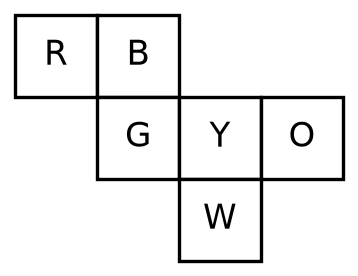
Six squares are coloured, front and back, red (R), blue (B), yellow (Y), green (G), white (W) and orange (O) and are hinged together as shown in the figure given below. If they were folded to form a cube, what would be the face opposite the white face?
Answer (c) & explanation
B is correct (c). Step 1: keep Y as the front face. In the net, G folds to the left, O to the right and W folds under to become the bottom. Step 2: B is attached to the top of G. When G folds to the left side, B lands on the top of the cube. Step 3: top and bottom are opposite, so B is opposite W. R then folds round to the back, opposite Y. So R, G and O are not opposite white, and (a), (b) and (d) fail.
Tip: in a cube net, fix one face as the front and fold the others one by one. Two faces that are separated by one square in a straight line of the net are usually opposite.
Answer as per the official UPSC answer key.
You are involved in setting up a water supply project in a remote area. Full recovery of cost is impossible in any case. The income levels in the area are low and 25% of the population is below poverty line (BPL). When a decision has to be taken on pricing you would...
Answer (c) & explanation
(c) and (d) are both correct (UPSC accepted both; no negative marking). Step 1: full cost recovery is impossible, incomes are low and 25% of people are BPL. A fair price must protect the poor but still recover some cost. Step 2: (c) free water for BPL and a fixed charge for others, and (d) charges by use with lower rates for BPL, both do this; (d) also discourages waste. Step 3: (a) free water for all recovers nothing and invites waste. (b) a one-time fee with free use does the same.
Tip: for these interpersonal items, pick the response that is lawful, honest and fixes the real problem through proper channels. Avoid options that give in, run away from duty or act without hearing the facts.
Answer as per the official UPSC answer key.
Which of the following is/are among the noticeable features of the recommendations of the Thirteenth Finance Commission?
- 1. A design for the Goods and Services Tax, and a compensation package linked to adherence to the proposed design
- 2. A design for the creation of lakhs of jobs in the next ten years in consonance with India’s demographic dividend
- 3. Devolution of a specified share of central taxes to local bodies as grants
Select the correct answer using the codes given below :
Answer (c) & explanation
Statements 1 and 3 are correct (c). The 13th Finance Commission (chair Vijay Kelkar, covering 2010–15) proposed a 'model GST' and a ₹50,000-crore compensation package for states that adopted it (1). It also linked grants to local bodies to a specified share of the divisible pool of central taxes (3). Statement 2 is wrong: job creation plans are not a Finance Commission task. So (a), (b) and (d) fail.
Notice what followed: GST arrived in July 2017 through the 101st Amendment, with a five-year compensation cess; the 14th FC raised states' share to 42%, the 15th set it at 41%, and the 16th (Arvind Panagariya) kept 41% for 2026–31. Trap: 'demographic dividend' is a buzzword, not a commission mandate.
Answer as per the official UPSC answer key.
Consider the following statements :
The most effective contribution made by Dadabhai Naoroji to the cause of Indian National Movement was that he
- 1. exposed the economic exploitation of India by the British
- 2. interpreted the ancient Indian texts and restored the self-confidence of Indians
- 3. stressed the need for eradication of all the social evils before anything else
Which of the statements given above is/are correct?
Answer (a) & explanation
Statement 1 only is correct (a). Dadabhai Naoroji's greatest contribution was the Drain Theory, set out in 'Poverty and Un-British Rule in India' (1901), showing how British rule drained India's wealth through Home Charges, salaries and profits (1). This became the core of economic nationalism. Statement 2 is wrong: reinterpreting ancient texts to restore self-confidence was the work of Dayanand Saraswati, Vivekananda and Tilak. Statement 3 is wrong: Naoroji did not put eradicating social evils before everything else. So (b), (c) and (d) fail.
Notice his other roles: the 'Grand Old Man of India', three-time Congress president (1886, 1893, 1906, when he first used 'Swaraj'), and the first Indian British MP (1892, Finsbury Central). Trap: 'most effective' points to the economic critique.
Answer as per the official UPSC answer key.