
UPSC Prelims PYQs with explanations
Real questions from official papers, mapped to syllabus topics. Attempt each one; the answer and the reason appear instantly.
Which one of the following terms describes not only the physical space occupied by an organism, but also its functional role in the community of organisms?
Answer (b) & explanation
Ecological niche is correct (b). A habitat is an organism's address, the physical place it lives, while its niche is its profession: the space it occupies plus its functional role, what it eats, when it is active and how it affects others. (a) is wrong: an ecotone is a transition zone between two ecosystems, such as a forest edge or mangrove, often rich in species (edge effect). (c) is wrong: habitat is only the physical space. (d) is wrong: a home range is the area an animal regularly moves through.
Notice the related principle: Gause's competitive exclusion principle says two species cannot share exactly the same niche for long. The idea was developed by Joseph Grinnell and G.E. Hutchinson. Trap: 'habitat' and 'niche' are often used loosely as synonyms.
Answer as per the official UPSC answer key.
The Ilbert Bill controversy was related to the
Answer (c) & explanation
Option (c) is correct. The Ilbert Bill (1883), named after law member C.P. Ilbert and proposed under Viceroy Lord Ripon, would have allowed Indian judges and magistrates to try Europeans in criminal cases in the districts. Europeans in India protested so fiercely, the 'white mutiny', that it was diluted: Europeans could demand a jury with half European members. (a) is wrong: arms restrictions came under Lytton's Arms Act (1878). (b) is wrong: press curbs came under Lytton's Vernacular Press Act (1878). (d) is wrong: cotton duties were a separate issue.
Notice the impact: Indians saw how organised protest worked, which helped inspire the founding of the Indian National Congress in 1885. Ripon also repealed the Vernacular Press Act (1882) and promoted local self-government. Trap: Lytton's and Ripon's measures are swapped.
Answer as per the official UPSC answer key.
Read the passage
A number of empirical studies find that farmers are risk-averse, though only moderately in many cases. There is also evidence to show that farmers’ risk aversion results in cropping patterns and input use designed to reduce risk rather than to maximize income. Farmers adopt a number of strategies to manage and cope with agricultural risks. These include practices like crop and field diversification, non-farm employment, storage of stocks and strategic migration of family members. There are also institutions ranging from share tenancy to kinship, extended family and informal credit agencies. One major obstacle to risk sharing by farmers is that the same type of risks can affect a large number of farmers in the region. Empirical studies show that the traditional methods are not adequate. Hence there is a need for policy interventions, especially measures that cut across geographical regions.
Policies may aim at tackling agricultural risks directly or indirectly. Examples of risk-specific policies are crop insurance, price stabilization and the development of varieties resistant to pests and diseases. Policies which affect risk indirectly are irrigation, subsidized credit and access to information. No single risk-specific policy is sufficient to reduce risk and is without side-effects, whereas policies not specific to risk influence the general situation and affect risks only indirectly. Crop insurance, as a policy measure to tackle agricultural risk directly, deserves careful consideration in the Indian context and in many other developing countries — because the majority of farmers depend on rain-fed agriculture and in many areas yield variability is the predominant cause of their income instability.
The need for policy intervention to mitigate risks in agriculture is because
Answer (c) & explanation
(c) is correct. Step 1: the passage lists farmers' own strategies (diversifying crops, non-farm jobs, storing stocks, migration) and institutions like share tenancy and kinship. Then it says: 'the traditional methods are not adequate. Hence there is a need for policy interventions.' So (c) gives the stated reason. Step 2: (a) is wrong: farmers are only 'moderately' risk-averse, not 'extremely'. (b) is wrong: farmers do know many ways to handle risk. Step 3: (d) is true, but it is the reason crop insurance in particular deserves attention, not the reason for policy intervention in general. So (a), (b) and (d) fail.
Tip: words like 'hence' and 'therefore' link a cause to its result; the sentence before them is the answer.
Answer as per the official UPSC answer key.
Read the passage
The law in many parts of the world increasingly restricts the discharge of agricultural slurry into watercourses. The simplest and often the most economically sound practice returns the material to the land as semisolid manure or as sprayed slurry. This dilutes its concentration in the environment to what might have occurred in a more primitive and sustainable type of agriculture and converts pollutant into fertilizer. Soil microorganisms decompose the organic components of sewage and slurry and most of the mineral nutrients become available to be absorbed again by the vegetation.
The excess input of nutrients, both nitrogen and phosphorus — based, from agricultural runoff (and human sewage) has caused many ‘healthy’ oligotrophic lakes (low nutrient concentrations, low plant productivity with abundant water weeds, and clear water) to change to eutrophic condition where high nutrient inputs lead to high phytoplankton productivity (sometimes dominated by bloom-forming toxic species). This makes the water turbid, eliminates large plants and, in the worst situations, leads to anoxia and fish kills; so called cultural eutrophication. Thus, important ecosystem services are lost, including the provisioning service of wild-caught fish and the cultural services associated with recreation.
The process of cultural eutrophication of lakes has been understood for some time. But only recently did scientists notice huge ‘dead zones’ in the oceans near river outlets, particularly those draining large catchment areas such as the Mississippi in North America and the Yangtze in China. The nutrient-enriched water flows through streams, rivers and lakes, and eventually to the estuary and ocean where the ecological impact may be huge, killing virtually all invertebrates and fish in areas up to 70,000 km² in extent. More than 150 sea areas worldwide are now regularly starved of oxygen as a result of decomposition of algal blooms, fuelled particularly by nitrogen from agricultural runoff of fertilizers and sewage from large cities. Oceanic dead zones are typically associated with industrialized nations and usually lie off countries that subsidize their agriculture, encouraging farmers to increase productivity and use more fertilizer.
According to the passage, what are the effects of indiscriminate use of fertilizers ?
- 1. Addition of pollutants to the soil and water.
- 2. Destruction of decomposer microorganisms in soil.
- 3. Nutrient enrichment of water bodies.
- 4. Creation of algal blooms.
Select the correct answer from the codes given below :
Answer (b) & explanation
1, 3 and 4 are correct (b). Step 1: fertilizer runoff adds excess nitrogen and phosphorus to soil and water, which pollutes them (1). Step 2: this nutrient enrichment turns clear lakes eutrophic (3), and the passage says dead zones are caused by 'algal blooms, fuelled particularly by nitrogen from agricultural runoff of fertilizers' (4). Step 3: point 2, destruction of soil decomposers, is never mentioned; the passage actually shows soil microbes working. So (a), (c) and (d) fail.
Tip: list the chain the passage describes: fertilizer → runoff → nutrient-rich water → algal blooms → no oxygen → dead fish. Any effect outside this chain is likely a trap.
Answer as per the official UPSC answer key.
Read the passage
It was already late when we set out for the next town, which according to the map was about fifteen kilometres away on the other side of the hills. There we felt that we would find a bed for the night. Darkness fell soon after we left the village, but luckily we met no one as we drove swiftly along the narrow winding road that led to the hills. As we climbed higher, it became colder and rain began to fall, making it difficult at times to see the road. I asked John, my companion, to drive more slowly. After we had travelled for about twenty kilometres, there was still no sign of the town which was marked on the map. We were beginning to get worried. Then without warning, the car stopped and we found we had run out of petrol.
The travellers were worried after twenty kilometres because
Answer (b) & explanation
(b) is correct. Step 1: the map showed the town about fifteen kilometres away, but after about twenty kilometres there was 'still no sign of the town'. So they feared they had lost their way: (b). Step 2: (c) and (d) are wrong: the rain and the cold had started earlier, while they climbed; the worry came after they found no town. Step 3: (a) is wrong: a lonely countryside is not given as the reason. So (a), (c) and (d) fail.
Tip: match the worry to the new fact that appears just before it. Here the new fact is 'no sign of the town' after travelling further than the map said.
Answer as per the official UPSC answer key.
The Government enacted the Panchayat Extension to Scheduled Areas (PESA) Act in 1996. Which one of the following is *not* identified as its objective?
Answer (c) & explanation
Creating autonomous regions is not a PESA objective (c). PESA (1996) extends Part IX on panchayats to Fifth Schedule areas, with changes that give tribal communities self-governance through the Gram Sabha (a), respect their customary and traditional rights over resources (b), and protect them from exploitation such as land alienation and money-lending (d). Option (c) is wrong: autonomous district councils belong to the Sixth Schedule areas of Assam, Meghalaya, Tripura and Mizoram, not PESA.
Notice the coverage: PESA applies to Fifth Schedule areas in ten states, including Jharkhand, Chhattisgarh and Odisha; Jharkhand notified its PESA rules only in January 2026. The Bhuria Committee (1995) recommended the law. Trap: Fifth and Sixth Schedules are easily mixed up.
Answer as per the official UPSC answer key.
In the context of India, which of the following principles is/are implied institutionally in the parliamentary government?
- 1. Members of the Cabinet are Members of the Parliament.
- 2. Ministers hold the office till they enjoy confidence in the Parliament.
- 3. Cabinet is headed by the Head of the State.
Select the correct answer using the codes given below.
Answer (a) & explanation
Statements 1 and 2 are correct (a). In a parliamentary system, ministers are drawn from the legislature (1); a non-member must become an MP within six months. They hold office only while they keep the confidence of the Lok Sabha, the principle of collective responsibility (2). Statement 3 is wrong: the Cabinet is headed by the Prime Minister, the head of government; the President is the head of state and stands outside the Cabinet. So (b), (c) and (d) fail.
Notice the contrast: in the presidential system of the USA, ministers (secretaries) are not legislators, and the President heads both state and government. India took the parliamentary model from Britain, with a nominal head (President) and a real executive (PM and Council). Trap: the President is not part of the Cabinet.
Answer as per the official UPSC answer key.
Economic growth in country X will necessarily have to occur if
Answer (c) & explanation
Capital formation in X is correct (c). Capital formation, investment in machines, factories, infrastructure and human capital, raises a country's capacity to produce, so it leads to economic growth. (a) is wrong: technical progress in the world need not reach country X. (b) is wrong: population growth may add workers, but without capital and jobs it can even lower per-capita income. (d) is wrong: growth in world trade need not raise X's output.
Notice the theory: the Harrod–Domar model links growth to the savings and investment rate, and the Solow model adds technology. India's gross fixed capital formation is about 30% of GDP, and the government has raised public capex to over ₹11 lakh crore. Trap: global trends are outside X's control and so not 'necessary'.
Answer as per the official UPSC answer key.
The music director of a film wants to select four persons to work on different aspects of the composition of a piece of music. Seven persons are available for this work; they are Rohit, Tanya, Shobha, Kaushal, Kunal, Mukesh and Jaswant.
Rohit and Tanya will not work together. Kunal and Shobha will not work together. Mukesh and Kunal want to work together.
Which of the following is the most acceptable group of people that can be selected by the music director?
Answer (c) & explanation
(c) is correct. Step 1: the rules are: Rohit and Tanya not together; Kunal and Shobha not together; Mukesh and Kunal together. Step 2: (a) has Kunal with Shobha: not allowed, and Kunal is without Mukesh. (b) has Rohit with Tanya: not allowed. (d) has Rohit with Tanya too, and Mukesh without Kunal. Step 3: (c) Tanya, Mukesh, Kunal and Jaswant breaks no rule and keeps Mukesh and Kunal together. So (a), (b) and (d) fail.
Tip: treat 'want to work together' as a pair that must come as a unit. Any option with only one of the pair fails, just like an option that joins two people who refuse to work together.
Answer as per the official UPSC answer key.
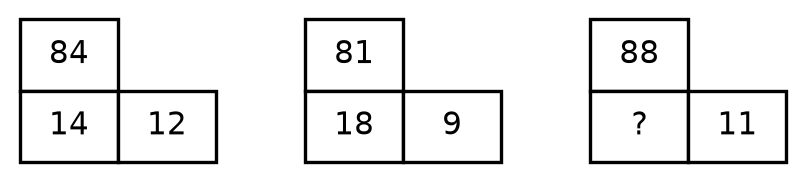
Examine the following three figures in which the numbers follow a specific pattern:
The missing number (?) in the third figure above is
Answer (b) & explanation
16 is correct (b). Step 1: in the first figure, 14 × 12 = 168, and half of 168 is 84, the top number. Step 2: in the second figure, 18 × 9 = 162, and half is 81. The rule holds: top number = (product of the two bottom numbers) ÷ 2. Step 3: in the third figure, ? × 11 must equal 2 × 88 = 176. So ? = 176 ÷ 11 = 16. So (a), (c) and (d) fail.
Tip: in number figures, try simple operations (add, multiply, half, double) on the given numbers and check the rule on every complete figure before using it on the missing one.
Answer as per the official UPSC answer key.
Which one of the following pairs is correctly matched?
| Geographical Feature | Region
Answer (b) & explanation
Option (b) is correct. The Atlas Mountains run through Morocco, Algeria and Tunisia in north-west Africa; they are young fold mountains formed as Africa pressed against Europe. (a) is wrong: the Abyssinian Plateau is in Ethiopia, East Africa, not Arabia; the Blue Nile rises there from Lake Tana. (c) is wrong: the Guiana Highlands are in northern South America, home to Angel Falls in Venezuela. (d) is wrong: the Okavango Basin is in Botswana, southern Africa, where the river forms a great inland delta; Patagonia is in Argentina and Chile.
Notice the related fact: the Okavango Delta became UNESCO's 1,000th World Heritage Site (2014). Trap: each wrong pair swaps a real feature to the wrong continent.
Answer as per the official UPSC answer key.
Some Buddhist rock-cut caves are called Chaityas, while the others are called Viharas. What is the difference between the two?
Answer (b) & explanation
Option (b) is correct. A chaitya is a prayer hall, usually apsidal, with a small stupa at the far end for worship, as at Karle, Bhaja and Ajanta Caves 9, 10, 19 and 26. A vihara is a monastery, a central hall surrounded by small cells where monks lived. (a) is the reverse. (c) is wrong: the stupa is inside the chaitya, and the vihara is a separate residential cave. (d) is wrong: there is a clear functional difference.
Notice the examples: Karle's chaitya (Maharashtra, 1st century CE) is the largest; Ajanta has 5 chaityas and about 24 viharas; Nalanda's viharas grew into a great monastic university. Early chaityas imitated wooden architecture, with ribbed roofs. Trap: (a) swaps the two terms.
Answer as per the official UPSC answer key.
With reference to National Legal Services Authority, consider the following statements :
- 1. Its objective is to provide free and competent legal services to the weaker sections of the society on the basis of equal opportunity.
- 2. It issues guidelines for the State Legal Services Authorities to implement the legal programmes and schemes throughout the country.
Which of the statements given above is/are correct?
Answer (c) & explanation
Both statements are correct (c). NALSA was set up under the Legal Services Authorities Act, 1987, which came into force in 1995. Its objective is to provide free and competent legal services to weaker sections so that no citizen is denied justice for economic or other disabilities, in line with Article 39A (1). It lays down policies and guidelines for State Legal Services Authorities, which carry out the programmes through district and taluk bodies (2). So (a), (b) and (d) fail.
Notice the structure: the Chief Justice of India is the Patron-in-Chief, and the senior-most judge after the CJI is the Executive Chairman. NALSA runs Lok Adalats, whose awards are final and cannot be appealed. Free legal aid covers women, children, SC/ST, disabled persons and people below income limits. Trap: both are routine functions, so look for no catch.
Answer as per the official UPSC answer key.
Which one of the following describes best the concept of Nirvana in Buddhism?
Answer (a) & explanation
The extinction of the flame of desire is correct (a). Nirvana literally means 'blowing out': the flame of desire (tanha), along with greed, hatred and delusion, is put out, ending suffering and the cycle of rebirth. (b) is wrong: Buddhism does not teach the annihilation of a self; it denies a permanent self (anatta) in the first place. (c) describes a feeling, not the core concept, though nirvana is peaceful. (d) is wrong: the Buddha described it clearly enough as the end of craving.
Notice the framework: the Four Noble Truths say suffering has a cause, desire, and an end, nirvana, reached by the Eightfold Path. Mahaparinirvana is the Buddha's final passing at Kushinagar. Trap: (b) confuses nirvana with nihilism.
Answer as per the official UPSC answer key.
A, B, C, D and E belong to five different cities P, Q, R, S and T (not necessarily in that order). Each one of them comes from a different city. Further it is given that
- 1. B and C do not belong to Q.
- 2. B and E do not belong to P and R.
- 3. A and C do not belong to R, S and T.
- 4. D and E do not belong to Q and T.
Which one of the following statements is not correct?
Answer (d) & explanation
'B belongs to S' is not correct (d). Step 1: from clue 3, A and C are not in R, S or T, so they are in P or Q. Clue 1 says C is not in Q, so C = P and A = Q. Step 2: clue 4 says E is not in Q or T, and clue 2 says E is not in P or R, so E = S. Clue 4 says D is not in T, so D = R, and B = T. Step 3: so C belongs to P (true), D to R (true), A to Q (true), but B belongs to T, not S. So (a), (b) and (c) are correct statements and (d) is the incorrect one.
Tip: in 'not correct' questions, solve fully first, then pick the false statement. Start with people who have only two possible cities.
Answer as per the official UPSC answer key.
A gardener has 1000 plants. He wants to plant them in such a way that the number of rows and the number of columns remains the same. What is the minimum number of plants that he needs more for this purpose?
Answer (b) & explanation
24 is correct (b). Step 1: equal rows and columns means the plants form a square, so the total must be a perfect square. Step 2: 31² = 961, which is less than 1,000, so too small. The next square is 32² = 1,024. Step 3: he needs 1,024 − 1,000 = 24 more plants. (a) 14 gives 1,014, (c) 32 gives 1,032 and (d) 34 gives 1,034, none of which is a perfect square. So (a), (c) and (d) fail.
Tip: learn squares up to 35 or so; they save time in CSAT. 'Minimum number to add' means go up to the next perfect square; 'minimum to remove' means go down to the one before it (here 961, removing 39).
Answer as per the official UPSC answer key.
The Narmada river flows to the west, while most other large peninsular rivers flow to the east. Why?
- 1. It occupies a linear rift valley.
- 2. It flows between the Vindhyas and the Satpuras.
- 3. The land slopes to the west from Central India.
Select the correct answer using the codes given below.
Answer (a) & explanation
Statement 1 only is correct (a). The Narmada, like the Tapi, flows west because it follows a rift valley formed by faulting, so its course is set by that trough (1). Statement 2 is a fact, but it only describes where it flows, between the Vindhyas and the Satpuras, not why it flows west; UPSC treats it as not a reason. Statement 3 is wrong: the Peninsular plateau as a whole slopes east, which is why most rivers flow into the Bay of Bengal. So (b), (c) and (d) fail.
Notice the consequence: rift-valley rivers form estuaries, not deltas, and have few tributaries. The Sardar Sarovar dam is on the Narmada, and the river rises at Amarkantak. Trap: a true fact can still be the wrong reason.
Answer as per the official UPSC answer key.
Photochemical smog is a resultant of the reaction among
Answer (a) & explanation
Option (a) is correct. Photochemical smog, the Los Angeles type, forms when sunlight acts on nitrogen oxides and hydrocarbons from vehicle exhaust. The reactions produce ozone and peroxyacetyl nitrate (PAN), which irritate eyes and lungs and damage plants; the brown haze includes NO₂. So the mixture of NO₂, O₃ and PAN in sunlight describes it best. (b) is wrong: carbon monoxide and oxygen are not its key components. (c) is wrong: it forms in warm, sunny conditions, not low temperatures. (d) is wrong: it peaks in the afternoon, not evening.
Notice the contrast: classical or London smog (1952) is sulphur dioxide plus smoke and fog in cold, damp weather. Delhi's winter smog mixes both types with stubble smoke. Trap: (a) lists products of the reaction, which UPSC accepts.
Answer as per the official UPSC answer key.
A rise in general level of prices may be caused by
- 1. an increase in the money supply
- 2. a decrease in the aggregate level of output
- 3. an increase in the effective demand
Select the correct answer using the codes given below.
Answer (d) & explanation
All three are correct (d). Prices rise when more money chases fewer goods. An increase in the money supply puts more money in people's hands (1). A decrease in output, from a drought or supply shock, cuts the goods available (2). An increase in effective demand, the demand backed by purchasing power, pushes prices up (3). So options (a), (b) and (c) leave out real causes.
Notice the types: demand-pull inflation (1, 3) and cost-push or supply-side inflation (2), such as the vegetable price spikes from erratic monsoons in India. The quantity theory of money (MV = PT) links money supply to prices. The RBI's 4% CPI target under flexible inflation targeting guides policy. Trap: all three are textbook causes.
Answer as per the official UPSC answer key.
Read the passage
A number of empirical studies find that farmers are risk-averse, though only moderately in many cases. There is also evidence to show that farmers’ risk aversion results in cropping patterns and input use designed to reduce risk rather than to maximize income. Farmers adopt a number of strategies to manage and cope with agricultural risks. These include practices like crop and field diversification, non-farm employment, storage of stocks and strategic migration of family members. There are also institutions ranging from share tenancy to kinship, extended family and informal credit agencies. One major obstacle to risk sharing by farmers is that the same type of risks can affect a large number of farmers in the region. Empirical studies show that the traditional methods are not adequate. Hence there is a need for policy interventions, especially measures that cut across geographical regions.
Policies may aim at tackling agricultural risks directly or indirectly. Examples of risk-specific policies are crop insurance, price stabilization and the development of varieties resistant to pests and diseases. Policies which affect risk indirectly are irrigation, subsidized credit and access to information. No single risk-specific policy is sufficient to reduce risk and is without side-effects, whereas policies not specific to risk influence the general situation and affect risks only indirectly. Crop insurance, as a policy measure to tackle agricultural risk directly, deserves careful consideration in the Indian context and in many other developing countries — because the majority of farmers depend on rain-fed agriculture and in many areas yield variability is the predominant cause of their income instability.
Which of the following observations emerges from the above passage ?
Answer (b) & explanation
(b) is correct. Step 1: the passage says plainly: 'No single risk-specific policy is sufficient to reduce risk and is without side-effects.' That is (b). Step 2: (a) says one can find a single policy that reduces risk with no side-effect, which is the opposite of the passage. Step 3: (c) is wrong: indirect policies only 'affect risks indirectly'; they do not eliminate risk. (d) is wrong: the passage never says government action can remove risk completely. So (a), (c) and (d) fail.
Tip: options with 'eliminate' and 'completely' are almost always wrong in passages that talk about reducing or managing a problem. Choose the option that repeats the passage's careful wording.
Answer as per the official UPSC answer key.