
UPSC Prelims PYQs with explanations
Real questions from official papers, mapped to syllabus topics. Attempt each one; the answer and the reason appear instantly.
Read the passage
The law in many parts of the world increasingly restricts the discharge of agricultural slurry into watercourses. The simplest and often the most economically sound practice returns the material to the land as semisolid manure or as sprayed slurry. This dilutes its concentration in the environment to what might have occurred in a more primitive and sustainable type of agriculture and converts pollutant into fertilizer. Soil microorganisms decompose the organic components of sewage and slurry and most of the mineral nutrients become available to be absorbed again by the vegetation.
The excess input of nutrients, both nitrogen and phosphorus — based, from agricultural runoff (and human sewage) has caused many ‘healthy’ oligotrophic lakes (low nutrient concentrations, low plant productivity with abundant water weeds, and clear water) to change to eutrophic condition where high nutrient inputs lead to high phytoplankton productivity (sometimes dominated by bloom-forming toxic species). This makes the water turbid, eliminates large plants and, in the worst situations, leads to anoxia and fish kills; so called cultural eutrophication. Thus, important ecosystem services are lost, including the provisioning service of wild-caught fish and the cultural services associated with recreation.
The process of cultural eutrophication of lakes has been understood for some time. But only recently did scientists notice huge ‘dead zones’ in the oceans near river outlets, particularly those draining large catchment areas such as the Mississippi in North America and the Yangtze in China. The nutrient-enriched water flows through streams, rivers and lakes, and eventually to the estuary and ocean where the ecological impact may be huge, killing virtually all invertebrates and fish in areas up to 70,000 km² in extent. More than 150 sea areas worldwide are now regularly starved of oxygen as a result of decomposition of algal blooms, fuelled particularly by nitrogen from agricultural runoff of fertilizers and sewage from large cities. Oceanic dead zones are typically associated with industrialized nations and usually lie off countries that subsidize their agriculture, encouraging farmers to increase productivity and use more fertilizer.
What is/are the characteristics of a water body with cultural eutrophication ?
- 1. Loss of ecosystem services
- 2. Loss of flora and fauna
- 3. Loss of mineral nutrients
Select the correct answer using the code given below :
Answer (b) & explanation
1 and 2 are correct (b). Step 1: the passage says 'important ecosystem services are lost', such as wild-caught fish and recreation (1). Step 2: it says eutrophication 'eliminates large plants' and leads to anoxia and 'fish kills', so flora and fauna are lost (2). Step 3: point 3 is wrong: eutrophication comes from an excess of nutrients, not a loss of them. So (a), (c) and (d) fail.
Tip: 'eutrophic' means 'well-fed' or nutrient-rich. Any option saying nutrients are lost contradicts the very meaning of the word. Remember: too many nutrients → algae bloom → oxygen falls → plants and fish die.
Answer as per the official UPSC answer key.
Read the passage
A stout old lady was walking with her basket down the middle of a street in Petrograd to the great confusion of the traffic and no small peril to herself. It was pointed out to her that the pavement was the place for foot-passengers, but she replied, “I’m going to walk where I like. We’ve got liberty now.” It did not occur to the dear lady that if liberty entitled the foot-passenger to walk down the middle of the road it also entitled the taxi-driver to drive on the pavement, and that the end of such liberty would be universal chaos. Everything would be getting in everybody else’s way and nobody would get anywhere. Individual liberty would have become social anarchy.
It was pointed out to the lady that she should walk on the pavement because she was
Answer (a) & explanation
'A pedestrian' is correct (a). Step 1: she was told that 'the pavement was the place for foot-passengers'. A foot-passenger is a pedestrian. So she was asked to use the pavement because she was walking. Step 2: (b) carrying a basket, (c) being stout and (d) being old are descriptions of her, but they are not the reason given. Step 3: the rule applies to every walker, whatever their age, size or luggage. So (b), (c) and (d) fail.
Tip: separate description from reason. Writers add colourful details (stout, old, basket), but the 'because' answer should come from the actual explanation, here the rule about foot-passengers.
Answer as per the official UPSC answer key.
Under the Scheduled Tribes and Other Traditional Forest Dwellers (Recognition of Forest Rights) Act, 2006, who shall be the authority to initiate the process for determining the nature and extent of individual or community forest rights or both?
Answer (d) & explanation
Gram Sabha is correct (d). Under the Forest Rights Act, 2006, the Gram Sabha starts the process of determining individual and community forest rights. It receives claims, verifies them through its elected Forest Rights Committee, and passes a resolution, which then goes to the Sub-Divisional Level Committee and finally the District Level Committee for approval (Section 6). (a) is wrong: the Forest Department is only represented on the committees. (b) is wrong: the Collector chairs the district committee, which reviews, not initiates. (c) is wrong: revenue officers sit on the sub-divisional committee.
Notice the impact: the Niyamgiri case (2013) let Gram Sabhas decide on Vedanta's bauxite mining. Community Forest Resource rights let villages manage forests. The Ministry of Tribal Affairs is the nodal ministry. Trap: officials review claims, but the Gram Sabha begins them.
Answer as per the official UPSC answer key.
The annual range of temperature in the interior of the continents is high as compared to coastal areas. What is/are the reason/reasons?
- 1. Thermal difference between land and water
- 2. Variation in altitude between continents and oceans
- 3. Presence of strong winds in the interior
- 4. Heavy rains in the interior as compared to coasts
Select the correct answer using the codes given below.
Answer (a) & explanation
Statement 1 only is correct (a). Land heats up and cools down much faster than water, which has a higher specific heat, mixes heat downwards and is partly transparent. Coasts are moderated by the sea, but far inland there is no such effect, so summers are very hot and winters very cold. This is continentality (1). Statement 2 is wrong: altitude affects temperature levels, not this contrast. Statement 3 is wrong: strong winds are not typical of interiors. Statement 4 is wrong: interiors usually get less rain, not more. So (b), (c) and (d) fail.
Notice the examples: Verkhoyansk in Siberia has an annual range of over 60°C, while Mumbai's is a few degrees; Delhi's range is much larger than Chennai's. Trap: rain and wind sound climatic but are not the cause here.
Answer as per the official UPSC answer key.
Which of the following statements is/are correct?
- 1. Viruses lack enzymes necessary for the generation of energy.
- 2. Viruses can be cultured in any synthetic medium.
- 3. Viruses are transmitted from one organism to another by biological vectors only.
Select the correct answer using the codes given below.
Answer (a) & explanation
Statement 1 only is correct (a). Viruses have no energy-making enzymes or metabolism of their own; they use the host cell's machinery to make copies (1). Statement 2 is wrong: viruses grow only in living cells, such as cell cultures or embryonated eggs, not in a synthetic, cell-free medium. Statement 3 is wrong: viruses spread by many routes: air (influenza, COVID-19), water and food (hepatitis A), contact, blood (HIV) and also vectors (dengue). So (b), (c) and (d) fail.
Notice the debate: viruses are at the edge of life, active only inside cells. Bacteriophages infect bacteria and are studied as alternatives to antibiotics. India's NIV, Pune is the main virology institute. Trap: 'only' makes statement 3 too narrow.
Answer as per the official UPSC answer key.
Five people A, B, C, D and E are seated about a round table. Every chair is spaced equidistant from adjacent chairs.
- (i) C is seated next to A.
- (ii) A is seated two seats from D.
- (iii) B is not seated next to A.
Which of the following must be true?
- 1. D is seated next to B.
- 2. E is seated next to A.
Select the correct answer from the codes given below:
Answer (c) & explanation
Both statements are correct (c). Step 1: B is not next to A (clue iii), and D is two seats from A (clue ii), so D is not next to A either. A's two neighbours must therefore be C and E. So E sits next to A: statement 2 is true. Step 2: at a table of five, the two seats not next to A are next to each other. B and D fill those two seats. Step 3: so D is seated next to B: statement 1 is true. Hence (a), (b) and (d) fail.
Tip: at a round table of five, each person has two neighbours and two 'far' seats, and the two far seats always touch each other.
Answer as per the official UPSC answer key.
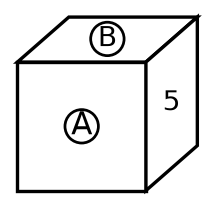
A cube has six numbers marked 1, 2, 3, 4, 5 and 6 on its faces. Three views of the cube are shown below:
What possible number can exist on the two faces marked (A) and (B), respectively on the cube?
Answer (a) & explanation
1. Find what is opposite 6. In the views, 6 sits next to 1, 4 (view 1) and 5, 3 (view 3). The only number never beside 6 is 2, so 2 is opposite 6.
2. Take view 3 (front 5, top 3, right 6) and give the cube a quarter turn so that 5 moves to the right side.
3. The top stays 3. The face that comes to the front is the one that was on the left, which is opposite 6, that is, 2.
4. So A = 2 and B = 3: (a).
Answer as per the official UPSC answer key.
With reference to the history of Indian rock-cut architecture, consider the following statements :
- 1. The caves at Badami are the oldest surviving rock-cut caves in India.
- 2. The Barabar rock-cut caves were originally made for Ajivikas by Emperor Chandragupta Maurya.
- 3. At Ellora, caves were made for different faiths.
Which of the statements given above is/are correct?
Answer (c) & explanation
Statement 3 only is correct (c). Ellora (Maharashtra) has 34 caves of three faiths side by side: Buddhist, Hindu (including the Kailasa temple) and Jain (3). Statement 1 is wrong: the Badami caves (6th century CE, Chalukyas) are much later; the Barabar caves of Bihar (3rd century BCE) are the oldest. Statement 2 is wrong: the Barabar caves were given to the Ajivikas by Ashoka, and the nearby Nagarjuni caves by his grandson Dasharatha, not by Chandragupta Maurya. So (a), (b) and (d) fail.
Notice the highlights: the Lomas Rishi cave's arched doorway imitates wooden architecture, and the Kailasa temple at Ellora was carved under the Rashtrakuta king Krishna I. Ellora and Ajanta became World Heritage Sites in 1983. Trap: the right caves are given to the wrong Mauryan king.
Answer as per the official UPSC answer key.
According to the Constitution of India, which of the following are fundamental for the governance of the country?
Answer (c) & explanation
Directive Principles of State Policy is correct (c). Article 37 says the Directive Principles are not enforceable by any court, but they are 'nevertheless fundamental in the governance of the country', and the State must apply them in making laws. (a) is wrong: Fundamental Rights are enforceable but are not described in these words. (b) and (d) are wrong: Fundamental Duties (Article 51A) apply to citizens and are not called fundamental for governance.
Notice the balance: in Minerva Mills (1980), the Supreme Court held that harmony between Fundamental Rights and DPSPs is part of the basic structure. DPSPs were borrowed from the Irish Constitution, and B.R. Ambedkar called them 'novel features'. Trap: the word 'fundamental' appears in all options, but the phrase belongs to Article 37.
Answer as per the official UPSC answer key.
During a thunderstorm, the thunder in the skies is produced by the
- 1. meeting of cumulonimbus clouds in the sky
- 2. lightning that separates the nimbus clouds
- 3. violent upward movement of air and water particles
Select the correct answer using the codes given below.
Answer (d) & explanation
None of the above is correct (d). Lightning heats the air along its path to around 30,000°C in a split second, about five times hotter than the Sun's surface. The air expands explosively, and this shock wave travels as the sound of thunder. Statement 1 is wrong: clouds do not 'meet' and clap together. Statement 2 is wrong: lightning does not separate clouds. Statement 3 is wrong: updrafts build the charge in cumulonimbus clouds, but they do not themselves make the sound. So (a), (b) and (c) fail.
Notice the related facts: we see lightning before we hear thunder because light travels faster than sound; counting the seconds and dividing by three gives the distance in km. Lightning is notified as a disaster in several states; India's Damini app warns of strikes. Trap: updrafts cause lightning indirectly, but thunder comes from the heated air.
Answer as per the official UPSC answer key.
Which one of the following statements is correct?
Answer (c) & explanation
Option (c) is correct. The Governor holds office during the pleasure of the President (Article 156), and the Constitution lays down no removal procedure or grounds. (a) is wrong: the 7th Amendment (1956) allows one person to be Governor of two or more States. (b) is wrong: High Court judges are appointed by the President, after consulting the CJI and the Governor (Article 217). (d) is wrong: in a UT with a legislature, such as Delhi or Puducherry, the Chief Minister is appointed by the President, not the Lt Governor.
Notice the safeguard: in B.P. Singhal (2010), the Supreme Court held that the President's pleasure is not unfettered; a Governor cannot be removed arbitrarily, and removal is open to limited judicial review. Trap: 'pleasure' tenure means no fixed procedure.
Answer as per the official UPSC answer key.
Seven men, A, B, C, D, E, F and G are standing in a queue in that order. Each one is wearing a cap of a different colour like violet, indigo, blue, green, yellow, orange and red. D is able to see in front of him green and blue, but not violet. E can see violet and yellow, but not red. G can see caps of all colours other than orange. If E is wearing an indigo coloured cap, then the colour of the cap worn by F is
Answer (c) & explanation
Red is correct (c). Step 1: G, last in the queue, sees everyone but cannot see orange, so G wears orange. Step 2: D sees green and blue in front (A, B, C) but not violet. E sees violet and yellow but not red. So violet is on D, and A, B, C wear green, blue and yellow. Step 3: E wears indigo (given). The only colour left is red, so F wears red. Check: E cannot see red because F is behind him. So (a), (b) and (d) fail.
Tip: in queue questions, a person sees only those in front. A colour someone cannot see is either his own or behind him.
Answer as per the official UPSC answer key.
A sum of Rs. 700 has to be used to give seven cash prizes to the students of a school for their overall academic performance. If each prize is Rs. 20 less than its preceding prize, then what is the least value of the prize?
Answer (b) & explanation
Rs. 40 is correct (b). Step 1: the seven prizes fall in equal steps of Rs. 20, so they form an arithmetic series. In such a series, the middle (4th) prize equals the average: 700 ÷ 7 = Rs. 100. Step 2: the smallest prize is three steps below the middle: 100 − 3 × 20 = Rs. 40. Step 3: check: 160 + 140 + 120 + 100 + 80 + 60 + 40 = 700. So (a), (c) and (d) fail.
Tip: for an odd number of equally spaced values, the middle value is the average. This avoids writing equations. With an even count, the average lies halfway between the two middle values.
Answer as per the official UPSC answer key.
On the planet earth, most of the freshwater exists as ice caps and glaciers. Out of the remaining freshwater, the largest proportion
Answer (c) & explanation
Groundwater is correct (c). About 69% of the Earth's fresh water is locked in ice caps and glaciers. Most of the rest, about 30%, is groundwater. (a) is wrong: the atmosphere holds only about 0.04% as vapour and clouds. (b) is wrong: lakes and rivers hold well under 1%. (d) is wrong: soil moisture is also a tiny share. Fresh water itself is only about 2.5% of all water on Earth.
Notice India's case: India is the world's largest user of groundwater, drawing about a quarter of the global total, and the CGWB finds over 10% of assessment units over-exploited. Atal Bhujal Yojana promotes community groundwater management. Trap: rivers are visible, but groundwater is far larger.
Answer as per the official UPSC answer key.
Consider the following minerals :
- 1. Calcium
- 2. Iron
- 3. Sodium
Which of the minerals given above is/are required by human body for the contraction of muscles?
Answer (d) & explanation
All three per UPSC's key (d), but iron's place is doubtful. Sodium ions rush into nerve and muscle cells to create the action potential that triggers contraction (3). Calcium released inside the muscle cell binds troponin and lets actin and myosin slide (1). Iron is not directly part of the contraction mechanism; it sits in myoglobin and haemoglobin, supplying the oxygen muscles need to keep working, so many argue for (c). UPSC counted iron as required. (a) and (b) fail on any reading.
Notice the others: potassium restores the resting state, and magnesium helps muscles relax; low calcium causes tetany and cramps. Anaemia from iron deficiency, common in India, causes muscle fatigue. Trap: 'required for contraction' can be read narrowly or broadly.
Answer as per the official UPSC answer key.
Which one of the following groups of items is included in India’s foreign-exchange reserves?
Answer (b) & explanation
Foreign-currency assets, gold and SDRs is correct (b). India's foreign-exchange reserves have four parts: foreign currency assets (the largest, held in dollars, euros and others), gold held by the RBI, Special Drawing Rights, and the reserve tranche position in the IMF. (a), (c) and (d) are wrong because loans from foreign countries or the World Bank are liabilities, not reserves.
Notice the scale: India's reserves have been in the range of US$650–700 billion, among the world's largest; they hit a record above US$700 billion in September 2024. The RBI has been adding gold and brought tonnes back from the Bank of England in 2024. In 1991, reserves fell to about two weeks of imports, forcing gold to be pledged. Trap: borrowed money boosts liquidity but is not a reserve asset.
Answer as per the official UPSC answer key.
Consider the following statements:
- 1. A primary group is relatively smaller in size.
- 2. Intimacy is an essential characteristic of a primary group.
- 3. A family may be an example of a primary group.
In the light of the above statements, which one of the following is true?
Answer (d) & explanation
(d) is correct. Step 1: statement 2 says intimacy is essential to a primary group. So members of every primary group know each other intimately: (d) follows. Step 2: (a) is wrong: statement 3 says a family 'may be' an example of a primary group, not that all families are. (b) reverses this: nothing says every primary group is a family. Step 3: (c) is wrong: statement 1 says primary groups are relatively small, but a small group need not be primary; without intimacy, it is not. So (a), (b) and (c) fail.
Tip: 'essential characteristic' means every member of the category has it; that gives a safe 'all' conclusion. 'May be' and 'relatively' never do.
Answer as per the official UPSC answer key.
Read the passage
The law in many parts of the world increasingly restricts the discharge of agricultural slurry into watercourses. The simplest and often the most economically sound practice returns the material to the land as semisolid manure or as sprayed slurry. This dilutes its concentration in the environment to what might have occurred in a more primitive and sustainable type of agriculture and converts pollutant into fertilizer. Soil microorganisms decompose the organic components of sewage and slurry and most of the mineral nutrients become available to be absorbed again by the vegetation.
The excess input of nutrients, both nitrogen and phosphorus — based, from agricultural runoff (and human sewage) has caused many ‘healthy’ oligotrophic lakes (low nutrient concentrations, low plant productivity with abundant water weeds, and clear water) to change to eutrophic condition where high nutrient inputs lead to high phytoplankton productivity (sometimes dominated by bloom-forming toxic species). This makes the water turbid, eliminates large plants and, in the worst situations, leads to anoxia and fish kills; so called cultural eutrophication. Thus, important ecosystem services are lost, including the provisioning service of wild-caught fish and the cultural services associated with recreation.
The process of cultural eutrophication of lakes has been understood for some time. But only recently did scientists notice huge ‘dead zones’ in the oceans near river outlets, particularly those draining large catchment areas such as the Mississippi in North America and the Yangtze in China. The nutrient-enriched water flows through streams, rivers and lakes, and eventually to the estuary and ocean where the ecological impact may be huge, killing virtually all invertebrates and fish in areas up to 70,000 km² in extent. More than 150 sea areas worldwide are now regularly starved of oxygen as a result of decomposition of algal blooms, fuelled particularly by nitrogen from agricultural runoff of fertilizers and sewage from large cities. Oceanic dead zones are typically associated with industrialized nations and usually lie off countries that subsidize their agriculture, encouraging farmers to increase productivity and use more fertilizer.
What is the central theme of this passage ?
Answer (c) & explanation
(c) is correct. Step 1: the passage begins with laws on agricultural slurry, then explains how nutrient runoff causes eutrophication of lakes and huge 'dead zones' in the oceans. The common thread is that improper disposal of farm waste damages aquatic ecosystems: (c). Step 2: (a) is wrong: legislation is only mentioned in the first sentence; it is not the theme. Step 3: (b) and (d) are too sweeping: the passage does not blame all of modern agriculture, nor say chemical fertilizers are undesirable in themselves; it even recommends turning slurry into fertilizer. So (a), (b) and (d) fail.
Tip: the central theme should cover the whole passage, not only one sentence, and should not go further than the passage does.
Answer as per the official UPSC answer key.
Read the passage
A stout old lady was walking with her basket down the middle of a street in Petrograd to the great confusion of the traffic and no small peril to herself. It was pointed out to her that the pavement was the place for foot-passengers, but she replied, “I’m going to walk where I like. We’ve got liberty now.” It did not occur to the dear lady that if liberty entitled the foot-passenger to walk down the middle of the road it also entitled the taxi-driver to drive on the pavement, and that the end of such liberty would be universal chaos. Everything would be getting in everybody else’s way and nobody would get anywhere. Individual liberty would have become social anarchy.
The lady refused to move from the middle of the street because
Answer (b) & explanation
(b) is correct. Step 1: she replied, 'I'm going to walk where I like. We've got liberty now.' She believed her new freedom entitled her to do whatever she liked: (b). Step 2: (a) is wrong: she was in danger, but the passage does not say she refused because she was not afraid. Step 3: (c) is wrong: she never says she dislikes the pavement. (d) is wrong: it was the traffic that was confused, not her. So (a), (c) and (d) fail.
Tip: when a character's own words explain the action, use them. Note that 'confusion' in the passage belongs to the traffic, a classic word-swap trap.
Answer as per the official UPSC answer key.
Improper handling and storage of cereal grains and oilseeds result in the production of toxins known as aflatoxins which are not generally destroyed by normal cooking process. Aflatoxins are produced by
Answer (c) & explanation
Moulds is correct (c). Aflatoxins are produced by the moulds (fungi) Aspergillus flavus and A. parasiticus, which grow on damp or poorly stored groundnuts, maize, cottonseed, spices and other grains. They are potent liver toxins and among the strongest natural carcinogens, and normal cooking does not destroy them. (a) is wrong: bacteria cause other food poisoning, such as botulinum toxin. (b) and (d) are wrong: protozoa and viruses do not make aflatoxins.
Notice the safety rules: FSSAI sets limits on aflatoxin in food, and aflatoxin M1 appears in milk when cattle eat contaminated feed. Good drying to low moisture and proper storage prevent it. Aflatoxin rejections have hit Indian groundnut and spice exports to the EU. Trap: toxins in food are often blamed on bacteria.
Answer as per the official UPSC answer key.