
UPSC Prelims PYQs with explanations
Real questions from official papers, mapped to syllabus topics. Attempt each one; the answer and the reason appear instantly.
Which of the following is/are the characteristic/characteristics of Indian coal?
- 1. High ash content
- 2. Low sulphur content
- 3. Low ash fusion temperature
Select the correct answer using the codes given below.
Answer (a) & explanation
Statements 1 and 2 are correct (a). Most Indian coal is Gondwana coal with high ash content, often 30–45% (1), and low sulphur, usually under 1% (2). Statement 3 is wrong: Indian coal ash has a high ash fusion temperature, meaning the ash melts only at high heat, because it is rich in silica and alumina. So (b), (c) and (d) fail.
Notice the consequences: high ash lowers heat value and creates huge fly ash volumes; rules push 100% fly ash use in bricks, cement and roads. High ash also makes India import coking coal for steel. Low sulphur is a plus, which is partly why most plants were exempted from FGD rules in July 2025. Tertiary coal of the north-east is high in sulphur. Trap: the third statement inverts the ash melting property.
Answer as per the official UPSC answer key.
Which of the following leaf modifications occurs/occur in desert areas to inhibit water loss?
- 1. Hard and waxy leaves
- 2. Tiny leaves or no leaves
- 3. Thorns instead of leaves
Select the correct answer using the codes given below.
Answer (d) & explanation
All three are correct (d). Desert plants (xerophytes) cut transpiration in every way. Hard, waxy leaves with a thick cuticle reduce evaporation (1). Tiny leaves or no leaves reduce the surface losing water (2). Thorns or spines instead of leaves, as in cactus, reduce water loss further, while the green stem does photosynthesis (3). So options (a), (b) and (c) leave out real adaptations.
Notice the other adaptations: sunken stomata, stomata that open at night (CAM photosynthesis in cacti and pineapple), deep tap roots, and fleshy succulent stems that store water. India's Thar has khejri, which has deep roots, and ker with tiny leaves. Trap: all three are textbook xerophyte features.
Answer as per the official UPSC answer key.
Directions for the following 3 (three) items: Examine carefully the following statements and answer the three items that follow:
Out of four friends A, B, C and D,
A and B play football and cricket,
B and C play cricket and hockey,
A and D play basketball and football,
C and D play hockey and basketball.
Who does not play hockey?
Answer (d) & explanation
A is correct (d). Step 1: each pair plays two games, so build a list for each friend. A: football, cricket (with B), basketball, football (with D) = football, cricket, basketball. Step 2: B: football, cricket, hockey. C: cricket, hockey, basketball. D: basketball, football, hockey. Step 3: B, C and D all play hockey; only A does not. So (a), (b) and (c) fail.
Tip: turn pair statements into one list per person before answering. A small table of friends against games, with ticks, makes all three linked questions quick and avoids missing a game.
Answer as per the official UPSC answer key.
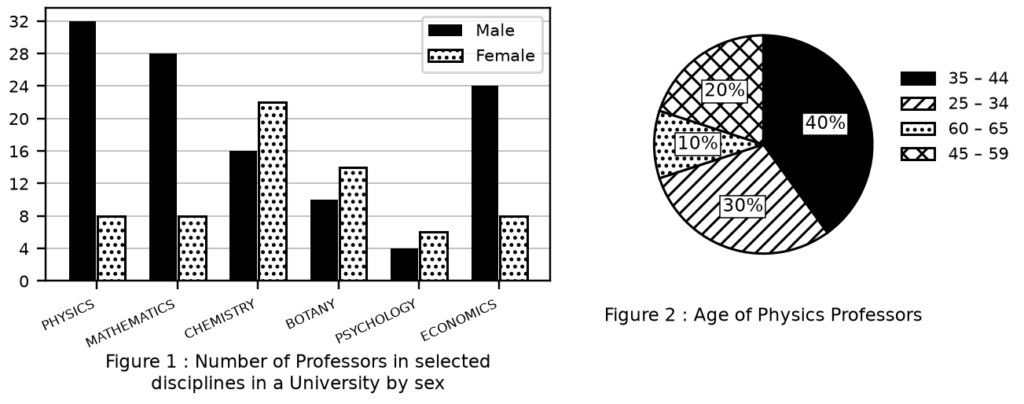
Direction for the following 5 (five) items: Study the two figures given below and answer the five items that follow:
How many Physics professors belong to the age group 35 – 44?
Answer (b) & explanation
16 is correct (b). Step 1: from Figure 1, Physics has 32 men + 8 women = 40 professors. Step 2: Figure 2 shows that 40% of Physics professors are in the age group 35–44. Step 3: 40% of 40 = 0.4 × 40 = 16. So (a), (c) and (d) fail.
Tip: in data questions, first get the total for the group (here all Physics professors), then apply the percentage. Write down the totals for each subject once at the start; the next four questions use the same figures. A quick check: 40% of 40 is the same as 40% × 40 = 16, as 10% is 4.
Answer as per the official UPSC answer key.
Recombinant DNA technology (Genetic Engineering) allows genes to be transferred
- 1. across different species of plants
- 2. from animals to plants
- 3. from microorganisms to higher organisms
Select the correct answer using the codes given below.
Answer (d) & explanation
All three are correct (d). Because the genetic code is universal, a gene from one organism can work in another. Recombinant DNA technology therefore allows transfer across plant species (1), from animals to plants, as in trials with a fish antifreeze gene in tomato (2), and from microbes to higher organisms, as with the Bt gene in cotton and the human insulin gene in bacteria in reverse (3). So options (a), (b) and (c) leave out real possibilities.
Notice the tools: restriction enzymes cut DNA, ligase joins it, and plasmids or Agrobacterium carry it. Newer CRISPR-Cas9 editing (Nobel 2020) changes a plant's own genes; India exempted such SDN-1 and SDN-2 edits from GM rules in 2022. Trap: the universality of the code makes all three transfers possible.
Answer as per the official UPSC answer key.
The people of India agitated against the arrival of Simon Commission because
Answer (c) & explanation
There was no Indian member is correct (c). The Simon Commission, appointed in November 1927 to review the 1919 Act, had seven British MPs under Sir John Simon, including Clement Attlee, and no Indian member. Indians saw this as an insult to their right to decide their own constitution and greeted it with 'Simon, Go Back' protests when it arrived in February 1928. (a) is wrong: Indians wanted reforms reviewed, just with Indian voices. (b) and (d) are wrong: its report came in 1930, after the protests, and did not suggest partition.
Notice the consequences: Lala Lajpat Rai died after a police lathi charge in Lahore (1928), and Indians answered with the Nehru Report (1928). The commission's report fed into the 1935 Act, which abolished provincial dyarchy. Trap: (b) is a real recommendation but not the cause of protest.
Answer as per the official UPSC answer key.
Consider the following pairs :
| Tribe | State
| 1. Limboo (Limbu) | Sikkim
| 2. Karbi | Himachal Pradesh
| 3. Dongaria Kondh | Odisha
| 4. Bonda | Tamil Nadu
Which of the above pairs are correctly matched?
Answer (a) & explanation
Pairs 1 and 3 are correct (a). The Limbu people live in Sikkim and eastern Nepal (1). The Dongaria Kondh live in the Niyamgiri hills of Odisha and famously used Gram Sabha votes to block Vedanta's bauxite mining in 2013 (3). Pair 2 is wrong: the Karbi are from Assam, mainly Karbi Anglong, not Himachal Pradesh. Pair 4 is wrong: the Bonda are a PVTG of Odisha's Malkangiri hills, not Tamil Nadu. So (b), (c) and (d) fail.
Notice the related groups: Odisha has the most PVTGs (13) of any state. The PM-JANMAN scheme (2023) targets PVTG habitations. The Karbi Anglong Autonomous Council is a Sixth Schedule body. Trap: a tribe from Odisha is moved to Tamil Nadu.
Answer as per the official UPSC answer key.
Quit India Movement was launched in response to
Answer (b) & explanation
Cripps Proposals is correct (b). The Cripps Mission (March–April 1942) offered India dominion status after the war, a constituent assembly, and the right of provinces to stay out, but nothing substantial at once. Gandhi called it a 'post-dated cheque'. Its failure convinced Congress that Britain would not part with power, and the Quit India resolution followed on 8 August 1942. (a) is wrong: the Cabinet Mission came in 1946. (c) is wrong: the Simon Commission reported in 1930. (d) is wrong: the Wavell Plan and Simla Conference came in 1945.
Notice the context: Japan's advance to Burma made Britain seek Indian support, and Stafford Cripps was a Labour minister sympathetic to India. Trap: order the events: Cripps 1942, Quit India 1942, Wavell 1945, Cabinet Mission 1946.
Answer as per the official UPSC answer key.
There are some balls of red, green and yellow colour lying on a table. There are as many red balls as there are yellow balls. There are twice as many yellow balls as there are green ones. The number of red balls
Answer (b) & explanation
'Double the number of green balls' is correct (b). Step 1: let the green balls be g. Yellow balls are twice the green, so yellow = 2g. Red balls equal yellow, so red = 2g. Step 2: so red is double the green balls: (b). Step 3: (a) says red = yellow + green = 3g, but red is 2g. (c) says red = yellow − green = g, but red is 2g. (d) is wrong because the relationship can be fixed even without the actual numbers. So (a), (c) and (d) fail.
Tip: when only relations are given, call the smallest group x and express the others in terms of it. 'Cannot be ascertained' is wrong whenever the ratios are fully fixed.
(d) is tempting because no number is given, but a ratio is enough here.
Answer as per the official UPSC answer key.
Out of 120 applications for a post, 70 are male and 80 have a driver's license. What is the ratio between the minimum to maximum number of males having driver's license?
Answer (c) & explanation
3 to 7 is correct (c). Step 1: the maximum number of licensed males is when all 70 males have a licence: 70 (there are 80 licences, enough). Step 2: the minimum is when overlap is as small as possible: 70 males + 80 licence-holders = 150, but there are only 120 people, so at least 150 − 120 = 30 must be both. Step 3: minimum : maximum = 30 : 70 = 3 : 7. So (a), (b) and (d) fail.
Tip: for two groups in a fixed total, maximum overlap = the smaller group; minimum overlap = sum of groups − total (or zero if that is negative). Draw two circles inside a box to see it.
Answer as per the official UPSC answer key.
Consider the following pairs :
- 1. Nokrek Biosphere Reserve : Garo Hills
- 2. Logtak (Loktak) Lake : Barail Range
- 3. Namdapha National Park : Dafla Hills
Which of the above pairs is/are correctly matched?
Answer (a) & explanation
Pair 1 only is correct (a). Nokrek is the highest peak of the Garo Hills in Meghalaya, and the Nokrek Biosphere Reserve is known for wild citrus (Citrus indica) and red pandas (1). Pair 2 is wrong: Loktak Lake, with its floating phumdis and Keibul Lamjao, the only floating national park, home of the sangai deer, lies in the Manipur valley, not the Barail Range. Pair 3 is wrong: Namdapha is in eastern Arunachal near the Patkai range; the Dafla Hills are in western Arunachal. So (b), (c) and (d) fail.
Notice the related facts: Namdapha hosts four big cats (tiger, leopard, clouded leopard, snow leopard). Loktak is a Ramsar site on the Montreux Record. Trap: real places matched to wrong hills.
Answer as per the official UPSC answer key.
Consider the following statements :
The Parliamentary Committee on Public Accounts
- 1. consists of not more than 25 Members of the Lok Sabha
- 2. scrutinizes appropriation and finance accounts of the Government
- 3. examines the report of the Comptroller and Auditor General of India
Which of the statements given above is/are correct?
Answer (b) & explanation
Statements 2 and 3 are correct (b). The Public Accounts Committee scrutinises the government's appropriation accounts and finance accounts (2) and examines the CAG's audit reports (3), checking that money was spent as Parliament intended. Statement 1 is wrong: the PAC has 22 members: 15 from the Lok Sabha and 7 from the Rajya Sabha, elected each year by proportional representation. So (a), (c) and (d) fail.
Notice the conventions: since 1967 the PAC chair has been from the Opposition, appointed by the Speaker, and ministers cannot be members. It was first set up in 1921 under the 1919 Act. The Estimates Committee (30 members, all Lok Sabha) and the Committee on Public Undertakings (22) are the other financial committees. Trap: '25 Lok Sabha members' mixes up the numbers.
Answer as per the official UPSC answer key.
Which one of the following is likely to be the most inflationary in its effect?
Answer (d) & explanation
Creating new money is correct (d). Creating new money to finance a deficit, by borrowing from the central bank, which prints it (monetisation), adds fresh money to the economy without any matching output, so it is the most inflationary. (a) is wrong: repaying public debt returns money to holders but is not strongly inflationary. (b) is wrong: borrowing from the public only moves existing money from people to the government. (c) is less inflationary than (d): borrowing from banks uses existing deposits, though it can expand credit somewhat.
Notice the history: India ended automatic monetisation through ad hoc Treasury Bills in 1997, and the FRBM Act bars direct RBI funding except in special cases. During COVID-19, the RBI bought bonds in the secondary market under G-SAP. Trap: all deficits are not equally inflationary.
Answer as per the official UPSC answer key.
Four friends, A, B, C and D distribute some money among themselves in such a manner that A gets one less than B, C gets 5 more than D, D gets 3 more than B. Who gets the smallest amount?
Answer (a) & explanation
A is correct (a). Step 1: let B get x. A gets one less than B, so A = x − 1. D gets 3 more than B, so D = x + 3. C gets 5 more than D, so C = x + 8. Step 2: put them in order: C (x + 8) > D (x + 3) > B (x) > A (x − 1). Step 3: A gets the smallest amount. B is just above A, D is in the middle and C gets the most, so (b), (c) and (d) fail.
Tip: when everything is described relative to others, give one person the value x and write everyone else in terms of x. The order then becomes clear without knowing the actual money.
Answer as per the official UPSC answer key.
Read the passage
The miseries of the world cannot be cured by physical help only. Until man’s nature changes, his physical needs will always arise, and miseries will always be felt, and no amount of physical help will remove them completely. The only solution of the problem is to make mankind pure. Ignorance is the mother of evil and of all the misery we see. Let men have light, let them be pure and spiritually strong and educated; then alone will misery cease in the world. We may convert every house in the country into a charitable asylum, we may fill the land with hospitals, but human misery will continue until man’s character changes.
According to the passage, which of the following statements is most likely to be true as the reason for man’s miseries ?
Answer (b) & explanation
(b) is correct. Step 1: the passage says 'human misery will continue until man's character changes' and 'Until man's nature changes… miseries will always be felt'. So the root of misery is man's failure to change his character: (b). Step 2: (a) is wrong: poor economic and social conditions are not called the cause; the author says even hospitals and charity everywhere will not end misery. Step 3: (c) is wrong: physical help cannot cure misery, so its absence is not the cause. (d) is wrong: changing social structure is never mentioned. So (a), (c) and (d) fail.
Tip: find the sentence the author repeats in different words; the repeated idea is usually the main reason he gives.
Answer as per the official UPSC answer key.
Read the passage
A stout old lady was walking with her basket down the middle of a street in Petrograd to the great confusion of the traffic and no small peril to herself. It was pointed out to her that the pavement was the place for foot-passengers, but she replied, “I’m going to walk where I like. We’ve got liberty now.” It did not occur to the dear lady that if liberty entitled the foot-passenger to walk down the middle of the road it also entitled the taxi-driver to drive on the pavement, and that the end of such liberty would be universal chaos. Everything would be getting in everybody else’s way and nobody would get anywhere. Individual liberty would have become social anarchy.
The old lady failed to realise that
Answer (b) & explanation
(b) is correct. Step 1: the author says she did not realise that if liberty let a walker use the middle of the road, it also let a taxi drive on the pavement, ending in 'universal chaos'. So she failed to see that liberty is not unlimited: (b). Step 2: (a) is wrong: she was free; the point is that freedom has limits, not that she lacked it. Step 3: (c) is wrong: her age is irrelevant. (d) is wrong: the author never says roads are for vehicles only. So (a), (c) and (d) fail.
Tip: this is a passage about the limits of rights: one person's freedom ends where it harms others. The answer often has words like 'not unlimited'.
Answer as per the official UPSC answer key.
‘Economic Justice’ as one of the objectives of the Indian Constitution has been provided in
Answer (b) & explanation
The Preamble and the Directive Principles is correct (b). The Preamble promises 'Justice, social, economic and political' to all citizens. The Directive Principles turn economic justice into policy goals, especially Article 38 (a social order with justice and reduced inequality) and Article 39 (adequate livelihood, fair distribution of resources, equal pay for equal work). (a) and (c) are wrong: Fundamental Rights mainly secure political and civil justice, such as equality before law and freedom of speech, not economic justice as such.
Notice the source: the ideal of social, economic and political justice was taken from the Russian Revolution (1917). The 42nd Amendment added 'socialist' to the Preamble. In Kesavananda Bharati (1973) the Preamble was held part of the Constitution. Trap: rights and directives are often grouped, but economic justice lives in the DPSP.
Answer as per the official UPSC answer key.
Which of the following statements regarding laterite soils of India are correct?
- 1. They are generally red in colour.
- 2. They are rich in nitrogen and potash.
- 3. They are well-developed in Rajasthan and UP.
- 4. Tapioca and cashew nuts grow well on these soils.
Select the correct answer using the codes given below.
Answer (c) & explanation
Statements 1 and 4 are correct (c). Laterite soils form under heavy rain and high heat, which leach away silica and nutrients and leave iron and aluminium oxides. They are generally red from iron oxide (1). With manure and fertiliser they grow cashew, tapioca, tea, coffee and rubber well (4). Statement 2 is wrong: they are poor in nitrogen, potash, phosphate and lime. Statement 3 is wrong: they are found in the Western Ghats, Kerala, Karnataka, Odisha, Meghalaya and the north-east, not in dry Rajasthan and UP. So (a), (b) and (d) fail.
Notice the name: 'laterite' comes from Latin later, brick, since the soil hardens on exposure and was cut into building blocks, as in Kerala and Goa. Trap: red soil is not rich soil.
Answer as per the official UPSC answer key.
The known forces of nature can be divided into four classes, viz., gravity, electromagnetism, weak nuclear force and strong nuclear force. With reference to them, which one of the following statements is *not* correct?
Answer (a) & explanation
Gravity is the strongest is the statement not correct (a). Gravity is the weakest of the four forces; it dominates only at large scales because masses always attract and add up, while electric charges cancel. The strong nuclear force is the strongest. (b) is correct: electromagnetism acts on charged particles. (c) is correct: the weak nuclear force causes beta decay, a form of radioactivity. (d) is correct: the strong force holds protons and neutrons in the nucleus despite the protons' repulsion.
Notice the ranking: strong (1) > electromagnetic (about 1/137) > weak > gravity (about 10⁻³⁸). Electromagnetism and the weak force are unified as the electroweak force (Nobel 1979). Gravity is explained by general relativity, not yet joined with quantum theory. Trap: gravity feels powerful in daily life but is the weakest.
Answer as per the official UPSC answer key.
(Same information as the question above.)
Who plays football, basketball and hockey?
Answer (a) & explanation
D is correct (a). Step 1: from the pair statements, D plays basketball and football (with A) and hockey and basketball (with C). So D plays football, basketball and hockey. Step 2: C plays cricket, hockey and basketball, but not football. Step 3: B plays football, cricket and hockey, but not basketball. A plays football, cricket and basketball, but not hockey. So only D plays all three named games, and (b), (c) and (d) fail.
Tip: the friends' lists: A — football, cricket, basketball; B — football, cricket, hockey; C — cricket, hockey, basketball; D — football, basketball, hockey. Each friend misses exactly one game, which is a quick check that your table is right.
Answer as per the official UPSC answer key.