
UPSC Prelims PYQs with explanations
Real questions from official papers, mapped to syllabus topics. Attempt each one; the answer and the reason appear instantly.
In the context of Indian economy, ‘Open Market Operations’ refers to
Answer (c) & explanation
Purchase and sale of government securities by the RBI is correct (c). Open Market Operations are the RBI's buying and selling of government securities in the market to manage liquidity. Buying securities pays out money and adds liquidity; selling them absorbs money. (a) is wrong: banks borrowing from the RBI happens through the repo window or Marginal Standing Facility. (b) is wrong: bank lending to industry is ordinary credit, not OMO. (d) fails because (c) is correct.
Notice the variants: 'Operation Twist' (2019–20) bought long-term and sold short-term bonds at the same time, and G-SAP (2021) was a pre-announced bond-buying programme. OMOs are part of quantitative monetary tools, with CRR and SLR. Trap: (a) is a liquidity tool too, but not OMO.
Answer as per the official UPSC answer key.
Read the passage
The subject of democracy has become severely muddled because of the way the rhetoric surrounding it has been used in recent years. There is, increasingly, an oddly confused dichotomy between those who want to ‘impose’ democracy on countries in the non-Western world (in these countries’ ‘own interest’, of course) and those who are opposed to such ‘imposition’ (because of the respect for the countries’ ‘own ways’). But the entire language of ‘imposition’, used by both sides, is extraordinarily inappropriate since it makes the implicit assumption that democracy belongs exclusively to the West, taking it to be a quintessentially ‘Western’ idea which has originated and flourished only in the West.
But the thesis and the pessimism it generates about the possibility of democratic practice in the world would be extremely hard to justify. There were several experiments in local democracy in ancient India. Indeed, in understanding the roots of democracy in the world, we have to take an interest in the history of people participation and public reasoning in different parts of the world. We have to look beyond thinking of democracy only in terms of European and American evolution. We would fail to understand the pervasive demands for participatory living, on which Aristotle spoke with far-reaching insight, if we take democracy to be a kind of a specialized cultural product of the West.
It cannot, of course, be doubted that the institutional structure of the contemporary practice of democracy is largely the product of European and American experience over the last few centuries. This is extremely important to recognize since these developments in institutional formats were immensely innovative and ultimately effective. There can be little doubt that there is a major ‘Western’ achievement here.
Which of the following is closest to the view of democracy as mentioned in the above passage ?
Answer (c) & explanation
(c) is correct. Step 1: the author makes two points. Democracy is not a purely Western idea; there were experiments in local democracy in ancient India, and participation and public reasoning existed in many places. But the institutional structure of today's democracy is 'largely the product of European and American experience', a 'major Western achievement'. (c) states both points. Step 2: (a) is wrong: the muddle comes from the confused rhetoric of 'imposition', and no one is said to call democracy 'alien'. Step 3: (b) is wrong: its second half adopts the 'own ways' position that the author criticises. So (a), (b) and (d) fail.
Tip: when a passage says 'X, but also Y', the best option keeps both halves.
Answer as per the official UPSC answer key.
Read the passage
Crude mineral oil comes out of the earth as a thick brown or black liquid with a strong smell. It is a complex mixture of many different substances, each with its own individual qualities. Most of them are combinations of hydrogen and carbon in varying proportions. Such hydrocarbons are also found in other forms such as bitumen, asphalt and natural gas. Mineral oil originates from the carcasses of tiny animals and from plants that live in the sea. Over millions of years, these dead creatures form large deposits under the sea-bed; and ocean currents cover them with a blanket of sand and silt. As this mineral hardens, it becomes sedimentary rock and effectively shuts out the oxygen, so preventing the complete decomposition of the marine deposits underneath. The layers of sedimentary rock become thicker and heavier. Their pressure produces heat, which transforms the tiny carcasses into crude oil in a process that is still going on today.
Sedimentary rock leads to the formation of oil deposits because
Answer (c) & explanation
(c) is correct. Step 1: the passage says the rock layers 'become thicker and heavier. Their pressure produces heat, which transforms the tiny carcasses into crude oil'. So the weight of the layers above makes heat, which forms oil. Step 2: (a) is wrong: saline conditions are never mentioned. (b) is wrong: the rock shuts out oxygen, the opposite of letting it in. Step 3: (d) is wrong: the passage mentions no catalysts in the rock. So (a), (b) and (d) fail.
Tip: follow the chain of cause and effect in a process passage: rock layers grow → pressure rises → heat is produced → oil forms. The question usually asks about one link in this chain.
Answer as per the official UPSC answer key.
The tank-full petrol in Arun's motorcycle lasts for 10 days. If he starts using 25% more everyday, how many days will the tank-full petrol last?
Answer (d) & explanation
8 days is correct (d). Step 1: let the tank hold 10 units, so he uses 1 unit a day for 10 days. Step 2: using 25% more means 1.25 units a day. Step 3: days = 10 ÷ 1.25 = 8. So (a), (b) and (c) fail.
Tip: when use per day goes up by 25%, the days do not fall by 25% (which would give 7.5). They fall to 1 ÷ 1.25 = 4/5 of the old figure, a 20% drop. Remember: a 25% rise is undone by a 20% fall. This pair (25% up, 20% down) appears often in CSAT, so it is worth memorising, along with 50% up and 33⅓% down.
Answer as per the official UPSC answer key.
Which of the following bodies *does not/do not* find mention in the Constitution?
- 1. National Development Council
- 2. Planning Commission
- 3. Zonal Councils
Select the correct answer using the codes given below.
Answer (d) & explanation
All three are correct (d), as none is in the Constitution. The Planning Commission (1950) and the National Development Council (1952) were set up by executive resolutions of the Union government (1, 2). The Zonal Councils were created by the States Reorganisation Act, 1956, a statute (3). So (a), (b) and (c) fail.
Notice what followed: the Planning Commission was replaced by NITI Aayog on 1 January 2015, also by executive resolution, and the NDC has become defunct. Bodies that are constitutional include the Finance Commission (Article 280), the Inter-State Council (Article 263) and the GST Council (279A). The North-Eastern Council is statutory (1971). Trap: important bodies are not always constitutional.
Answer as per the official UPSC answer key.
With reference to the food chains in ecosystems, which of the following kinds of organism is/are known as decomposer organism/organisms?
- 1. Virus
- 2. Fungi
- 3. Bacteria
Select the correct answer using the codes given below.
Answer (b) & explanation
Fungi and bacteria are correct (b). Fungi and bacteria break down dead plants, animals and wastes by secreting enzymes and absorbing the products, returning nutrients such as nitrogen and phosphorus to the soil. They are the decomposers of the food chain (2, 3). Item 1 is wrong: viruses cannot feed on dead matter; they have no metabolism of their own and multiply only inside living cells. So (a), (c) and (d) fail.
Notice the related terms: detritivores such as earthworms and termites physically break down litter before decomposers finish the job. The detritus food chain starts from dead matter and is important in forests. Without decomposers, nutrients would stay locked in dead bodies. Trap: viruses are microbes but not decomposers.
Answer as per the official UPSC answer key.
Fruits stored in a cold chamber exhibit longer storage life because
Answer (c) & explanation
The rate of respiration is decreased is correct (c). Harvested fruit is still alive and keeps respiring, burning its stored sugars, losing water and ripening further. Low temperature slows respiration and enzyme action, and also slows the growth of microbes that cause rot, so the fruit lasts longer. (a) is wrong: cold chambers are dark, but blocking sunlight is not the main reason. (b) is wrong: higher CO₂ helps only in special controlled-atmosphere storage, not in a simple cold chamber. (d) is wrong: humidity is kept moderate to prevent shrivelling, but it is not the main reason.
Notice the related methods: ethylene scrubbing slows ripening, and irradiation extends shelf life of onions and potatoes. India loses a large share of fruits and vegetables after harvest; the Integrated Cold Chain scheme under PM Kisan SAMPADA tackles this. Trap: cold slows life processes; that is the core idea.
Answer as per the official UPSC answer key.
(Same information as the question above.)
If a person visits each of the places starting from P and gets back to P, which of the following places must he visit twice?
Answer (b) & explanation
R is correct (b). Step 1: from the links (P–Q, S–R, Q–T, P–R, T–R), S is linked only to R. So to visit S you must go R → S and then come back to R. Step 2: this means R is passed through twice in any round trip from P back to P. Example trip: P → Q → T → R → S → R → P. Step 3: Q, T and S can each be visited once on this route, so (a), (c) and (d) fail.
Tip: look for a 'dead end': a place with only one link. To leave it you must return the way you came, so its only neighbour gets visited twice. Draw the five cities as dots with lines to see this at once.
Answer as per the official UPSC answer key.
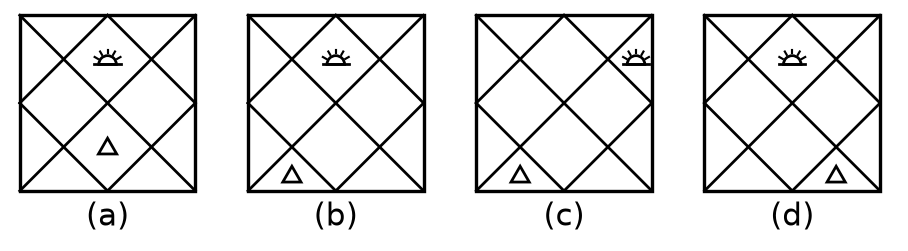
Consider the following figures 1, 2, 3 and 4:
In the figures from 1 to 4 above, two symbols are shown to change their position in a regular direction. Following the same sequence, which one of the following will appear at the fifth stage?
Answer (b) & explanation
Figure (b) is correct. Step 1: follow the sun. It moves round the four middle boxes anticlockwise: top, left, bottom, right. Next it returns to the top box. Step 2: follow the triangle. It moves down the left side one space at a time: top-left corner (upper half), top-left corner (side half), left middle box, bottom-left corner (side half). Next is the lower half of the bottom-left corner. Step 3: the figure with the sun at the top and the triangle in the lower half of the bottom-left corner is (b). So (a), (c) and (d) fail.
Tip: track each moving symbol separately. Write its path in words, find the next step, then pick the answer figure that matches both.
(d) has the sun right but puts the triangle in the wrong (bottom-right) corner.
Answer as per the official UPSC answer key.
While travelling in a Delhi-registered commercial taxi from Delhi to an adjacent city (another State), your taxi driver informs you that as he has no permit for running the taxi in that city, he will stop at its Transport Office and pay the prescribed fee of ₹ forty for a day. While paying the fee at the counter you find that the transport clerk is taking an extra fifty rupees for which no receipt is being given. You are in a hurry for your meeting. In such circumstances, what would you do ?
Answer (a) & explanation
(a) and (c) are both correct (UPSC accepted both; no negative marking). Step 1: the clerk is taking an extra Rs. 50 with no receipt, which is plain corruption. Step 2: (a) asking him on the spot to return the money, or (c) noting the details and reporting it later when you have time, both act against it. Step 3: (b) saying it is only the driver's business, and (d) treating it as normal, both let corruption continue. A good citizen does not ignore it because he is in a hurry.
Tip: for these interpersonal items, pick the response that is lawful, honest and fixes the real problem through proper channels. Avoid options that give in to pressure, show favouritism or dodge a decision.
Answer as per the official UPSC answer key.
Acid rain is caused by the pollution of environment by
Answer (d) & explanation
Nitrous oxide and sulphur dioxide is correct (d), read as nitrogen oxides and sulphur dioxide. Sulphur dioxide, mainly from burning coal, and nitrogen oxides, from vehicles and power plants, react with water vapour and oxygen to form sulphuric and nitric acids, which fall as acid rain with pH below 5.6. (a) is wrong: nitrogen gas is inert, and CO₂ forms only weak carbonic acid. (b) is wrong: carbon monoxide does not cause acid rain. (c) is wrong: ozone is not an acid former.
Notice the effects: acid rain damages forests, acidifies lakes and erodes marble, as feared for the Taj Mahal from the Mathura refinery; the Taj Trapezium Zone was created to protect it. Flue gas desulphurisation cuts SO₂. Trap: the option's 'nitrous oxide' is loose wording for NOx.
Answer as per the official UPSC answer key.
Consider the following crops :
- 1. Cotton
- 2. Groundnut
- 3. Rice
- 4. Wheat
Which of these are Kharif crops?
Answer (c) & explanation
Cotton, groundnut and rice are correct (c). Kharif crops are sown with the south-west monsoon (June–July) and harvested in autumn (September–October). They include rice, cotton, groundnut, maize, jowar, bajra, soybean, tur and jute (1, 2, 3). Item 4 is wrong: wheat is a rabi crop, sown in winter (October–December) and harvested in spring. So (a), (b) and (d) fail.
Notice the related seasons: rabi crops include wheat, barley, mustard and gram; zaid crops such as watermelon, cucumber and moong grow in the short summer between rabi and kharif. Groundnut is also grown in rabi in the south, but it is mainly a kharif crop. The government announces MSPs for kharif crops in June. Trap: wheat is the classic rabi crop.
Answer as per the official UPSC answer key.
Mycorrhizal biotechnology has been used in rehabilitating degraded sites because mycorrhiza enables the plants to
- 1. resist drought and increase absorptive area
- 2. tolerate extremes of pH
- 3. resist disease infestation
Select the correct answer using the codes given below.
Answer (d) & explanation
All three are correct (d). Mycorrhiza is a partnership between a fungus and plant roots. The fungal threads extend the absorbing area of roots far into the soil, helping the plant take up water and resist drought (1). They help plants tolerate extremes of pH, salinity and heavy metals in poor soils (2). They also protect roots against soil pathogens by forming a barrier and competing with them (3). This is why mycorrhizal inoculants are used to rehabilitate degraded sites such as mine spoils. So (a), (b) and (c) leave out real benefits.
Notice the main benefit: mycorrhiza greatly improves phosphorus uptake. About 80% of land plants form such partnerships. TERI in India developed mycorrhizal biofertilisers for wasteland reclamation. Trap: all three effects are documented.
Answer as per the official UPSC answer key.
Geeta is older than her cousin Meena. Meena's brother Bipin is older than Geeta. When Meena and Bipin visit Geeta, they like to play chess. Meena wins the game more often than Geeta. Based on the above information, four conclusions, as given below, have been made. Which one of these logically follows from the information given above?
Answer (d) & explanation
'Meena is the youngest' is correct (d). Step 1: Geeta is older than Meena: Geeta > Meena. Bipin is older than Geeta: Bipin > Geeta. So the order is Bipin > Geeta > Meena, and Meena is youngest. Step 2: (b) is wrong: Bipin, not Geeta, is the oldest. Step 3: (a) is wrong: we only know Meena wins more than Geeta; nothing is said about Bipin's results. (c) is wrong: Geeta's feelings about losing are never mentioned. So (a), (b) and (c) fail.
Tip: separate facts (ages) from extra details (chess). Conclusions about feelings or unstated results are guesses, not logical conclusions.
Answer as per the official UPSC answer key.
(Same figures as the question above.)
If the number of female Physics professors in the age group 25 – 34 equals 25% of all the Physics professors in that age group, then what is the number of male Physics professors in the age group 25 – 34?
Answer (a) & explanation
9 is correct (a). Step 1: Physics has 40 professors in all, and Figure 2 shows 30% of them are aged 25–34. So 30% of 40 = 12 professors in that age group. Step 2: women are 25% (one quarter) of these 12, so women = 3. Step 3: men = 12 − 3 = 9. (c) 3 is the number of women, a common trap. So (b), (c) and (d) fail.
Tip: in multi-step percentage questions, find the size of the sub-group first, then apply the second percentage to that sub-group, not to the whole. Read the last line of the question again to check whether it asks for men or women.
Answer as per the official UPSC answer key.
Which of the following can be found as pollutants in the drinking water in some parts of India?
- 1. Arsenic
- 2. Sorbitol
- 3. Fluoride
- 4. Formaldehyde
- 5. Uranium
Select the correct answer using the codes given below.
Answer (c) & explanation
Arsenic, fluoride and uranium are correct (c). Indian groundwater is contaminated with arsenic in the Ganga–Brahmaputra plains of West Bengal, Bihar, UP and Assam (1), fluoride in Rajasthan, Andhra Pradesh, Telangana and other states (3), and uranium in Punjab, Rajasthan and elsewhere (5). Item 2 is wrong: sorbitol is a sugar substitute. Item 4 is wrong: formaldehyde is an industrial chemical and preservative, not a known drinking-water contaminant here. So (a), (b) and (d) fail.
Notice the data: the CGWB's 2024 report found uranium above safe limits in parts of Punjab and nitrate in many districts. The Jal Jeevan Mission treats such water through community plants. Fluoride causes fluorosis, arsenic causes skin lesions and cancer. Trap: lab-sounding names are not always pollutants.
Answer as per the official UPSC answer key.
An increase in the Bank Rate generally indicates that the
Answer (d) & explanation
A tight money policy is correct (d). Raising the Bank Rate makes central-bank credit costlier, so banks raise their own lending rates and credit shrinks. This is a tight or dear money policy, used to fight inflation. (a) is wrong: market interest rates tend to rise, not fall. (b) is wrong: the central bank still lends, only at a higher rate. (c) is wrong: an easy money policy would cut rates.
Notice the present tools: the repo rate is now the main signal, with the Bank Rate aligned to the Marginal Standing Facility rate. The RBI raised the repo rate by 250 basis points in 2022–23 to fight inflation, then cut it through 2025. The Monetary Policy Committee has six members. Trap: higher rates mean tighter, not easier, money.
Answer as per the official UPSC answer key.
Priority Sector Lending by banks in India constitutes the lending to
Answer (d) & explanation
All of the above is correct (d). Banks must lend a set share of their credit to priority sectors, which include agriculture (a), micro and small enterprises (b) and weaker sections (c), along with education, housing, export credit, social infrastructure and renewable energy. So each single option is only part of the answer.
Notice the targets: domestic scheduled commercial banks must give 40% of adjusted net bank credit to priority sectors, including 18% to agriculture (10% to small and marginal farmers), 7.5% to micro enterprises and 12% to weaker sections. Small finance banks have a 60% target, raised for some. Shortfalls go to the RIDF with NABARD, and Priority Sector Lending Certificates can be traded. The RBI revised the framework in 2025. Trap: picking one familiar sector misses the 'all' option.
Answer as per the official UPSC answer key.
Read the passage
The subject of democracy has become severely muddled because of the way the rhetoric surrounding it has been used in recent years. There is, increasingly, an oddly confused dichotomy between those who want to ‘impose’ democracy on countries in the non-Western world (in these countries’ ‘own interest’, of course) and those who are opposed to such ‘imposition’ (because of the respect for the countries’ ‘own ways’). But the entire language of ‘imposition’, used by both sides, is extraordinarily inappropriate since it makes the implicit assumption that democracy belongs exclusively to the West, taking it to be a quintessentially ‘Western’ idea which has originated and flourished only in the West.
But the thesis and the pessimism it generates about the possibility of democratic practice in the world would be extremely hard to justify. There were several experiments in local democracy in ancient India. Indeed, in understanding the roots of democracy in the world, we have to take an interest in the history of people participation and public reasoning in different parts of the world. We have to look beyond thinking of democracy only in terms of European and American evolution. We would fail to understand the pervasive demands for participatory living, on which Aristotle spoke with far-reaching insight, if we take democracy to be a kind of a specialized cultural product of the West.
It cannot, of course, be doubted that the institutional structure of the contemporary practice of democracy is largely the product of European and American experience over the last few centuries. This is extremely important to recognize since these developments in institutional formats were immensely innovative and ultimately effective. There can be little doubt that there is a major ‘Western’ achievement here.
With reference to the passage, the following assumptions have been made :
- 1. Many of the non-Western countries are unable to have democracy because they take democracy to be a specialized cultural product of the West.
- 2. Western countries are always trying to impose democracy on non-Western countries.
Which of the above is/are valid assumption/assumptions ?
Answer (d) & explanation
Neither assumption is valid (d). Step 1: assumption 1 says non-Western countries are unable to have democracy because they see it as a Western product. The passage says the 'Western idea' thesis is held by those debating imposition, and it calls the resulting pessimism 'hard to justify'. It never says these countries cannot have democracy. Step 2: assumption 2 says Western countries always try to impose democracy. The passage speaks only of 'those who want to impose' it, without naming the West as a whole or saying 'always'. Step 3: so (a), (b) and (c) fail.
Tip: an assumption must be something the author takes for granted. Strong words like 'unable' and 'always' rarely pass that test.
Answer as per the official UPSC answer key.
In a class of 45 students, a boy is ranked 20th. When two boys joined, his rank was dropped by one. What is his new rank from the end?
Answer (c) & explanation
27th is correct (c). Step 1: two boys joined, so the class now has 45 + 2 = 47 students. His rank dropped by one, so he is now 21st from the top. Step 2: rank from the end = total − rank from top + 1 = 47 − 21 + 1 = 27. Step 3: check: 20 students above him plus himself is 21, and 26 students are below him, so he is 27th from the bottom. So (a), (b) and (d) fail.
Tip: remember the rule: rank from top + rank from bottom = total + 1. Always update both the total and the rank when people join or leave before using it.
Answer as per the official UPSC answer key.