
UPSC Prelims PYQs with explanations
Real questions from official papers, mapped to syllabus topics. Attempt each one; the answer and the reason appear instantly.
A person can walk a certain distance and drive back in six hours. He can also walk both ways in 10 hours. How much time will he take to drive both ways?
Answer (a) & explanation
2 hours is correct (a). Step 1: walking both ways takes 10 hours, so one walk takes 5 hours. Step 2: walking one way and driving back takes 6 hours, so one drive takes 6 − 5 = 1 hour. Step 3: driving both ways takes 1 + 1 = 2 hours. So (b), (c) and (d) fail.
Tip: break 'both ways' into one-way trips and use the information that has the same activity twice (walking both ways) to find one unit first. Then the mixed trip gives the other unit. A shortcut: drive both ways = 2 × (walk + drive) − (walk both ways) = 12 − 10 = 2 hours.
Answer as per the official UPSC answer key.
The demand for the Tebhaga Peasant Movement in Bengal was for
Answer (a) & explanation
Reducing the landlord's share from half to one-third is correct (a). In the Tebhaga movement (1946–47) in Bengal, led by the Bengal Provincial Kisan Sabha (linked to the Communist Party), sharecroppers (bargadars) demanded that the jotedar's share of the crop be cut from half to one-third; 'tebhaga' means 'three shares'. The movement drew on the Floud Commission's recommendation (1940). (b), (c) and (d) are wrong: ownership of land, abolition of zamindari and writing off debts were not the core demand.
Notice the legacy: the demand was partly met by the Bargadars Act (1950), and later by Operation Barga (1978) in West Bengal, which registered sharecroppers. Other peasant risings of the 1940s include Telangana (1946–51) and Warli (1945). Trap: tebhaga is about the share, not ownership.
Answer as per the official UPSC answer key.
The most important fishing grounds of the world are found in the regions where
Answer (c) & explanation
Where warm and cold ocean currents meet is correct (c). When warm and cold currents meet, the mixing brings up nutrients from deep water; plankton thrives in the sunlit surface and feeds huge fish stocks. Examples are the Grand Banks off Newfoundland (Gulf Stream and Labrador current) and the waters off Japan (Kuroshio and Oyashio). (a) is wrong: atmospheric currents are winds, not the cause. (b) is wrong: river mouths can be rich, but they are not the main world fishing grounds. (d) is wrong: a shallow, broad continental shelf helps, but 'undulating' is not the key.
Notice the other cause: cold upwelling off Peru (Humboldt current) gives the anchovy fishery, which collapses in El Niño years. The North Sea's Dogger Bank is another rich ground. Trap: wind and water currents are confused.
Answer as per the official UPSC answer key.
Consider the following fauna of India :
- 1. Gharial
- 2. Leatherback turtle
- 3. Swamp deer
Which of the above is/are endangered?
Answer (c) & explanation
All three are correct per UPSC's key (c). The gharial, the leatherback turtle and the swamp deer (barasingha) are all threatened species protected under Schedule I of the Wildlife (Protection) Act, and UPSC treats all as endangered. In the current IUCN categories, the gharial is Critically Endangered, while the leatherback and swamp deer are Vulnerable, so 'endangered' is used loosely here. So (a), (b) and (d) fail on the key.
Notice the habitats: gharials survive mainly in the Chambal sanctuary; leatherbacks, the largest turtles, nest in the Andaman and Nicobar Islands (Galathea Bay, near the Great Nicobar project); the hard-ground barasingha lives in Kanha, Madhya Pradesh's state animal. Trap: legal 'endangered' and IUCN 'Endangered' are not the same.
Answer as per the official UPSC answer key.
(Same information as the question above.)
Which one of the following pairs of cities is connected by any of the routes directly without going to any other city?
Answer (d) & explanation
None of these is correct (d). Step 1: the direct links given are P–Q, S–R, Q–T, P–R and T–R. No other pairs are joined directly. Step 2: (a) P and T: no direct link (you must go through Q or R). (b) T and S: no direct link (you must go through R). Step 3: (c) Q and R: no direct link (you must go through P or T). Since none of the three pairs is directly connected, (a), (b) and (c) fail and the answer is 'none of these'.
Tip: copy the list of direct links before answering. Then check each pair against it; anything not in the list needs a stop in another city, which the question rules out.
Answer as per the official UPSC answer key.
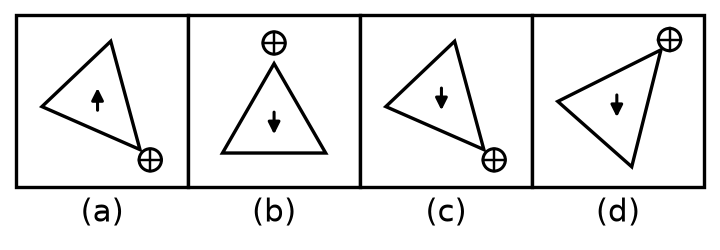
Directions for the following 2 (two) items: In each item, there are two sets of figures; first four figures named Problem figures and next four figures named Answer figures indicated as (a), (b), (c) and (d). The problem figures follow a particular sequence. In accordance with the same, which one of the four answer figures should appear as the fifth figure?
Problem figures:
Answer figures:
Answer (c) & explanation
Figure (c) is correct. Step 1: watch the arrow inside. It flips each time: down, up, down, up. So in the fifth figure it points down. Step 2: watch the triangle's position. It goes 1, 2, 3, then back to 1 in figure 4. So figure 5 repeats figure 2's position (circle at the bottom-right). Step 3: figure 2's position with a downward arrow is (c). So (a), (b) and (d) fail.
Tip: when a pattern returns to its start, it is cycling. Find the cycle length (here 3 positions) and count forward. Combine that with the simpler flipping rule to fix the next figure.
(a) has the right position but the arrow points up.
Answer as per the official UPSC answer key.
A person lives in a far off village which is almost two hours by bus. The villager’s neighbour is a very powerful landlord who is trying to occupy the poor villager’s land by force. You are the District Magistrate and busy in a meeting called by a local Minister. The villager has come all the way, by bus and on foot, to see you and give an application seeking protection from the powerful landlord. The villager keeps on waiting outside the meeting hall for an hour. You come out of the meeting and are rushing to another meeting. The villager follows you to submit his application. What would you do ?
Answer (c) & explanation
(c) and (d) are both correct (UPSC accepted both; no negative marking). Step 1: a poor villager has travelled far and waited an hour for protection from a powerful landlord. His complaint is urgent. Step 2: (d) quickly taking his application and asking key questions, or (c) handing it to a senior officer to resolve, both ensure action today. Step 3: (a) asking him to wait two more hours is unkind and delays protection. (b) sending him to a junior officer passes the buck and may leave him unheard.
Tip: for these interpersonal items, pick the response that is lawful, honest and fixes the real problem through proper channels. Avoid options that give in to pressure, show favouritism or dodge a decision.
Answer as per the official UPSC answer key.
With reference to food chains in ecosystems, consider the following statements :
- 1. A food chain illustrates the order in which a chain of organisms feed upon each other.
- 2. Food chains are found within the populations of a species.
- 3. A food chain illustrates the numbers of each organism which are eaten by others.
Which of the statements given above is/are correct?
Answer (a) & explanation
Statement 1 only is correct (a). A food chain shows the order in which organisms feed on each other, who eats whom, in sequence, such as grass → grasshopper → frog → snake → eagle (1). Statement 2 is wrong: a food chain links different species at different trophic levels, not members of one population. Statement 3 is wrong: a food chain shows no numbers; counts of organisms at each level are shown by ecological pyramids of number, biomass and energy. So (b), (c) and (d) fail.
Notice the related ideas: many interlinked chains form a food web. Only about 10% of energy passes to the next level (Lindeman's rule), so chains rarely exceed four or five links. Detritus food chains start from dead matter. Trap: chains show order, pyramids show quantity.
Answer as per the official UPSC answer key.
“Climate is extreme, rainfall is scanty and the people used to be nomadic herders.”
The above statement best describes which of the following regions?
Answer (b) & explanation
Central Asian Steppe is correct (b). The Central Asian steppes lie deep inside Eurasia, far from the sea, so they have an extreme continental climate with hot summers and bitter winters, and scanty rainfall. Peoples such as the Kazakhs, Kirghiz and Mongols lived as nomadic herders of horses, sheep and camels. (a) is wrong: the African savanna is hot all year with a wet season, and herders like the Maasai are semi-nomadic, but the climate is not 'extreme'. (c) is wrong: the North American prairies are now settled, mechanised grain farms. (d) is wrong: the tundra is cold, with reindeer herders, but rainfall and climate descriptions fit the steppe better.
Notice the history: steppe nomads, from the Scythians to Genghis Khan, shaped Eurasian history. Trap: 'used to be' signals traditional herding.
Answer as per the official UPSC answer key.
Who among the following constitute the National Development Council?
- 1. The Prime Minister
- 2. The Chairman, Finance Commission
- 3. Ministers of the Union Cabinet
- 4. Chief Ministers of the States
Select the correct answer using the codes given below.
Answer (b) & explanation
Items 1, 3 and 4 are correct (b). The National Development Council (1952) was chaired by the Prime Minister (1) and included all Union Cabinet ministers (3), the Chief Ministers of all States (4), administrators of Union Territories, and members of the Planning Commission. Item 2 is wrong: the Finance Commission chairman was not a member. So (a), (c) and (d) fail.
Notice its fate: the NDC approved the Five-Year Plans, but after NITI Aayog replaced the Planning Commission in 2015, it has not met; NITI's Governing Council, with the PM, all Chief Ministers and UT Lt Governors, now does a similar job. The last NDC meeting was in 2012, approving the 12th Plan. Trap: the Finance Commission is a constitutional body but was outside the NDC.
Answer as per the official UPSC answer key.
Read the passage
Financial markets in India have acquired greater depth and liquidity over the years. Steady reforms since 1991 have led to growing linkages and integration of the Indian economy and its financial system with the global economy. Weak global economic prospects and continuing uncertainties in the international financial markets therefore, have had their impact on the emerging market economies. Sovereign risk concerns, particularly in the Euro area, affected financial markets for the greater part of the year, with the contagion of Greece’s sovereign debt problem spreading to India and other economies by way of higher-than-normal levels of volatility.
The funding constraints in international financial markets could impact both the availability and cost of foreign funding for banks and corporates. Since the Indian financial system is bank dominated, banks’ ability to withstand stress is critical to overall financial stability. Indian banks, however, remain robust, notwithstanding a decline in capital to risk-weighted assets ratio and a rise in non-performing asset levels in the recent past. Capital adequacy levels remain above the regulatory requirements. The financial market infrastructure continues to function without any major disruption. With further globalization, consolidation, deregulation, and diversification of the financial system, the banking business may become more complex and riskier. Issues like risk and liquidity management and enhancing skill therefore assume greater significance.
According to the passage, the financial markets in the emerging market economies including India had the adverse impact in recent years due to
- 1. weak global economic prospects.
- 2. uncertainties in the international financial markets.
- 3. sovereign risk concerns in the Euro area.
- 4. bad monsoons and the resultant crop loss.
Select the correct answer using the code given below :
Answer (b) & explanation
1, 2 and 3 are correct (b). Step 1: the passage names 'weak global economic prospects' (1) and 'continuing uncertainties in the international financial markets' (2) as affecting emerging markets. Step 2: it adds that 'sovereign risk concerns, particularly in the Euro area' hit markets, with Greece's debt problem spreading to India (3). Step 3: point 4, bad monsoons and crop loss, is never mentioned. So (a), (c) and (d) fail; (a) and (c) leave out true points, and (d) includes 4.
Tip: in 'select the correct points' questions, tick each point only if you can find it in the passage. A point that sounds reasonable for India (monsoon) but is absent from the text is a trap.
Answer as per the official UPSC answer key.
(Same figures as the question above.)
If the Psychology professors in the University constitute 2% of all the professors in the University, then what is the number of professors in the University?
Answer (b) & explanation
500 is correct (b). Step 1: from Figure 1, Psychology has 4 men + 6 women = 10 professors. Step 2: these 10 are 2% of all professors. So 1% = 10 ÷ 2 = 5. Step 3: 100% = 5 × 100 = 500. Check: 2% of 500 = 10. So (a), (c) and (d) fail; for example, 2% of 400 is only 8, and 2% of 600 is 12.
Tip: when a part and its percentage are given, find 1% first and then multiply by 100. Or simply divide the part by the percentage as a decimal: 10 ÷ 0.02 = 500. Always check by working backwards from your answer.
Answer as per the official UPSC answer key.
With reference to Indian History, the Members of the Constituent Assembly from the Provinces were
Answer (c) & explanation
Elected by the Provincial Legislative Assemblies is correct (c). Under the Cabinet Mission Plan (1946), the provincial members of the Constituent Assembly were indirectly elected by the members of the Provincial Legislative Assemblies through proportional representation by single transferable vote. Seats were roughly one per million population, divided among Muslims, Sikhs and General. (a) is wrong: there was no direct election. (b) is wrong: parties did not nominate members. (d) is wrong: the government did not select experts. Members from the princely states were nominated by the rulers.
Notice the numbers: the Assembly had 389 members (292 provinces, 93 princely states, 4 chief commissioners' provinces), reduced to 299 after Partition. It first met on 9 December 1946. Trap: 'directly elected' sounds democratic but was not the method.
Answer as per the official UPSC answer key.
In India, deficit financing is used for raising resources for
Answer (a) & explanation
Economic development is correct (a). Deficit financing means the government spends more than it earns and fills the gap by borrowing or, in the old sense, by printing money through the central bank. In planned India, it was used to fund development spending under the Five-Year Plans, such as dams, steel plants and infrastructure, when tax revenue was not enough. (b) is wrong: deficit financing adds to debt rather than redeeming it. (c) is wrong: balance-of-payments gaps are met through reserves or IMF help. (d) is wrong: it does not reduce foreign debt.
Notice the risk: excessive deficit financing fuels inflation. The FRBM Act, 2003 set limits, and the Centre's fiscal deficit target is 4.4% of GDP for 2025–26, with a shift to a debt-to-GDP anchor from 2026–27. Trap: deficit financing is a means, not a debt-reduction tool.
Answer as per the official UPSC answer key.
Which one among the following industries is the maximum consumer of water in India?
Answer (d) & explanation
Thermal power is correct (d). Thermal power plants use huge volumes of water for cooling condensers and making steam, and account for the largest share, close to 90%, of industrial water withdrawal in India. (a) is wrong: engineering industries use far less. (b) is wrong: paper and pulp is water-intensive per tonne, but its total use is much smaller. (c) is wrong: textiles, especially dyeing, use a lot of water, but still far less than power.
Notice the rules: since 2015 the environment ministry has capped water use at 3.5 m³ per MWh for new plants, and plants within 50 km of sewage plants must use treated sewage water. Water shortages have shut plants in drought years, as in Maharashtra. Dry cooling and air-cooled condensers cut use. Trap: per-tonne intensity differs from total consumption.
Answer as per the official UPSC answer key.
Read the passage
Corporate governance is based on principles such as conducting the business with all integrity and fairness, being transparent with regard to all transactions, making all the necessary disclosures and decisions, complying with all the laws of the land, accountability and responsibility towards the stakeholders and commitment to conducting business in an ethical manner. Another point which is highlighted on corporate governance is the need for those in control to be able to distinguish between what are personal and corporate funds while managing a company.
Fundamentally, there is a level of confidence that is associated with a company that is known to have good corporate governance. The presence of an active group of independent directors on the board contributes a great deal towards ensuring confidence in the market. Corporate governance is known to be one of the criteria that foreign institutional investors are increasingly depending on when deciding on which companies to invest in. It is also known to have a positive influence on the share price of the company. Having a clean image on the corporate governance front could also make it easier for companies to source capital at more reasonable costs. Unfortunately, corporate governance often becomes the centre of discussion only after the exposure of a large scam.
According to the passage, which of the following should be the practice/practices in good corporate governance ?
- 1. Companies should always comply with labour and tax laws of the land.
- 2. Every company in the country should have a government representative as one of the independent directors on the board to ensure transparency.
- 3. The manager of a company should never invest his personal funds in the company.
Select the correct answer using the codes given below :
Answer (a) & explanation
Only practice 1 is correct (a). Step 1: the passage lists 'complying with all the laws of the land' as a principle of corporate governance. Labour and tax laws are laws of the land, so 1 fits. Step 2: practice 2 is wrong: the passage praises an active group of independent directors, but never says one must be a government representative. Step 3: practice 3 is wrong: the passage only asks those in control to distinguish between personal and corporate funds. It does not ban managers from investing their own money. So (b), (c) and (d) fail.
Tip: 'keep separate' is not 'never mix at all'. Watch for options that turn a mild rule into a strict ban.
Answer as per the official UPSC answer key.
A thief running at 8 km/hr is chased by a policeman whose speed is 10 km/hr. If the thief is 100 m ahead of the policeman, then the time required for the policeman to catch the thief will be
Answer (b) & explanation
3 minutes is correct (b). Step 1: both are running the same way, so the policeman gains on the thief at the relative speed: 10 − 8 = 2 km/hr. Step 2: the gap is 100 m = 0.1 km. Step 3: time = 0.1 ÷ 2 = 1/20 hour = 60/20 = 3 minutes. So (a), (c) and (d) fail.
Tip: when two things move in the same direction, subtract their speeds; when they move towards each other, add them. Then convert units carefully: metres to km and hours to minutes. A quick check: at 2 km/hr, the policeman gains about 33 m per minute, so 100 m takes 3 minutes.
Answer as per the official UPSC answer key.
Read the passage
Seven-year-old Jim came home from the park without his new bicycle. “An old man and a little boy borrowed it,” he explained. “They are going to bring it back at four o’clock.” His parents were upset that he had given his expensive new bicycle, but were secretly proud of his kindness and faith. Came four o’clock, no bicycle. The parents were anxious. But at 4:30, the door bell rang, and there stood a happy man and a boy, with the bicycle and a box of chocolates. Jim suddenly disappeared into his bedroom, and then came running out. “All right,” he said, after examining the bicycle. “You can have your watch back !”
When Jim came home without his bicycle, his parents
Answer (b) & explanation
'Were worried' is correct (b). Step 1: the passage says his parents 'were upset that he had given his expensive new bicycle', and at four o'clock with no bicycle 'the parents were anxious'. Being upset and anxious means worried. Step 2: (a) is wrong: they were 'secretly proud of his kindness and faith', so not angry with him. Step 3: (c) is wrong: they clearly were concerned. (d) is wrong: nothing says they were eager to meet the man and the boy. So (a), (c) and (d) fail.
Tip: collect all the emotion words in the passage (upset, proud, anxious). The answer should fit them together; 'angry' clashes with 'proud'.
Answer as per the official UPSC answer key.
The Parliament can make any law for whole or any part of India for implementing international treaties
Answer (d) & explanation
Without the consent of any State is correct (d). Article 253 lets Parliament make any law for the whole or any part of India to implement treaties, agreements or conventions, or decisions of international conferences, even on State List subjects, and without the consent of any State. (a), (b) and (c) are wrong because no State consent is needed.
Notice the examples: the Environment (Protection) Act, 1986 and the Air Act, 1981 implemented the 1972 Stockholm conference decisions; the Biological Diversity Act, 2002 implemented the CBD. The Ninth Schedule and Article 246 work alongside this. In Maganbhai Patel (1969), the Supreme Court held that ceding territory needs a constitutional amendment, not just Article 253. Trap: federal subjects seem to need State consent, but treaty law overrides that.
Answer as per the official UPSC answer key.
Which of the following is/are unique characteristic/characteristics of equatorial forests?
- 1. Presence of tall, closely set trees with crowns forming a continuous canopy
- 2. Coexistence of a large number of species
- 3. Presence of numerous varieties of epiphytes
Select the correct answer using the codes given below.
Answer (d) & explanation
All three are correct (d). Constant heat and heavy rain all year give equatorial rainforests tall, closely set trees whose crowns form a continuous canopy, with emergents rising above (1). They hold the highest species diversity of any land ecosystem, with many species living side by side (2). Many epiphytes, such as orchids, ferns and bromeliads, grow on tree branches to reach the light (3). So options (a), (b) and (c) leave out real features.
Notice the structure: layers of emergent, canopy, understorey and a dim forest floor; soils are surprisingly poor, as nutrients are locked in plants. The Amazon, Congo and South-East Asian forests are the main blocks; India's nearest equivalents are in the Western Ghats, the north-east and the Andaman Islands. Trap: 'unique' does not exclude any of the three.
Answer as per the official UPSC answer key.