
UPSC Prelims PYQs with explanations
Real questions from official papers, mapped to syllabus topics. Attempt each one; the answer and the reason appear instantly.
Ball bearings are used in bicycles, cars, etc., because
Answer (c) & explanation
The effective area of contact is reduced is correct (c). Ball bearings replace sliding with rolling. The balls touch the races only at tiny points, so the effective area of contact is reduced, and rolling friction is far less than sliding friction. Less friction means less heat, wear and energy loss. (a) and (b) are wrong: more contact area would increase friction. (d) fails because (c) is correct.
Notice the related ideas: lubricants such as oil and grease add a thin film to cut friction further, and roller bearings handle heavier loads. Friction is not always bad: tyres need grip, and treads increase it on roads. The invention of the wheel was the first use of rolling over sliding. Trap: 'actual' versus 'effective' area is the subtle distinction.
Answer as per the official UPSC answer key.
(Same information as the question above.)
Between which two cities among the pairs of cities given below are there maximum travel options available?
Answer (a) & explanation
1. Count the ways by multiplying the number of modes on each leg.
2. Q to S: Q → P (2 ways) → R (1) → S (2) = 4; Q → T (1) → R (2) → S (2) = 4. Total 8.
3. P to R: direct boat 1; P → Q → T → R = 2 × 1 × 2 = 4. Total 5.
4. P to T: P → Q → T = 2; P → R → T = 2. Total 4. Q to R: via P = 2, via T = 2. Total 4.
5. The most options are between Q and S.
Answer as per the official UPSC answer key.
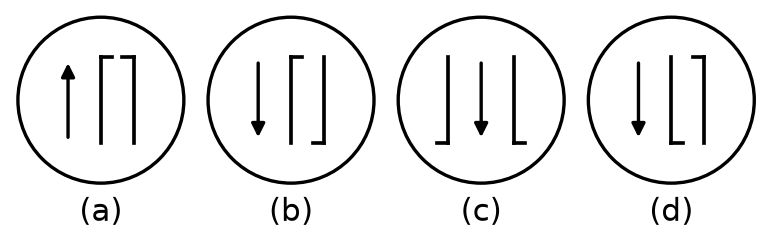
(Same directions as the question above.)
Problem figures:
Answer figures:
Answer (b) & explanation
1. Read the elements as one long chain: hook-left foot, up-arrow, right foot, hook-left top, down-arrow, hook-right top, …
2. Each figure shows three elements in a row, and the next figure slides one step along the chain (the left one drops off, a new one joins on the right).
3. Figure 4 ends with down-arrow and right-top hook. So figure 5 starts with these two, and the chain then restarts with the first element (the left-foot piece).
4. Down-arrow, right-top hook, left-foot piece: (b).
Answer as per the official UPSC answer key.
There is a shortage of sugar in your District where you are the District Magistrate. The Government has ordered that only a maximum amount of 30 kg sugar is to be released for wedding celebrations. A son of your close friend is getting married and your friend requests you to release at least 50 kg sugar for his son’s wedding. He expresses annoyance when you tell him about the Government’s restrictions on this matter. He feels that since you are the District Magistrate you can release any amount. You do not want to spoil your friendship with him. In such circumstances, how would you deal with the situation ?
Answer (b) & explanation
(b) and (c) are both correct (UPSC accepted both; no negative marking). Step 1: there is a sugar shortage and a government limit of 30 kg per wedding. Your friend wants 50 kg. Step 2: (b) refusing and strictly following the rule, and (c) showing him the government order and persuading him to accept 30 kg, both obey the rule; (c) also tries to save the friendship. Step 3: (a) releasing extra sugar misuses your office. (d) sending him to another authority dodges your own responsibility.
Tip: for these interpersonal items, pick the response that is lawful, honest and fixes the real problem through proper channels. Avoid options that give in to pressure, show favouritism or dodge a decision.
Answer as per the official UPSC answer key.
Consider the following pairs :
| National Park | River flowing through the Park
| 1. Corbett National Park | Ganga
| 2. Kaziranga National Park | Manas
| 3. Silent Valley National Park | Kaveri
Which of the above pairs is/are correctly matched?
Answer (d) & explanation
None of the pairs is correct (d). Pair 1 is wrong: Corbett National Park, India's first (1936, as Hailey National Park), lies on the Ramganga, not the Ganga. Pair 2 is wrong: Kaziranga lies on the south bank of the Brahmaputra, with the Diphlu flowing through it; the Manas river flows through Manas National Park. Pair 3 is wrong: Silent Valley is drained by the Kunthipuzha, a tributary of the Bharathapuzha, not the Kaveri. So (a), (b) and (c) fail.
Notice the related facts: Kaziranga holds about two-thirds of the world's one-horned rhinos; Silent Valley was saved from a hydro project in the 1980s; Corbett was the first Project Tiger reserve in 1973. Trap: each park is paired with a famous but wrong river.
Manas is a river and a separate national park on the Bhutan border; it does not flow through Kaziranga.
Answer as per the official UPSC answer key.
Consider the following statements :
- 1. Inflation benefits the debtors.
- 2. Inflation benefits the bond-holders.
Which of the statements given above is/are correct?
Answer (a) & explanation
Statement 1 only is correct (a). Inflation lowers the real value of money. A debtor gains because he repays a fixed sum with money that buys less than when he borrowed (1). Statement 2 is wrong: a bond-holder loses, because the fixed interest and principal he receives buy less than before; inflation erodes the real return. So (b), (c) and (d) fail.
Notice the other winners and losers: fixed-income earners and pensioners lose, while businesses and borrowers, including governments with large debts, gain. That is why governments issue inflation-indexed bonds, such as India's Capital Indexed Bonds and the 2013 Inflation Indexed Bonds linked to WPI and CPI. Unexpected inflation moves wealth from lenders to borrowers. Trap: 'bond-holder' is a lender, not a borrower.
Answer as per the official UPSC answer key.
The national income of a country for a given period is equal to the
Answer (d) & explanation
Money value of final goods and services is correct per UPSC's key (d), though it is a simplified definition. National income is measured as the money value of all final goods and services produced in a year; counting only final goods avoids double counting of intermediate goods. Strictly, national income is Net National Product at factor cost, which also adds net factor income from abroad and subtracts depreciation, so (d) is the best of the options, not a perfect definition. (a) is partly right but vague. (b) is wrong: it leaves out government spending and net exports. (c) is wrong: personal income excludes retained profits and taxes.
Notice the update: India's GDP series is being moved to a 2022–23 base year. Trap: (b) misses two parts of C + I + G + (X − M).
Answer as per the official UPSC answer key.
Read the passage
Financial markets in India have acquired greater depth and liquidity over the years. Steady reforms since 1991 have led to growing linkages and integration of the Indian economy and its financial system with the global economy. Weak global economic prospects and continuing uncertainties in the international financial markets therefore, have had their impact on the emerging market economies. Sovereign risk concerns, particularly in the Euro area, affected financial markets for the greater part of the year, with the contagion of Greece’s sovereign debt problem spreading to India and other economies by way of higher-than-normal levels of volatility.
The funding constraints in international financial markets could impact both the availability and cost of foreign funding for banks and corporates. Since the Indian financial system is bank dominated, banks’ ability to withstand stress is critical to overall financial stability. Indian banks, however, remain robust, notwithstanding a decline in capital to risk-weighted assets ratio and a rise in non-performing asset levels in the recent past. Capital adequacy levels remain above the regulatory requirements. The financial market infrastructure continues to function without any major disruption. With further globalization, consolidation, deregulation, and diversification of the financial system, the banking business may become more complex and riskier. Issues like risk and liquidity management and enhancing skill therefore assume greater significance.
The Indian financial markets are affected by global changes mainly due to the
Answer (c) & explanation
(c) is correct. Step 1: the passage says reforms since 1991 'have led to growing linkages and integration' of India's economy with the global economy, and global troubles 'therefore' affected emerging markets. So integration is the main reason. Step 2: (a) remittances and (b) foreign exchange reserves are never mentioned. Step 3: (d) Greece's debt problem is one example of a shock that spread to India; it travelled through the linkages, so it is not the main reason. So (a), (b) and (d) fail.
Tip: distinguish the channel (the reason things spread) from a single event that used it. 'Mainly due to' asks for the general cause, not one instance.
Answer as per the official UPSC answer key.
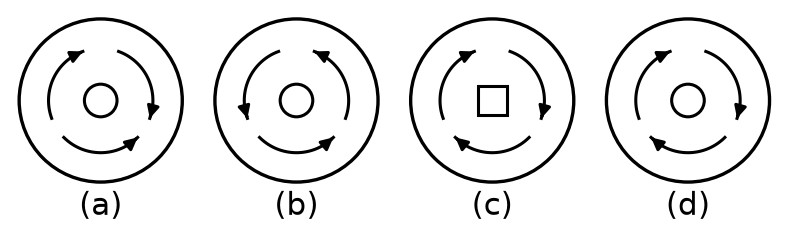
Consider the following figures:
Which one of the following figures would logically come in the 7th position indicated above by a question mark?
Answer (d) & explanation
Figure (d) is correct. Step 1: the centre shape alternates: circle, square, circle, square… Figure 7 is odd-numbered, so it has a circle. Step 2: the three arrows repeat every three figures: figure 4 matches figure 1, figure 5 matches figure 2, figure 6 matches figure 3. So figure 7 matches figure 1, with all three arrows going clockwise. Step 3: a circle with all three arrows clockwise is (d). So (a), (b) and (c) fail.
Tip: when a series has two or more changing parts, find the cycle of each separately (here 2 for the shape and 3 for the arrows). Then use the position number to find where each part is at the required step.
(a) has the circle but its bottom arrow points the other way.
Fell for this one? Most aspirants do. The PYQ Book puts every UPSC trap side by side, so the pattern finally clicks. Try the free sample
Answer as per the official UPSC answer key.
Consider the following animals :
- 1. Sea cow
- 2. Sea horse
- 3. Sea lion
Which of the above is/are mammal/mammals?
Answer (b) & explanation
Sea cow and sea lion are correct (b). The sea cow (dugong) and the sea lion are mammals: they breathe air with lungs, are warm-blooded and suckle their young (1, 3). The sea horse is a small fish, unusual because the male carries the eggs in a brood pouch (2). So (a), (c) and (d) fail.
Notice the Indian angle: the dugong lives in the Gulf of Mannar, Palk Bay and Andaman waters, and Tamil Nadu notified India's first Dugong Conservation Reserve in Palk Bay in 2022. It is the state animal of the Andaman and Nicobar Islands and is in Schedule I. Seahorses are threatened by the traditional medicine trade. Trap: 'sea' in the name says nothing about the class.
Answer as per the official UPSC answer key.
Which of the following characterizes/characterize the people of Indus Civilization?
- 1. They possessed great palaces and temples.
- 2. They worshipped both male and female deities.
- 3. They employed horse-drawn chariots in warfare.
Select the correct statement/statements using the codes given below.
Answer (b) & explanation
Statement 2 only is correct (b). Harappans worshipped both female and male deities: many terracotta Mother Goddess figurines and the 'Pashupati' or proto-Shiva seal showing a horned figure among animals (2). Statement 1 is wrong: no grand palaces or temples have been found; the Great Bath and granaries are the main public buildings. Statement 3 is wrong: horse-drawn chariots belong to the later Vedic Aryans; the horse is barely attested in Harappan sites, and the Sinauli chariots (UP) are later and not Harappan. So (a), (c) and (d) fail.
Notice the other features: fire altars at Kalibangan and Lothal, worship of trees (pipal) and animals (the bull, the unicorn). The Harappan script remains undeciphered. Trap: horses are a classic marker separating Harappan from Vedic culture.
Answer as per the official UPSC answer key.
To obtain full benefits of demographic dividend, what should India do?
Answer (a) & explanation
Promoting skill development is correct (a). A demographic dividend is the growth boost from a large working-age population. It pays off only if those people are employable and productive, so skill development, along with education and jobs, is the key step. (b) is wrong: social security helps welfare but does not unlock the dividend directly. (c) is wrong: lowering infant mortality matters for health, but it does not raise the productivity of today's workers. (d) is wrong: privatising higher education is not a necessary condition.
Notice India's case: about two-thirds of Indians are of working age, and the window lasts until about the 2040s. Programmes include Skill India Mission (2015), PMKVY, the PM Internship Scheme (2024) and NEP 2020's vocational focus. Only a small share of the workforce has formal skill training. Trap: health and welfare are worthy but not the core lever.
Answer as per the official UPSC answer key.
Read the passage
Corporate governance is based on principles such as conducting the business with all integrity and fairness, being transparent with regard to all transactions, making all the necessary disclosures and decisions, complying with all the laws of the land, accountability and responsibility towards the stakeholders and commitment to conducting business in an ethical manner. Another point which is highlighted on corporate governance is the need for those in control to be able to distinguish between what are personal and corporate funds while managing a company.
Fundamentally, there is a level of confidence that is associated with a company that is known to have good corporate governance. The presence of an active group of independent directors on the board contributes a great deal towards ensuring confidence in the market. Corporate governance is known to be one of the criteria that foreign institutional investors are increasingly depending on when deciding on which companies to invest in. It is also known to have a positive influence on the share price of the company. Having a clean image on the corporate governance front could also make it easier for companies to source capital at more reasonable costs. Unfortunately, corporate governance often becomes the centre of discussion only after the exposure of a large scam.
According to the passage, which of the following is/are the major benefit/benefits of good corporate governance ?
- 1. Good corporate governance leads to increase in share price of the company.
- 2. A company with good corporate governance always increases its business turnover rapidly.
- 3. Good corporate governance is the main criterion for foreign institutional investors when they decide to buy a company.
Select the correct answer using the codes given below :
Answer (a) & explanation
Only benefit 1 is correct (a). Step 1: the passage says good corporate governance has 'a positive influence on the share price'. So 1 is right. Step 2: benefit 2 is wrong: business turnover is never mentioned, and 'always increases rapidly' is far too strong. Step 3: benefit 3 is wrong: the passage calls governance 'one of the criteria' foreign investors use, not the main criterion. So (b), (c) and (d) fail.
Tip: compare small words: 'one of the' never equals 'the main'. Also note the other benefits named in the passage, such as market confidence and cheaper capital; UPSC often tests whether you notice which one the options actually match.
Answer as per the official UPSC answer key.
A train travels at a certain average speed for a distance of 63 km and then travels a distance of 72 km at an average speed of 6 km/hr more than its original speed. If it takes 3 hours to complete the total journey, what is the original speed of the train in km/hr?
Answer (c) & explanation
42 km/hr is correct (c). Step 1: let the speed be v. Time for 63 km = 63/v; time for 72 km = 72/(v + 6). Total = 3 hours. Step 2: solving the quadratic is slow, so test the options. v = 42: 63/42 = 1.5 hours and 72/48 = 1.5 hours. Total = 3 hours. It fits. Step 3: v = 24 gives 2.6 + 2.4 = 5 hours; v = 33 gives about 1.9 + 1.85 = 3.75 hours; v = 66 gives about 0.95 + 1 = 1.95 hours. So (a), (b) and (d) fail.
Tip: in CSAT, plugging options back in is often quicker than algebra. Start with a number that divides evenly (63 and 42 share 21).
Answer as per the official UPSC answer key.
Read the passage
Seven-year-old Jim came home from the park without his new bicycle. “An old man and a little boy borrowed it,” he explained. “They are going to bring it back at four o’clock.” His parents were upset that he had given his expensive new bicycle, but were secretly proud of his kindness and faith. Came four o’clock, no bicycle. The parents were anxious. But at 4:30, the door bell rang, and there stood a happy man and a boy, with the bicycle and a box of chocolates. Jim suddenly disappeared into his bedroom, and then came running out. “All right,” he said, after examining the bicycle. “You can have your watch back !”
Jim returned the watch to the old man and the little boy because
Answer (c) & explanation
(c) is correct. Step 1: Jim said 'All right… You can have your watch back!' only 'after examining the bicycle'. So the watch was security for the bicycle's safe return, and he gave it back once he was satisfied with the bicycle's condition. Step 2: (a) is wrong: the chocolates were a thank-you gift; Jim's reply depends on checking the bicycle. Step 3: (b) is wrong: his father's pride is not linked to the watch. (d) is wrong: being late by 30 minutes is not a reason to return the watch. So (a), (b) and (d) fail.
Tip: the twist at the end of such stories shows the real reason. Read the last lines carefully: here Jim was not just trusting; he was also careful.
Answer as per the official UPSC answer key.
In the grasslands, trees do not replace the grasses as a part of an ecological succession because of
Answer (c) & explanation
Water limits and fire is correct (c). Grasslands get too little rainfall to support a full forest, and frequent fires, together with grazing, kill tree seedlings, while grasses regrow from their underground roots. Succession therefore stops at the grassland stage, a fire- or drought-maintained climax. (a) is wrong: insects and fungi affect both trees and grasses but do not stop succession. (b) is wrong: grasslands get plenty of sunlight, and their soils are often rich, as in the prairies and steppes. (d) fails because (c) is correct.
Notice India's grasslands: the terai and Kaziranga floodplain grasslands, the shola grasslands of the Nilgiris and the Banni grasslands of Kutch. Many are wrongly classed as 'wastelands' and planted with trees. Trap: (b) misreads open, sunny grasslands.
Answer as per the official UPSC answer key.
Which of the following constitute Capital Account?
- 1. Foreign Loans
- 2. Foreign Direct Investment
- 3. Private Remittances
- 4. Portfolio Investment
Select the correct answer using the codes given below.
Answer (b) & explanation
Items 1, 2 and 4 are correct (b). The capital account (strictly the capital and financial account) records flows that create assets or liabilities: foreign loans such as external commercial borrowings and aid (1), foreign direct investment (2) and portfolio investment (4). Item 3 is wrong: private remittances are unilateral transfers, recorded in the current account under secondary income. So (a), (c) and (d) fail.
Notice India's case: remittances of about US$135 billion in 2024–25 make India the world's largest recipient and help finance the trade deficit. Capital account convertibility remains partial in India; the Tarapore Committees (1997, 2006) set out a roadmap. Trap: remittances are inflows of money, but they create no asset or liability.
Answer as per the official UPSC answer key.
Consider the following phenomena :
- 1. Size of the sun at dusk
- 2. Colour of the sun at dawn
- 3. Moon being visible at dawn
- 4. Twinkle of stars in the sky
- 5. Polestar being visible in the sky
Which of the above are optical illusions?
Answer (c) & explanation
Items 1, 2 and 4 are correct (c). The sun looks larger near the horizon at dusk, a perception effect called the moon illusion, which also applies to the sun (1). Its reddish colour at dawn comes from scattering of shorter blue wavelengths as light travels through more air (2). The twinkling of stars comes from refraction by moving layers of air of different density (4). Items 3 and 5 are wrong: the moon at dawn and the pole star are really there, so they are not illusions. So (a), (b) and (d) fail.
Notice the related effects: atmospheric refraction lets us see the sun about two minutes before it actually rises and after it sets. Planets do not twinkle much because they appear as discs, not points. Trap: 'colour' is a real scattering effect, but UPSC groups it with appearances.
Answer as per the official UPSC answer key.
Directions for the following 3 (three) items: Read the following passage and answer the three items that follow:
A tennis coach is trying to put together a team of four players for the forthcoming tournament. For this 7 players are available: males A, B and C; and females W, X, Y and Z. All players have equal capability and at least 2 males will be there in the team. For a team of four, all players must be able to play with each other. But, B cannot play with W, C cannot play with Z and W cannot play with Y.
If Y is selected and B is rejected, the team will consist of which one of the following groups?
Answer (b) & explanation
A, C, X and Y is correct (b). Step 1: B is rejected, and the team needs at least 2 males, so both A and C must play. Y is selected, so the team so far is A, C, Y. One more woman is needed. Step 2: W cannot play with Y, so W is out. Z cannot play with C, so Z is out. Only X is left. Step 3: the team is A, C, X and Y. (a) puts W with Y, (c) puts Z with C, and (d) has only one male and puts W with Y. So (a), (c) and (d) fail.
Tip: first fix the people forced in or out, then use each 'cannot play with' rule to remove candidates one by one.
Answer as per the official UPSC answer key.
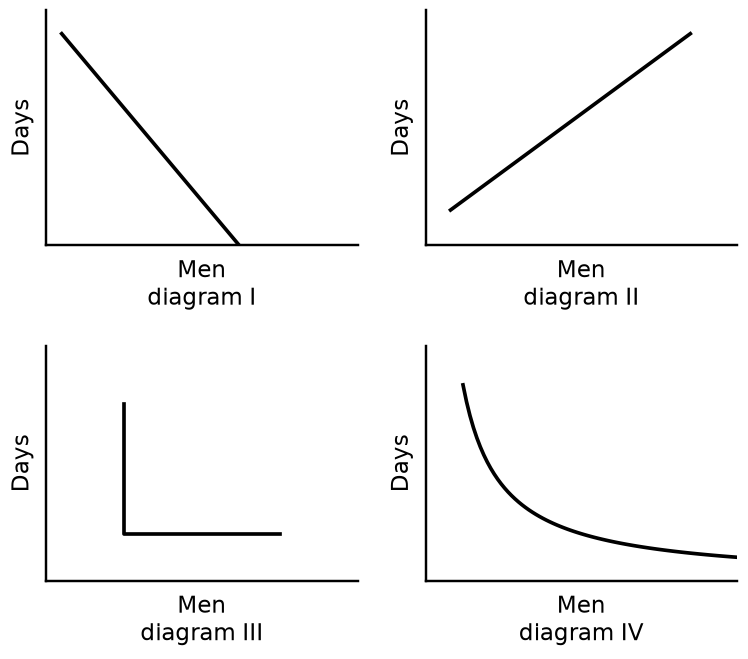
Consider the following diagrams:
x men, working at constant speed, do a certain job in y days. Which one of these diagrams shows the relation between x and y?
Answer (d) & explanation
Diagram IV is correct (d). Step 1: the job is fixed, so men × days = constant. More men finish the job in fewer days: double the men, half the days. This is inverse proportion. Step 2: on a graph, inverse proportion is a smooth curve that falls steeply at first and then more slowly, but never reaches zero. Step 3: diagram I hits zero days, which is impossible. Diagram II rises, which is the wrong direction. Diagram III has a sharp corner, which does not fit a steady rule. Diagram IV shows the smooth falling curve. So (a), (b) and (c) fail.
Tip: xy = constant always gives a smooth curve (a hyperbola) that approaches but never touches the axes.
Answer as per the official UPSC answer key.