
UPSC Prelims PYQs with explanations
Real questions from official papers, mapped to syllabus topics. Attempt each one; the answer and the reason appear instantly.
If the interest rate is decreased in an economy, it will
Answer (c) & explanation
A lower interest rate makes borrowing cheaper, so firms invest more in plant and machinery (c). Option (a) is wrong because cheaper credit usually raises, not lowers, consumption on homes, cars and consumer goods. Option (d) is wrong because saving earns less and becomes less attractive, so savings tend to fall. Any rise in tax collection (b) would be indirect and uncertain, not a direct effect.
This is why the RBI's Monetary Policy Committee cuts the repo rate to support growth and raises it to fight inflation. Notice how one policy rate ripples through loans, deposits, investment and prices.
Answer as per the official UPSC answer key.
In the context of food and nutritional security of India, enhancing the 'Seed Replacement Rates' of various crops helps in achieving the food production targets of the future. But what is/are the constraint/constraints in its wider/greater implementation?
- 1. There is no National Seeds Policy in place.
- 2. There is no participation of private sector seed companies in the supply of quality seeds of vegetables and planting materials of horticultural crops.
- 3. There is a demand-supply gap regarding quality seeds in case of low value and high volume crops.
Select the correct answer using the code given below.
Answer (b) & explanation
The seed replacement rate is the share of area sown with fresh certified seed instead of farm-saved seed. Statement 1 is wrong because India has had a National Seeds Policy since 2002. Statement 2 is wrong because private firms dominate vegetable and horticulture seed. The real gap lies in low-value, high-volume crops such as wheat, paddy and pulses, where private firms see little profit (3 correct). So the answer is (b).
Public bodies like the National Seeds Corporation and State seed corporations fill this gap. Notice how better seed is the cheapest input for higher yields.
Answer as per the official UPSC answer key.
Six books are labelled A, B, C, D, E and F and are placed side by side. Books B, C, E and F have green covers while others have yellow covers. Books A, B and D are new while the rest are old volumes. Books A, B and C are law reports while the rest are medical extracts. Which two books are old medical extracts and have green covers ?
Answer (b) & explanation
E and F are old, medical and green (b). Step 1: make three lists. Green covers: B, C, E, F. Old books (not new): C, E, F. Medical extracts (not law reports): D, E, F. Step 2: find the books in all three lists. C is green and old but a law report. D is medical but yellow and new. Only E and F are in all three. Options (a), (c) and (d) include B or C, which are law reports.
Tip: when items have several features, write one short list per feature and look for the common members. This avoids mixing up "the rest" in each clue.
Answer as per the official UPSC answer key.
Read the passage
Many nations now place their faith in capitalism and governments choose it as the strategy to create wealth for their people. The spectacular economic growth seen in Brazil, China and India after the liberalisation of their economies is proof of its enormous potential and success. However, the global banking crisis and the economic recession have left many bewildered. The debates tend to focus on free market operations and forces, their efficiency and their ability for self correction. Issues of justice, integrity and honesty are rarely elaborated to highlight the failure of the global banking system. The apologists of the system continue to justify the success of capitalism and argue that the recent crisis was a blip. Their arguments betray an ideological bias with the assumptions that an unregulated market is fair and competent, and that the exercise of private greed will be in the larger public interest.
Few recognize the bidirectional relationship between capitalism and greed; that each reinforces the other. Surely, a more honest conceptualisation of the conflicts of interest among the rich and powerful players who have benefited from the system, their biases and ideology is needed; the focus on the wealth creation should also highlight the resultant gross inequity.
With reference to “ideological bias”, the passage implies that
Answer (c) & explanation
The bias assumes the free market is fair and competent (c). Step 1: find the phrase. The apologists' arguments "betray an ideological bias with the assumptions that an unregulated market is fair and competent". Option (c) repeats this. Step 2: test the others. Options (a) and (b) are wrong: each keeps only one of the two qualities. Option (d) is wrong: "neither fair nor biased" is not what the passage says at all.
Tip: when a question quotes a phrase in inverted commas, like "ideological bias", go straight to that phrase in the passage. The answer is usually in the same sentence. Look for options that keep all the parts, here both "fair" and "competent".
Answer as per the official UPSC answer key.
With reference to Bombay Natural History Society (BNHS), consider the following statements :
- 1. It is an autonomous organization under the Ministry of Environment and Forests.
- 2. It strives to conserve nature through action-based research, education and public awareness.
- 3. It organizes and conducts nature trails and camps for the general public.
Which of the statements given above is/are correct?
Answer (c) & explanation
The BNHS (founded in 1883 in Mumbai) is a non-government society, not an autonomous body under the environment ministry, so statement 1 is wrong. It does action-based research, education and public awareness (2 correct), and it runs nature trails and camps for the public (3 correct).
Its best-known figure is Salim Ali, the "Birdman of India", and it is BirdLife International's partner in India. BNHS research has shaped work on vultures, bustards and Important Bird Areas. Notice how UPSC often tests whether an organisation is governmental or not: a quick check that removes many wrong options.
Getting government grants does not make the BNHS a government body.
Answer as per the official UPSC answer key.
With reference to two non-conventional energy sources called ‘coalbed methane’ and ‘shale gas’, consider the following statements :
- 1. Coalbed methane is the pure methane gas extracted from coal seams, while shale gas is a mixture of propane and butane only that can be extracted from fine-grained sedimentary rocks.
- 2. In India, abundant coalbed methane sources exist, but so far no shale gas sources have been found.
Which of the statements given above is/are correct?
Answer (d) & explanation
Neither statement is correct (d). Statement 1 is wrong because shale gas is mostly methane, like other natural gas, not just propane and butane; and coalbed methane is mainly methane but not pure. Statement 2 is wrong because India has identified shale basins, including Cambay, Krishna–Godavari, Cauvery and Damodar, and ONGC drilled its first shale well in 2013.
Shale gas is extracted by hydraulic fracturing, which needs huge volumes of water. That has limited its spread in water-stressed India. Notice how the next question on guar gum connects to this same fracking process.
Answer as per the official UPSC answer key.
Consider the following techniques/phenomena :
- 1. Budding and grafting in fruit plants
- 2. Cytoplasmic male sterility
- 3. Gene silencing
Which of the above is/are used to create transgenic crops?
Answer (b) & explanation
Transgenic crops carry genes from another species. Cytoplasmic male sterility systems, such as GM mustard's barnase–barstar system, and gene silencing through RNAi, used in virus-resistant papaya and non-browning apples, are built in through genetic engineering. So 2 and 3 are correct (b). Budding and grafting are traditional propagation methods that join plant parts but change no genes, so options with 1 fail.
India has approved only Bt cotton for commercial cultivation, while DMH-11 mustard got environmental release approval in 2022. Notice how biotechnology meets policy, trade and farmer concerns.
Answer as per the official UPSC answer key.
The national motto of India, ‘Satyameva Jayate’ inscribed below the Emblem of India is taken from
Answer (d) & explanation
"Satyameva Jayate" (truth alone triumphs) comes from the Mundaka Upanishad (3.1.6), so the answer is (d). The other Upanishads have their own famous lines: the Katha (a) has the Nachiketa–Yama dialogue, the Chandogya (b) has "Tat tvam asi", and the Aitareya (c) has "Prajnanam Brahma". The motto is written in Devanagari below the Sarnath lion capital in the State Emblem, adopted on 26 January 1950.
Madan Mohan Malaviya did much to popularise the phrase during the freedom struggle. Notice how ancient texts gave the new Republic its symbols.
Answer as per the official UPSC answer key.
Read the passage
It is often forgotten that globalization is not only about policies on international economic relationships and transactions, but has equally to do with domestic policies of a nation. Policy changes necessitated by meeting the internationally set conditions (by WTO etc.) of free trade and investment flows obviously affect domestic producers and investors. But the basic philosophy underlying globalization emphasizes absolute freedom to markets to determine prices and production and distribution patterns, and view government interventions as processes that create distortions and bring in inefficiency. Thus, public enterprises have to be privatized through disinvestments and sales; sectors and activities hitherto reserved for the public sector have to be opened to the private sector. This logic extends to the social services like education and health. Any restrictions on the adjustments in workforce by way of retrenchment of workers should also be removed and exit should be made easier by removing any restrictions on closures. Employment and wages should be governed by free play of market forces, as any measure to regulate them can discourage investment and also create inefficiency in production. Above all, in line with the overall philosophy of reduction in the role of the State, fiscal reforms should be undertaken to have generally low levels of taxation and government expenditure should be kept to the minimum to abide by the principle of fiscal prudence. All these are policy actions on the domestic front and are not directly related to the core items of the globalization agenda, namely free international flow of goods and finance.
According to the passage, which of the following is/are necessary for ensuring globalization ?
- 1. Privatization of public enterprises
- 2. Expansionary policy of public expenditure
- 3. Free play of market forces to determine wages and employment
- 4. Privatization of social services like education and health
Select the correct answer using the code given below :
Answer (c) & explanation
Privatization, market-set wages and private social services are needed (c). Step 1: list what the passage requires. Public enterprises "have to be privatized" (item 1). "Employment and wages should be governed by free play of market forces" (item 3). The same logic "extends to the social services like education and health" (item 4). Step 2: test item 2. It is wrong: the passage says government expenditure "should be kept to the minimum", so an expansionary spending policy is the opposite. Options (a), (b) and (d) fail.
Tip: tick items one by one against the text. One item that reverses the passage, like "expansionary" against "minimum", knocks out every option containing it.
Answer as per the official UPSC answer key.
Read the passage
“If political leadership fails to emerge, there is likelihood of military taking over power in developing countries. Radical student groups or labour may try to raise revolution but they are not likely to compete with the military. Military intervention, rule, and withdrawal from politics is closely related to a society’s level of political development.”
In the context of political development, the assumption in the above passage is that
Answer (b) & explanation
The assumption is that the military fills a political vacuum (b). Step 1: read the first line. "If political leadership fails to emerge, there is likelihood of military taking over power." So when there is a vacuum of leadership, the military steps in. Step 2: test the others. Option (a) is wrong: the passage does not say political leadership is ineffective; it talks about it failing to emerge. Option (c) is wrong: the passage says "likelihood", not that military rule is inevitable or needed for development. Option (d) is wrong because (b) fits.
Tip: "likelihood" is not "inevitable". UPSC often offers an option that turns a possibility into a certainty.
Answer as per the official UPSC answer key.
Brominated flame retardants are used in many household products like mattresses and upholstery. Why is there some concern about their use?
- 1. They are highly resistant to degradation in the environment.
- 2. They are able to accumulate in humans and animals.
Select the correct answer using the code given below.
Answer (c) & explanation
Both concerns are valid (c). Brominated flame retardants such as PBDEs are persistent: they resist breaking down in the environment (1 correct). Being fat-soluble, they bioaccumulate in humans and animals and build up along food chains (2 correct). They have been linked to hormone disruption and effects on brain development.
Several PBDEs are listed under the Stockholm Convention on Persistent Organic Pollutants (2001), which aims to eliminate or restrict such chemicals. Notice how "persistent, bioaccumulative, toxic" is the common pattern behind DDT, PCBs and these flame retardants.
Answer as per the official UPSC answer key.
Which one of the following Schedules of the Constitution of India contains provisions regarding anti-defection?
Answer (d) & explanation
The Tenth Schedule contains the anti-defection provisions (d). It was added by the 52nd Amendment (1985). The 91st Amendment (2003) removed the "split" exception and kept only mergers backed by two-thirds of the legislature party. The other schedules are unrelated: the Second covers salaries and allowances, the Fifth the administration of Scheduled Areas, and the Eighth the official languages.
The Speaker or Chairman decides on disqualification, and the Supreme Court in Kihoto Hollohan (1992) held that such decisions are open to judicial review. Notice how this schedule links party discipline to the stability of governments.
Answer as per the official UPSC answer key.
Chaitra 1 of the national calendar based on the Saka Era corresponds to which one of the following dates of the Gregorian calendar in a normal year of 365 days?
Answer (a) & explanation
India adopted the Saka national calendar on 22 March 1957. Chaitra 1 falls on 22 March in a normal year and 21 March in a leap year, close to the spring equinox (a). The other dates do not match: 15 May (b), 31 March (c) and 21 April (d) are not linked to the national calendar's new year.
The Saka era began in 78 CE and is linked with the Kushana king Kanishka. The calendar was reformed by the Calendar Reform Committee led by Meghnad Saha. It is used alongside the Gregorian calendar in the Gazette of India and government notices. Notice how astronomy shaped the calendar's design.
Answer as per the official UPSC answer key.
Four children are sitting in a row. A is occupying the seat next to B but not next to C. If C is not sitting next to D, who is/are occupying seat/seats adjacent to D ?
Answer (b) & explanation
Only A sits next to D (b). Step 1: four children sit in a row. C is next to neither A nor D, so C can only sit next to B. That means C must be at an end, with B beside it. Step 2: A sits next to B but not C, so A comes next: C, B, A, D (or the reverse, D, A, B, C). Step 3: in both cases D is at the other end, and its only neighbour is A. Option (a) is wrong: B is two seats away from D. Option (c) is wrong: D has only one neighbour. Option (d) is wrong: the answer is fixed.
Tip: find the person with the most restrictions first. Here C can sit beside only one person, which forces the whole row.
Answer as per the official UPSC answer key.
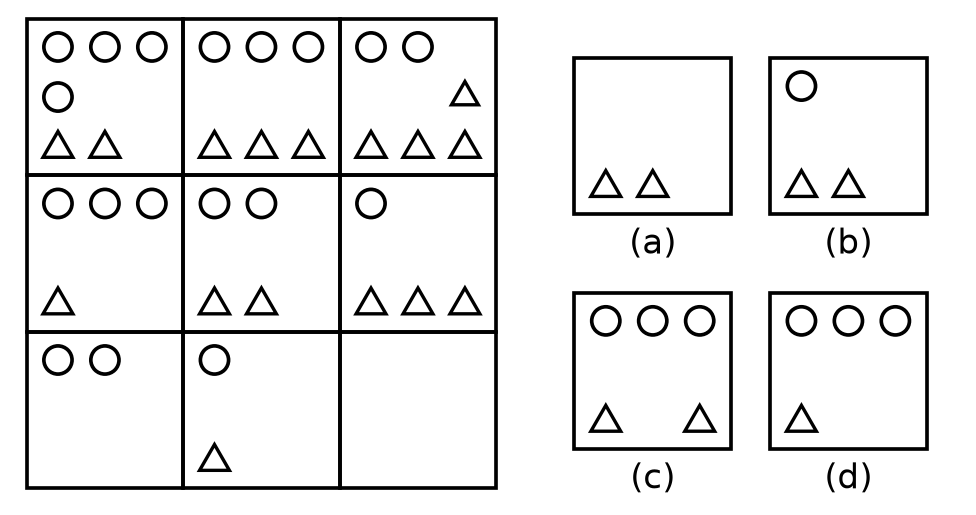
Consider the following matrix with one empty block in the lower extreme corner :
Which of the following figures could fit in the empty block and thus complete the matrix ?
Answer (a) & explanation
Figure (a) completes the matrix (a). Step 1: count the shapes in each box, left to right. Row 1: circles 4, 3, 2; triangles 2, 3, 4. Row 2: circles 3, 2, 1; triangles 1, 2, 3. Step 2: find the rule. Each step to the right, one circle goes and one triangle comes. Step 3: apply it to row 3. Circles go 2, 1, so next is 0. Triangles go 0, 1, so next is 2. The empty box needs two triangles and no circle, which is figure (a). Options (b), (c) and (d) have the wrong counts.
Tip: in figure matrices, count each kind of shape separately; a simple plus-one, minus-one rule is very common.
Answer as per the official UPSC answer key.
Read the passage
Passage - 2
Cynthia was a shy girl. She believed that she was plain and untalented. One day her teacher ordered the entire class to show up for audition for the school play. Cynthia nearly died of fright when she was told that she would have to stand on stage in front of the entire class and deliver dialogues. The mere thought of it made her feel sick. But a remarkable transformation occurred during the audition. A thin, shy girl, her knees quaking, her stomach churning in terror, began to stun everyone with her excellent performance. Her bored classmates suddenly stopped their noisy chat to stare at her slender figure on the stage. At the end of her audition, the entire room erupted in thunderous applause.
The transformation that occurred during the audition refers to
No official answer (question dropped) & notes
The answer is (d), her stunning performance. UPSC did not evaluate the six English-only items of 2014 (Q70 to Q75), so this answer is for practice. Step 1: find the transformation. "But a remarkable transformation occurred during the audition. A thin, shy girl... began to stun everyone with her excellent performance." The change is from a frightened, shy girl to a confident performer. Step 2: test the others. Option (a) is wrong: her nervousness is what she started with, not the change. Options (b) and (c) are wrong: the applause and the classmates' surprise were reactions to the change, not the change itself.
Tip: a "transformation" is a change in the main character. Look for the sentence that comes right after the word, which usually describes it.
UPSC did not evaluate the six English-only items of 2014 (Q70 to Q75), so there is no official key. The answer given in the explanation is for practice.
UPSC dropped this question from evaluation; there is no official answer.
What does venture capital mean?
Answer (b) & explanation
Venture capital is long-term equity invested in new, risky businesses with high growth potential, usually start-ups (b). The investor takes a stake, often offers guidance, and exits later through a sale or an IPO. Option (a) is wrong because VC is long-term, not short-term working capital. Options (c) and (d) describe rescue finance and modernisation loans, not venture funding.
In India VC funds are registered with SEBI as Category I Alternative Investment Funds. Notice how VC links to the start-up ecosystem, angel investors and schemes like the Fund of Funds for Startups run through SIDBI.
Answer as per the official UPSC answer key.
Consider the following statements :
- 1. The President shall make rules for the more convenient transaction of the business of the Government of India, and for the allocation among Ministers of the said business.
- 2. All executive actions of the Government of India shall be expressed to be taken in the name of the Prime Minister.
Which of the statements given above is/are correct?
Answer (a) & explanation
Statement 1 repeats Article 77(3) almost word for word: the President makes rules for the convenient transaction of business and for allocating it among ministers. Statement 2 is wrong because Article 77(1) says all executive action of the Government of India is expressed in the name of the President, not the Prime Minister. So the answer is (a).
The rules made under Article 77(3) are the Allocation of Business Rules and the Transaction of Business Rules. Notice how the President is the formal head while real power lies with the Council of Ministers led by the PM, the heart of a parliamentary system.
Answer as per the official UPSC answer key.
With reference to ‘Eco-Sensitive Zones’, which of the following statements is/are correct?
- 1. Eco-Sensitive Zones are the areas that are declared under the Wildlife (Protection) Act, 1972.
- 2. The purpose of the declaration of Eco-Sensitive Zones is to prohibit all kinds of human activities in those zones except agriculture.
Select the correct answer using the code given below.
Answer (d) & explanation
Neither statement is correct (d). Eco-Sensitive Zones are notified under the Environment (Protection) Act, 1986, not the Wildlife (Protection) Act, so statement 1 is wrong. They act as buffers around national parks and sanctuaries and regulate activities: mining and polluting industries are banned, some activities are regulated and others allowed. They do not ban everything except farming, so statement 2 is wrong.
The 2011 guidelines suggest up to 10 km around protected areas, and the Supreme Court has pressed for at least a 1 km zone. Notice how ESZs try to balance conservation with local livelihoods.
ESZs surround protected areas, but the power to notify them comes from the EPA, not the Wildlife Act.
Answer as per the official UPSC answer key.
A straight line segment is 36 cm long. Points are to be marked on the line from both the end points. From each end, the first point is at a distance of 1 cm from the end, the second point is at a distance of 2 cm from the first point and the third point is at a distance of 3 cm from the second point and so on. If the points on the ends are not counted and the common points are counted as one, what is the number of points?
Answer (b) & explanation
There are 12 points (b). Step 1: from the left end, gaps are 1, 2, 3, 4 and so on. Points fall at running totals: 1, 3, 6, 10, 15, 21, 28. The next total would be 36, the far end, which is not counted. That is 7 points. Step 2: from the right end, measured from the left, points fall at 36 − 1 = 35, then 33, 30, 26, 21, 15, 8. Another 7 points. Step 3: the points at 15 and 21 appear in both lists, so count them once. Total = 7 + 7 − 2 = 12. Options (a), (c) and (d) do not match.
Tip: convert both sets into distances from one end so that shared points are easy to spot.
Answer as per the official UPSC answer key.