
UPSC Prelims PYQs with explanations
Real questions from official papers, mapped to syllabus topics. Attempt each one; the answer and the reason appear instantly.
Read the passage
Many nations now place their faith in capitalism and governments choose it as the strategy to create wealth for their people. The spectacular economic growth seen in Brazil, China and India after the liberalisation of their economies is proof of its enormous potential and success. However, the global banking crisis and the economic recession have left many bewildered. The debates tend to focus on free market operations and forces, their efficiency and their ability for self correction. Issues of justice, integrity and honesty are rarely elaborated to highlight the failure of the global banking system. The apologists of the system continue to justify the success of capitalism and argue that the recent crisis was a blip. Their arguments betray an ideological bias with the assumptions that an unregulated market is fair and competent, and that the exercise of private greed will be in the larger public interest.
Few recognize the bidirectional relationship between capitalism and greed; that each reinforces the other. Surely, a more honest conceptualisation of the conflicts of interest among the rich and powerful players who have benefited from the system, their biases and ideology is needed; the focus on the wealth creation should also highlight the resultant gross inequity.
“The exercise of private greed will be in the larger public interest” from the passage
- 1. refers to the false ideology of capitalism.
- 2. underlies the righteous claims of the free market.
- 3. shows the benevolent face of capitalism.
- 4. ignores resultant gross inequity.
Which of the statements given above is/are correct ?
Answer (c) & explanation
Statements 1 and 4 are correct (c). Step 1: the line "private greed will be in the larger public interest" is one of the assumptions the author calls an "ideological bias". So he sees it as a false ideology (statement 1). Step 2: he also wants the focus on wealth creation to "highlight the resultant gross inequity", which the claim ignores (statement 4). Step 3: test the others. Statement 2 is wrong: the author does not see the free market's claims as righteous. Statement 3 is wrong: he does not see greed as capitalism's benevolent face. Options (a), (b) and (d) fail.
Tip: first decide whether the author agrees or disagrees with the quoted line. Here he disagrees, so positive words like "righteous" and "benevolent" are wrong.
Answer as per the official UPSC answer key.
With reference to ‘Global Environment Facility’, which of the following statements is/are correct?
Answer (a) & explanation
The GEF (1991) is the financial mechanism for the CBD and the UNFCCC (a), and also for the UNCCD, the Stockholm Convention on POPs and the Minamata Convention on mercury. Option (b) is wrong because the GEF funds projects but does not carry out scientific research itself, so (d) also fails. Option (c) is wrong: the GEF is not an OECD agency. The World Bank acts as its trustee, and UNDP, UNEP and others implement its projects.
Notice how the GEF links the three Rio conventions of 1992: biodiversity, climate and desertification share one funding window.
Answer as per the official UPSC answer key.
With reference to ‘Changpa’ community of India, consider the following statements :
- 1. They live mainly in the State of Uttarakhand.
- 2. They rear the Pashmina goats that yield a fine wool.
- 3. They are kept in the category of Scheduled Tribes.
Which of the statements given above is/are correct?
Answer (b) & explanation
The Changpa are semi-nomadic herders of the Changthang plateau in eastern Ladakh, not Uttarakhand, so statement 1 is wrong. They rear the Changthangi (Pashmina) goat, whose fine underwool becomes pashmina shawls (2 correct). They are recognised as a Scheduled Tribe (3 correct), so the answer is (b).
The goats grow this wool to survive winters of –30 °C or colder. Climate change, shrinking pastures and youth moving to towns now threaten the Changpa way of life. Notice how geography, livelihoods and a GI-tagged craft (Kashmir Pashmina) meet in one community.
Answer as per the official UPSC answer key.
Consider the following statements :
- 1. Maize can be used for the production of starch.
- 2. Oil extracted from maize can be a feedstock for biodiesel.
- 3. Alcoholic beverages can be produced by using maize.
Which of the statements given above is/are correct?
Answer (d) & explanation
All three are correct (d). Maize grain gives starch and sweeteners (1). Corn oil can be a feedstock for biodiesel (2). Fermented maize gives alcohol, from bourbon whisky to fuel ethanol (3). Options leaving out any of these are incomplete.
Today maize is a key feedstock for India's ethanol blending programme, which reached about 20% blending (E20) in 2025. That has raised maize demand and prices, and even led India to import maize. Maize is also used for poultry feed. Notice how one crop links farming to energy security and the food-versus-fuel debate.
Answer as per the official UPSC answer key.
Read the passage
In recent times, India has grown fast not only compared to its own past but also in comparison with other nations. But there cannot be any room for complacency because it is possible for the Indian economy to develop even faster and also to spread the benefits of this growth more widely than has been done thus far. Before going into details of the kinds of micro-structural changes that we need to conceptualize and then proceed to implement, it is worthwhile elaborating on the idea of inclusive growth that constitutes the defining concept behind this Government’s various economic policies and decisions. A nation interested in inclusive growth views the same growth differently depending on whether the gains of the growth are heaped primarily on a small segment or shared widely by the population. The latter is cause for celebration but not the former. In other words, growth must not be treated as an end in itself but as an instrument for spreading prosperity to all. India’s own past experience and the experience of other nations suggests that growth is necessary for eradicating poverty but it is not a sufficient condition. In other words, policies for promoting growth need to be complemented with policies to ensure that more and more people join in the growth process and, further, that there are mechanisms in place to redistribute some of the gains to those who are unable to partake in the market process and, hence, get left behind.
A simple way of giving this idea of inclusive growth a sharper form is to measure a nation’s progress in terms of the progress of its poorest segment, for instance the bottom 20 per cent of the population. One could measure the per capita income of the bottom quintile of the population and also calculate the growth rate of income; and evaluate our economic success in terms of these measures that pertain to the poorest segment. This approach is attractive because it does not ignore growth like some of the older heterodox criteria did. It simply looks at the growth of income of the poorest sections of the population. It also ensures that those who are outside of the bottom quintile do not get ignored. If that were done, then those people would in all likelihood drop down into the bottom quintile and so would automatically become a direct target of our policies. Hence the criterion being suggested here is a statistical summing up of the idea of inclusive growth, which, in turn, leads to two corollaries : to wish that India must strive to achieve high growth and that we must work to ensure that the weakest segments benefit from the growth.
The author’s central focus is on
Answer (c) & explanation
The central focus is inclusive growth (c). Step 1: find the key phrase. The author calls inclusive growth "the defining concept" behind policy, and says growth should be judged by whether its gains are "shared widely by the population". Step 2: test the other options. Option (a) is wrong: India's fast growth is mentioned only in the opening line, and the author then says there is "no room for complacency". Option (b) is wrong: the passage says growth is "not a sufficient condition", so it cannot be the "sole determinant". Option (d) is wrong: high growth is only half the idea; the other half is spreading its benefits.
Tip: the central focus is usually the idea the author defines and keeps returning to, not the first fact mentioned.
Answer as per the official UPSC answer key.
Read the passage
It is often forgotten that globalization is not only about policies on international economic relationships and transactions, but has equally to do with domestic policies of a nation. Policy changes necessitated by meeting the internationally set conditions (by WTO etc.) of free trade and investment flows obviously affect domestic producers and investors. But the basic philosophy underlying globalization emphasizes absolute freedom to markets to determine prices and production and distribution patterns, and view government interventions as processes that create distortions and bring in inefficiency. Thus, public enterprises have to be privatized through disinvestments and sales; sectors and activities hitherto reserved for the public sector have to be opened to the private sector. This logic extends to the social services like education and health. Any restrictions on the adjustments in workforce by way of retrenchment of workers should also be removed and exit should be made easier by removing any restrictions on closures. Employment and wages should be governed by free play of market forces, as any measure to regulate them can discourage investment and also create inefficiency in production. Above all, in line with the overall philosophy of reduction in the role of the State, fiscal reforms should be undertaken to have generally low levels of taxation and government expenditure should be kept to the minimum to abide by the principle of fiscal prudence. All these are policy actions on the domestic front and are not directly related to the core items of the globalization agenda, namely free international flow of goods and finance.
According to the passage, in the process of globalization the State should have
Answer (b) & explanation
The State should have a reducing role (b). Step 1: find the phrase. The passage speaks of "the overall philosophy of reduction in the role of the State", with low taxes, minimum spending and privatization. Step 2: test the others. Option (a) is wrong: an expanding role is the opposite. Option (c) is wrong: a statutory role is not discussed; the passage is about how much the State does, not its legal form. Option (d) is wrong: the passage clearly states a role, a smaller one.
Tip: short questions like this often lift a phrase straight from the passage. Scan for the key noun, here "role of the State", and read the word next to it.
Answer as per the official UPSC answer key.
Four persons, Alok, Bhupesh, Chander and Dinesh have a total of ₹ 100 among themselves. Alok and Bhupesh between them have as much money as Chander and Dinesh between them, but Alok has more money than Bhupesh; and Chander has only half the money that Dinesh has. Alok has in fact ₹ 5 more than Dinesh has. Who has the maximum amount of money?
Answer (a) & explanation
Alok has the most money (a). Step 1: Alok + Bhupesh = Chander + Dinesh, and all four total ₹100, so each pair has ₹50. Step 2: Chander has half of Dinesh's money. So Chander + Dinesh = 50 with Dinesh = 2 × Chander. That gives Chander = ₹16⅔ and Dinesh = ₹33⅓. Step 3: Alok has ₹5 more than Dinesh: 33⅓ + 5 = ₹38⅓. Then Bhupesh = 50 − 38⅓ = ₹11⅔. Step 4: the largest is Alok. Options (b), (c) and (d) have less.
Tip: split the total into the pairs first. "Half as much" means three equal parts: one for Chander and two for Dinesh, so 50 ÷ 3 per part.
Answer as per the official UPSC answer key.
Consider the following :
- 1. Bats
- 2. Bears
- 3. Rodents
The phenomenon of hibernation can be observed in which of the above kinds of animals?
Answer (c) & explanation
All three show it (c). Many bats hibernate in caves in winter. Bears enter a deep winter sleep, a form of hibernation in which body temperature falls only a little. Many rodents, such as ground squirrels, marmots and dormice, are true hibernators. Options (a), (b) and (d) each leave out a group that does hibernate.
Hibernation saves energy when food is scarce in cold seasons. Its summer counterpart is aestivation, seen in some snails, lungfish and frogs during heat and drought. Notice how adaptation questions often turn on temperature and food: the same logic explains migration in birds.
Answer as per the official UPSC answer key.
The most important strategy for the conservation of biodiversity together with traditional human life is the establishment of
Answer (a) & explanation
Biosphere reserves, under UNESCO's Man and the Biosphere programme (1971), are designed to conserve biodiversity together with human life (a). They have a strictly protected core, a buffer and a transition zone where people keep living and farming. Botanical gardens (b) are ex situ conservation. National parks (c) allow almost no human activity, and wildlife sanctuaries (d) allow some but are not built around community life.
India has 18 biosphere reserves, of which 13 are on UNESCO's world network, the first being the Nilgiri and the latest the Cold Desert (2025). Notice how this model treats people as part of the solution.
Answer as per the official UPSC answer key.
With reference to the Indian history of art and culture, consider the following pairs :
| Famous work of sculpture | Site
| 1. A grand image of Buddha’s Mahaparinirvana with numerous celestial musicians above and the sorrowful figures of his followers below | Ajanta
| 2. A huge image of Varaha Avatar (boar incarnation) of Vishnu, as he rescues Goddess Earth from the deep and chaotic waters, sculpted on rock | Mount Abu
| 3. “Arjuna’s Penance”/ “Descent of Ganga” sculpted on the surface of huge boulders | Mamallapuram
Which of the pairs given above is/are correctly matched?
Answer (c) & explanation
Pairs 1 and 3 are correct (c). Ajanta Cave 26 has the huge reclining Mahaparinirvana Buddha with mourning followers below and celestial beings above. The Descent of the Ganga (Arjuna's Penance) at Mamallapuram is carved on two huge boulders under the Pallavas. Pair 2 is wrong: the great rock-cut Varaha panel is at Udayagiri near Vidisha, a Gupta work of about 401 CE, not Mount Abu, which is famous for the marble Dilwara Jain temples.
Notice how each site anchors a dynasty: Vakatakas at Ajanta, Guptas at Udayagiri and Pallavas at Mamallapuram.
Answer as per the official UPSC answer key.
Assume that
- 1. the hour and minute hands of a clock move without jerking.
- 2. the clock shows a time between 8 o'clock and 9 o'clock.
- 3. the two hands of the clock are one above the other.
After how many minutes (nearest integer) will the two hands be again lying one above the other ?
Answer (c) & explanation
The hands meet again after about 65 minutes (c). Step 1: the minute hand moves 6° a minute and the hour hand 0.5° a minute. So the minute hand gains 5.5° every minute. Step 2: once the hands are together, the minute hand must gain a full 360° to catch the hour hand again. Step 3: 360 ÷ 5.5 = 65 5/11 minutes, which is about 65 minutes. Options (a), (b) and (d) do not match. Option (a), 60 minutes, is the trap: after one hour the hour hand has also moved ahead.
Tip: the hands of a clock overlap 11 times in 12 hours, not 12 times, because each overlap comes about 65 5/11 minutes after the last one.
Answer as per the official UPSC answer key.
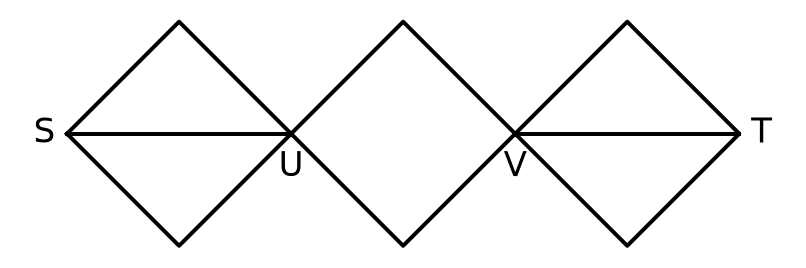
With reference to the figure given below, the number of different routes from S to T without retracing from U and/or V, is
Answer (d) & explanation
There are 18 routes (d). Step 1: break the journey into three parts. From S to U there are three paths: the top, the middle line and the bottom, so 3 ways. Step 2: from U to V there are two paths, top or bottom, so 2 ways. Step 3: from V to T there are again three paths, so 3 ways. Step 4: each choice can be combined with every other choice, so multiply: 3 × 2 × 3 = 18. Options (a), (b) and (c) add instead of multiplying or skip a part.
Tip: when a route passes through fixed points one after another, multiply the number of ways for each part. Add only when the routes are alternatives that do not combine.
Answer as per the official UPSC answer key.
If the 3rd day of a month is Monday, which one of the following will be the fifth day from 21st of this month?
Answer (c) & explanation
The fifth day from the 21st is a Wednesday (c). Step 1: the 3rd is a Monday. Add 7 at a time to find more Mondays: 3, 10, 17, 24. Step 2: "the fifth day from the 21st" means count five days after the 21st: 21 + 5 = the 26th. Step 3: the 24th is a Monday, so the 25th is Tuesday and the 26th is Wednesday. Options (a), (b) and (d) fall on the wrong day.
Tip: in calendar questions, jump in steps of 7 from a known day, because the weekday repeats every 7 days. Then count only the small gap that is left.
counting the 21st itself as day 1 gives the 25th (Tuesday). Fifth day from the 21st is the 26th.
Answer as per the official UPSC answer key.
The main objective of the 12th Five-Year Plan is
Answer (d) & explanation
The 12th Five-Year Plan (2012–17) had the theme "Faster, More Inclusive and Sustainable Growth" (d). Options (b) and (c) use some of the same words but miss "faster", and (a) is closer in spirit to earlier plans. The 11th Plan (2007–12) was "Towards Faster and More Inclusive Growth", so the 12th simply added sustainability.
The 12th was India's last Five-Year Plan. NITI Aayog replaced the Planning Commission in January 2015 and moved to vision and strategy documents instead. Notice how plan themes trace India's changing priorities: from heavy industry in the 2nd Plan to inclusion and sustainability later.
options (b) and (c) use the same words. Only (d) has all three: faster, sustainable, inclusive.
Answer as per the official UPSC answer key.
Consider the following statements regarding a No-Confidence Motion in India :
- 1. There is no mention of a No-Confidence Motion in the Constitution of India.
- 2. A Motion of No-Confidence can be introduced in the Lok Sabha only.
Which of the statements given above is/are correct?
Answer (c) & explanation
Both are correct (c). The Constitution speaks of collective responsibility of the Council of Ministers to the Lok Sabha (Article 75(3)) but never uses the words "no-confidence motion" (1 correct). The motion comes from Rule 198 of the Lok Sabha Rules of Procedure and can be moved only in the Lok Sabha (2 correct). It needs the support of at least 50 members to be admitted, and no reason has to be given.
If it passes, the whole Council of Ministers must resign. Notice how it differs from a censure motion, which must state reasons and targets specific policies without forcing resignation.
Article 75(3) feels like a mention. It states the principle; the motion itself comes from the Rules.
Answer as per the official UPSC answer key.
Consider the following statements :
- 1. Animal Welfare Board of India is established under the Environment (Protection) Act, 1986.
- 2. National Tiger Conservation Authority is a statutory body.
- 3. National Ganga River Basin Authority is chaired by the Prime Minister.
Which of the statements given above is/are correct?
Answer (b) & explanation
Statements 2 and 3 are correct (b). The Animal Welfare Board of India (1962) was set up under the Prevention of Cruelty to Animals Act, 1960, not the Environment Act, so statement 1 is wrong. The National Tiger Conservation Authority became a statutory body through a 2006 amendment to the Wildlife (Protection) Act. The National Ganga River Basin Authority (2009) was chaired by the Prime Minister.
In 2016 the NGRBA was replaced by the National Ganga Council, also chaired by the PM, with the National Mission for Clean Ganga under it. Notice how river and wildlife bodies often draw their power from different laws.
Answer as per the official UPSC answer key.
If Sohan, while selling two goats at the same price, makes a profit of 10% on one goat and suffers a loss of 10% on the other
Answer (c) & explanation
He loses 1% (c). Step 1: take an easy selling price that works for both goats, say ₹99 each. Step 2: 10% profit means cost × 1.1 = 99, so cost = ₹90. 10% loss means cost × 0.9 = 99, so cost = ₹110. Step 3: total cost = 90 + 110 = ₹200. Total sale = 99 + 99 = ₹198. Loss = ₹2 on ₹200 = 1%. Option (a) is the trap: the profit and loss are on different costs, so they do not cancel. Options (b) and (d) are wrong.
Tip: whenever two things sell at the same price, one at x% profit and one at x% loss, there is always a loss of (x × x ÷ 100)%. Here 10 × 10 ÷ 100 = 1%.
"+10 and –10 cancel" is wrong. The cost prices differ.
Answer as per the official UPSC answer key.
Read the passage
Net profits are only 2·2% of their total assets for central public sector undertakings, lower than for the private corporate sector. While the public sector or the State-led entrepreneurship played an important role in triggering India’s industrialization, our evolving development needs, comparatively less-than-satisfactory performance of the public sector enterprises, the maturing of our private sector, a much larger social base now available for expanding entrepreneurship and the growing institutional capabilities to enforce competition policies would suggest that the time has come to review the role of public sector.
What should the portfolio composition of the government be ? It should not remain static all times. The airline industry works well as a purely private affair. At the opposite end, rural roads, whose sparse traffic makes tolling unviable, have to be on the balance-sheet of the State. If the government did not own rural roads, they would not exist. Similarly, public health capital in our towns and cities will need to come from the public sector. Equally, preservation and improvement of forest cover will have to be a new priority for the public sector assets.
Take the example of steel. With near-zero tariffs, India is a globally competitive market for the metal. Indian firms export steel into the global market, which demonstrates there is no gap in technology. Indian companies are buying up global steel companies, which shows there is no gap in capital availability. Under these conditions, private ownership works best.
Private ownership is clearly desirable in regulated industries, ranging from finance to infrastructure, where a government agency performs the function of regulation and multiple competing firms are located in the private sector. Here, the simple and clean solution — government as the umpire and the private sector as the players is what works best. In many of these industries, we have a legacy of government ownership, where productivity tends to be lower, fear of bankruptcy is absent, and the risk of asking for money from the tax payer is ever present. There is also the conflict of interest between government as an owner and as the regulator. The formulation and implementation of competition policy will be more vigorous and fair if government companies are out of action.
According to the passage, what is/are the reason/reasons for saying that the time has come to review the role of public sector ?
- 1. Now public sector has lost its relevance in the industrialization process.
- 2. Public sector does not perform satisfactorily.
- 3. Entrepreneurship in private sector is expanding.
- 4. Effective competition policies are available now.
Which of the statements given above is/are correct in the given context ?
Answer (c) & explanation
Reasons 2, 3 and 4 are given (c). Step 1: list the reasons in the passage. It cites "comparatively less-than-satisfactory performance" of public enterprises (item 2), "a much larger social base now available for expanding entrepreneurship" (item 3), and "growing institutional capabilities to enforce competition policies" (item 4). Step 2: test item 1. It is wrong: the passage says the public sector "played an important role" in India's industrialization. It never says it has lost all relevance. Options (a), (b) and (d) fail.
Tip: "time to review" a role is much milder than "it has lost relevance". Do not let a strong option replace a moderate idea in the text.
Answer as per the official UPSC answer key.
With reference to technologies for solar power production, consider the following statements :
- 1. ‘Photovoltaics’ is a technology that generates electricity by direct conversion of light into electricity, while ‘Solar Thermal’ is a technology that utilizes the Sun’s rays to generate heat which is further used in electricity generation process.
- 2. Photovoltaics generates Alternating Current (AC), while Solar Thermal generates Direct Current (DC).
- 3. India has manufacturing base for Solar Thermal technology, but not for Photovoltaics.
Which of the statements given above is/are correct?
Answer (a) & explanation
Statement 1 is correct: photovoltaic cells convert light directly into electricity, while solar thermal (concentrated solar power) uses mirrors to heat a fluid whose steam drives a turbine. Statement 2 has it reversed: PV gives direct current (DC), which an inverter turns into AC, while a turbine-driven generator produces AC. Statement 3 is wrong because in 2014 India already had a PV manufacturing base for cells and modules, though small.
Since then the PLI scheme and the ALMM list have pushed domestic module making. Notice how a basic physics idea (AC vs DC) turns into an energy-policy question.
Answer as per the official UPSC answer key.
In India, cluster bean (Guar) is traditionally used as a vegetable or animal feed, but recently the cultivation of this has assumed significance. Which one of the following statements is correct in this context?
Answer (b) & explanation
Guar gum, made from the seed of the cluster bean, thickens the water used in hydraulic fracturing to extract shale gas and oil (b). The shale boom in the USA turned guar into a big export crop for Rajasthan, which grows most of the world's guar, and prices shot up around 2012. Option (a) is wrong: guar oil is not used for biodegradable plastics. Options (c) and (d), anti-histamine leaves and biodiesel, are not its claim to fame.
Guar gum is also used as a thickener in food, cosmetics and paper. Notice how a hardy dryland crop became tied to global energy markets.
Answer as per the official UPSC answer key.