
UPSC Prelims PYQs with explanations
Real questions from official papers, mapped to syllabus topics. Attempt each one; the answer and the reason appear instantly.
Among the following organisms, which one does not belong to the class of other three?
Answer (a) & explanation
Mites, scorpions and spiders are arachnids: they have eight legs, two main body parts and no antennae. The crab is a crustacean, with ten legs and two pairs of antennae, so it is the odd one out (a). All four belong to the phylum Arthropoda, with jointed legs and an exoskeleton.
Other arthropod classes include insects (six legs, three body parts, one pair of antennae) and myriapods such as centipedes. Notice how counting legs and antennae is often enough to classify an animal, a handy shortcut for biology questions.
Answer as per the official UPSC answer key.
Read the passage
In recent times, India has grown fast not only compared to its own past but also in comparison with other nations. But there cannot be any room for complacency because it is possible for the Indian economy to develop even faster and also to spread the benefits of this growth more widely than has been done thus far. Before going into details of the kinds of micro-structural changes that we need to conceptualize and then proceed to implement, it is worthwhile elaborating on the idea of inclusive growth that constitutes the defining concept behind this Government’s various economic policies and decisions. A nation interested in inclusive growth views the same growth differently depending on whether the gains of the growth are heaped primarily on a small segment or shared widely by the population. The latter is cause for celebration but not the former. In other words, growth must not be treated as an end in itself but as an instrument for spreading prosperity to all. India’s own past experience and the experience of other nations suggests that growth is necessary for eradicating poverty but it is not a sufficient condition. In other words, policies for promoting growth need to be complemented with policies to ensure that more and more people join in the growth process and, further, that there are mechanisms in place to redistribute some of the gains to those who are unable to partake in the market process and, hence, get left behind.
A simple way of giving this idea of inclusive growth a sharper form is to measure a nation’s progress in terms of the progress of its poorest segment, for instance the bottom 20 per cent of the population. One could measure the per capita income of the bottom quintile of the population and also calculate the growth rate of income; and evaluate our economic success in terms of these measures that pertain to the poorest segment. This approach is attractive because it does not ignore growth like some of the older heterodox criteria did. It simply looks at the growth of income of the poorest sections of the population. It also ensures that those who are outside of the bottom quintile do not get ignored. If that were done, then those people would in all likelihood drop down into the bottom quintile and so would automatically become a direct target of our policies. Hence the criterion being suggested here is a statistical summing up of the idea of inclusive growth, which, in turn, leads to two corollaries : to wish that India must strive to achieve high growth and that we must work to ensure that the weakest segments benefit from the growth.
The author supports policies which will help
Answer (c) & explanation
The author wants growth plus redistribution (c). Step 1: find the policy line. Growth policies "need to be complemented" with policies that bring more people into growth and mechanisms "to redistribute some of the gains" to those "left behind". Step 2: test the others. Option (a) is wrong: it keeps only growth and drops redistribution. Option (b) is wrong: the author's method "does not ignore growth", so "irrespective of rate of growth" contradicts him. Option (d) is wrong: the poorest matter, but the author also wants high growth and does not ignore those outside the bottom 20%.
Tip: when one option combines both halves of the author's argument, and the others hold only one half, the combined option is usually right.
Answer as per the official UPSC answer key.
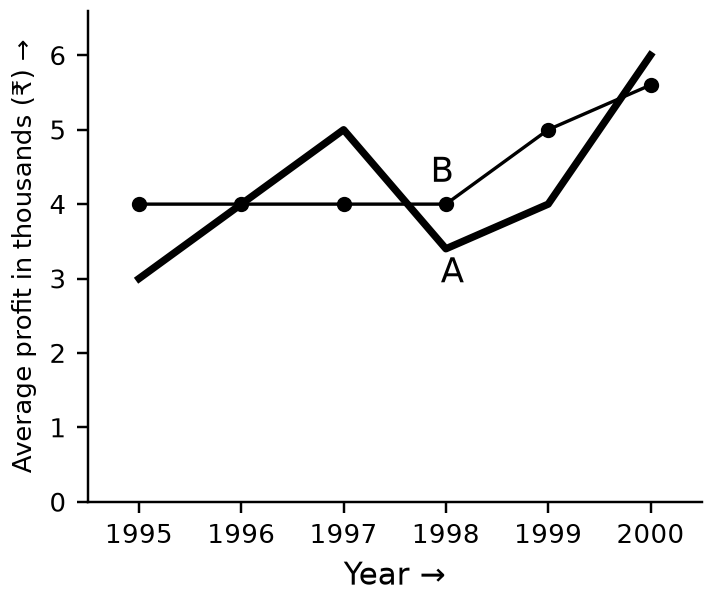
Directions for the following 4 (four) items : The following graph shows the average profit of two fruit-sellers A and B in thousands (₹) per year from the year 1995 to 2000. Consider the graph and answer the 4 (four) items that follow :
In which year is the average profit of A and B same ?
Answer (b) & explanation
Their profits are equal in 1996 (b). Step 1: read B's line on the graph. B's dotted line stays flat at ₹4,000 from 1995 to 1998. Step 2: read A's thick line. It crosses the 4 thousand level exactly at 1996. So in that year both sellers earn ₹4,000. Step 3: check the other years. In 1995, 1997 and 1998, A's line is above or below 4, so options (a), (c) and (d) fail.
Tip: on a two-line graph, "same value" means the point where the two lines cross or touch. Look for the meeting point first, then read the year below it.
Answer as per the official UPSC answer key.
Examine the following statements :
- 1. George attends Music classes on Monday.
- 2. He attends Mathematics classes on Wednesday.
- 3. His Literature classes are not on Friday.
- 4. He attends History classes on the day following the day of his Mathematics classes.
- 5. On Tuesday, he attends his Sports classes.
If he attends just one subject in a day and his Sunday is free, then he is also free on
Answer (d) & explanation
He is free on Friday (d). Step 1: fill in the week. Monday: Music. Tuesday: Sports. Wednesday: Mathematics. Thursday: History, the day after Mathematics. Sunday: free. Step 2: only Friday and Saturday are left for Literature. Literature is not on Friday, so it is on Saturday. Step 3: that leaves Friday free. Options (a), (b) and (c) are all filled days.
Tip: in scheduling puzzles, place the fixed clues first (named days), then the relative clues ("the day after"), and use the negative clue ("not on Friday") last to settle what is left.
Answer as per the official UPSC answer key.
Which one of the following is the largest Committee of the Parliament?
Answer (b) & explanation
The Estimates Committee is the largest, with 30 members, all from the Lok Sabha (b). The Public Accounts Committee (a) and the Committee on Public Undertakings (c) have 22 members each: 15 from the Lok Sabha and 7 from the Rajya Sabha. The Committee on Petitions (d) is smaller, with 15 members in the Lok Sabha.
The three financial committees keep a check on the executive: Estimates suggests economies, PAC examines the CAG's audit reports, and Public Undertakings reviews PSUs. A minister cannot be a member of them. Notice how the Estimates Committee being Lok Sabha-only mirrors that House's control over money.
PAC is the most famous, not the largest.
Answer as per the official UPSC answer key.
Turkey is located between
Answer (b) & explanation
Turkey has the Black Sea to the north and the Mediterranean, with its arm the Aegean, to the south and west (b). The Bosporus and Dardanelles straits, joined by the Sea of Marmara, link these two seas and split Turkey between Europe and Asia. The Caspian Sea (a) lies further east, beyond Georgia, Armenia and Azerbaijan. The Gulf of Suez (c) is in Egypt, and the Gulf of Aqaba and Dead Sea (d) are around Jordan, Israel and Egypt.
Notice how control of these straits has made Turkey strategically vital, from the Ottoman era to the Black Sea grain trade during the Ukraine war.
Answer as per the official UPSC answer key.
The Ghadr (Ghadar) was a
Answer (a) & explanation
The Ghadar Party (1913) was a revolutionary association of Indians with headquarters at the Yugantar Ashram in San Francisco (a). Founded by Lala Har Dayal, Sohan Singh Bhakna and others, it drew Punjabi workers on the US Pacific coast, and its paper Ghadar called for armed revolt. Singapore (b) saw a 1915 mutiny inspired by Ghadar ideas but was not its base. The Berlin Committee (c) and the Tashkent communist group (d) were separate bodies.
The Komagata Maru incident (1914) fuelled its anger. Notice how the diaspora played a real part in the freedom struggle.
Answer as per the official UPSC answer key.
Read the passage
Climate change poses potentially devastating effects on India’s agriculture. While the overall parameters of climate change are increasingly accepted — a 1°C average temperature increase over the next 30 years, sea level rise of less than 10 cm in the same period, and regional monsoon variations and corresponding droughts — the impacts in India are likely to be quite site and crop specific. Some crops may respond favourably to the changing conditions, others may not. This emphasizes the need to promote agricultural research and create maximum flexibility in the system to permit adaptations.
The key ingredient for “drought proofing” is the managed recharge of aquifers. To ensure continued yields of important staple crops (e.g. wheat), it may also be necessary to shift the locations where these crops are grown, in response to temperature changes as well as to water availability. The latter will be a key factor in making long term investment decisions.
For example, water runoff from the Himalayas is predicted to increase over the next 30 years as glaciers melt, but then decline substantially thereafter. It will be critical to provide incentives to plan for these large-scale shifts in agro-ecological conditions.
India needs to make long term investment in research and development in agriculture. India is likely to experience changed weather patterns in future.
Consider the following statements :
Climate change may force the shifting of locations of the existing crops due to
- 1. melting of glaciers.
- 2. water availability and temperature suitability at other locations.
- 3. poor productivity of crops.
- 4. wider adaptability of crop plants.
Select the correct answer using the code given below :
Answer (b) & explanation
Water, temperature and yields drive the shift (b). Step 1: find the sentence. To keep "continued yields" of staple crops, it may be necessary to shift where crops are grown "in response to temperature changes as well as to water availability". That gives item 2 (water and temperature) and item 3 (poor productivity, the reason yields would fall). Step 2: test the others. Item 1 is not taken by UPSC's key: glacier melt is mentioned only as an example of changing runoff, not as the direct reason for shifting crops. Item 4 is wrong: wider adaptability would let crops stay where they are. So options (a), (c) and (d) fail.
Tip: separate the reason the author gives from examples used to illustrate it.
Answer as per the official UPSC answer key.
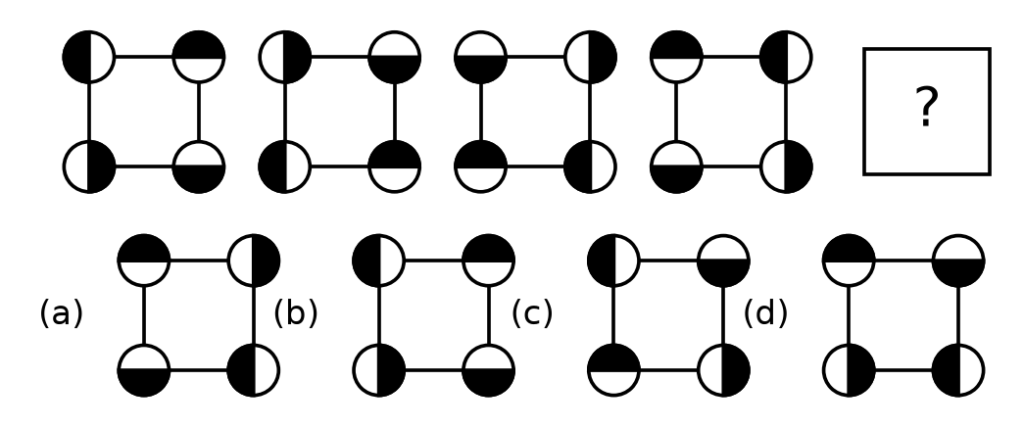
Consider the following figures :
Change in positions of beads in the four figures above follows a sequence. Following the same sequence, which of the figures below should appear as the fifth figure above ?
Answer (b) & explanation
Figure (b) comes fifth (b). Step 1: follow one bead at a time. The top-left bead's dark half moves left, then right, then bottom, then top across the four figures. Step 2: check another bead, the top-right one: top, bottom, right, left. Each bead runs through a 4-step cycle. Step 3: after four steps the cycle starts again, so the fifth figure must look like the first: dark halves left, top, right, bottom. That is figure (b). Options (a), (c) and (d) do not repeat the first figure.
Tip: in sequence questions, if a pattern seems to have four distinct positions, the fifth figure is often a repeat of the first. Check one element at a time.
Answer as per the official UPSC answer key.
For a charity show, the total tickets sold were 420. Half of these tickets were sold at the rate of ₹ 5 each, one-third at the rate of ₹ 3 each and the rest for ₹ 2 each. What was the total amount received?
Answer (c) & explanation
The total collected is ₹1,610 (c). Step 1: split the 420 tickets. Half = 210 tickets at ₹5 = ₹1,050. One-third = 140 tickets at ₹3 = ₹420. Step 2: the rest = 420 − 210 − 140 = 70 tickets at ₹2 = ₹140. Step 3: total = 1,050 + 420 + 140 = ₹1,610. Options (a), (b) and (d) come from miscounting "the rest".
Tip: always work out "the rest" by subtracting from the total, not by guessing a fraction. Here half plus one-third is five-sixths, so the rest is one-sixth: 420 ÷ 6 = 70.
Answer as per the official UPSC answer key.
With reference to Balance of Payments, which of the following constitutes/constitute the Current Account?
- 1. Balance of trade
- 2. Foreign assets
- 3. Balance of invisibles
- 4. Special Drawing Rights
Select the correct answer using the code given below.
Answer (c) & explanation
The current account = balance of trade in goods + the balance of invisibles (services, income such as interest and dividends, and transfers such as remittances). So 1 and 3 are correct (c). Foreign assets belong to the capital and financial account, and Special Drawing Rights are part of official foreign exchange reserves, so options with 2 or 4 fail.
India usually runs a trade deficit in goods that is partly offset by a surplus in software services and remittances, India being the world's largest recipient. Notice how the current account deficit links trade, the rupee's value and the stability of the whole economy.
Answer as per the official UPSC answer key.
With reference to Neem tree, consider the following statements :
- 1. Neem oil can be used as a pesticide to control the proliferation of some species of insects and mites.
- 2. Neem seeds are used in the manufacture of biofuels and hospital detergents.
- 3. Neem oil has applications in pharmaceutical industry.
Which of the statements given above is/are correct?
Answer (c) & explanation
Azadirachtin in neem oil repels insects and disrupts their growth, so neem-based products control many insects and mites (1 correct). Neem oil is also used in the pharmaceutical industry, as well as in soaps and toothpastes (3 correct). UPSC's key does not accept statement 2 on biofuels and hospital detergents, so the answer is (c).
India made neem-coated urea compulsory in 2015: the coating slows nitrogen release and stopped urea from being diverted to industry. Neem was also at the centre of a famous biopiracy case, in which a European patent on a neem fungicide was revoked. Notice how traditional knowledge links to IPR.
Answer as per the official UPSC answer key.
Consider the following pairs :
| Vitamin | Deficiency disease
| 1. Vitamin C | Scurvy
| 2. Vitamin D | Rickets
| 3. Vitamin E | Night blindness
Which of the pairs given above is/are correctly matched?
Answer (a) & explanation
Pairs 1 and 2 are correct (a). A lack of vitamin C causes scurvy, with bleeding gums, and a lack of vitamin D causes rickets, with soft bones in children. Pair 3 is wrong: night blindness is caused by a lack of vitamin A. Vitamin E deficiency mainly affects nerves and red blood cells.
Other links worth knowing: vitamin B1 and beriberi, B3 and pellagra, B12 and pernicious anaemia, and vitamin K and poor blood clotting. Notice how deficiency diseases tie biology to public policy, such as food fortification and the Vitamin A supplementation programme.
Answer as per the official UPSC answer key.
Out of a total of 120 musicians in a club, 5% can play all the three instruments, guitar, violin and flute. It so happens that the number of musicians who can play any two and only two of the above instruments is 30. The number of musicians who can play the guitar alone is 40. What is the total number of those who can play violin alone or flute alone ?
Answer (b) & explanation
44 play only the violin or only the flute (b). Step 1: work out each group. All three instruments: 5% of 120 = 6. Exactly two instruments: 30. Guitar alone: 40. Step 2: everyone else plays only one of the other two, violin alone or flute alone. So 120 − 6 − 30 − 40 = 44. This assumes every musician plays at least one of the three. Options (a), (c) and (d) do not match.
Tip: in such questions, split the total into non-overlapping groups: all three, exactly two, and each one alone. They must add up to the total, so the missing group is the total minus the rest.
Answer as per the official UPSC answer key.
Read the passage
Net profits are only 2·2% of their total assets for central public sector undertakings, lower than for the private corporate sector. While the public sector or the State-led entrepreneurship played an important role in triggering India’s industrialization, our evolving development needs, comparatively less-than-satisfactory performance of the public sector enterprises, the maturing of our private sector, a much larger social base now available for expanding entrepreneurship and the growing institutional capabilities to enforce competition policies would suggest that the time has come to review the role of public sector.
What should the portfolio composition of the government be ? It should not remain static all times. The airline industry works well as a purely private affair. At the opposite end, rural roads, whose sparse traffic makes tolling unviable, have to be on the balance-sheet of the State. If the government did not own rural roads, they would not exist. Similarly, public health capital in our towns and cities will need to come from the public sector. Equally, preservation and improvement of forest cover will have to be a new priority for the public sector assets.
Take the example of steel. With near-zero tariffs, India is a globally competitive market for the metal. Indian firms export steel into the global market, which demonstrates there is no gap in technology. Indian companies are buying up global steel companies, which shows there is no gap in capital availability. Under these conditions, private ownership works best.
Private ownership is clearly desirable in regulated industries, ranging from finance to infrastructure, where a government agency performs the function of regulation and multiple competing firms are located in the private sector. Here, the simple and clean solution — government as the umpire and the private sector as the players is what works best. In many of these industries, we have a legacy of government ownership, where productivity tends to be lower, fear of bankruptcy is absent, and the risk of asking for money from the tax payer is ever present. There is also the conflict of interest between government as an owner and as the regulator. The formulation and implementation of competition policy will be more vigorous and fair if government companies are out of action.
According to the passage, rural roads should be in the domain of public sector only. Why ?
Answer (b) & explanation
The private sector cannot profit from rural roads (b). Step 1: find the reason. Rural roads have "sparse traffic" that "makes tolling unviable". With little traffic, a private builder cannot collect enough tolls to earn money. So "if the government did not own rural roads, they would not exist". Step 2: test the others. Option (a) is wrong: the passage does not say all rural development is only the government's job. Option (c) is wrong: taxpayers' money is not the reason given. Option (d) is wrong: social responsibility of firms is not discussed.
Tip: a "Why?" question needs the cause the passage gives. Look for linking words like "whose" and "makes" that show cause and effect.
Answer as per the official UPSC answer key.
Consider the following languages :
- 1. Gujarati
- 2. Kannada
- 3. Telugu
Which of the above has/have been declared as ‘Classical Language/Languages’ by the Government?
Answer (c) & explanation
Telugu and Kannada were declared classical languages in 2008, after Tamil (2004) and Sanskrit (2005). So 2 and 3 are correct. Gujarati has never received the status, which rules out options (a) and (d); option (b) misses Kannada.
Malayalam followed in 2013 and Odia in 2014. In October 2024 Marathi, Pali, Prakrit, Assamese and Bengali were added, taking the total to eleven. The criteria include high antiquity of early texts (1,500–2,000 years), a body of ancient literature valued as heritage, and an original literary tradition. Notice how this links language policy to the Eighth Schedule and to cultural history.
Answer as per the official UPSC answer key.
Which of the following have coral reefs?
- 1. Andaman and Nicobar Islands
- 2. Gulf of Kachchh
- 3. Gulf of Mannar
- 4. Sunderbans
Select the correct answer using the code given below.
Answer (a) & explanation
Coral reefs are found in the Andaman and Nicobar Islands, the Gulf of Kachchh and the Gulf of Mannar, so the answer is (a). Lakshadweep is the fourth major reef area. The Sundarbans delta has muddy, low-salinity water full of sediment, which suits mangroves but not corals, so options with 4 fail.
Corals need warm, clear, shallow salt water. They are threatened by bleaching when sea temperatures rise, and India's reefs suffered in the global bleaching events. Notice how corals and mangroves are neighbours in many places, yet each needs very different water.
Answer as per the official UPSC answer key.
The power to increase the number of judges in the Supreme Court of India is vested in
Answer (b) & explanation
Article 124(1) fixed the Supreme Court's strength and allowed Parliament to change it by law (b). Parliament has done so through the Supreme Court (Number of Judges) Act, 1956, amended several times; the sanctioned strength is now 34, including the Chief Justice, since 2019. The President (a) appoints judges but cannot add posts. The Chief Justice (c) and the Law Commission (d) can only advise.
The original Constitution provided for eight judges in all. Notice how judicial appointments follow the collegium system that grew out of the Judges cases.
the President appoints judges but cannot add posts.
Answer as per the official UPSC answer key.
Read the passage
In recent times, India has grown fast not only compared to its own past but also in comparison with other nations. But there cannot be any room for complacency because it is possible for the Indian economy to develop even faster and also to spread the benefits of this growth more widely than has been done thus far. Before going into details of the kinds of micro-structural changes that we need to conceptualize and then proceed to implement, it is worthwhile elaborating on the idea of inclusive growth that constitutes the defining concept behind this Government’s various economic policies and decisions. A nation interested in inclusive growth views the same growth differently depending on whether the gains of the growth are heaped primarily on a small segment or shared widely by the population. The latter is cause for celebration but not the former. In other words, growth must not be treated as an end in itself but as an instrument for spreading prosperity to all. India’s own past experience and the experience of other nations suggests that growth is necessary for eradicating poverty but it is not a sufficient condition. In other words, policies for promoting growth need to be complemented with policies to ensure that more and more people join in the growth process and, further, that there are mechanisms in place to redistribute some of the gains to those who are unable to partake in the market process and, hence, get left behind.
A simple way of giving this idea of inclusive growth a sharper form is to measure a nation’s progress in terms of the progress of its poorest segment, for instance the bottom 20 per cent of the population. One could measure the per capita income of the bottom quintile of the population and also calculate the growth rate of income; and evaluate our economic success in terms of these measures that pertain to the poorest segment. This approach is attractive because it does not ignore growth like some of the older heterodox criteria did. It simply looks at the growth of income of the poorest sections of the population. It also ensures that those who are outside of the bottom quintile do not get ignored. If that were done, then those people would in all likelihood drop down into the bottom quintile and so would automatically become a direct target of our policies. Hence the criterion being suggested here is a statistical summing up of the idea of inclusive growth, which, in turn, leads to two corollaries : to wish that India must strive to achieve high growth and that we must work to ensure that the weakest segments benefit from the growth.
Consider the following statements :
According to the author, India’s economy has grown but there is no room for complacency as
- 1. growth eradicates poverty.
- 2. growth has resulted in prosperity for all.
Which of the statements given above is/are correct ?
Answer (d) & explanation
Neither statement is correct (d). Step 1: find why there is "no room for complacency". The passage says India can grow faster and spread the benefits more widely than so far. Step 2: test statement 1. It says growth eradicates poverty, but the author says growth is "necessary" but "not a sufficient condition" for ending poverty. So 1 fails. Step 3: test statement 2. It says growth has brought prosperity for all. If that were true, there would be no need to spread benefits "more widely". So 2 fails. Options (a), (b) and (c) all include a wrong statement.
Tip: watch for statements that turn the author's worry into a success. If the author calls for more action, the statement saying the job is done is wrong.
Answer as per the official UPSC answer key.
(Same graph as the question above.)
What is the difference between the average profit of B and A in the year 1998 ?
Answer (c) & explanation
B minus A in 1998 is +₹600 (c). Step 1: read the graph for 1998. B is at 4 thousand, that is ₹4,000. A is at about 3.4 thousand, that is ₹3,400. Step 2: the question asks for B − A: 4,000 − 3,400 = +₹600. The answer is positive because B is higher. Options (a), (b) and (d) are wrong: they are negative values, which would mean A earned more than B.
Tip: notice the order of subtraction in the question, "B and A". A minus sign in the options tells you the examiner is testing whether you subtract the right way round.
Answer as per the official UPSC answer key.