
World Bank Group: Bretton Woods Origins, the Five Institutions, Governance and Voting, Lending to India, Key Reports and the Reform Debate (UPSC Notes + PYQs)
UPSC has already asked about this. Read the story with these questions in mind.
Origins
In July 1944, delegates of 44 countries met at Bretton Woods in New Hampshire to plan the post-war economy. They created the International Monetary Fund to keep exchange rates stable and the International Bank for Reconstruction and Development to rebuild war-torn Europe and develop poorer countries. The IBRD’s first loan, in 1947, went to France. As the Marshall Plan took over Europe’s rebuilding, the Bank turned to the developing world: dams, roads, power and later schools, health and poverty. Its mission today is stated as ending extreme poverty and boosting shared prosperity on a livable planet.
The five institutions
| Institution | Year | What it does | India |
|---|---|---|---|
| IBRD | 1944 | Loans to middle-income and creditworthy poorer countries at near-market rates | Founding member; major borrower |
| IDA (International Development Association) | 1960 | Grants and very cheap long-term credits to the poorest countries | Largest cumulative borrower; graduated in 2014 |
| IFC (International Finance Corporation) | 1956 | Invests in and lends to private firms | Member; issued “Masala bonds” in rupees |
| MIGA (Multilateral Investment Guarantee Agency) | 1988 | Insures foreign investors against political risk | Member |
| ICSID | 1966 | Settles investment disputes between States and investors | Not a member |
The IBRD and IDA together are called the World Bank; all five make up the World Bank Group. Prelims likes the ICSID point: India has stayed out, preferring its own bilateral investment treaty model.
- IBRD1944, middle-income loans
- IDA1960, poorest countries
- IFC1956, private sector
- MIGA1988, risk guarantees
- ICSID1966, disputes; India not a member
Governance and voting
Each member country is a shareholder. The Board of Governors, usually finance ministers, meets at the Annual Meetings held with the IMF. Day-to-day work is done by 25 Executive Directors. Voting power depends largely on capital subscribed, so the United States, the largest shareholder with about 15-16% of IBRD votes, has a veto over changes that need an 85% majority. Japan, China, Germany, France and the UK follow; India holds about 3%. By an unwritten deal since 1944, an American heads the World Bank and a European heads the IMF. Ajay Banga, an Indian-born American business leader, became President in June 2023.
World Bank and the IMF
The two “Bretton Woods twins” are often confused. The IMF looks after the stability of the global monetary system; it watches economies, gives short- to medium-term loans to countries with balance of payments crises, and runs the SDR. The World Bank funds long-term development projects and policy reforms. India borrowed from the IMF in 1991 to survive its crisis, while it borrows from the Bank for projects such as rural roads, watershed development, the National Rural Livelihoods Mission and clean Ganga.
- Long-term development finance
- Projects and policy reforms
- Head: by convention an American
- Reports: WDR, GEP
- Global monetary stability
- Balance of payments support, SDR
- Head: by convention a European
- Reports: WEO, GFSR
India and the World Bank
India has borrowed from the Bank since 1949, when a loan funded the Indian Railways. For decades it was the largest IDA borrower. Its rise to lower-middle income status ended IDA access in 2014, and it now borrows on IBRD terms. Bank lending supported the Green Revolution, the Damodar Valley and other irrigation works, and more recently COVID-19 health support, social protection and the “Accelerating India’s COVID-19 Social Protection” programme. Not all projects went well: the Sardar Sarovar dam drew global protest over displacement, and an independent review (the Morse Report, 1992) led the Bank to withdraw in 1993. That episode helped create the Bank’s Inspection Panel (1993), which lets affected people complain directly.
Reports and indicators
- World Development Report: annual, on one theme.
- Global Economic Prospects: twice-yearly growth forecasts (asked in Prelims 2015).
- Logistics Performance Index, Human Capital Index, Poverty and Shared Prosperity report.
- Ease of Doing Business: discontinued in September 2021 after data irregularities came to light; India had climbed from 142nd (2014) to 63rd (2019). The Business Ready (B-READY) report replaced it in 2024.
In June 2025 the Bank raised the international extreme poverty line from USD 2.15 to USD 3.00 a day (2021 prices). On this line it estimated India’s extreme poverty fell from about 27% in 2011-12 to 5.3% in 2022-23.
Criticism
- Unequal voice: votes still favour rich countries, though shares for developing countries rose after 2010 reforms.
- Conditions: the structural adjustment loans of the 1980s and 1990s pushed privatisation and spending cuts that hurt the poor in Africa and Latin America.
- Displacement and environment: big dams and mines financed by the Bank uprooted communities.
- Too little money: development needs, especially for climate, run to trillions; Bank lending is a small fraction.
- Competition: the AIIB (2016) and the BRICS New Development Bank (2015) emerged partly from frustration with slow reform.
Reforming development banks
In 2023 the Bank adopted an Evolution Roadmap to add climate, pandemics and other global challenges to its mission and to stretch its balance sheet. India’s G20 presidency in 2023 backed this through an expert group led by N.K. Singh and Lawrence Summers, which called for tripling sustainable lending by multilateral development banks by 2030. India argues for fairer voting shares, cheaper climate finance and lending without heavy conditions, so that the Bank serves a world very different from that of 1944.
PYQ trend
Prelims tests which body publishes which report and the roles of the five institutions. Mains GS-II asks about the reform of international institutions and India’s place in them.
World Bank: UPSC angle
For UPSC CSE
Prelims: institutions, reports, India’s membership. Mains GS-II: reform of global institutions; GS-III: external finance and development.
World Bank UPSC PYQs (Prelims)
Questions UPSC has actually asked, from the official papers. Pick an option to check yourself.
Which one of the following issues the 'Global Economic Prospects' report periodically?
The World Bank publishes Global Economic Prospects twice a year, in January and June. Do not confuse it with the IMF’s World Economic Outlook and Global Financial Stability Report (2016 Q75 asked about the latter). Answer as per the official UPSC key · Battle IAS PYQ bankAnswer (d) & why
The Global Infrastructure Facility is a/an
The Global Infrastructure Facility (2014) is a G20 initiative hosted by the World Bank. It helps governments prepare and structure complex infrastructure PPPs, so that private and institutional investors such as pension funds will put money into them. Answer as per the official UPSC key · Battle IAS PYQ bankAnswer (b) & why
Which one of the following is not a sub-index of the World Bank's 'Ease of Doing Business Index'?
The Doing Business report had ten sub-indices: starting a business, construction permits, getting electricity, registering property, getting credit, protecting minority investors, paying taxes, trading across borders, enforcing contracts and resolving insolvency. Law and order was not one of them. The World Bank stopped the report in 2021. Answer as per the official UPSC key · Battle IAS PYQ bankAnswer (a) & why
"Gold Tranche" (Reserve Tranche) refers to
Each IMF member pays part of its quota (originally 25%) in gold or hard currency. That share is the reserve tranche. A member can draw it at any time, with no conditions and no interest, because it is really its own money. It counts as part of India’s foreign exchange reserves. Answer as per the official UPSC key · Battle IAS PYQ bankAnswer (d) & why
Mains PYQs on this topic
No UPSC Mains question from 2023-2026 is directly on this topic. Older papers (2013-2022) will be added as the Mains bank grows.
Quick quiz
Of which World Bank Group body is India NOT a member?
India has not joined ICSID.Answer (c)
Which arm gives cheap credits and grants to the poorest countries?
The International Development Association, set up in 1960.Answer (b)
The Global Economic Prospects report is published by
The World Bank, twice a year.Answer (c)
FAQs
What is the difference between the World Bank and the World Bank Group?
The World Bank means the IBRD and IDA. The Group adds the IFC, MIGA and ICSID.
Does India still borrow from the World Bank?
Yes, on IBRD terms. It stopped receiving IDA credits after graduating in 2014.
Who heads the World Bank?
Ajay Banga, President since June 2023. By convention the President is an American.
Why was the Ease of Doing Business report stopped?
The Bank discontinued it in 2021 after an investigation found data irregularities in the 2018 and 2020 editions.
What is the new international poverty line?
USD 3.00 a day at 2021 prices, adopted in June 2025, replacing USD 2.15.
Spotted an error? Tell us. We correct within 48 hours.
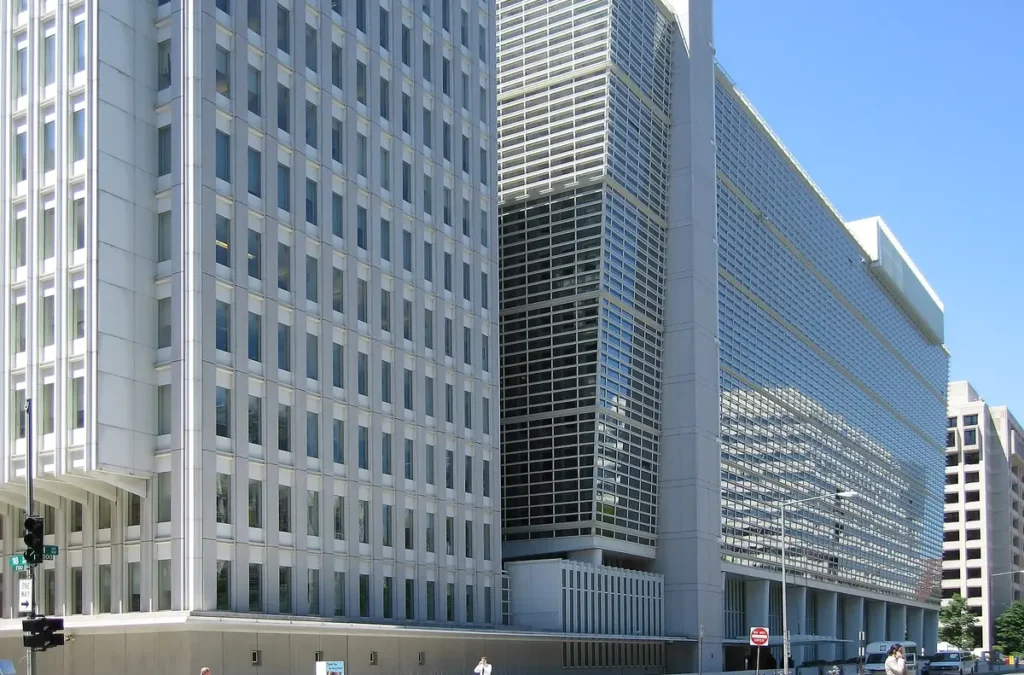
Image: Shiny Things, Wikimedia Commons, CC BY 2.0
How to use this in Mains
If asked: Is the World Bank still relevant to developing countries? Critically examine. (GS-II)
Quote: “Unequal voice: votes still favour rich countries, though shares for developing countries rose after 2010 reforms.”
Use it: Your first criticism point; follow with India's demand for reform.
In the news
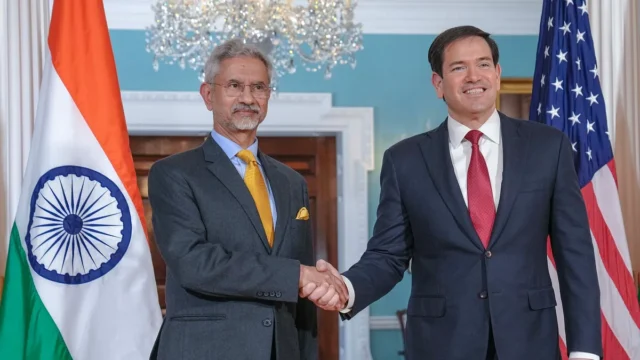
Rubio in Mumbai: India–US trade deal ‘very, very close’; energy and defence on the table
US Secretary of State Marco Rubio began his second India visit of the year in Mumbai on 20 October 2026 and met External Affairs Minister S. Jaishankar on trade, energy, technology and defence. Rubio said the two sides are ‘very, very close’ to a trade deal with ‘a small number of items left’, and praised India’s progress in diversifying energy supplies.
20 Oct 2026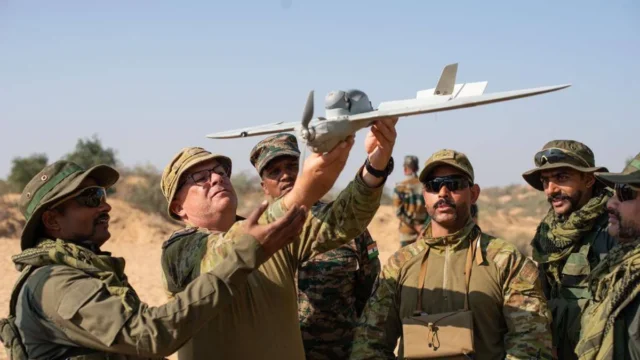
AUSTRAHIND 2026: fifth India–Australia Army exercise begins in Thiruvananthapuram
The fifth edition of the India–Australia joint military exercise AUSTRAHIND began on 19 October 2026 at the Foreign Training Node, Thiruvananthapuram, and runs till 1 November. About 120 soldiers from each army will train for sub-conventional operations in island and coastal terrain under a UN Chapter VII mandate. For the first time, New Zealand has sent observers.
20 Oct 2026
India–New Zealand FTA enters into force: zero duty on all Indian exports from day one
The India–New Zealand Free Trade Agreement came into force on 20 October 2026. From day one, New Zealand charges no customs duty on any Indian export, the first time India has got full duty-free access on all tariff lines at entry into force. New Zealand has also committed to facilitate USD 20 billion of investment into India, while dairy, sugar and edible oils stay protected.
20 Oct 2026
India to host 61st CIML meeting on legal metrology in New Delhi, 26–28 October
India will host the 61st meeting of the International Committee of Legal Metrology (CIML) for the first time, in New Delhi from 26 to 28 October 2026. The Department of Consumer Affairs is organising it with the International Organization of Legal Metrology (OIML), and more than 100 delegates are expected, PIB said on 19 October.
19 Oct 2026