
UPSC Mains 2025 GS2 Q12: model answer
Indian Constitution has conferred the amending power on the ordinary legislative institutions with a few procedural hurdles. In view of this statement, examine the procedural and substantive limitations on the amending power of the Parliament to change the Constitution.
What the question wants
Procedural limits under Art. 368 and substantive limits from the basic structure doctrine.
How to structure it
Intro: flexible yet rigid. Body: (1) Procedural limitations; (2) Substantive limitations; (3) Assessment. Conclusion: The balance lets Parliament adapt the Constitution while keeping its identity intact.
- 1(1) Procedural limitations
- 2(2) Substantive limitations
- 3(3) Assessment
Model answer
The Constitution does not create a separate constituent body for amendments. Parliament itself amends it under Article 368, but with conditions that make it neither too rigid nor too flexible.
- 1Bill only in Parliament
- 2Special majority in each House, no joint sitting
- 3Federal provisions: half the States ratify
- 4President must assent (24th Amendment)
- 5Court tests it against basic structure (Kesavananda, 1973)
Procedural limitations
- A Bill can be introduced only in Parliament, not in State legislatures.
- Special majority in each House: majority of total membership and two-thirds of members present and voting.
- No joint sitting if the Houses disagree.
- Federal provisions (election of President, Union-State powers, Seventh Schedule, representation of States, Art. 368 itself) also need ratification by half the State legislatures.
- The President must assent (24th Amendment, 1971).
Substantive limitations
- Kesavananda Bharati (1973): Parliament cannot alter the basic structure.
- Indira Gandhi v. Raj Narain (1975): free and fair elections part of it.
- Minerva Mills (1980): limited amending power and judicial review are themselves basic features; parts of the 42nd Amendment struck down.
- I.R. Coelho (2007): Ninth Schedule laws after 1973 open to review.
- NJAC case (2015): 99th Amendment struck down for affecting judicial independence.
Assessment
- Over 100 amendments show flexibility, e.g. GST (101st).
- Critics say the basic structure is judge-made and vague; supporters say it saved the Constitution after the Emergency.
The balance lets Parliament adapt the Constitution while keeping its identity intact.
Keywords, cases and data to drop in
Art. 368 special majority State ratification basic structure Kesavananda Minerva Mills
Where most answers lose marks
- Only listing cases without procedure.
- Saying a joint sitting can pass amendments.
Same theme in Prelims
Consider the following statements in respect of questions asked by the Members in the Parliament of India :
- 1. Unstarred questions are those to which a Member desires an oral answer in the House.
- 2. Starred questions are those to which a Member desires a written answer.
- 3. No supplementary question can be asked on an unstarred question.
Which one of the following conclusions based on the above statements is correct ?
Answer (c) & explanation
Only one statement is correct (c). Statement 3 is right: an unstarred question gets a written answer, so no supplementary question can follow. Statement 1 is wrong: unstarred questions get written, not oral, answers. Statement 2 is wrong: a starred question, marked with an asterisk, gets an oral answer on the floor, and supplementaries may follow. Statements 1 and 2 swap the two types. So options (a), (b) and (d) fail.
Notice the third type: a short notice question is on a matter of urgent public importance, asked with less than ten days' notice and answered orally. Question Hour is usually the first hour of a sitting, followed by Zero Hour, an Indian innovation not found in the Rules of Procedure.
a clean swap of definitions. Remember: the star is for the spoken answer on the floor.
Answer as per the official UPSC answer key.
Consider the following statements about the Committee on the Welfare of Scheduled Castes and Scheduled Tribes of the Parliament of India :
- 1. Although members of this Committee are elected from both Houses of Parliament, the Chairperson of this Committee is appointed by the Chairman of the Rajya Sabha.
- 2. Twenty members are elected by the Rajya Sabha and ten members by the Lok Sabha.
- 3. No Minister, except for the Union Minister of Social Justice and Empowerment, is eligible to be a member of this Committee.
- 4. Members are elected for a fixed term of two years from the date they enter their office.
Which one of the following conclusions based on the above statements is correct ?
Answer (d) & explanation
No statement is correct (d). The Committee on the Welfare of SCs and STs has 30 members. Statement 1 is wrong: the Speaker appoints its Chairperson from among the Lok Sabha members. Statement 2 is wrong: 20 members come from the Lok Sabha and 10 from the Rajya Sabha, the reverse of the statement. Statement 3 is wrong: no Minister at all can be a member. Statement 4 is wrong: the term is one year, not two. So options (a), (b) and (c) fail.
Notice the pattern: like the Estimates and Public Accounts committees, it is a financial-style committee where Ministers are barred. Its job is to examine the work of the National Commissions for SCs and STs and the implementation of safeguards.
four confident details, all slightly off. When every line has a number or an office, check each one.
Answer as per the official UPSC answer key.
Consider the following statements :
- I. On the dissolution of the House of the People, the Speaker shall not vacate his/her office until immediately before the first meeting of the House of the People after the dissolution.
- II. According to the provisions of the Constitution of India, a Member of the House of the People on being elected as Speaker shall resign from his/her political party immediately.
- III. The Speaker of the House of the People may be removed from his/her office by a resolution of the House of the People passed by a majority of all the then Members of the House, provided that no resolution shall be moved unless at least fourteen days' notice has been given of the intention to move the resolution.
Which of the statements given above are correct?
Answer (c) & explanation
Statements I and III are correct (c). Statement I is right: under Article 94, on dissolution of the Lok Sabha the Speaker stays in office until just before the first meeting of the new House. Statement III is right: the Speaker may be removed by a resolution passed by a majority of all the then members, after at least 14 days' notice. Both lines are copied almost word for word from Article 94. Statement II is wrong: nothing in the Constitution asks the Speaker to leave the party.
Notice that resigning from the party is a convention in Britain, not a rule in India. The Speaker decides defection cases under the Tenth Schedule and certifies Money Bills. The Deputy Speaker post stayed vacant for the whole 17th Lok Sabha.
a good practice dressed as a constitutional rule. Ask, "Which Article says this?"
Fell for this one? Most aspirants do. The PYQ Book puts every UPSC trap side by side, so the pattern finally clicks. Try the free sample
Answer as per the official UPSC answer key.
Fresh examples from current affairs

Supreme Court: no prior approval under Section 17A needed to probe a bribe demand
In a judgment of 16 October 2026, a Supreme Court Bench of Justices S.V.N. Bhatti and N.V. Anjaria held that investigating a bribe demand by a public servant does not need prior approval under Section 17A of the Prevention of Corruption Act. Asking for a bribe, the court said, is not part of discharging official duties.
UPSC angle: Prelims: Sections 7, 7A, 17A and 19 of the PC Act. · Mains GS-II/GS-IV: honest officers versus accountability.
19 Oct 2026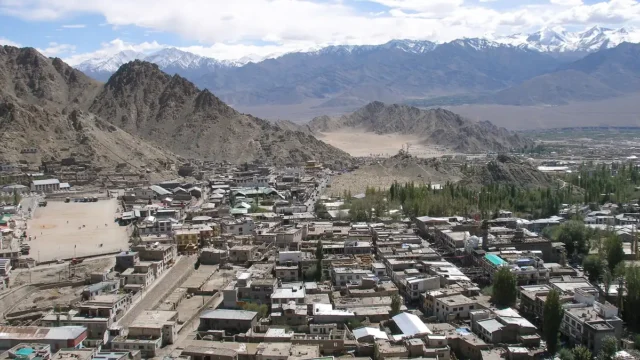
CJI Surya Kant inaugurates the first permanent High Court bench in Leh
On 18 October 2026 Chief Justice of India Surya Kant inaugurated a permanent bench of the High Court of Jammu and Kashmir and Ladakh in Leh. Until now, a person in Ladakh who wanted to file a writ petition had to travel to Srinagar or Jammu, across high passes and harsh winters. The bench was made possible by a regulation that the President promulgated on 27 August and that came into force on 5 September. It is a simple idea with a big effect: bring the court to the people.
UPSC angle: Prelims: Arts. 214, 231, 241, 226, 39A; common High Court. · Mains GS-II: access to justice, judicial infrastructure.
18 Oct 2026
Three High Court Chief Justices appointed as Supreme Court judges
On 5 October 2026 the President appointed three High Court Chief Justices as judges of the Supreme Court: Justice Sunita Agarwal (Gujarat), Justice Devendra Kumar Upadhyaya (Delhi) and Justice Aparesh Kumar Singh (Telangana). The first two have Allahabad as their parent High Court and the third Jharkhand.
UPSC angle: Prelims: Article 124. · Mains GS-II: judicial appointments.
5 Oct 2026
President at NGT climate conference: community-based adaptation rooted in traditional knowledge
On 20 September 2026 President Droupadi Murmu spoke at the valedictory session of the International Conference on "The Future of Environment and Climate Dynamics", organised by the National Green Tribunal in New Delhi. She called for people-centric, community-based climate adaptation rooted in traditional knowledge, and for afforestation that restores whole ecosystems.
UPSC angle: Mains: Role of traditional knowledge in climate adaptation.
20 Sep 2026Learn the concept
Question text as printed in the official UPSC question paper: https://www.upsc.gov.in/sites/default/files/GENERAL-STUDIES-PAPER-II-QP-CSM-25-010925.pdf The model answer is original Battle IAS work; use it to learn structure, not to memorise.