
UP-AGREES: World Bank-backed farm project signs MoUs with Google, ITC and Aquabridge
Next story · 21 OctPolice Commemoration Day in UP: 2.26 lakh recruited, commissionerates in seven cities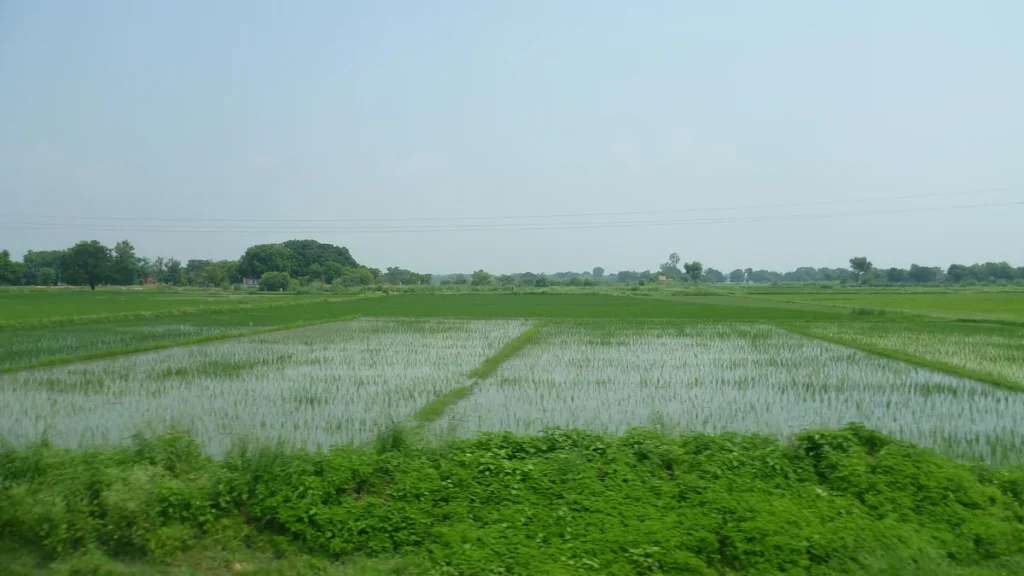
The roughly ₹4,000 crore World Bank-supported UP-AGREES project, which covers 28 districts of eastern UP and Bundelkhand, has signed MoUs with Google and Network for Humanity, ITC and Aquabridge in the presence of Chief Minister Yogi Adityanath. The aim is to move farming beyond higher output to better incomes, through an open digital network for farmers, climate-smart crop clusters and technology-led fish farming.
- Cost
- ₹4,000 crore (approx.)
- Coverage
- 28 districts, 123 blocks
- Farmers
- about 10 lakh
- Area
- about 6 lakh ha
UP-AGREES: what happened?
For years farm success was measured in tonnes of grain. UP-AGREES asks a different question: how much does the farmer actually earn? The new agreements show how the State wants to answer it.
- The UP Diversified Agriculture Support Project (UPDASP) signed MoUs with Google and Network for Humanity, ITC and Aquabridge (TOI, 20 Oct 2026).
- Google partnership: an Open Network for Agriculture, modelled on UPI and ONDC, giving weather, price, soil and advisory services in one place.
- ITC partnership: climate-resilient paddy and wheat clusters on over two lakh acres, including a 1,500-acre residue-compliant paddy cluster in Bahraich.
- Aquabridge partnership: AI-based fish farming and a 60-acre integrated aquaculture project in Unnao.
What is UP-AGREES?
- Full name: Uttar Pradesh Agriculture Growth and Rural Enterprise Ecosystem Strengthening project.
- It covers 21 districts of eastern UP and 7 of Bundelkhand, across 123 blocks.
- Targets: about 10 lakh farmers, 35,000 fish farmers and around 3 lakh women.
- About 1.75 lakh ha came under it in Kharif 2026, with IRRI helping trial Direct Seeded Rice on 3,000 ha.
How does the old model compare with UP-AGREES?
| Point | Production-first model | UP-AGREES approach |
|---|---|---|
| Goal | More grain | Higher farm income |
| Inputs | High water, urea and labour | DSR, zero tillage, need-based nutrients |
| Market | Local mandi | Value chains, processing, exports |
| Data | Scattered apps | One open digital network |
Which laws and rules apply?
- Agriculture (State List Entry 14) and fisheries (Entry 21) are State subjects.
- Article 293 lets States borrow only within India, so World Bank support reaches them through the Union.
- Maximum Residue Limits (MRLs) for pesticides are set under food safety law and by importing countries.
- Farm produce trade in UP is governed by the UP Krishi Utpadan Mandi Adhiniyam, 1964.
What are the concerns?
- Small and marginal farmers may lack smartphones or digital skills.
- Farm data shared with private firms needs clear consent and protection.
- Bundelkhand’s water stress makes yield gains harder.
- Pilots must scale up to reach 10 lakh farmers.
What should be done next?
- Work through FPOs and women’s groups so small farmers benefit.
- Set farmer-first data rules for the open agriculture network.
- Spread DSR and zero tillage with local demonstrations.
- Link clusters to the proposed Mega Food Park and Agri Export Centre near Noida International Airport.
What can Prelims ask?
- UP-AGREES: World Bank-supported; eastern UP and Bundelkhand.
- Implementing agency: UPDASP.
- Direct Seeded Rice saves water and cuts methane from flooded fields.
- IRRI South Asia Regional Centre (ISARC) is in Varanasi.
- Bundelkhand districts of UP: Jhansi, Lalitpur, Jalaun, Hamirpur, Mahoba, Banda, Chitrakoot.
How to write about UP-AGREES in Mains
Practice question (10 marks, 150 words): Discuss how UP-AGREES seeks to shift agriculture in eastern Uttar Pradesh and Bundelkhand from productivity to prosperity. (UPPCS GS-VI)
- Intro: ₹4,000 crore World Bank project; new MoUs.
- Pillars: technology, climate resilience, markets, enterprise.
- Examples: open agri network, Bahraich paddy cluster, Unnao aquaculture.
- Concerns: digital divide, data, water stress.
- Conclusion: farmer as a partner in the value chain.
Image: Rice fields in Uttar Pradesh. Radosław Botev, Wikimedia Commons, CC BY 3.0 PL
Read all of October 2026 in the monthly UP current affairs compilation →
How to use this in Mains
If asked: Examine the role of digital public infrastructure in transforming agriculture in Uttar Pradesh. (UPPCS GS-VI)
Quote: “The proposed platform draws inspiration from successful open digital infrastructure models such as UPI and ONDC.”
Use it: Use it to link the open agri network to India’s DPI story.
If asked: Discuss the potential of climate-smart agriculture for Bundelkhand and eastern UP. (UPPCS GS-VI)
Quote: “These interventions will include zero tillage, Direct Seeded Rice, climate-resilient improved seeds and decision-based nutrient management.”
Use it: List the practices, then tie them to water stress and input costs.
Exam angle
UPPCS GS-VI: UP agriculture and regional development; Prelims: UP-AGREES facts, DSR, ISARC Varanasi, Bundelkhand districts.
Practice MCQs
Original practice questions (not PYQs).
UP-AGREES, recently in the news, is supported by
Answer (b) & explanation
UP-AGREES is a World Bank-supported project for eastern UP and Bundelkhand.
The South Asia Regional Centre of the International Rice Research Institute (ISARC) is located in
Answer (c) & explanation
ISARC, the IRRI South Asia Regional Centre, is on the campus of the National Seed Research and Training Centre in Varanasi.
Consider the following statements about Direct Seeded Rice:
1. It avoids raising a nursery and transplanting seedlings.
2. It generally needs more irrigation water than transplanted paddy.
Which of the statements given above is/are correct?
Answer (a) & explanation
In DSR seeds are sown directly in the field, which saves water and labour, so statement 2 is wrong.
Questions students ask about this
What is UP-AGREES?
A World Bank-supported project of about Rs 4,000 crore to raise farm incomes in eastern UP and Bundelkhand.
Which companies signed MoUs?
Google with Network for Humanity, ITC and Aquabridge, with UPDASP.
What is the Open Network for Agriculture?
A proposed single digital platform, modelled on UPI and ONDC, for weather, price, soil and advisory services.
How many farmers will benefit?
About 10 lakh farmers, 35,000 fish farmers and around 3 lakh women.
Keep studying
Go deeper
facts from cited sources only; cross-checked; faculty review pending