
UPSC Mains 2013 GS Paper 3 Q16: model answer
(a) What is a digital signature? What does its authentication mean? Give various salient built-in features of a digital signature. (100 words) (b) How does the 3D printing technology work? List out the advantages and disadvantages of the technology. (100 words)
What the question wants
(a) Explain what a digital signature is, what authentication means, and its built-in features. (b) Explain how 3D printing works and list its advantages and disadvantages.
How to structure it
(a) What, authentication, features.
- Definition
- Authentication
- Salient features
(b) Process, pros, cons.
- How it works
- Advantages
- Disadvantages
How to think it through
(a) Based on public key cryptography (asymmetric keys). Signer hashes the document, encrypts the hash with private key; verifier decrypts with public key and compares hashes. Legal under IT Act 2000; certifying authorities under the Controller of Certifying Authorities. Features: authenticity, integrity, non-repudiation, time-stamping. (b) Additive manufacturing: CAD model sliced into layers; printer deposits material layer by layer (FDM plastic, SLA resin, SLS metal powder). Advantages: customisation, prototypes, less waste, complex shapes, medical implants, on-site printing. Disadvantages: slow for mass production, costly material, strength, IP piracy, printed weapons.
Model answer
(a)
A digital signature is an electronic code that proves who signed a document and that it was not changed. It uses public key cryptography.
What authentication means
- The signer makes a hash of the document and encrypts it with a private key.
- The receiver decrypts it with the signer's public key and compares it with a fresh hash.
- A match authenticates the signer and shows the document is unaltered.
- Under the IT Act, 2000, keys are certified by licensed Certifying Authorities.
Built-in features
- Authenticity: confirms the signer's identity.
- Integrity: any change breaks the match.
- Non-repudiation: the signer cannot deny signing.
- Time-stamping and secure, tamperevident storage.
It is the reason an income tax return can be filed without paper.
(b)
3D printing, or additive manufacturing, builds an object layer by layer from a digital design, instead of cutting it out of a block.
How it works
- A CAD model is sliced into thin layers by software.
- The printer deposits plastic, resin or metal powder, fusing each layer with heat or a laser.
Advantages
- Customisation: implants and prosthetics made for one patient.
- Rapid prototypes and complex shapes impossible by machining.
- Less waste of raw material.
- Printing on site: IIT Madras start-up Tvasta printed a house in 2021.
Disadvantages
- Slow and costly for mass production.
- Weaker parts in some materials.
- IP piracy and printed weapons.
- High energy use for metal printers.
It is best for making a few special things, not millions of ordinary ones.
Draw: (a) Two keys, a hashed document, and a match check. (b) A stack of thin layers forming an object.
Keywords, cases and data to drop in
(a) digital signature, public key cryptography, private key, hash, Certifying Authority, CCA, IT Act 2000, integrity, non-repudiation, DSC, e-Sign. (b) additive manufacturing, CAD, layer by layer, FDM, SLA, SLS, prosthetics, Tvasta, IP piracy, ghost guns.
Where most answers lose marks
- (a) Calling it a scanned signature image. (b) Listing only advantages.
Related Mains PYQs
- What is the basic principle behind vaccine development? How do vaccines work? What approaches were adopted by the Indian vaccine manufacturers to… UPSC 2022 · GS-III
- The increase in life expectancy in the country has led to newer health challenges in the community. What are those challenges and… UPSC 2022 · GS-III
- Each year a large amount of plant material, cellulose, is deposited on the surface of Planet Earth. What are the natural processes… UPSC 2022 · GS-III
- Launched on 25th December, 2021, James Webb Space Telescope has been much in the news since then. What are its unique features… UPSC 2022 · GS-III
Fresh examples from current affairs

DRDO’s indigenous AIP for Kalvari-class submarines reaches the Setting to Work Phase-2 stage
Diesel-electric submarines must come up often to run their engines and charge batteries, which can give away their position. Air Independent Propulsion (AIP) lets them stay underwater much longer. The DRDO’s Naval Materials Research Laboratory has built India’s own AIP, and its energy module began the Setting to Work Phase-2 activity at Larsen and Toubro’s Hazira yard on 24 October. For you, it links fuel cells, the Kalvari class and defence self-reliance.
UPSC angle: Prelims: AIP, fuel cells, Kalvari class, Project-75. · Mains GS-III: defence indigenisation; maritime security.
25 Oct 2026
Panel to review pharma marketing code: UCPMP 2024 and why a voluntary code is not enough
The Department of Pharmaceuticals has set up a committee under Dr. M. Srinivas, Member, NITI Aayog, to review how drug companies market medicines and to suggest ways to curb unethical practices, PIB said on 23 October 2026. Former Union Health Secretary Preeti Sudan and Dr. Naresh Trehan of Medanta are members, and the report is due within two months of its first meeting. The core issue: the Uniform Code for Pharmaceutical Marketing Practices is still voluntary.
UPSC angle: Prelims: UCPMP, Department of Pharmaceuticals, NITI Aayog. · Mains GS-II: health governance, regulation and ethics.
24 Oct 2026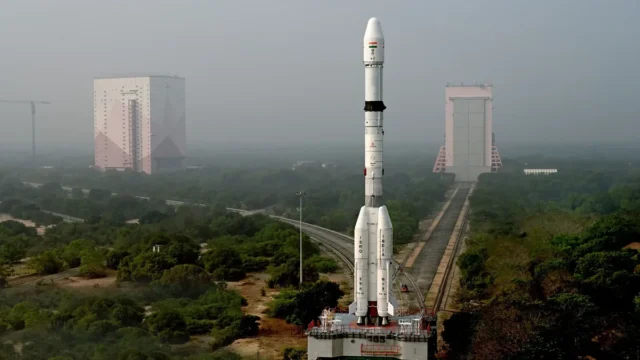
NVS-03 launch on 30 October: can ISRO’s new satellite bring NavIC back to life?
ISRO will launch NVS-03, its third new-generation navigation satellite, on 30 October 2026, The Indian Express reported on 24 October. NavIC, India’s own GPS-like system, has not been able to give location data because only three satellites work, while positioning needs at least four. If NVS-03 works, NavIC can offer positioning again. It is a lesson in why strategic technology needs both satellites and users.
UPSC angle: Prelims: NavIC/IRNSS, coverage, signals, global GNSS. · Mains GS-III: indigenisation of technology, space programme.
24 Oct 2026
Nasha Mukt Bharat Abhiyaan reaches 35 crore people: demand reduction and the 2029 drug-free goal
The Ministry of Social Justice and Empowerment said on 22 October 2026 that the Nasha Mukt Bharat Abhiyaan has reached over 35 crore people, including 13.94 crore youth and 10.86 crore women, and more than 32 lakh educational institutions. Launched on 15 August 2020 in 272 vulnerable districts, it now runs across the country. It is the demand side of a twin strategy, while police and the NCB attack supply, with the Home Minister’s target of uprooting the drug trade by 31 December 2029.
UPSC angle: Prelims: NMBA, NAPDDR, Article 47, NDPS Act, helpline 14446. · Mains GS-II/III: drug abuse, demand and supply reduction.
23 Oct 2026Learn the concept
Question text as printed in the official UPSC Civil Services (Main) question paper. The model answer is original Battle IAS work; use it to learn structure, not to memorise.
Want every PYQ in one place? See the Battle IAS PYQ Book.