
UPSC Mains 2020 GS Paper 3 Q15: model answer
COVID-19 pandemic has caused unprecedented devastation worldwide. However, technological advancements are being availed readily to win over the crisis. Give an account of how technology was sought to aid management of the pandemic.
What the question wants
Give an account of how technology was used to manage the COVID-19 pandemic.
How to structure it
Detect, track, treat, vaccinate, continue life.
- Testing
- Tracking and data
- Treatment and health care
- Vaccines and CoWIN
- Keeping life going
- Limits
How to think it through
Testing: RT-PCR scaled from one lab (NIV Pune) to thousands; indigenous kits (Mylab); TrueNat; pooled testing. Tracking: Aarogya Setu, ICMR portal, drones for surveillance and disinfection, GIS hotspot mapping. Treatment: eSanjeevani telemedicine (crores of consultations), oxygen tracking, ventilators by startups, PPE scaled from zero to world's second-largest maker. Vaccines: Covishield, Covaxin, ZyCoV-D; CoWIN platform, 220 crore doses, digital certificates. Life: online education (DIKSHA), DBT cash transfers, ONORC, UPI. Limits: digital divide, privacy concerns.
Model answer
In January 2020, India could test for the new coronavirus in just one laboratory, the National Institute of Virology in Pune. Within a year it had thousands of labs, Indian-made test kits and, soon after, a digital platform that delivered more than 220 crore vaccine doses. Technology turned a slow response into a fast one.
Testing and detection
- RT-PCR capacity scaled across the country; Mylab produced the first Indian kit.
- TrueNat machines, first made for TB, used in district hospitals.
- Pooled testing to save kits; rapid antigen tests for speed.
- Genome sequencing through INSACOG to track variants.
Tracking and data
- Aarogya Setu app for contact alerts.
- GIS mapping of hotspots and containment zones.
- Drones for surveillance and disinfection.
- Supercomputer models used to forecast case surges.
Treatment and health care
- eSanjeevani telemedicine, which went on to serve crores of consultations.
- Oxygen tracking and supply software during the second wave.
- PPE kits: India went from almost no production to one of the world's largest makers within months.
- Low-cost ventilators from startups and DRDO.
Vaccines
- Covishield, Covaxin and ZyCoV-D, the world's first DNA vaccine.
- CoWIN for registration, scheduling and digital certificates, later shared with other countries.
- Vaccine Maitri exports to partner countries.
Keeping life going
- Online education through DIKSHA and SWAYAM.
- Cash transfers to Jan Dhan accounts and free grain under PMGKAY via ONORC.
- UPI and e-commerce for contact-free payments.
Limits
- Digital divide: many poor and rural people could not use apps or online classes.
- Privacy concerns over Aarogya Setu data.
- Misinformation spread online as fast as the virus.
Technology did not stop the virus, but it made India's fight against it faster, wider and fairer than it would otherwise have been.
Draw: A timeline: Jan 2020 one lab → mid-2020 PPE and testing scale-up → 2021 CoWIN vaccination.
Keywords, cases and data to drop in
NIV Pune, RT-PCR, Mylab, TrueNat, INSACOG, Aarogya Setu, eSanjeevani, PPE scale-up, Covaxin, ZyCoV-D, CoWIN, 220 crore doses, Vaccine Maitri, DIKSHA, ONORC, digital divide.
Where most answers lose marks
- Listing apps only. Cover testing, treatment and vaccines too.
Related Mains PYQs
- What is the basic principle behind vaccine development? How do vaccines work? What approaches were adopted by the Indian vaccine manufacturers to… UPSC 2022 · GS-III
- The increase in life expectancy in the country has led to newer health challenges in the community. What are those challenges and… UPSC 2022 · GS-III
- Each year a large amount of plant material, cellulose, is deposited on the surface of Planet Earth. What are the natural processes… UPSC 2022 · GS-III
- Launched on 25th December, 2021, James Webb Space Telescope has been much in the news since then. What are its unique features… UPSC 2022 · GS-III
Fresh examples from current affairs

DRDO’s indigenous AIP for Kalvari-class submarines reaches the Setting to Work Phase-2 stage
Diesel-electric submarines must come up often to run their engines and charge batteries, which can give away their position. Air Independent Propulsion (AIP) lets them stay underwater much longer. The DRDO’s Naval Materials Research Laboratory has built India’s own AIP, and its energy module began the Setting to Work Phase-2 activity at Larsen and Toubro’s Hazira yard on 24 October. For you, it links fuel cells, the Kalvari class and defence self-reliance.
UPSC angle: Prelims: AIP, fuel cells, Kalvari class, Project-75. · Mains GS-III: defence indigenisation; maritime security.
25 Oct 2026
Panel to review pharma marketing code: UCPMP 2024 and why a voluntary code is not enough
The Department of Pharmaceuticals has set up a committee under Dr. M. Srinivas, Member, NITI Aayog, to review how drug companies market medicines and to suggest ways to curb unethical practices, PIB said on 23 October 2026. Former Union Health Secretary Preeti Sudan and Dr. Naresh Trehan of Medanta are members, and the report is due within two months of its first meeting. The core issue: the Uniform Code for Pharmaceutical Marketing Practices is still voluntary.
UPSC angle: Prelims: UCPMP, Department of Pharmaceuticals, NITI Aayog. · Mains GS-II: health governance, regulation and ethics.
24 Oct 2026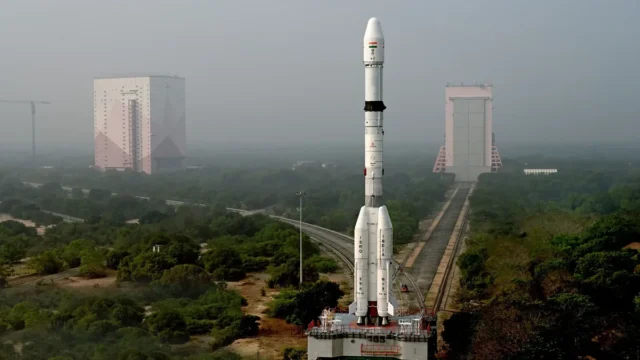
NVS-03 launch on 30 October: can ISRO’s new satellite bring NavIC back to life?
ISRO will launch NVS-03, its third new-generation navigation satellite, on 30 October 2026, The Indian Express reported on 24 October. NavIC, India’s own GPS-like system, has not been able to give location data because only three satellites work, while positioning needs at least four. If NVS-03 works, NavIC can offer positioning again. It is a lesson in why strategic technology needs both satellites and users.
UPSC angle: Prelims: NavIC/IRNSS, coverage, signals, global GNSS. · Mains GS-III: indigenisation of technology, space programme.
24 Oct 2026
Nasha Mukt Bharat Abhiyaan reaches 35 crore people: demand reduction and the 2029 drug-free goal
The Ministry of Social Justice and Empowerment said on 22 October 2026 that the Nasha Mukt Bharat Abhiyaan has reached over 35 crore people, including 13.94 crore youth and 10.86 crore women, and more than 32 lakh educational institutions. Launched on 15 August 2020 in 272 vulnerable districts, it now runs across the country. It is the demand side of a twin strategy, while police and the NCB attack supply, with the Home Minister’s target of uprooting the drug trade by 31 December 2029.
UPSC angle: Prelims: NMBA, NAPDDR, Article 47, NDPS Act, helpline 14446. · Mains GS-II/III: drug abuse, demand and supply reduction.
23 Oct 2026Learn the concept
Question text as printed in the official UPSC Civil Services (Main) question paper. The model answer is original Battle IAS work; use it to learn structure, not to memorise.
Want every PYQ in one place? See the Battle IAS PYQ Book.