
UPSC Mains 2022 GS Paper 3 Q6: model answer
Each year a large amount of plant material, cellulose, is deposited on the surface of Planet Earth. What are the natural processes this cellulose undergoes before yielding carbon dioxide, water, and other end products?
What the question wants
Explain the natural processes cellulose goes through before turning into carbon dioxide, water and other end products.
How to structure it
Process step by step.
- What cellulose is
- Breakdown by microbes
- Aerobic route
- Anaerobic route
- Other routes and significance
How to think it through
Cellulose: polymer of beta-glucose, most abundant organic compound. Decomposition: fragmentation by detritivores (earthworms, termites); enzymatic hydrolysis by cellulases from fungi (Trichoderma) and bacteria into cellobiose, glucose; aerobic respiration: glucose → CO2 + H2O + energy; anaerobic: fermentation → organic acids, alcohols, methane (methanogens) in wetlands, rumen; humification into soil organic matter; fire combustion. Significance: carbon cycle, soil fertility; biofuels.
Model answer
Every autumn, forests drop billions of tonnes of leaves. Most of it is cellulose, the most abundant organic compound on Earth. Within a few years, nearly all of it has vanished back into the air and soil.
What cellulose is
- A long chain of glucose units in plant cell walls; very tough to break.
The natural processes
- Fragmentation: earthworms, termites and insects chew litter into small pieces.
- Enzyme action: fungi such as *Trichoderma* and bacteria release cellulases that cut cellulose into cellobiose and then glucose.
- Aerobic decomposition: microbes respire glucose with oxygen into carbon dioxide, water and energy.
- Anaerobic decomposition in wetlands, paddy fields and animal guts: fermentation gives organic acids and alcohols, then methane from methanogens.
- Humification: part becomes stable humus, storing carbon in soil.
- Lignin around cellulose slows decay, so wood rots more slowly than leaves.
- Fire burns it directly to CO2.
Why it matters
- Returns carbon to the carbon cycle and nutrients to soil.
- Basis of 2G ethanol and biogas.
- Methane from paddy fields and cattle is a strong greenhouse gas.
Rotting leaves are one of nature's largest recycling plants.
Draw: A flow: leaf litter → fragments → glucose → CO2 + H2O (or CH4), with humus branching off.
Keywords, cases and data to drop in
cellulose, beta-glucose, detritivores, cellulase, Trichoderma, aerobic respiration, fermentation, methanogens, humus, carbon cycle, 2G ethanol.
Where most answers lose marks
- Writing about plastics or deforestation; this is a biology question.
Related Mains PYQs
- What is the basic principle behind vaccine development? How do vaccines work? What approaches were adopted by the Indian vaccine manufacturers to… UPSC 2022 · GS-III
- The increase in life expectancy in the country has led to newer health challenges in the community. What are those challenges and… UPSC 2022 · GS-III
- Launched on 25th December, 2021, James Webb Space Telescope has been much in the news since then. What are its unique features… UPSC 2022 · GS-III
- How is S-400 air defence system technically superior to any other system presently available in the world? UPSC 2021 · GS-III
Fresh examples from current affairs

DRDO’s indigenous AIP for Kalvari-class submarines reaches the Setting to Work Phase-2 stage
Diesel-electric submarines must come up often to run their engines and charge batteries, which can give away their position. Air Independent Propulsion (AIP) lets them stay underwater much longer. The DRDO’s Naval Materials Research Laboratory has built India’s own AIP, and its energy module began the Setting to Work Phase-2 activity at Larsen and Toubro’s Hazira yard on 24 October. For you, it links fuel cells, the Kalvari class and defence self-reliance.
UPSC angle: Prelims: AIP, fuel cells, Kalvari class, Project-75. · Mains GS-III: defence indigenisation; maritime security.
25 Oct 2026
Panel to review pharma marketing code: UCPMP 2024 and why a voluntary code is not enough
The Department of Pharmaceuticals has set up a committee under Dr. M. Srinivas, Member, NITI Aayog, to review how drug companies market medicines and to suggest ways to curb unethical practices, PIB said on 23 October 2026. Former Union Health Secretary Preeti Sudan and Dr. Naresh Trehan of Medanta are members, and the report is due within two months of its first meeting. The core issue: the Uniform Code for Pharmaceutical Marketing Practices is still voluntary.
UPSC angle: Prelims: UCPMP, Department of Pharmaceuticals, NITI Aayog. · Mains GS-II: health governance, regulation and ethics.
24 Oct 2026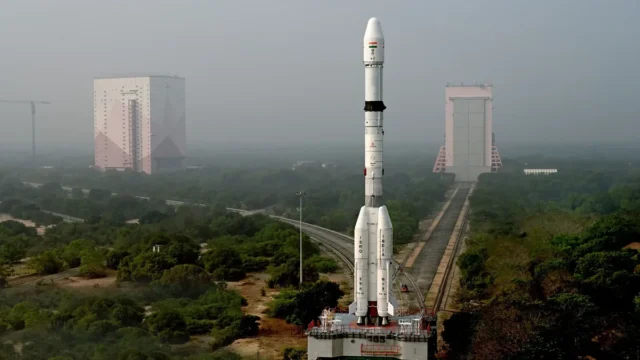
NVS-03 launch on 30 October: can ISRO’s new satellite bring NavIC back to life?
ISRO will launch NVS-03, its third new-generation navigation satellite, on 30 October 2026, The Indian Express reported on 24 October. NavIC, India’s own GPS-like system, has not been able to give location data because only three satellites work, while positioning needs at least four. If NVS-03 works, NavIC can offer positioning again. It is a lesson in why strategic technology needs both satellites and users.
UPSC angle: Prelims: NavIC/IRNSS, coverage, signals, global GNSS. · Mains GS-III: indigenisation of technology, space programme.
24 Oct 2026
Nasha Mukt Bharat Abhiyaan reaches 35 crore people: demand reduction and the 2029 drug-free goal
The Ministry of Social Justice and Empowerment said on 22 October 2026 that the Nasha Mukt Bharat Abhiyaan has reached over 35 crore people, including 13.94 crore youth and 10.86 crore women, and more than 32 lakh educational institutions. Launched on 15 August 2020 in 272 vulnerable districts, it now runs across the country. It is the demand side of a twin strategy, while police and the NCB attack supply, with the Home Minister’s target of uprooting the drug trade by 31 December 2029.
UPSC angle: Prelims: NMBA, NAPDDR, Article 47, NDPS Act, helpline 14446. · Mains GS-II/III: drug abuse, demand and supply reduction.
23 Oct 2026Learn the concept
Question text as printed in the official UPSC Civil Services (Main) question paper. The model answer is original Battle IAS work; use it to learn structure, not to memorise.
Want every PYQ in one place? See the Battle IAS PYQ Book.