
Money Bill (Article 110): Definition, Procedure, Rajya Sabha’s Role and the Aadhaar Controversy (UPSC Notes + PYQs)
UPSC has already asked about this. Read the story with these questions in mind.
- Prelims 2013What will follow if a Money Bill is substantially amended by the Rajya Sabha?Solve it below ↓
- Prelims 2015Consider the following statements: The Rajya Sabha has no power either to reject or to amend a Money Bill. …Solve it below ↓
See all 5 PYQs
- Prelims 2018Regarding Money Bill, which of the following statements is not correct?Solve it below ↓
- Prelims 2023With reference to Finance Bill and Money Bill in the Indian Parliament, consider the following statementsSolve it below ↓
- Prelims 2024Which of the following statements are correct in respect of a Money Bill in the Parliament ?Solve with answer →
Background: why the Lok Sabha controls money
The principle that the elected House controls taxation goes back to British constitutional history, where the House of Commons won the power of the purse from the Crown, and the Parliament Act, 1911 curbed the House of Lords on money Bills. India adopted the same idea: the Lok Sabha, directly elected, has the final word on taxes and spending, while the Rajya Sabha, representing States, can only delay a Money Bill by 14 days. The Constitution defines a Money Bill narrowly in Article 110, and the Speaker’s certificate decides whether a Bill qualifies.
What makes a Bill a Money Bill
Article 110(1) lists the matters: imposing or changing a tax; borrowing by the government; custody of and payments into or out of the Consolidated Fund or Contingency Fund; appropriation; declaring any expenditure charged on the Consolidated Fund; receipts and audit of public money; and anything incidental. The key word is “only”: the Bill must contain only these matters. Fines, licence fees or local taxes do not make a Bill a Money Bill.
Procedure
- Introduced only in the Lok Sabha, on the President’s recommendation.
- Rajya Sabha cannot reject or amend it; it returns the Bill with or without recommendations within 14 days.
- Lok Sabha may accept or reject those recommendations.
- If not returned in 14 days, it is deemed passed by both Houses.
- No joint sitting is possible or needed.
- The President may give or withhold assent but cannot return it for reconsideration.
- 1Introduced in Lok Sabha on President's recommendation
- 2Passed by Lok Sabha; Speaker certifies it
- 3Rajya Sabha may recommend changes within 14 days
- 4Lok Sabha accepts or rejects recommendations
- 5Sent to the President, who cannot return it
Money Bill vs Financial Bills
| Point | Money Bill (Art. 110) | Financial Bill (I) (Art. 117(1)) | Financial Bill (II) (Art. 117(3)) |
|---|---|---|---|
| Contents | Only Art. 110 matters | Art. 110 matters plus other matters | Spending from the Consolidated Fund, no Art. 110 matter |
| Where introduced | Lok Sabha only | Lok Sabha only | Either House |
| Rajya Sabha | Recommendations only | Full powers, can amend or reject | Full powers |
| Joint sitting | Not possible | Possible | Possible |
- TaxesImposition, abolition, change
- BorrowingRegulation of government borrowing
- Consolidated FundCustody, payments in and out
- AppropriationMoney out of the Consolidated Fund
- Charged expenditureDeclaring or increasing it
- IncidentalMatters incidental to the above
The Speaker’s certificate and the courts
Article 110(3) makes the Speaker’s decision final. In K.S. Puttaswamy (Aadhaar, 2018) the majority upheld the Aadhaar Act as a Money Bill; Justice Chandrachud dissented, calling it a “fraud on the Constitution”. In Rojer Mathew (2019) a five-judge bench doubted that reasoning and referred the question to a larger bench, which is still pending. The issue matters because using the Money Bill route bypasses the Rajya Sabha.
Money Bill, Financial Bill (I) and Financial Bill (II)
| Feature | Money Bill (Art. 110) | Financial Bill (I) (Art. 117(1)) | Financial Bill (II) (Art. 117(3)) |
|---|---|---|---|
| Contents | Only Article 110 matters | Article 110 matters plus other matters | Involves expenditure from the Consolidated Fund |
| Introduced in | Lok Sabha only | Lok Sabha only | Either House |
| President’s recommendation | Needed to introduce | Needed to introduce | Needed for consideration |
| Rajya Sabha power | Recommend within 14 days | Full power, like an ordinary Bill | Full power |
| Joint sitting | Not possible | Possible | Possible |
The Aadhaar and Rojer Mathew controversy
In K.S. Puttaswamy (Aadhaar) (2018) the majority upheld the Aadhaar Act, 2016 as a Money Bill because its core was the use of the Consolidated Fund for subsidies. Justice D.Y. Chandrachud dissented, calling its passage as a Money Bill “a fraud on the Constitution”. In Rojer Mathew (2019), concerning tribunal provisions in the Finance Act, 2017, a five-judge bench doubted the Aadhaar reasoning and referred the question of Money Bills to a larger bench. The issue matters because certifying a Bill as a Money Bill sidesteps the Rajya Sabha.
Why it matters for Mains
- Bicameralism: misuse of the Money Bill route weakens the Rajya Sabha and the voice of States.
- Judicial review: Article 110(3) makes the Speaker’s decision “final”, but courts have read finality as not excluding review for constitutional illegality.
- Reform ideas: clear guidelines for certification, or consultation with a committee before certifying.
Money Bill: UPSC angle
For UPSC CSE
Prelims: 14 days, who certifies, Money vs Financial Bill, President’s options. Mains GS-II: Money Bill route and the Rajya Sabha’s role; judicial review of the Speaker’s certificate.
Money Bill UPSC PYQs (Prelims)
Questions UPSC has actually asked, from the official papers. Pick an option to check yourself.
What will follow if a Money Bill is substantially amended by the Rajya Sabha?
The Rajya Sabha can only recommend changes to a Money Bill, within 14 days. The Lok Sabha is free to accept or reject them, and the Bill is then deemed passed by both Houses (Art. 109). There is no joint sitting on a Money Bill. Answer as per the official UPSC key · Battle IAS PYQ bankAnswer (a) & why
Consider the following statements :
– 1. The Rajya Sabha has no power either to reject or to amend a Money Bill.
– 2. The Rajya Sabha cannot vote on the Demands for Grants.
– 3. The Rajya Sabha cannot discuss the Annual Financial Statement.
Which of the statements given above is/are correct?
On a Money Bill the Rajya Sabha can only recommend, within 14 days (Article 109). Demands for Grants are voted only in the Lok Sabha (Article 113). But the Budget is laid before both Houses (Article 112), and the Rajya Sabha debates it. Answer as per the official UPSC key · Battle IAS PYQ bankAnswer (b) & why
Regarding Money Bill, which of the following statements is not correct?
Article 110(1) covers taxes, borrowing, custody of the Consolidated and Contingency Funds, and appropriation out of the Consolidated Fund. The Contingency Fund is at the President’s disposal for urgent spending. Withdrawals from it need no appropriation Bill. Answer as per the official UPSC key · Battle IAS PYQ bankAnswer (c) & why
With reference to Finance Bill and Money Bill in the Indian Parliament, consider the following statements :
– 1. When the Lok Sabha transmits Finance Bill to the Rajya Sabha, it can amend or reject the Bill.
– 2. When the Lok Sabha transmits Money Bill to the Rajya Sabha, it cannot amend or reject the Bill, it can only make recommendations.
– 3. In the case of disagreement between the Lok Sabha and the Rajya Sabha, there is no joint sitting for Money Bill, but a joint sitting becomes necessary for Finance Bill.
How many of the above statements are correct?
A Finance Bill that is not a Money Bill goes through the Rajya Sabha like an ordinary Bill, so the Rajya Sabha can amend or reject it. A Money Bill can only get recommendations. There is no joint sitting for a Money Bill. For a Finance Bill a joint sitting is possible, but it is not “necessary”. Two are correct. Answer as per the official UPSC key · Battle IAS PYQ bankAnswer (b) & why
Mains PYQs on this topic
No UPSC Mains question from 2023-2026 is directly on this topic. Older papers (2013-2022) will be added as the Mains bank grows.
Quick quiz
Within how many days must the Rajya Sabha return a Money Bill?
Otherwise it is deemed passed.Answer (b)
Who decides whether a Bill is a Money Bill?
Article 110(3).Answer (c)
Which of these can be introduced in the Rajya Sabha?
Financial Bill (II) is treated like an ordinary Bill except for presidential recommendation for consideration.Answer (c)
FAQs
Can the President return a Money Bill?
No. The President can only assent or withhold assent.
Can the Rajya Sabha amend a Money Bill?
No. It can only recommend changes, which the Lok Sabha may ignore.
Is the Speaker’s certificate subject to judicial review?
The Constitution calls it final, but the Supreme Court examined it in the Aadhaar case, and a larger bench is to settle the question.
Is the Finance Bill a Money Bill?
Usually it is certified as a Money Bill because it contains the tax proposals of the Budget.
Is every Finance Bill a Money Bill?
Not necessarily. A Finance Bill is usually certified as a Money Bill, but one that contains other matters may be a Financial Bill (I).
Which case referred the Money Bill question to a larger bench?
Rojer Mathew v South Indian Bank (2019).
Spotted an error? Tell us. We correct within 48 hours.
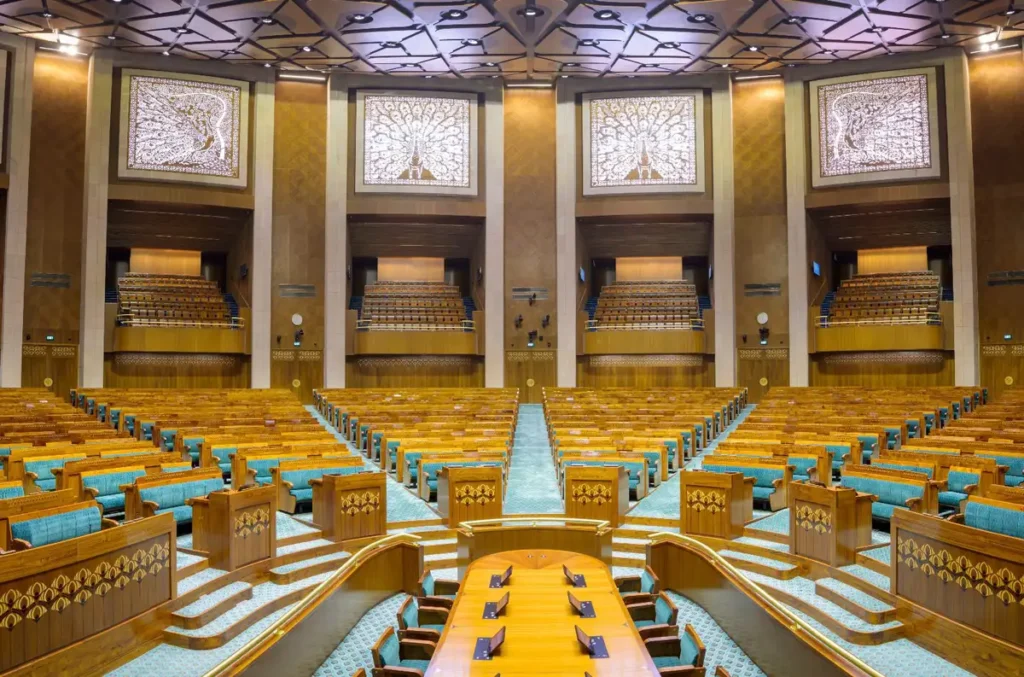
Image: Ministry of Parliamentary Affairs, Wikimedia Commons, GODL-India
How to use this in Mains
If asked: Does the Money Bill route weaken the Rajya Sabha? Discuss. (GS-II)
Quote: “Bicameralism: misuse of the Money Bill route weakens the Rajya Sabha and the voice of States.”
Use it: Use as your federalism argument.
In the news

Supreme Court: no prior approval under Section 17A needed to probe a bribe demand
In a judgment of 16 October 2026, a Supreme Court Bench of Justices S.V.N. Bhatti and N.V. Anjaria held that investigating a bribe demand by a public servant does not need prior approval under Section 17A of the Prevention of Corruption Act. Asking for a bribe, the court said, is not part of discharging official duties.
19 Oct 2026
CCPA acts against online sale of explosives: 3,940 sellers delisted from seven platforms
The Central Consumer Protection Authority (CCPA) said on 19 October 2026 that 3,940 sellers of regulated explosives such as ammonium nitrate, picric acid and PETN have been delisted from seven online platforms after its action. It has fined Dial4Trade and ExportersIndia ₹10 lakh per order, and other cases are under hearing or investigation.
19 Oct 2026
India to host 61st CIML meeting on legal metrology in New Delhi, 26–28 October
India will host the 61st meeting of the International Committee of Legal Metrology (CIML) for the first time, in New Delhi from 26 to 28 October 2026. The Department of Consumer Affairs is organising it with the International Organization of Legal Metrology (OIML), and more than 100 delegates are expected, PIB said on 19 October.
19 Oct 2026
NMC withdraws MSMER-2023: medical colleges lose the fixed penalty rulebook, annual disclosure stays
The National Medical Commission (NMC) has de-notified the Maintenance of Standards of Medical Education Regulations, 2023 (MSMER-2023) by a notification dated 14 October 2026, published in the Gazette on 16 October. Its fixed penalties, including seat cuts and fines of up to ₹5 lakh for false records, go with it. The Annual Disclosure Report stays.
19 Oct 2026