
Collegium System of Appointing Judges: Three Judges Cases, NJAC Verdict and Reform Debate (UPSC Notes + PYQs)
UPSC has already asked about this. Read the story with these questions in mind.
- Prelims 2019Consider the following statements: The motion to impeach a Judge of the Supreme Court of India cannot be rejected by the Speaker of the…Solve it below ↓
- Mains 2025 · GS2Discuss the evolution of collegium system in India. Critically examine the advantages and disadvantages of the system of appointment of the Judges of the…See model answer →
Background: why appointments matter
Who picks the judges decides, over time, what kind of judiciary a country has. The framers wanted judges who were independent of the government of the day yet not a closed club accountable to nobody. They rejected two models: appointment by the executive alone, as in the UK of that time, and confirmation by the legislature, as in the United States, which they feared would politicise the Bench. Instead, they gave the formal power to the President, which in practice means the Union Cabinet, but tied it to “consultation” with the Chief Justice of India and other judges. For the first four decades the executive had the final word. Supersession of senior judges in 1973 and 1977 and mass transfers during the Emergency convinced many that executive primacy threatened independence. The collegium grew out of that experience, built not by Parliament but by the Supreme Court itself through interpretation.
What the Constitution says
Article 124(2) says the President appoints Supreme Court judges “after consultation with” judges as the President deems necessary, and the CJI must always be consulted for other judges. Article 217 has a similar rule for High Courts, adding the Governor.
The three Judges cases
| Case | Year | Held |
|---|---|---|
| S.P. Gupta (First) | 1981 | “Consultation” does not mean concurrence; executive primacy |
| SC Advocates-on-Record Assn (Second) | 1993 | CJI’s opinion has primacy, formed with two senior judges: the collegium is born |
| Presidential Reference (Third) | 1998 | Collegium expanded to CJI + four senior-most judges |
- 1950Article 124: consultation with CJI
- 1981First Judges case: executive primacy
- 1993Second Judges case: collegium born
- 1998Third Judges case: CJI + four judges
- 201499th Amendment creates NJAC
- 2015Fourth Judges case strikes down NJAC
The NJAC episode
The 99th Amendment (2014) and the NJAC Act set up a six-member National Judicial Appointments Commission: the CJI, two senior judges, the Law Minister and two eminent persons. In October 2015 a five-judge bench struck it down 4-1, holding that judicial primacy in appointments protects judicial independence, a basic feature.
Criticism
- Opaque: no published criteria or reasons for most decisions.
- “Judges appointing judges”, which no other major democracy follows in this form.
- Delays because the Memorandum of Procedure is still not finalised and the government sits on files.
- Low representation of women and some regions and communities.
How the collegium works in practice
For the Supreme Court, the collegium is the CJI and the four senior-most judges. For a High Court, the proposal starts with that court’s Chief Justice and two senior-most judges, then goes through the State government and the Governor to the Union Law Ministry, which adds Intelligence Bureau inputs and sends the file to the Supreme Court collegium. The SC collegium also consults judges who come from that High Court. The government may return a name once for reconsideration; if the collegium reiterates it, the government is bound to appoint, though no time limit is fixed in the Constitution. Transfers of High Court judges and Chief Justices are decided the same way. The procedural rules are set out in the Memorandum of Procedure (MoP) of 1998-99, which the Union and the judiciary have been revising since 2015 without agreeing on a final text.
| Stage | Supreme Court judge | High Court judge |
|---|---|---|
| Initiated by | CJI and collegium of five | HC Chief Justice and two senior-most judges |
| State’s role | None | Chief Minister and Governor give views |
| Union’s role | Law Ministry processes; may send back once | Law Ministry adds IB report; may send back once |
| Final say | Collegium on reiteration | SC collegium of three senior-most on reiteration |
| Formal appointment | President under Article 124(2) | President under Article 217 |
- 1HC collegium recommends names
- 2State government and Governor give views
- 3Union Law Ministry adds IB inputs
- 4SC collegium approves or rejects
- 5President issues warrant of appointment
Reform ideas
Publishing collegium resolutions (begun in 2017), a finalised Memorandum of Procedure with time limits, a permanent secretariat, written criteria, and greater diversity. Some argue for a revised NJAC with judicial majority.
How other democracies appoint judges
| Country | Method | Lesson for India |
|---|---|---|
| United States | President nominates, Senate confirms | Open hearings, but highly partisan |
| United Kingdom | Independent Judicial Appointments Commission and a selection commission for the Supreme Court | Mixed body with lay members and published criteria |
| South Africa | Judicial Service Commission with judges, lawyers, legislators; public interviews | Transparency through open interviews |
| Germany | Constitutional judges elected by the two houses with two-thirds majority | Supermajority forces consensus |
No major democracy leaves appointments entirely to sitting judges. That is the core of the criticism of the collegium, but the Indian answer has been that the executive is the biggest litigant before Indian courts, so its control must be limited.
Arguments for and against the collegium
- For: insulates appointments from political pressure; judges know the competence of lawyers and lower-court judges best; the Supreme Court held judicial primacy part of the basic structure; it has made some reforms, such as publishing resolutions and the reasons for some choices.
- Against: no written eligibility criteria; no secretariat or record of how candidates are assessed; charges of nepotism (“uncle judges”); conflict between seniority and merit; the government delays files it dislikes, so the system is neither fully judicial nor fully accountable; diversity of gender, caste and region remains limited.
Way forward for Mains
A good Mains answer avoids choosing between “judges only” and “executive only”. It can suggest: a finalised MoP with time limits for both the collegium and the government; a permanent secretariat to maintain data on candidates; published criteria covering judgments, disposal record and integrity; consultation with the Bar; and conscious attention to diversity. If a commission is tried again, the Fourth Judges case suggests it would survive only if the judicial members keep a decisive voice. The real test is whether appointments become predictable, reasoned and timely, because vacancies directly feed the backlog of cases.
Collegium System: UPSC angle
For UPSC CSE
Prelims: composition, which case created it, 99th Amendment. Mains GS-II: judicial independence vs accountability; reform of appointments.
Collegium System UPSC PYQs (Prelims)
Questions UPSC has actually asked, from the official papers. Pick an option to check yourself.
Consider the following statements :
– 1. The motion to impeach a Judge of the Supreme Court of India cannot be rejected by the Speaker of the Lok Sabha as per the Judges (Inquiry) Act, 1968.
– 2. The Constitution of India defines and gives details of what constitutes 'incapacity and proved misbehaviour' of the Judges of the Supreme Court of India.
– 3. The details of the process of impeachment of the Judges of the Supreme Court of India are given in the Judges (Inquiry) Act, 1968.
– 4. If the motion for the impeachment of a Judge is taken up for voting, the law requires the motion to be backed by each House of the Parliament and supported by a majority of total membership of that House and by not less than two-thirds of total members of that House present and voting.
Which of the statements given above is/are correct?
Under Section 3 of the Judges (Inquiry) Act, the Speaker or Chairman may admit or refuse the motion. The Constitution uses “proved misbehaviour or incapacity” but does not define them. The procedure is in the Act. Article 124(4) sets the special majority in each House. Answer as per the official UPSC key · Battle IAS PYQ bankAnswer (c) & why
Which one of the following statements is correct?
The Governor holds office during the pleasure of the President (Art. 156), and the Constitution lays down no removal procedure or grounds. One person can be Governor of two or more States (7th Amendment), High Court judges are appointed by the President, and a UT Chief Minister is appointed by the President. Answer as per the official UPSC key · Battle IAS PYQ bankAnswer (c) & why
Mains PYQs on this topic
Questions from the official UPSC Mains papers (2023-2026 in the Battle IAS Mains bank), newest first. Each links to a model answer.
- UPSC Mains 2025 · GS Paper II · Q13 · 15 marks
Discuss the evolution of collegium system in India. Critically examine the advantages and disadvantages of the system of appointment of the Judges of the Supreme Court of India and that of the USA.
Quick quiz
The collegium for Supreme Court appointments consists of
Third Judges case, 1998.Answer (b)
The NJAC was struck down in
October 2015, 4-1.Answer (b)
Which Constitutional Amendment created the NJAC?
99th Amendment, 2014.Answer (b)
FAQs
Is the collegium system mentioned in the Constitution?
No. It developed through Supreme Court judgments in 1993 and 1998.
Who appoints Supreme Court judges?
The President, on the collegium’s recommendation.
Can the government return a collegium recommendation?
Yes, once. If the collegium reiterates the name, it is binding by convention.
What is the Memorandum of Procedure?
The document that sets out the steps for appointments; its revision has been pending since 2015.
Is the collegium mentioned in the Constitution?
No. The word does not appear in the Constitution; the system was created by the Supreme Court’s interpretation of ‘consultation’ in the Second and Third Judges cases.
Can the government reject a collegium recommendation?
It can return a name once for reconsideration. If the collegium reiterates the name, the government is bound to appoint, though in practice it sometimes delays.
What is the Memorandum of Procedure?
An agreed document between the government and the judiciary that sets out the steps, timelines and roles in appointing and transferring judges.
Spotted an error? Tell us. We correct within 48 hours.
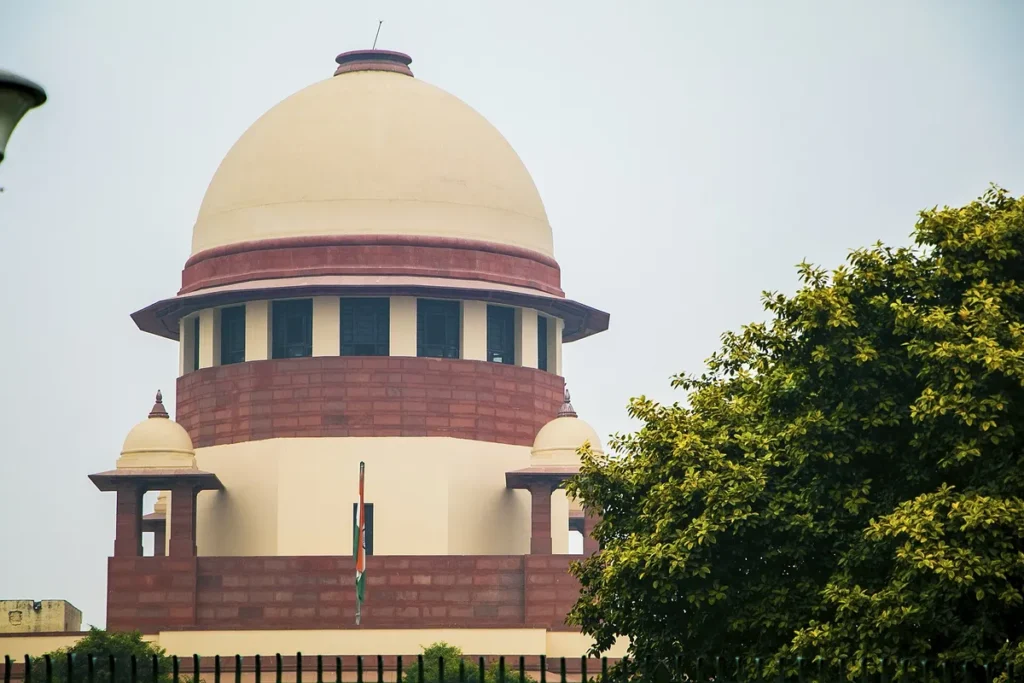
Image: Subhashish Panigrahi, Wikimedia Commons, CC BY-SA 4.0
How to use this in Mains
If asked: UPSC Mains 2025, GS-II: Discuss the evolution of collegium system in India. Critically examine the advantages and disadvantages of the system of appointment of the Judges of the Supreme Court of India and that of the USA.
Quote: “Opaque: no published criteria or reasons for most decisions.”
Use it: Your first criticism of the collegium.
In the news

Supreme Court: no prior approval under Section 17A needed to probe a bribe demand
In a judgment of 16 October 2026, a Supreme Court Bench of Justices S.V.N. Bhatti and N.V. Anjaria held that investigating a bribe demand by a public servant does not need prior approval under Section 17A of the Prevention of Corruption Act. Asking for a bribe, the court said, is not part of discharging official duties.
19 Oct 2026
CCPA acts against online sale of explosives: 3,940 sellers delisted from seven platforms
The Central Consumer Protection Authority (CCPA) said on 19 October 2026 that 3,940 sellers of regulated explosives such as ammonium nitrate, picric acid and PETN have been delisted from seven online platforms after its action. It has fined Dial4Trade and ExportersIndia ₹10 lakh per order, and other cases are under hearing or investigation.
19 Oct 2026
India to host 61st CIML meeting on legal metrology in New Delhi, 26–28 October
India will host the 61st meeting of the International Committee of Legal Metrology (CIML) for the first time, in New Delhi from 26 to 28 October 2026. The Department of Consumer Affairs is organising it with the International Organization of Legal Metrology (OIML), and more than 100 delegates are expected, PIB said on 19 October.
19 Oct 2026
NMC withdraws MSMER-2023: medical colleges lose the fixed penalty rulebook, annual disclosure stays
The National Medical Commission (NMC) has de-notified the Maintenance of Standards of Medical Education Regulations, 2023 (MSMER-2023) by a notification dated 14 October 2026, published in the Gazette on 16 October. Its fixed penalties, including seat cuts and fines of up to ₹5 lakh for false records, go with it. The Annual Disclosure Report stays.
19 Oct 2026