
Tribunals in India: Articles 323A and 323B, Key Tribunals, Independence Concerns and the 2021 Reforms Act (UPSC Notes + PYQs)
UPSC has already asked about this. Read the story with these questions in mind.
- Prelims 2012The National Green Tribunal Act, 2010 was enacted in consonance with which of the following provisions of the Constitution of India?Solve it below ↓
- Mains 2024 · GS2Explain and distinguish between Lok Adalats and Arbitration Tribunals. Whether they entertain civil as well as criminal cases?See model answer →
See all 4 PYQs
- Prelims 2019Consider the following statements: Petroleum and Natural Gas Regulatory Board (PNGRB) is the first regulatory body set up by the Government of India. …Solve with answer →
- Mains 2025 · GS2Comment on the need of administrative tribunals as compared to the court system. Assess the impact of the recent tribunal reforms through rationalization of…See model answer →
Background: how tribunals entered the Constitution
Tribunals existed in India before 1976, for instance the Income Tax Appellate Tribunal set up in 1941. But they received constitutional status only through the 42nd Amendment (1976), which added Part XIV-A with Articles 323A and 323B. The Swaran Singh Committee had recommended them to reduce the load on High Courts, especially in service and tax matters. The amendment also tried to shut out High Court review of tribunal decisions, a move later reversed by the Supreme Court. Today India has a wide range of bodies, from the Central Administrative Tribunal to the National Green Tribunal and the Armed Forces Tribunal. Some sit under the two Articles; many are created by ordinary laws. A tribunal is a quasi-judicial body: it decides disputes like a court but is usually not bound by the Code of Civil Procedure, follows natural justice, and often has both judicial and technical members.
Why tribunals
Courts were clogged, and some disputes need technical knowledge a generalist judge may lack. Tribunals were meant to be cheaper, quicker and expert. In practice many have faced vacancies and questions about independence.
323A vs 323B
| Point | Article 323A | Article 323B |
|---|---|---|
| Subject | Service matters of public servants | Taxation, foreign exchange, land reforms, elections, rent, industrial disputes, etc. |
| Who creates | Only Parliament | Parliament or State legislatures, within their lists |
| Example | Central Administrative Tribunal (1985) | Income Tax Appellate Tribunal, State tribunals |
Many tribunals are created by ordinary statutes outside these Articles, such as the National Green Tribunal (2010), NCLT and NCLAT (2016).
- Only service matters
- Only Parliament can create
- One tribunal per level
- Example: CAT (1985)
- Listed subjects: tax, land reform, elections, rent, labour
- Parliament and State legislatures
- Hierarchy of tribunals possible
- Example: State land tribunals
Key cases
- L. Chandra Kumar (1997): exclusion of High Court jurisdiction is invalid; review under Articles 226/227 and 32 is basic structure.
- Madras Bar Association cases (2010, 2014, 2020, 2021): on qualifications, tenure and the dominance of the executive in selection.
The Tribunals Reforms Act, 2021
It abolished several appellate tribunals (such as the Film Certification Appellate Tribunal) and moved their work to High Courts, and set a four-year tenure and search-cum-selection committees. In November 2025 the Supreme Court (Madras Bar Association line of cases) struck down key parts of the Act for repeating provisions it had earlier invalidated, such as the four-year tenure and the minimum age of 50.
Tribunals vs courts
| Point | Courts | Tribunals |
|---|---|---|
| Origin | Constitution and general laws | Articles 323A/323B or a specific statute |
| Jurisdiction | General; all kinds of disputes | Specialised subject (tax, service, environment, company law) |
| Members | Only judges | Judicial and technical or expert members |
| Procedure | Bound by CPC and Evidence law | Flexible; natural justice |
| Administration | Under the judiciary | Often under the parent ministry |
| Further remedy | Appeal up the court hierarchy | Writ to High Court; statutory appeal to SC in some cases |
The last two rows explain most of the litigation. A tribunal that is staffed, funded and serviced by the very ministry whose orders it judges cannot easily appear independent, which is why the Supreme Court has repeatedly insisted on judicial dominance in selection and on a single independent body to administer tribunals.
Tribunals in Prelims: common traps
Remember that only Parliament can create tribunals under Article 323A, while both Parliament and State legislatures can create them under 323B for their own subjects. The National Green Tribunal, NCLT and Armed Forces Tribunal are statutory bodies, not created under Part XIV-A. A frequent trap is to say tribunals are outside judicial review; after L. Chandra Kumar, every tribunal order can be taken to a High Court division bench.
- 197642nd Amendment adds Part XIV-A
- 1985Central Administrative Tribunal set up
- 1997L. Chandra Kumar restores HC review
- 2021Ordinance struck down; Tribunals Reforms Act passed
- Nov 2025Key parts of the 2021 Act struck down
Reform agenda
A National Tribunals Commission to oversee appointments and administration, as the Supreme Court has suggested; parent ministry should not control the tribunal that hears cases against it; filling vacancies on time.
Important tribunals at a glance
| Tribunal | Set up | Deals with |
|---|---|---|
| Central Administrative Tribunal | 1985, Administrative Tribunals Act | Service matters of central employees |
| Income Tax Appellate Tribunal | 1941 | Direct tax appeals |
| Armed Forces Tribunal | 2009 | Service matters and court-martial appeals |
| National Green Tribunal | 2010 | Environmental disputes; can award compensation |
| NCLT and NCLAT | 2016 | Company law and insolvency |
| Appellate Tribunal for Electricity | 2003 Act | Appeals from electricity regulators |
The November 2025 judgment
On 19 November 2025, in Madras Bar Association v Union of India, a bench of Chief Justice B.R. Gavai and Justice K. Vinod Chandran held that the Tribunals Reforms Act, 2021 largely reproduced the ordinance the Court had struck down in July 2021. Calling this an impermissible “legislative override” of binding judgments, it struck down provisions such as the four-year tenure and the minimum age of 50 for appointment. It directed the Centre to set up a National Tribunals Commission within four months as a structural safeguard for independence, and held that the principles of its earlier Madras Bar Association rulings would govern appointments and service conditions until a compliant law is made. The case shows the separation of powers at work: Parliament may legislate on tribunals, but it cannot simply re-enact what the Court has declared unconstitutional without removing the basis of that ruling.
Assessment for Mains
- Gains: specialised benches, technical members and faster disposal in areas such as company law and environment; NGT has shaped environmental law through polluter-pays orders.
- Problems: large vacancies, short tenures that deter good lawyers, retired officers dominating benches, executive control over budgets and staff, and appeals that still end up in High Courts and the Supreme Court, so delay simply moves.
- Rationalisation: abolishing tribunals with little work saves money but shifts cases back to already burdened High Courts unless they get more benches.
- Reform: an independent commission, uniform service conditions, five-year terms, judicial members in a majority in selection, and online filing.
Tribunals: UPSC angle
For UPSC CSE
Prelims: 323A vs 323B, which amendment, which tribunals exist under which law. Mains GS-II: tribunalisation of justice and independence.
Tribunals UPSC PYQs (Prelims)
Questions UPSC has actually asked, from the official papers. Pick an option to check yourself.
The National Green Tribunal Act, 2010 was enacted in consonance with which of the following provisions of the Constitution of India?
– 1. Right to healthy environment, construed as a part of Right to life under Article 21
– 2. Provision of grants for raising the level of administration in the Scheduled Areas for the welfare of Scheduled Tribes under Article 275(1)
– 3. Powers and functions of Gram Sabha as mentioned under Article 243(A)
Select the correct answer using the codes given below :
The NGT Act’s preamble says that the right to a healthy environment is part of the right to life under Article 21, and that it gives effect to India’s Rio commitments. Articles 275(1) (grants for tribal areas) and 243A (Gram Sabha) have nothing to do with it. Answer as per the official UPSC key · Battle IAS PYQ bankAnswer (a) & why
Mains PYQs on this topic
Questions from the official UPSC Mains papers (2023-2026 in the Battle IAS Mains bank), newest first. Each links to a model answer.
- UPSC Mains 2025 · GS Paper II · Q2 · 10 marks
Comment on the need of administrative tribunals as compared to the court system. Assess the impact of the recent tribunal reforms through rationalization of tribunals made in 2021.
Quick quiz
Which Article provides for administrative tribunals for service matters?
Added by the 42nd Amendment.Answer (a)
The National Green Tribunal was established in
National Green Tribunal Act, 2010.Answer (b)
Which case held that High Courts retain review over tribunal decisions?
L. Chandra Kumar, 1997.Answer (b)
FAQs
What is the difference between a court and a tribunal?
Courts have general jurisdiction; tribunals deal with specific subjects and may have technical members.
Who can create tribunals under Article 323B?
Both Parliament and State legislatures, for subjects within their legislative competence.
Can a tribunal’s decision be challenged in a High Court?
Yes, after L. Chandra Kumar (1997).
What is the NGT?
The National Green Tribunal, a statutory body for environmental cases, set up in 2010.
Is a tribunal a court?
Not in the full sense. It is a quasi-judicial body that decides disputes in a specialised area, but its decisions remain subject to judicial review by High Courts and the Supreme Court.
Can a person go directly to a High Court instead of a tribunal?
Generally no. After L. Chandra Kumar, a tribunal is the court of first instance in its field, and the High Court hears the matter afterwards under Articles 226/227.
What is the National Tribunals Commission?
A proposed independent body to oversee appointments, functioning and administration of tribunals, which the Supreme Court has directed the Centre to set up.
Spotted an error? Tell us. We correct within 48 hours.
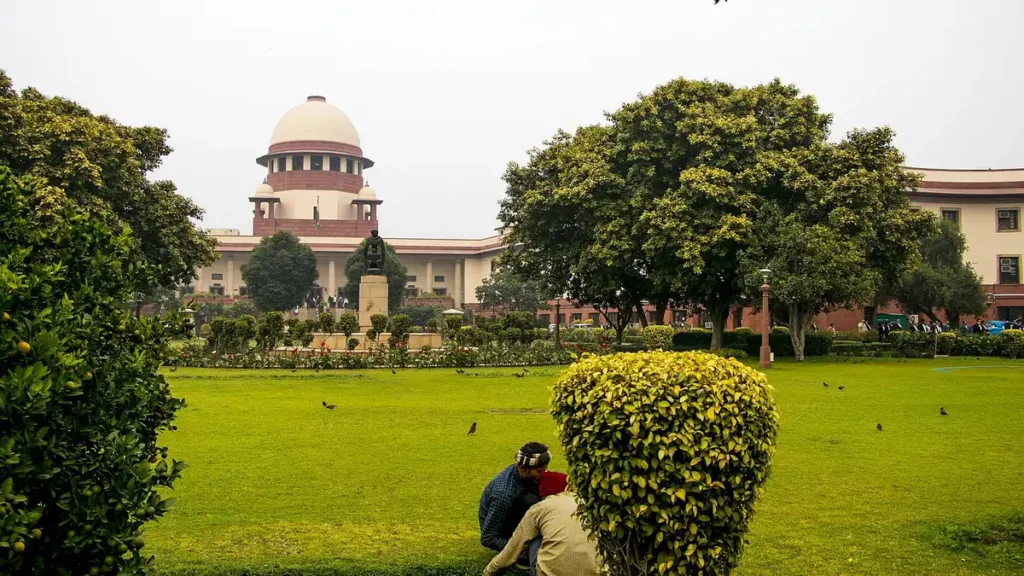
Image: Subhashish Panigrahi, Wikimedia Commons, CC BY-SA 4.0
How to use this in Mains
If asked: UPSC Mains 2025, GS-II: Comment on the need of administrative tribunals as compared to the court system. Assess the impact of the recent tribunal reforms through rationalization of tribunals made in 2021.
Quote: “Rationalisation: abolishing tribunals with little work saves money but shifts cases back to already burdened High Courts unless they get more benches.”
Use it: Use as a balanced assessment of the 2021 rationalisation.
In the news

Supreme Court: no prior approval under Section 17A needed to probe a bribe demand
In a judgment of 16 October 2026, a Supreme Court Bench of Justices S.V.N. Bhatti and N.V. Anjaria held that investigating a bribe demand by a public servant does not need prior approval under Section 17A of the Prevention of Corruption Act. Asking for a bribe, the court said, is not part of discharging official duties.
19 Oct 2026
CCPA acts against online sale of explosives: 3,940 sellers delisted from seven platforms
The Central Consumer Protection Authority (CCPA) said on 19 October 2026 that 3,940 sellers of regulated explosives such as ammonium nitrate, picric acid and PETN have been delisted from seven online platforms after its action. It has fined Dial4Trade and ExportersIndia ₹10 lakh per order, and other cases are under hearing or investigation.
19 Oct 2026
India to host 61st CIML meeting on legal metrology in New Delhi, 26–28 October
India will host the 61st meeting of the International Committee of Legal Metrology (CIML) for the first time, in New Delhi from 26 to 28 October 2026. The Department of Consumer Affairs is organising it with the International Organization of Legal Metrology (OIML), and more than 100 delegates are expected, PIB said on 19 October.
19 Oct 2026
NMC withdraws MSMER-2023: medical colleges lose the fixed penalty rulebook, annual disclosure stays
The National Medical Commission (NMC) has de-notified the Maintenance of Standards of Medical Education Regulations, 2023 (MSMER-2023) by a notification dated 14 October 2026, published in the Gazette on 16 October. Its fixed penalties, including seat cuts and fines of up to ₹5 lakh for false records, go with it. The Annual Disclosure Report stays.
19 Oct 2026