
Metal-free porous catalyst could cut cost of zinc–air batteries and fuel cells
Next story · 7 OctICAR signs agricultural research MoU with Ghana’s Crops Research Institute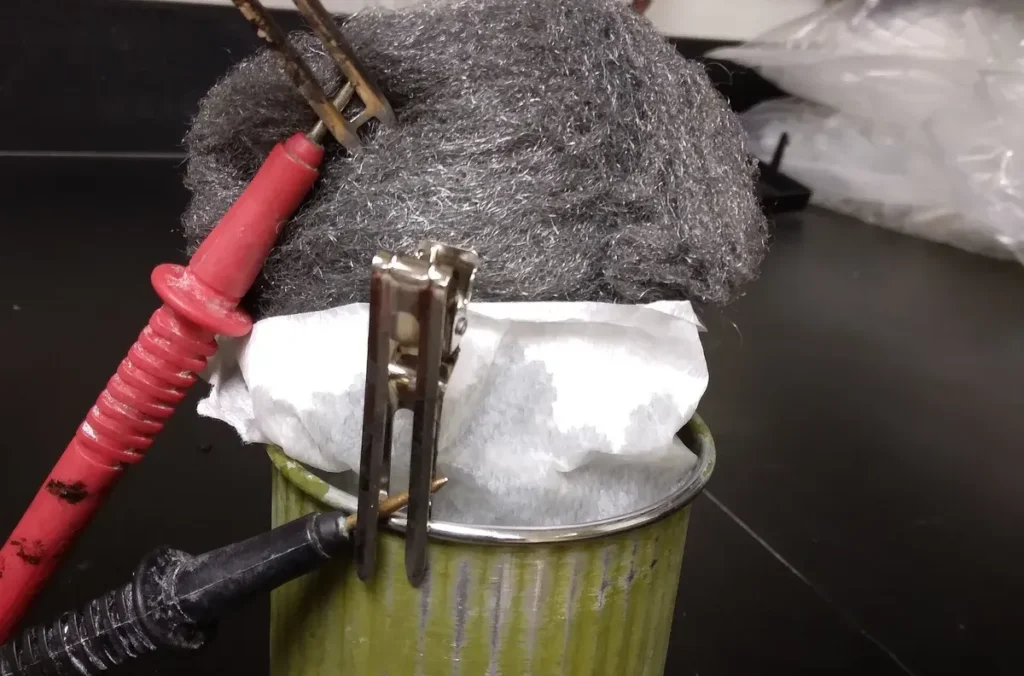
Scientists from S.N. Bose Centre Kolkata, INST Mohali and SRM University Amaravati made a metal-free porous organic catalyst, TTT-DHTD, for the oxygen reduction reaction in zinc-air batteries. It reached about 96% of commercial platinum’s performance and stayed stable for 120 hours. Replacing platinum could cut the cost of zinc-air batteries and fuel cells.
- Material
- TTT-DHTD, metal-free
- Performance
- ~96% of platinum
- Stability
- 120 hours
- Journal
- Science Advances
Metal-free catalyst for zinc-air batteries: what happened?
Platinum makes oxygen reactions fast but is rare and costly. A cheap catalyst made of common elements would make zinc-air batteries and fuel cells far cheaper.
- DST-supported scientists reported a metal-free catalyst for the oxygen reduction reaction (ORR) that could reduce costs of clean-energy technologies [PIB].
What is a zinc-air battery and what is ORR?
- A zinc-air battery uses zinc as one electrode and takes oxygen from the air for the other, so no cathode material needs to be stored.
- The oxygen reduction reaction (ORR) is the step where oxygen from air reacts at the electrode; its speed decides battery efficiency.
- Compared with lithium-ion, zinc-air promises higher theoretical energy density, lower cost and better safety, but rechargeability and cycle life are still problems.
How does zinc-air compare with lithium-ion?
| Feature | Zinc-air | Lithium-ion |
|---|---|---|
| Main metal | zinc (abundant, cheap) | lithium |
| Theoretical energy density | higher | lower |
| Safety | better | risk of fire |
| Weak points | rechargeability, cycle life, ORR speed | cost, material supply |
Why does Metal-free catalyst for zinc-air batteries matter?
- Energy: Cheaper storage for renewables and transport.
- Strategic: Reduces need for platinum, a rare metal.
What can Prelims ask on Metal-free catalyst for zinc-air batteries?
- ORR = oxygen reduction reaction.
- Zinc-air batteries draw oxygen from air.
- Platinum is the standard ORR catalyst in hydrogen fuel cells.
Image: David S. Soriano, Wikimedia Commons, CC BY-SA 4.0
How to use this in Mains
If asked: How can indigenous R&D reduce the cost of clean-energy technologies? (GS-III)
Quote: “It reached about 96% of commercial platinum’s performance and stayed stable for 120 hours.”
Use it: A ready example for the body on substituting costly platinum.
Exam angle
Prelims: battery chemistries. · Mains GS-III: energy storage, indigenous research.
Practice MCQs
Original practice questions (not PYQs).
In a zinc-air battery, the reaction at the air electrode is
Answer (b) & explanation
Oxygen from air is reduced at the electrode (ORR).
Which rare metal is widely used as the ORR catalyst in hydrogen fuel cells?
Answer (c) & explanation
PIB, 7 Oct 2026.
Questions students ask about this
What did Indian scientists develop?
A metal-free porous organic catalyst, TTT-DHTD, for the oxygen reduction reaction in zinc-air batteries.
How good is it compared with platinum?
About 96% of the performance of commercial platinum catalysts, stable for 120 hours.
Why are zinc-air batteries attractive?
Zinc is abundant and cheap, oxygen comes from air, and they promise higher theoretical energy density and better safety than lithium-ion.
Keep studying
Go deeper
Official source: PIB, Ministry of Science & Technology: New metal-free porous material for clean energy, 7 Oct 2026
facts from cited sources only; faculty review pending